The 12 Best AI Tools for Marketers in 2025: Your Ultimate Guide
best ai tools for marketers
Welcome offer — 56% OFF


Unleash your inner musician with an AI music maker. This guide breaks down how AI creates incredible music and how you can compose your first track today.
So, what exactly is an AI music maker? Think of it less like a piece of software and more like a creative partner—a co-producer who can take a simple idea scribbled on a napkin and turn it into a full-blown track. You feed it a text description, something like "an upbeat synthwave track for a YouTube intro," and in a matter of seconds, it hands you back a polished piece of music.
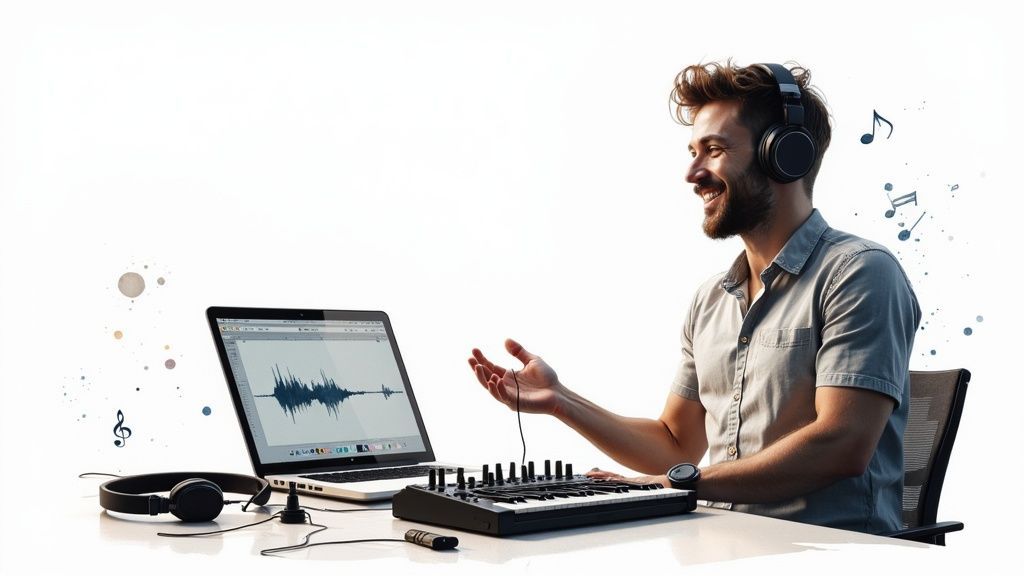
Ever had a killer song idea pop into your head, only to feel it fade away because the thought of actually producing it was just too much? The world of music production can be a real fortress, guarded by intimidating software, eye-wateringly expensive gear, and the ghost of your failed piano lessons. For most of us, that's where the creative journey ends.
But what if you could just… skip all that? Imagine having a personal recording studio on standby, with a full band ready to jam on your idea the moment you describe it. That’s not science fiction anymore; it's the new reality an AI music maker brings to the table.
Picture yourself as a movie director. You wouldn't be expected to act, run the camera, and design the sets all by yourself, right? You'd direct. That's exactly the role you play here. You don't need to know how to shred a guitar solo or program a complex drum pattern. Your only job is to communicate the vibe.
You just type in a prompt, say, "a melancholic piano melody for a rainy day scene," and the AI becomes your composer, arranger, and session musician all rolled into one. It digs into its massive understanding of music theory and sonic textures to cook up something brand new that fits your vision.
This completely tears down the old walls that kept so many people out of music creation. It’s no longer about who has the technical chops; it’s about who has the best ideas.
An AI music maker isn’t here to replace human artists. It’s a tool to amplify creativity. It does the heavy lifting so you can stay focused on the art, the story, and the emotion you want to convey.
This tech is fundamentally changing how we think about sound. And it’s not just for musicians. An AI music maker is a game-changer for anyone who needs custom audio without the massive budget or the time suck.
Just think about it:
Podcasters can finally get a unique, royalty-free jingle that isn't used by a thousand other shows. Game developers can create adaptive soundtracks that react to what the player is doing. Marketers can generate the perfect catchy tune for a TikTok ad in minutes, not weeks.
In all these cases, AI offers a fast, affordable, and perfectly tailored solution. You're no longer stuck scrolling through endless stock music libraries, trying to find a track that’s close enough. Now, you can create the perfect one from scratch. This shift empowers everyone to level up their projects with professional, bespoke audio. If you want to see it in action, a great AI music generator is the best place to start your journey.
So, how on earth does a machine with no soul learn to write a song that gives you chills? It’s not magic, but it is a kind of apprenticeship—one that happens at a mind-boggling scale. An AI music maker isn't born a prodigy; it has to learn, just like any human musician, but its classroom is the entire history of recorded music.
Imagine an aspiring jazz pianist. They don't just read a book on music theory. They immerse themselves in the greats, spending thousands of hours listening to Miles Davis, John Coltrane, and Ella Fitzgerald. They soak up every note, every chord change, and every subtle rhythmic feel until it's in their bones. They start to internalize the patterns, the unspoken rules, and the raw emotion behind a melody.
An AI does the exact same thing. But instead of just one genre, it listens to everything.
The engine driving an AI music maker is a neural network, a complex system designed to work a bit like the human brain. To get started, this digital "brain" is fed a truly colossal library of music—we're talking an endless buffet of classical, pop, rock, hip-hop, and every weird subgenre you can think of. This is the training phase.
During training, the AI isn't just listening along. It's meticulously dissecting every single song, breaking it down to its core components. It’s learning things like:
Melody and Harmony: What notes sound good together? Which chord progressions build tension or create a sense of peace? Rhythm and Tempo: What makes a drum pattern feel like a rock anthem versus a laid-back hip-hop beat? How does speed change the entire mood of a song? Instrumentation and Timbre: What does a cello sound like when it’s trying to be mournful? What instruments do you combine to get that massive, cinematic sound?
This isn’t just memorization. The AI is learning the fundamental grammar and vocabulary of music itself.
By analyzing massive amounts of music, an AI figures out the statistical probability of what comes next. It learns the patterns that our ears recognize as "musical" and uses that knowledge to build something new that follows the rules while still being completely original.
Once training is over, the AI is ready to create. When you give it a prompt like "a chill lo-fi beat for studying," it doesn’t just grab a pre-made track off a shelf. Nope. It uses everything it learned to build a brand-new piece of music from scratch, note by note. It’s constantly predicting what sound, chord, or drum hit should come next based on the thousands of similar songs it studied.
The process is incredibly clever. The AI can generate separate parts for a bassline, a drum pattern, and a piano melody, all while making sure they lock together perfectly. For a deeper dive into the nitty-gritty of how this all works, check out our guide on how AI music is made.
This is more than just a cool party trick; it’s changing the game. The global generative AI music market was valued at USD 569.7 million and is expected to rocket to USD 2,794.7 million by 2030. With over 60% of musicians already incorporating AI into their workflow, it's clear this isn't just a fad. You can see more data on the explosive growth of the generative AI music market.
In the end, think of the AI as a brilliant musical calculator, crunching probabilities to build something that feels both familiar and refreshingly new. It’s a wild combination of data science and pure artistry, turning cold, hard patterns into something with a pulse.
At the heart of every AI music maker is a simple, almost magical promise: turning your words into actual music. But what really separates a fun little toy from a serious creative partner? It all comes down to the features—the knobs, dials, and controls that let you take a vague idea and polish it into a track ready for the spotlight.
Think of these features as your personal production toolkit. Learning what they do is like a chef mastering their spices. Each one adds a unique flavor, giving you the power to cook up a song that hits just right. Let's pull back the curtain on the must-have features that make these tools truly sing.
The absolute cornerstone of any modern AI music maker is text-to-music generation. This is where the real wizardry happens. You type out a description—"funky, upbeat disco track with a groovy bassline and shimmering synths, perfect for a retro party scene"—and the AI gets to work, composing something brand new from scratch.
But the best tools don't just spit out a single result and call it a day. They offer layers of control, letting you guide the AI with more finesse. It's less like a vending machine and more like a jam session with a ridiculously talented (and fast) musician.
Your basic controls usually include:
Genre Selection: Instantly set the vibe by choosing between styles like cinematic, hip-hop, electronic, or acoustic folk. This lays the entire musical foundation. Mood and Vibe: Nail the emotional tone. Are you aiming for something energetic and happy, or maybe a little more melancholic and thoughtful? Instrumentation: Handpick the instruments you want to hear. You can ask for a piano-led ballad or a thumping, drum-heavy rock anthem.
These are your starting blocks, making sure the AI is painting with the right colors from the get-go.
This flowchart breaks down the journey from raw data to a finished AI-composed piece.
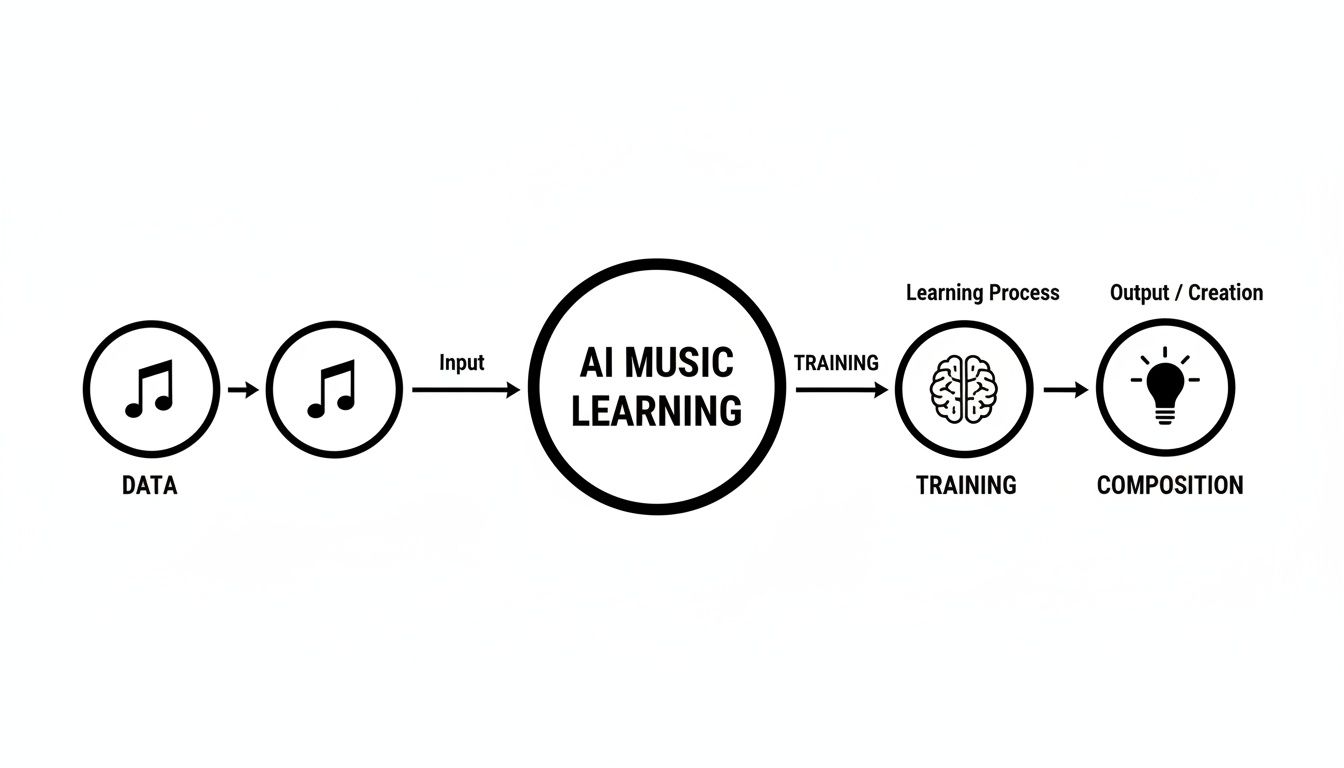
This process is all about the AI learning musical patterns from massive datasets and then using that knowledge to build original music based on your specific prompts.
Once your basic track is laid down, the advanced features are where the real fun starts. These are the tools that let you get your hands dirty, giving you producer-level control over the final sound. They’re what let you refine, remix, and truly make a track your own.
A top-tier AI music maker is packed with goodies. Below is a quick look at some of the most essential features you'll find and what they help you accomplish.
| Feature | What It Does | Best For |
|---|---|---|
| Instrument Separation | Isolates individual tracks (drums, bass, vocals, etc.) into "stems." | Remixing, creating instrumental versions, or fine-tuning the mix. |
| Custom Vocal Synthesis | Generates realistic AI vocals to sing your lyrics in various styles. | Adding custom vocals to your track without needing a singer. |
| Lyric Generation | Creates lyrics for you based on a topic, theme, or mood. | Overcoming writer's block and sparking lyrical ideas. |
| Structure Editing | Lets you rearrange song sections like intros, verses, and choruses. | Customizing the song's flow and building dynamic arrangements. |
These are the features that really close the gap between a simple prompt and a professionally polished song.
By combining these tools, you stop being just a director and become a hands-on producer. You're not just taking what the AI gives you; you're actively collaborating with it, molding its output to match your creative vision perfectly.
To really master these tools, learning how to talk to the AI is a skill in itself. Exploring the concept of prompt engineering will teach you how to give clearer, more effective instructions. It's the secret sauce to getting the most jaw-dropping results from any generative AI.
Ultimately, a powerful feature set turns an AI music maker from a neat trick into an indispensable instrument. It gives you the flexibility to either whip up a quick background track in minutes or meticulously craft a detailed song that becomes the foundation for your next big project. These tools are throwing the studio doors wide open, inviting everyone to shape sound in brand-new ways.
So, why are YouTubers, indie game devs, podcasters, and marketers all suddenly talking about AI music makers? It's simple, really. These tools are like a creative superpower, smashing the old-school roadblocks of time, money, and technical know-how. This isn't just a minor upgrade; it's a total game-changer.
For years, getting custom music for a project was a nightmare. You were either navigating a minefield of pricey studio sessions and complex licensing deals or settling for the same bland stock tracks everyone else was using. It was a lose-lose situation.
The most jaw-dropping benefit is sheer speed. Let's say you need a unique track for a video you have to publish tomorrow. The old way? You'd be looking at weeks of back-and-forth with a composer. With an AI music maker, you can have a full, broadcast-quality song ready before your coffee gets cold.
This isn't just a nice little convenience—it fundamentally changes how you work. A marketer can whip up a dozen different musical vibes for an ad campaign in one afternoon, testing each one to see what clicks with their audience. The music production bottleneck? Gone.
Besides the speed, the cost savings are just unreal. A custom-composed track traditionally came with a long, painful list of expenses that could easily run into thousands of dollars for just a couple of minutes of audio.
An AI music maker just deletes that entire list.
No Studio Fees: Your computer is the new recording studio. No Hired Musicians: The AI is your endlessly talented, always-available band. No Ridiculous Licensing: Most platforms offer straightforward, royalty-free licenses, especially with a subscription.
This new financial freedom puts indie creators on the same playing field as the big guys. A solo game developer can now have an epic, orchestral score that sounds like it came from a Hollywood studio, all for less than the cost of a few pizzas a month.
The rise of the AI music maker is about one thing: democratization. It’s taking the keys to the exclusive, intimidating world of music production and handing them to anyone with an idea.
Maybe the biggest deal of all is how these tools unlock everyone's inner creator. You no longer need years of music theory to bring a melody to life. If you can describe a mood, a scene, or a feeling, you can guide an AI to turn that vision into music.
This is opening up a universe of possibilities for creators who have incredible ideas but couldn't execute them musically.
This isn't just a future trend; it's happening right now. New data shows that 36.8% of music producers are already using AI in their daily work. Even more incredible, a recent study found that 82% of listeners can't even tell the difference between human and AI-made music. The quality is that good. If you want to dive deeper, you can discover key AI music industry statistics that show just how fast this is moving.
For a YouTuber, this means creating a one-of-a-kind intro that nobody else has. For a startup, it's about building a unique sonic brand without emptying the bank account. The AI music maker is your creative co-pilot, handling all the technical heavy lifting so you can focus on your vision. Everyone gets an invitation to the composer's chair.
Alright, let's get into the fun stuff. Enough talk, more music-making.
The best way to really get what these AI music tools are all about is to roll up your sleeves and dive in. We're going to walk through the entire process right now, taking a simple idea and turning it into a real, polished track you can actually use.
Let's imagine we need a killer intro for a new YouTube channel. The vibe? Upbeat, retro synthwave—something that hooks a viewer in the first five seconds and makes them stick around.
Think of yourself not as a musician, but as a director. You're not playing the instruments; you're describing the exact feeling you want to a super-talented (and super-fast) collaborator.
It all starts with the prompt. This is your creative brief, your direct line to the AI's brain. A lazy prompt like "make a song" will get you a lazy, generic result. But a sharp, descriptive prompt? That's how you get a track that sounds like it was plucked right out of your head.
For our synthwave YouTube intro, a great starting prompt would look something like this:
"An upbeat, energetic 1980s synthwave track. Fast tempo, with a driving electronic drum beat, a punchy bassline, and shimmering arpeggiated synths. Perfect for a retro tech YouTube intro."
See how much detail is in there? We're giving the AI a ton of helpful clues:
Genre: 1980s synthwave Mood: Upbeat, energetic Tempo: Fast Instruments: Electronic drums, punchy bass, shimmering synths Purpose: Retro tech YouTube intro
With that kind of direction, the AI has a much better shot at hitting the mark on the first try. It’ll probably spit out a few initial ideas for you to listen to.
Once you hit enter, the platform will work its magic and serve up a few different takes on your idea. Give each one a listen. You might find one has a killer melody, but another has a drum groove that just won't quit. Your job here is to pick the one that feels closest to what you envisioned.
Don't sweat it if none of them are perfect just yet. This is just the starting block. You're picking the raw clay you're going to sculpt. Find the version that gets your head nodding and think, "Yeah, I can work with this."
There's a reason the AI music market is absolutely blowing up—it's projected to smash USD 6 billion in revenue soon. Tools like these are letting regular creators make viral hits for platforms like TikTok and YouTube without needing a decade of piano lessons.
Now we get to the real magic: the refinement. That first generation was just a sketch. The real artistry comes from the back-and-forth, where you start giving the AI feedback. Most tools let you keep the conversation going with follow-up prompts.
Here’s how you could steer the AI to perfect our synthwave track:
Tweak the Instruments: You could tell it, "Make the bassline punchier and more prominent." Bam. The AI will re-render the track with a bass that really cuts through. Fix the Arrangement: Maybe the intro drags on a bit. A simple command like, "Shorten the intro to 5 seconds and get straight to the main beat," will tighten up the song's structure. Adjust the Mood: If the track feels a little too intense, you could ask it to "Add a dreamy synth pad in the background to make it feel more atmospheric."
This iterative process is where you become the producer. You're not just pushing a button; you're in the driver's seat, making creative calls. For a deeper dive into these techniques, check out our guide on how to create an AI song from start to finish for more pro tips.
Once you’ve got it just right, you hit export. And just like that, you've gone from a simple text idea to a completely original, custom-made synthwave track for your YouTube channel in minutes. That’s the awesome power of today’s AI music makers.
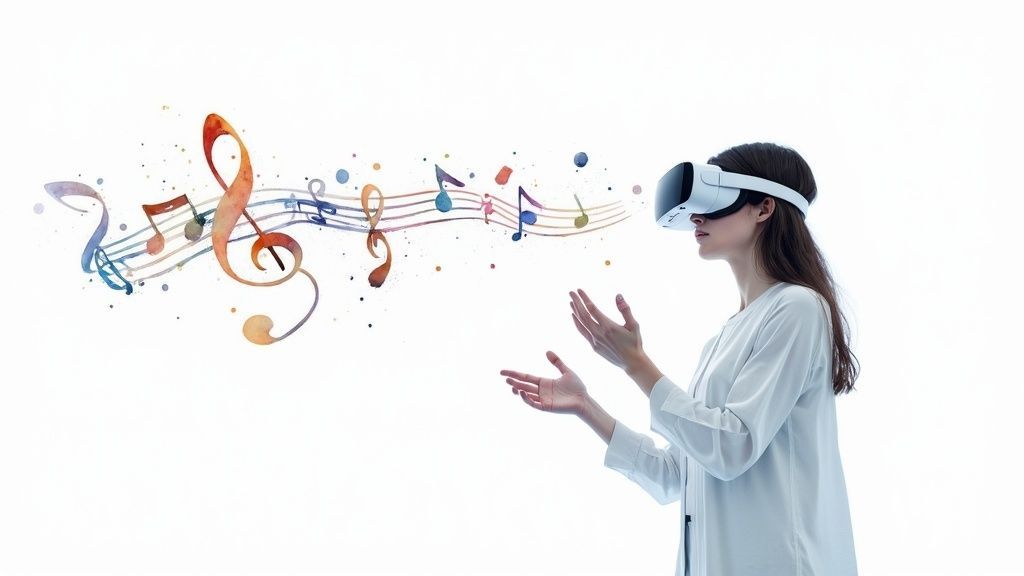
The speed at which the modern ai music maker is evolving is wild, but honestly, what we're hearing today is just the opening act. The main show is about to start, and it's promising a future where sound is more interactive, collaborative, and personal than we've ever imagined. This tech isn't just a new tool; it's the foundation for entirely new creative fields.
Think about playing a video game where the soundtrack isn't just a repeating loop. Instead, it’s a living score that adapts to you. Sneak past a guard, and the music becomes a tense, quiet whisper. A battle breaks out, and it explodes into an epic arrangement, perfectly synced to your every move. That's the world of interactive music generation, and it's right around the corner.
This same idea is set to blow up in virtual reality and live events, too, building immersive sonic worlds that react instantly to what you do, making digital spaces feel truly alive.
Beyond just cool media experiences, the whole idea of creative teamwork is getting a major rewrite. Picture this: a songwriter hits a creative wall, totally stuck on where to take a song. Instead of giving up for the day, they can now turn to an AI partner and say, "Hey, give me a dozen different chord progressions in the style of Queen."
This isn't about letting a robot take over. It’s about supercharging human creativity. AI can act like an tireless virtual bandmate, always ready with fresh ideas, unexpected harmonies, and a helping hand when inspiration is running low. This kind of partnership will not only make the creative process faster but also shove artists into exciting new sonic territory.
The future of music isn't a battle of humans versus machines. It's a symphony where human artistry conducts AI's incredible processing power to create sounds and experiences we previously thought were impossible.
Of course, this awesome new future comes with its own set of tricky questions. As the ai music maker gets smarter, the big conversations about copyright, ownership, and who gets credit are getting louder. The industry is scrambling to build new rules to make sure human artists are paid and recognized fairly in this new hybrid world.
Figuring out the ethics is absolutely vital for building a future where technology empowers people, not replaces them. The debates happening right now will set the legal and creative standards for generations of musicians and producers to come.
The road ahead is going to be a thrilling ride. From adaptive video game scores to AI co-producers, the tools we’re just starting to play with are setting the stage for a complete reimagining of sound itself. And it's not just about music; AI’s practical uses are popping up everywhere. To get a broader sense of its potential, you can discover different ways AI can be applied. This technology isn't just a new instrument—it’s a whole new orchestra.
Whenever cool new tech pops up, a million questions follow. AI music is no different. Is it even legal to use? Do you need a music degree? Is this the robot apocalypse for musicians?
Let’s cut through the noise. Here are the straight-up answers to the questions everyone’s asking.
For the most part, you bet it is. Most AI music platforms, especially the paid ones, give you a commercial license for the tracks you cook up. That means you're free to use your new soundtrack in YouTube videos, podcasts, ads, or anywhere else you need it, without worrying about copyright strikes.
Of course, it’s always a good idea to skim the fine print. Licensing terms can vary from one service to another, so a quick look at the terms of service is just smart practice.
Absolutely not! That’s the magic of it. These tools were built for everyone—the veteran producer looking for a spark and the complete newcomer who just has an idea.
The only real skill you need is knowing what you want to hear. If you can type "a chill, lo-fi beat for a study stream," you’ve got everything it takes to create something awesome. Knowing a bit of music jargon might help you get super specific, but it's far from necessary.
Think of an AI music maker less like an exam and more like a creative partner. It’s built to turn your vision into sound, not to test your technical chops.
This is the big one, isn't it? The consensus is a resounding no. Think of AI as a collaborator, not a replacement. It’s a new instrument in the toolbox, not the end of the artist. We actually dive deep into this very topic in our article exploring if AI can truly make music.
AI is fantastic at the grunt work. It can spitball ideas to get you past writer's block or handle the technical stuff, freeing up humans to do what they do best: add emotion, soul, and that spark of genuine creativity. The future isn't human vs. machine; it's humans and machines making sounds we've never even imagined.
Ready to stop wondering and start creating? With SendFame, you can turn a simple idea into a finished track in minutes. Jump into our AI Music Generator and hear for yourself how easy it is to compose your next masterpiece. Get started at https://sendfame.com.
Create Epic

SendFame

Create Epic with SendFame!
Questions: info@sendfame.com
