image to video ai: Turn Photos into Engaging Videos

image to video ai
Welcome offer — 56% OFF


Your first guide to machine learning for beginners. Learn core concepts, essential tools, and build your first project with easy-to-follow steps.
Ever wondered how Netflix just knows what you want to watch next? Or how your email magically filters out all that junk mail before it even hits your inbox? That’s not some weird tech sorcery—it’s machine learning.
Think of it as a powerful branch of artificial intelligence that gives computers the ability to learn from data, spot patterns, and make decisions all on their own, without a human programmer holding their hand every step of the way. This guide is your personal, no-fluff entry ticket into this amazing world.

Let's break down "machine learning" with a simple idea. Imagine you want to teach a computer to tell the difference between a picture of a cat and a picture of a dog.
You could try to write a bunch of rules—"if it has pointy ears and long whiskers, it's a cat"—but you'd be writing code forever. Instead, you just show the computer thousands of pictures, each one neatly labeled "cat" or "dog."
The computer, which we call a "model," pores over these examples, slowly figuring out for itself the subtle patterns that scream "cat" versus those that bark "dog." After seeing enough pictures, it gets smart enough to correctly guess whether a brand new photo it's never seen before is of a cat or a dog. That's the essence of machine learning right there: learning from experience, not from a strict rulebook.
Here's the thing: this technology is already a huge part of your daily life, working quietly behind the scenes. It's the engine powering so much of what we take for granted. You're using it whenever:
Amazon suggests a new book: Its "Customers who bought this also bought..." feature is classic machine learning in action. Your phone unlocks with your face: Facial recognition systems have learned your unique features from every angle. You ask Siri or Alexa for the weather: They use natural language processing to understand what you're saying and find an answer. Your bank sends you a fraud alert: Algorithms have learned your typical spending habits and can flag anything that looks fishy.
These examples just scratch the surface of how machine learning is shaking up industries, making things more personal and efficient. This ability to generate new, context-aware outputs is also the driving force behind the explosion of AI-generated content, which uses similar tech to create everything from articles to artwork.
At its heart, machine learning is about finding signals in the noise. It’s the art and science of giving computers the ability to make predictions and decisions without being explicitly programmed for every single scenario.
We’re about to embark on a journey designed to take you from total beginner to someone who genuinely gets what machine learning is all about. And here’s the best part: you don't need a Ph.D. in advanced mathematics to get started. All you need is a bit of curiosity and a clear map to follow.
We’ll explore the different "flavors" of machine learning, get you set up with the must-have tools, and demystify the most common algorithms with simple, intuitive explanations. By the time you're done, you'll have a step-by-step roadmap to build your very first predictive model and feel confident enough to take the next step.
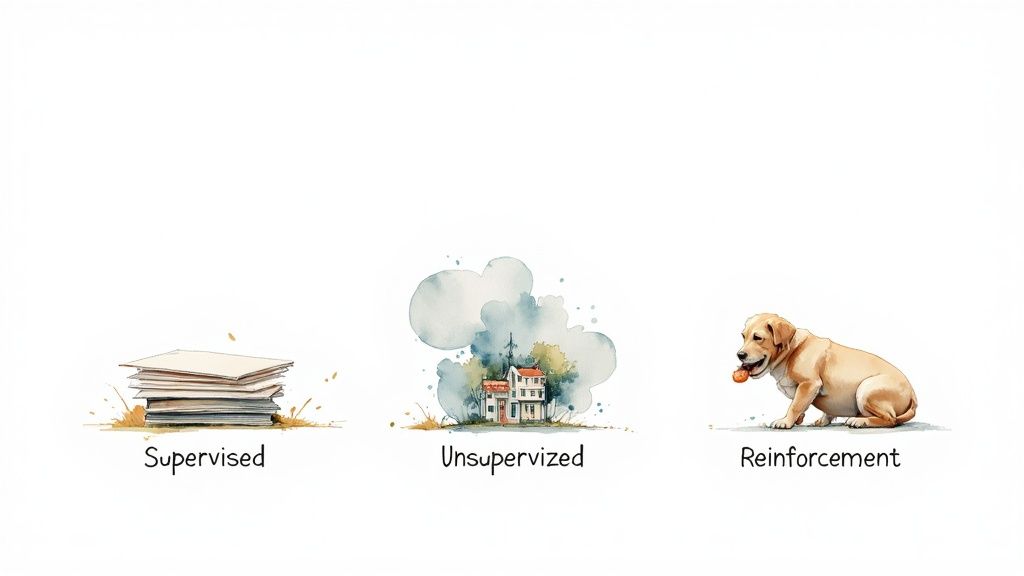
Machine learning isn't some monolithic, mysterious force. It’s more like a kitchen with three main styles of cooking. Each one has its own philosophy and is perfect for a different kind of dish. Getting a feel for these is your first real step into this world.
The big three are Supervised Learning, Unsupervised Learning, and Reinforcement Learning. Let's unpack what they are and, more importantly, what they do using some simple, real-world ideas.
Remember studying for a test with a stack of flashcards? On the front, you have a question (the input), and on the back, you have the answer (the label). You drill yourself over and over, training your brain to connect the question to the right answer until it's second nature.
That’s a perfect picture of supervised learning. We feed a model a huge dataset where all the "answers" are already known and labeled. The model's entire job is to figure out the patterns connecting the inputs to the outputs. Once it's trained, it can make lightning-fast predictions on new data it has never seen before.
This method is the workhorse of the ML world and probably powers dozens of things you use every day.
Spam Filters: Your email provider has trained its model on millions of emails that were already labeled "spam" or "not spam." The model learned what spam looks like—weird links, a sense of urgency, suspicious attachments—so it can protect your inbox. Medical Imaging: A model can be fed thousands of X-rays, with each one labeled by a radiologist as "cancerous" or "benign." After enough examples, the algorithm learns to spot the subtle visual cues of disease on its own. Predicting Home Prices: Ever wonder how Zillow comes up with its "Zestimate"? It's supervised learning! The model analyzes past sales data—square footage, location, number of bedrooms (inputs)—along with the final selling price (the output) to estimate what your house is worth.
Bottom line: if you have a clear target you want to predict and a ton of historical data with the correct answers, supervised learning is your best friend.
Okay, now imagine you're dropped into a foreign city with no map, no tour guide, and no knowledge of the local language. You start wandering. Pretty soon, you begin to notice patterns. This area has all the tall office buildings. That area over there is full of quiet residential streets. And another neighborhood is packed with bustling markets and street food stalls.
No one told you, "This is the financial district." You figured it out by observing the data and grouping things that seemed to belong together. That's unsupervised learning.
We hand the model a big pile of data and say, "Find something interesting." There are no labels, no right answers. The goal is to let the machine discover the hidden structures and relationships all by itself.
This is the go-to approach when you're exploring a dataset and aren't quite sure what you're looking for.
Think about customer segmentation. A company like Netflix can look at the viewing habits of millions of users and let an unsupervised algorithm group them. It might discover a cluster of people who love sci-fi and foreign documentaries, a group that only watches stand-up comedy, and another that binges reality TV. The algorithm creates these groups organically, helping Netflix recommend the right content to the right people.
Let's talk about training a puppy. You want to teach it to fetch. You throw the ball. It just looks at you. You throw it again; it chases a butterfly. You throw it a third time, it accidentally picks up the ball and brings it back. The second it does, you shower it with praise and a tasty treat!
Slowly but surely, the puppy connects the action (bringing the ball back) with a reward (the treat). This is reinforcement learning in its purest form.
In this model, an "agent" (the AI) operates in an "environment" (a game, a simulation, the real world). It tries different actions, and each action results in either a reward or a penalty. The agent's only goal is to figure out the best strategy to get the most rewards possible over time.
This trial-and-error approach is behind some of the most mind-blowing breakthroughs we've seen.
Self-Driving Cars: The AI learns by being rewarded for good driving (staying in its lane, smooth braking) and penalized for mistakes (getting too close to another car, jerky movements). Game-Playing AI: This is how systems like Google's AlphaGo became better than any human at the ancient game of Go. It played literally millions of games against itself, constantly tweaking its strategy after every win or loss until it achieved mastery.
To help tie this all together, here’s a quick cheat sheet that breaks down the key differences between these three powerful approaches.
| ML Type | How It Learns | Common Tasks | Simple Analogy |
|---|---|---|---|
| Supervised | From labeled data (like an answer key) | Prediction, Classification | Studying with flashcards |
| Unsupervised | By finding hidden patterns in unlabeled data | Clustering, Grouping | Exploring a new city without a map |
| Reinforcement | Through trial and error with rewards/penalties | Game playing, Robotics | Training a dog with treats |
These three flavors are the building blocks of almost everything in the field. To get a really solid grip on them, it's worth digging into the core concepts of Supervised, Unsupervised, and Reinforcement Learning to see how they drive modern AI.

Alright, every craftsperson needs their tools, and diving into machine learning is no different. Before you can start building incredible models, you need to assemble your toolkit. But don't sweat it—this isn't some overwhelming shopping list of expensive software and terrifying math textbooks.
Think of it like this: you don’t have to be a master chef to follow a recipe, but it definitely helps to know the difference between salt and sugar. We're going to walk through the absolute must-haves that form the foundation of any ML journey, focusing on intuition instead of intimidation.
Let's just get this out of the way. Yes, machine learning has math in it. But you absolutely do not need a Ph.D. in advanced calculus to get started. All you need is a casual grasp of a couple of big ideas to understand what your models are actually doing behind the scenes.
Linear Algebra: This is basically the language of data. It’s a super-efficient way to work with big, organized blocks of numbers (we call them matrices and vectors). Think of it as the grammar that lets your computer wrangle thousands of data points all at once without breaking a sweat. Probability & Statistics: This is all about handling uncertainty and making smart, educated guesses. Simple concepts like mean, median, and standard deviation help you understand the story your data is trying to tell. Probability is what allows your model to confidently say, "I'm 85% sure that's a cat."
The point isn't to solve crazy-long equations by hand. It's about building a gut feeling for why an algorithm behaves the way it does. Knowing the basics helps you figure out what went wrong and lets you pick the right tool for the job.
When it comes to the language of machine learning, one name stands head and shoulders above the rest: Python. It's the undisputed king of the hill, and for a few very good reasons.
First, its syntax is clean and easy to read, which makes it a fantastic language for beginners. More importantly, Python has a massive, supportive community and an entire ecosystem of powerful tools built specifically for data science.
Its gentle learning curve makes it the perfect launchpad. A solid programming foundation is key, and you can get up to speed with this practical guide to Python for data analysis. While Python reigns supreme, it’s good to know that other languages like R and Julia are also out there. If you're curious, you can check out the best AI programming languages to see how they stack up.
The real power of Python for machine learning comes from its libraries—they're like pre-built toolkits of code that do all the heavy lifting for you. There's no need to reinvent the wheel when you can just grab the perfect one off the shelf.
Here are the three absolute cornerstones every beginner needs to get familiar with:
NumPy: Short for "Numerical Python," this is the bedrock of scientific computing in Python. It's what lets you create and work with powerful, multi-dimensional arrays, which is how all your data gets represented. Pandas: If NumPy is the foundation, Pandas is the house you build on top of it. It gives you an amazing data structure called a "DataFrame"—basically a spreadsheet on steroids within your code. It makes cleaning, exploring, and manipulating data an absolute joy. Scikit-learn: This is your machine learning workhorse. It's a clean, efficient, and surprisingly simple library packed with ready-to-use algorithms for classification, regression, clustering, and tons more. It is, without a doubt, the best place for a beginner to run their first models without getting lost.
With just a bit of math intuition, a handle on Python, and these three libraries in your back pocket, you are more than ready to get your hands dirty and start building.
Think of a machine learning model as a brilliant chef. The algorithms? They're the recipes. Each recipe is purpose-built for a specific dish, whether it’s a perfectly grilled steak or a delicate soufflé. As a beginner, you don't start with molecular gastronomy; you master the classics first.
Let's pull back the curtain on a few of the most popular and intuitive algorithms out there. These are the trusty workhorses you'll run into time and time again. We’ll skip the scary math for now and just focus on the simple, powerful ideas that make them work.
Imagine you're trying to sell your house. You look at recent sales in your neighborhood and plot them on a simple chart: the horizontal axis is square footage, and the vertical axis is the sale price. Pretty quickly, you’d spot a trend, right? As houses get bigger, their price tends to go up.
What if you could draw a single straight line through all those data points that best represents that relationship? That’s exactly what Linear Regression does. It’s an algorithm that finds the perfect line to describe the connection between an input (like house size) and an output (like price).
Once you have that line, you're a forecasting machine. A new 2,000-square-foot house hits the market? Just find that spot on the horizontal axis, trace your finger up to the line, and see what the corresponding price is. It’s a beautifully simple—and incredibly powerful—way to predict numbers.
Ever played the game "20 Questions"? You try to guess what someone is thinking of by asking a series of simple yes-or-no questions. "Is it bigger than a breadbox?" "Is it alive?" Each answer narrows down the possibilities until you land on the right one.
A Decision Tree works in almost the exact same way. It learns by building a flowchart of simple, sequential questions that split your data into smaller and smaller piles.
For instance, if you're a bank trying to predict if a loan applicant is a high risk, the tree might ask:
Is their credit score below 600? If yes, is their annual income under $50,000? If yes again, have they ever defaulted on a loan before?
Each question channels the applicant down a different path until the tree makes a final call: "high risk" or "low risk." The best part is that you can literally see its thought process. This transparency makes Decision Trees a fantastic starting point for anyone new to the field.
A Decision Tree is basically a map of decisions and their potential outcomes. It's one of the clearest ways to see how a model is making its choices.
This algorithm is based on a piece of wisdom you've heard your whole life: you are who you hang out with.
Imagine you’re new to a city and want to find a good coffee shop. You’d probably ask the people who live closest to you for their top picks. The K-Nearest Neighbors (KNN) algorithm does the same thing, but with data points.
To figure out what to do with a new, unknown data point, KNN looks at its closest neighbors—the "K" is just the number of neighbors you tell it to check. It then takes a vote. If you set K to 5, the algorithm finds the five data points most similar to your new one. If three of those neighbors are "spam" emails and two are "not spam," KNN will classify the new email as spam. It’s democracy for data.
KNN is elegant because it makes no grand assumptions about how the data is structured. This flexibility makes it a go-to for things like recommendation engines. If you loved Movie A, and most people who loved Movie A also adored Movies B and C, the system will suggest B and C to you. It's all about finding your data's closest friends.
Alright, knowing the concepts is one thing, but turning that head knowledge into actual, hands-on skill? That’s a whole different ballgame. So, how do you go from just reading about machine learning to doing it? You need a solid plan.
Think of this as your personal blueprint for building momentum. We're breaking the journey down into five manageable steps that will guide you from the absolute basics to building your first projects and finding your tribe in the ML world.
Before you can dream of building intricate models, you need a rock-solid foundation. In machine learning, that foundation is Python. Don't worry, you don't need to be some coding wizard who speaks in binary, but you absolutely have to be comfortable with the core mechanics of the language.
Get a firm grip on the basics: variables, data types, loops, and functions. These are the nuts and bolts you’ll use every single day. Once those feel like second nature, focus on data structures like lists and dictionaries—they're crucial for wrangling the information you’ll eventually feed into your models.
The real magic of Python for machine learning comes from its incredible ecosystem of specialized libraries. These are pre-built toolkits that handle all the heavy lifting, letting you focus on the strategy instead of reinventing the wheel.
To get started, you only need to master the "big three" that form the backbone of nearly every project out there.
Here's a quick look at the starter pack for any aspiring machine learning practitioner. These libraries are the bread and butter of data science in Python.
| Tool/Library | Primary Purpose | Why It's Essential for Beginners |
|---|---|---|
| NumPy | Numerical computing | It’s the engine for high-performance math and working with large arrays of numbers. Speed and efficiency start here. |
| Pandas | Data manipulation and analysis | Gives you the "DataFrame," an intuitive, spreadsheet-like structure for cleaning, exploring, and preparing your data. |
| Scikit-learn | Machine learning algorithms | This is your ML playground. It has ready-to-use versions of all the classic algorithms, making it incredibly easy to start experimenting. |
Getting comfortable with these three is non-negotiable. They are the hammer, saw, and nails of your machine learning toolkit.
Theory is great, but practice is where the real learning happens. The single best way to make these concepts stick is to get your hands dirty with actual data. Start small with classic, beginner-friendly datasets that are already clean and well-documented.
Don't wait until you feel like an "expert" to start building. Your first projects are for learning, not for production. The goal is to apply what you've learned, make a glorious mess, and figure things out.
Two perfect starter projects are building a spam classifier or a house price predictor. Both use famous datasets (the UCI Spambase and Boston Housing datasets are fantastic) and give you a chance to apply fundamental classification and regression techniques in a low-stakes environment.
This is where you'll see how different algorithms tackle a problem.
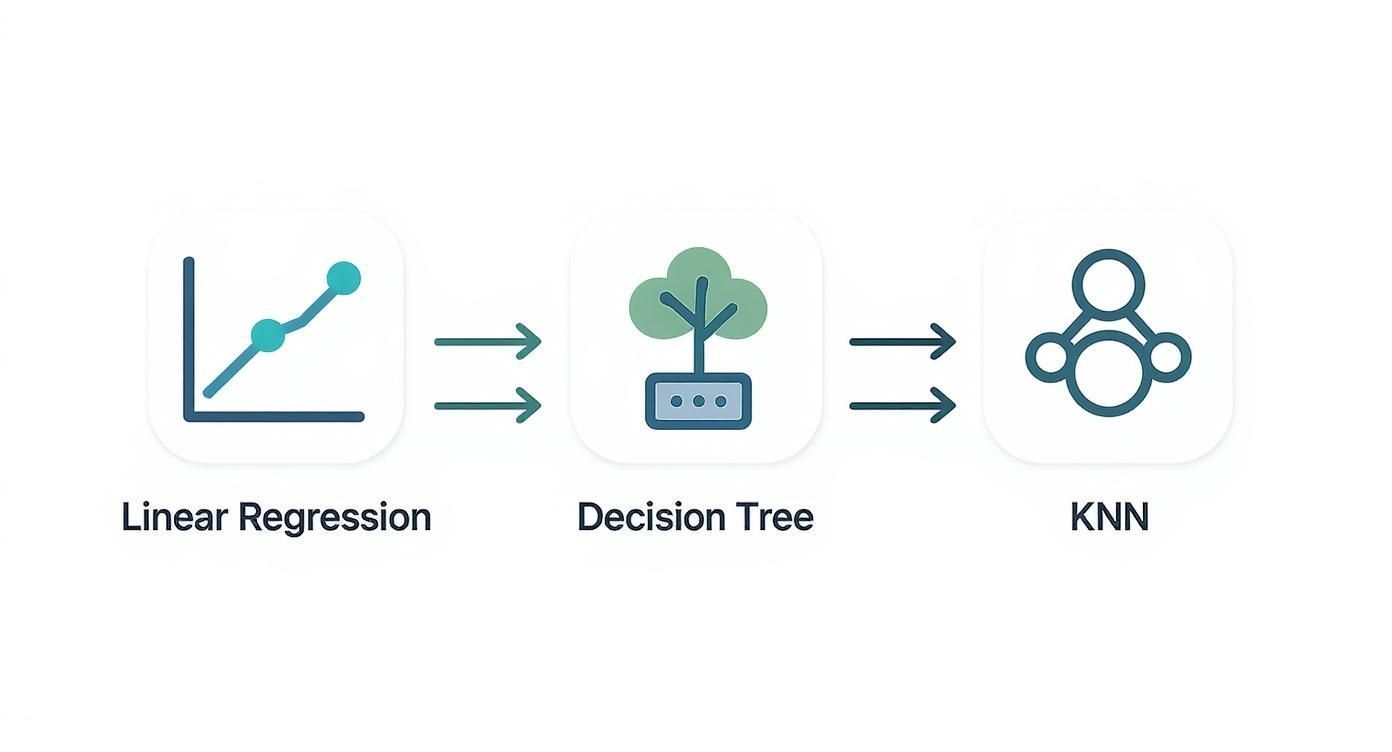
Each algorithm offers a unique "recipe" for learning from data, from drawing simple straight lines to creating a complex forest of branching rules.
Learning machine learning shouldn't be a solo grind. Honestly, one of the fastest ways to grow is to connect with other people. You'll get unstuck faster, stay motivated longer, and learn things you never would have found on your own.
Platforms like Kaggle are brilliant. They host competitions where you can test your skills on real-world problems and—here’s the best part—see the code shared by top data scientists. Subreddits like r/MachineLearning are also buzzing with great discussions, news, and advice from people at every skill level.
Once you’ve got a few projects under your belt and the basics feel solid, it's time to look at the horizon. The field of machine learning is massive, with fascinating specializations that focus on all sorts of cool problems. You could dive into Computer Vision (teaching computers to see) or Natural Language Processing (teaching them to understand human language).
This is also a great time to check out how modern AI tools for content creation are using these very principles to generate text, images, and more. Seeing these real-world applications can spark new project ideas and show you where the industry is heading. The key is to follow your curiosity and start digging into the areas that genuinely excite you.
Congratulations, you've officially made it through the bootcamp basics! Taking those first steps from grasping the core ideas to actually trying to build something is where the real fun begins. This isn't just about adding another skill to your resume; you're learning a whole new way to look at problems. And trust me, the reason this field is blowing up is simple: it works.
We're seeing it everywhere. Self-driving cars are (slowly but surely) figuring out how to navigate tricky city streets. Personalized medicine is starting to design treatments based on a person's unique genetic code. Machine learning is the engine under the hood of some of the most mind-boggling advancements happening right now, creating a huge demand for people who know how to build it.
The money and momentum behind this field are just staggering. The global machine learning market is on track to hit a whopping $192 billion by 2025. It's not just a far-off number, either—a wild 72% of US companies are already using ML to run their IT operations. Europe and North America are neck and neck in this race, holding 44.9% and 44.1% of the market, respectively. You can dive deeper into these machine learning market trends to really get a sense of the scale here.
And this isn't just a "big tech" thing. This growth is popping up everywhere, creating brand-new jobs in finance, healthcare, entertainment—you name it. By starting this journey, you’ve put yourself on a path to be part of that story.
Machine learning is so much more than just code and data. It's a creative toolkit for building smarter, faster, and more personal experiences. The skills you're picking up are your passport to the future of tech.
Okay, you've got the fundamentals down. Now it's time to decide where you want to aim all this newfound knowledge. The world of machine learning is huge, with all sorts of fascinating rabbit holes to go down.
Here are a few of the most popular paths people take:
Computer Vision: Ever wonder how your phone can recognize your face? That's computer vision. This field is all about teaching computers to see and understand the world through images and videos. Think self-driving cars, medical scan analysis, or even those goofy Instagram filters.Natural Language Processing (NLP): If you're a word nerd, NLP is your jam. This is all about the messy, wonderful world of human language and getting computers to understand it. It's the magic behind chatbots, Google Translate, and tools that can tell if a review is positive or negative.Generative AI: This is easily one of the most exciting frontiers right now. Generative models don't just analyze things; they create brand-new stuff—text, art, music, you name it. There's a whole universe of generative AI use cases that are completely changing creative work.Reinforcement Learning: Love games and strategy? This is for you. It's the science of teaching an agent to make the best possible decisions by rewarding it for good moves and punishing it for bad ones, almost like training a puppy. It's how AI masters complex games and learns to control robots.
Your next move is simple: pick one that sounds cool and go deep. Find an open-source project to contribute to, jump into a Kaggle competition, or just build something that solves a problem you actually care about. Keep building, keep being curious, and keep learning. Your adventure is just getting started.
Diving into machine learning can feel like you've just been dropped into a foreign country where everyone speaks in algorithms. It’s totally normal for a million questions to bubble up. Let's tackle some of the big ones so you can keep moving forward with confidence.
This is the question that keeps a lot of people up at night. The honest answer? Probably less than you think to get your hands dirty. You don't need to be a math genius who dreams in differential equations.
If you have a decent grasp of high school algebra and the basics of probability, you're in a great spot. The goal, especially at first, isn't to derive complex formulas from scratch. It's about understanding the intuition behind what makes these models tick.
Think of it like driving a car. You don't need to be a mechanical engineer to get from point A to B. But knowing what that blinking oil light on your dashboard means? That's essential. Basic math is your ML dashboard.
One hundred percent, yes. A formal degree is a great, structured path for some, but the world is full of brilliant, self-taught ML engineers and data scientists. The resources available online today are simply staggering.
Your portfolio will become your new résumé. A GitHub profile buzzing with interesting projects you’ve built says more about your skills than a piece of paper ever could. What truly matters is your curiosity, your persistence, and your knack for solving puzzles.
If machine learning had an official language, it would be Python. It's the undisputed king of the hill, and for good reason. Its syntax is clean and reads almost like plain English, which makes it way less intimidating for newcomers.
But the real magic is its ecosystem. Python comes with an entire toolbox of powerful libraries like NumPy, Pandas, and Scikit-learn that handle all the heavy lifting. This lets you focus on the fun part—the actual machine learning concepts—instead of getting lost in a jungle of complicated code.
Ready to see what AI can create for you? At SendFame, we make it easy to generate amazing videos, music, and images with just a click. Unleash your creativity and start making incredible content today at https://sendfame.com.
Create Epic

SendFame

Create Epic with SendFame!
Questions: info@sendfame.com