Unleash AI Character Voices for Your Next Project
ai character voices
Welcome offer — 56% OFF


Explore celebrity text to speech and AI voice cloning. Our guide explains how it works, its creative uses, and the ethics of creating synthetic voices.
Ever wished you could get Morgan Freeman to narrate your cat videos? Or maybe have Arnold Schwarzenegger leave you a voicemail? Welcome to the wild, wonderful world of celebrity text to speech. This isn't just a gimmick; it's some seriously clever AI that takes your written words and turns them into audio using a spot-on replica of a famous voice.
Essentially, it puts a star’s vocal cords right at your fingertips.
Forget those clunky, robotic voices from a decade ago. Modern AI is so good it can capture the unique rhythm, tone, and personality that makes a famous voice instantly recognizable. It’s like having a personal voice actor on speed dial, ready to bring any script to life.
This opens up a massive playground for creators, marketers, and anyone just looking to have a bit of fun. The possibilities are pretty much endless.
For Pure Fun: Imagine creating hilarious birthday shout-outs, custom wedding announcements, or viral memes voiced by your favorite movie characters. For Killer Content: You could make educational videos or social media clips way more engaging with a narrator everyone knows and loves. For Marketing That Pops: Craft unforgettable ads or promotional videos that stop people mid-scroll because they hear an iconic voice.
So, how is this even possible? It’s not science fiction—it's the result of some incredible leaps in artificial intelligence. The process involves feeding a powerful algorithm hours and hours of a celebrity's real audio. The AI meticulously studies every little detail, from subtle inflections to characteristic pauses, until it builds a digital model of their voice.
Once that model is built, it can generate entirely new speech that sounds uncannily like the real deal. If you want to see how this tech is being packaged for consumers, you can find various AI Voice Recreation products that bring these concepts to life.
This technology is a game-changer for content creation. It makes high-quality, recognizable voiceovers accessible to everyone, without needing a recording studio or a Hollywood budget. It's basically democratizing audio production.
To give you a sense of what's happening here, let's break down the core ideas.
| Concept | What It Means | Example Application |
|---|---|---|
| Voice Cloning | The AI "learns" a specific voice from audio data to create a digital replica. | Training a model on hours of a politician's speeches to voice a documentary. |
| Text-to-Speech (TTS) | The core engine that converts written text into spoken words. | Typing "Happy Birthday, Mark!" and having it spoken in a celebrity's voice. |
| Generative AI | The AI isn't just repeating words; it's generating new audio based on its training. | Creating a custom podcast intro that was never actually recorded by the star. |
This isn't some niche hobby, either. The demand for tools like this is absolutely exploding. The global text-to-speech market was valued at USD 3.45 billion and is on track to hit a mind-boggling USD 28.02 billion by 2034. That's a growth rate of 23.3% every single year.
People clearly want more personal and human-sounding synthetic voices. If you're curious about trying it out yourself, we've put together a guide on how to get started with a https://sendfame.com/celebrity-ai voice tool.
Ever wonder how a machine can nail the laid-back drawl of Matthew McConaughey or the commanding tone of Morgan Freeman? It's not magic, but it’s pretty darn close. The secret sauce is a process called AI voice cloning, and it’s all powered by some seriously smart technology called deep learning.
Think of the AI as the ultimate method actor. A human impersonator might binge-watch every movie and interview to absorb a celebrity's vocal habits. The AI does the digital version of that, but on a mind-boggling scale. It chews through hundreds, sometimes thousands, of hours of a celebrity's audio, breaking it all down into its most basic ingredients.
This isn't just about parroting words. The AI is learning the soul of the voice. It dissects every tiny detail:
Pitch: The highs and lows of their speech patterns. Cadence: The unique rhythm and flow they use to form sentences. Tone: The emotional flavor—is it sarcastic, warm, or serious? Pacing: How fast they talk and where they place those dramatic pauses.
All this data gets poured into a "neural network," which is basically the AI's brain. The network starts connecting the dots, finding all the hidden patterns until it builds a complete model of how that celebrity speaks. It gets so good that it can predict how they would say anything, even words they've never uttered on tape.
Once the neural network has done its homework, it's ready to perform. You give it a script, and the AI gets to work, building the audio piece by piece, phoneme by phoneme. It’s not just cutting and pasting old sound clips together; it's creating brand-new, synthetic audio that perfectly follows the vocal blueprint it learned from the real person.
This little graphic breaks down how your text gets turned into a famous voice.
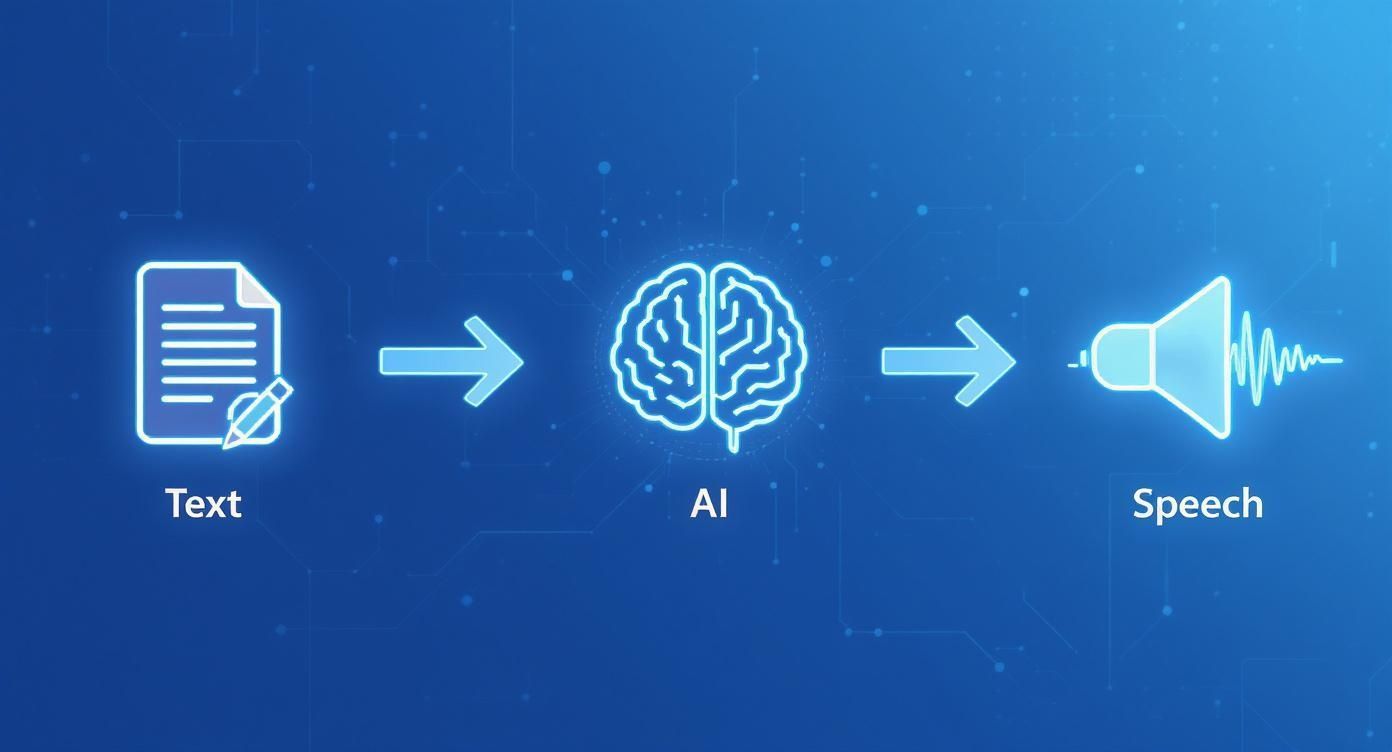
As you can see, it’s a direct line from a simple script to a complex audio file. The AI model is the sophisticated engine making it all happen. What used to be locked away in university research labs is now available to anyone, and the results can be shockingly realistic. The real key? Having tons of clean, high-quality audio to train the model right.
This whole field has exploded in recent years. Celebrity text-to-speech really started hitting its stride in the late 2010s, mostly thanks to massive improvements in deep neural networks. These breakthroughs made it possible to copy unique vocal quirks with an accuracy that was once pure science fiction.
As a result, the AI voice cloning market—which includes all these celebrity models—was valued at over USD 5 billion globally. It's on track to blow past USD 13 billion by 2032. This stuff is big business.
The goal of a great celebrity text-to-speech model isn't just to sound like the person. It's to capture their ability to convey emotion. The best systems can generate speech that sounds happy, sad, excited, or thoughtful, making the output feel truly alive.
This complex process is what separates today's tools from the clunky, robotic voices we all remember. The system learns the little nuances that make a voice sound human, producing audio that can be genuinely convincing and a whole lot of fun.
If you want to dive deeper into the tools that bring these voices to life, check out our guide on finding the perfect AI celebrity voice generator for your next project.
Alright, this is where the fun really begins. We’ve talked about the how, but what about the what? What can you actually do with a perfectly cloned celebrity voice? Once the novelty of making a famous actor say silly things wears off (does it ever?), you’ll find a massive creative sandbox just waiting for you.
The possibilities are genuinely endless, ranging from hilarious social media gags to surprisingly slick marketing campaigns. This is where all that tech talk about AI voice cloning gets put into practice. The rise of AI powered content creation has given everyone from bedroom producers to marketing pros a brand-new set of tools, and celebrity TTS is one of the most exciting.
Social media is the natural habitat for this kind of tech. If you're looking to create content that's shareable, funny, and unforgettable, you've hit the jackpot.
Viral Parody Videos: Imagine a dramatic movie villain narrating a makeup tutorial. Or a famous nature documentarian's voice describing your cat's afternoon nap. The comedic potential of dubbing over clips or creating original skits is off the charts, and it’s a surefire way to stop the scroll on TikTok and Instagram. Unique Podcast Intros: Want your podcast to stand out? Kick things off with an intro from a voice everyone instantly recognizes. It’s an easy trick to sound more professional and hook your listeners from the very first second. Engaging Storytelling: Let's be honest, some topics are just plain dry. Narrating a historical anecdote or explaining a complex scientific theory with a voice people know and love can make even the most complicated subjects feel fun and accessible.
You don't need a Hollywood budget to make your brand sound like a million bucks. For small businesses and marketers, a familiar voice is a secret weapon for cutting through the noise and making your brand stick.
Think about it: a social media ad for your local coffee shop voiced by an actor known for his high-energy roles, or a promo video for a new app narrated by a voice everyone associates with innovation. It adds a layer of polish and personality that can make a small startup feel like a major player.
The growing hunger for audio content is a huge driver here. One report found that while 10% of readers prefer listening to articles, an incredible 75% of those listeners stick around to the end. It's proof that a compelling voice doesn't just grab attention—it holds it.
This shift toward audio makes celebrity voices an incredibly potent way to connect with your customers on a much more human level.
But it's not all about business and viral videos. There are tons of ways to use this tech just for the fun of it.
Customized Greetings: Ditch the boring birthday cards. How about sending your buddy a personalized birthday message from their all-time favorite action hero? It’s a hilarious and surprisingly thoughtful gift they’ll never forget. Indie Game Development: If you're building a game on a shoestring budget, you know how crazy expensive professional voice actors can be. AI celebrity voices can fill that gap, giving you quality dialogue for characters and narration without draining your funds. Creative Wedding Announcements: Want to make sure your save-the-dates stand out? Imagine sending one out with a message narrated by the star of your favorite romantic comedy. It’s a guaranteed smile.
If you’re ready to jump in and start playing around, our guide to the best AI celebrity voice generator is the perfect place to find the right tool for the job.
To get your own creative gears turning, I've put together a few ideas that show just how versatile this technology can be.
| Use Case | Best For | Creative Tip |
|---|---|---|
| Social Media Skits | Content creators, influencers | Create comedic gold by having a super serious, dramatic voice review something mundane, like a new brand of ketchup. The contrast is hilarious. |
| Marketing Campaigns | Small businesses, startups | Pick a voice that matches your brand’s vibe. Think upbeat and energetic for a fitness app, or calm and reassuring for a wellness product. |
| Personalized Shout-Outs | Individuals, event planners | Go for the inside joke! Match the celebrity voice to the person's favorite movie or TV show for a message that feels truly personal. |
| Educational Content | Teachers, online educators | Use a trusted, authoritative voice to narrate history lessons or explain scientific concepts. It makes learning feel more official and engaging. |
Whether you're aiming to create the next viral meme or just add a bit of flair to a personal project, the door is wide open. It's time to get creative.
https://www.youtube.com/embed/u1zXaM4Bl_Q
Alright, so you’re itching to have a digital Morgan Freeman narrate your cat videos. Before you dive in and hit “generate,” we need to have a little chat about the big, scary words: laws and ethics.
Using a celebrity's voice is a bit like borrowing a Lamborghini. It's wildly powerful, a ton of fun, but you can’t just take it for a joyride without getting into a world of hurt.
The legal world has a fancy term for this: the right of publicity. In simple terms, this is a celebrity’s legal shield, protecting their name, image, and—most importantly for us—their unique voice from being used to make money without their explicit permission. Think of their voice as their personal brand, something they've spent a lifetime perfecting. You can't just slap it on your project to cash in.
This is where the line between harmless fun and a lawsuit gets drawn. Making a silly parody for your private group chat is one thing. But using that same voice in a paid ad for your new startup? That’s a completely different ballgame, and a fast track to getting a very stiff letter from a very expensive lawyer.
This is the golden rule, the one concept you absolutely have to get right. Understanding the difference between commercial and personal use is where most people trip up, so let's break it down.
Commercial Use: This is anything where you stand to make a buck, directly or indirectly. We're talking advertisements, sponsored social media posts, product promotions, or even selling audio clips. If it’s tied to a business, it’s commercial. Period. For this, you absolutely need permission and a licensing agreement. No ifs, ands, or buts. Personal Use and Parody: This is the fuzzy gray area. Creating a funny clip for your friends or a satirical video that pokes fun at a celebrity could fall under "fair use." But be warned: fair use is a legal defense, not a free pass. It's a tricky and risky path, especially if your creation suddenly goes viral.
The core principle is dead simple: If you're making money or promoting a business with someone else's voice, you must have their explicit consent. Assuming you're safe because your project is "small" is a dangerous gamble.
The bottom line is that using a celebrity's voice to endorse a product, service, or brand without their consent is a direct violation of their right of publicity.
Beyond the legal headaches, there's a massive ethical responsibility to consider. The exact same technology that lets you create a hilarious birthday message can also be used to create malicious deepfakes. This is where things get truly serious.
A deepfake uses AI to create hyper-realistic but entirely fake audio or video of a real person. Imagine a bogus audio clip of a politician endorsing a rival, a CEO announcing a fake bankruptcy, or a celebrity caught on tape saying something awful. The potential for spreading destructive lies and ruining reputations is enormous. Our guide on how to make deepfake videos dives deeper into the tech, showing just how frighteningly convincing these fakes can be.
This is exactly why transparency isn't just a good idea—it's non-negotiable. If you're using an AI-generated voice, you have an ethical duty to be crystal clear about it.
When you use these tools, you're not just a user; you're a creator with real responsibilities. Keeping your projects on the right side of the law and ethics is essential for protecting yourself and respecting the people whose voices you’re borrowing.
Here are the non-negotiables:
Always Disclose: If you publish content with a synthetic voice, label it. A simple disclaimer like "(AI-generated voice)" can head off confusion and accusations of deception before they even start. Never Impersonate for Malice: Do not create content that puts false words into someone's mouth to defame, harass, or mislead people. This crosses the line from unethical to illegal very quickly. Respect the Person: That voice belongs to a real human being. Avoid creating content that is defamatory, hateful, or just plain nasty. Just because you can make them say something doesn't mean you should.
Stick to these rules, and you can explore the incredibly creative world of celebrity TTS responsibly. You'll keep the fun in and the lawyers out.
Alright, enough with the theory. It's time to roll up our sleeves and actually make something cool. This is your crash course in generating your very first celebrity text-to-speech message, and you’ll be shocked at how easy it is. We're talking about turning a simple script into a polished audio clip in just a few clicks.
We’ll use a popular and super intuitive platform, SendFame, to walk through the process. By the end of this, you’ll be ready to cook up everything from viral social media clips to one-of-a-kind birthday shout-outs. Let's get to it.
First things first, take a deep breath. You don’t need to be a sound engineer or a tech wizard to do this. Most modern celebrity voice generators are built for normal people.
The kickoff is usually a walk in the park:
Sign Up or Log In: Pop over to the platform’s website. Most let you sign up in seconds, often with a Google or social media account. No fuss. Find the Fun Part: Once you’re in, look for the main event—it might be called "Voice Generator," "Text to Speech," or something equally obvious. This is your playground. Explore the Voice Library: Now we're talking! This is where you get to scroll through all the available voices. A good platform will have a ton of options, from A-list actors and pop stars to famous politicians and even cartoon characters.
Seriously, take your time here. The voice you pick sets the entire vibe. Are you going for a serious narration? A hilarious parody? The choice is yours.
Once you’ve landed on the perfect celebrity impersonation, you’ll see a text box. This is where the magic happens. You’ll type or paste in the script you want the AI to perform. It looks simple, but what you write—and how you write it—makes all the difference.
Think of your script as the blueprint for a believable performance. The AI is incredibly powerful, but it's not a mind reader. It needs you to be the director. Don't just dump text in there; guide it.
Here’s a look at the kind of clean, no-nonsense interface you'll likely find on a platform like SendFame. It’s all right there: pick a voice, type your text.
The whole point is to get you from idea to audio as fast as possible, without any confusing menus to slow you down.
Just typing out your message is step one. If you want that eerily convincing, human-like delivery, you need to learn a few simple tricks of the trade. These little tweaks give you control over the AI’s pacing, emotion, and tone, turning a decent clip into an amazing one.
Key Insight: Think of punctuation as the remote control for your AI actor. Every comma, period, and exclamation point is a command that directly shapes the performance.
Let's break down the best ways to finesse your message.
Mastering Pacing with PunctuationPunctuation is your secret weapon. The AI reads these marks as stage directions for how to speak the lines.
Commas (,) create a short, natural breath in the middle of a sentence. Use them to break up thoughts like a real person would. Periods (.) signal a full stop. This creates a longer, more final pause between different ideas. It's essential for clarity. Exclamation Points (!) tell the AI to inject some energy or excitement. Perfect for a big "Happy Birthday!" or a dramatic reveal. Question Marks (?) give the voice that classic upward tilt in tone at the end of a question. It’s a game-changer for sounding natural.
Handling Numbers and AcronymsSometimes, AI can get tripped up on numbers and acronyms, sounding a bit like a confused robot. The fix is easy: just spell them out.
| Instead Of This | Try This | Why It Works Better |
|---|---|---|
| "It costs $200." | "It costs two hundred dollars." | The AI pronounces the words flawlessly, avoiding any weird numerical glitches. |
| "Meet at 10 PM." | "Meet at ten P M." | Spelling out "PM" ensures it’s read as letters, not as... well, who knows. |
| "The FBI is here." | "The F B I is here." | This stops the AI from trying to pronounce "FBI" as a word, like "fibby." |
Experimenting with Sentence StructureFinally, don't be afraid to tinker! Your first draft might not be perfect, and that's okay. If a line sounds a bit flat or robotic, try rewriting it. Sometimes, breaking one long sentence into two short ones makes all the difference in the world.
Generate the audio, have a listen, and make small adjustments. This back-and-forth process of tweaking and refining your script is how you get that flawless, professional-sounding celebrity voice message every single time.
Jumping into the world of celebrity text-to-speech feels like something straight out of a sci-fi movie, doesn't it? It’s wild, it’s exciting, and it naturally brings up a whole lot of questions. If you're wondering about the rules, the quality, and which tools are actually worth your time, you're definitely not alone.
Let's cut through the noise and tackle the big questions head-on. Think of this as your personal, no-fluff FAQ for getting a grip on AI-generated celebrity voices.
Okay, let's get right to the million-dollar question. The short answer? It’s complicated. The legality of using an AI voice really boils down to one thing: how you're using it. There's a world of legal difference between making a goofy birthday message for your buddy and using an AI Morgan Freeman to narrate your company's next commercial.
The key legal idea here is the "right of publicity." This gives every individual control over how their name, face, and voice are used for commercial purposes. Slapping a famous voice onto a product you're selling without getting permission is the fastest way to get a very scary letter from a lawyer.
But what about just for fun? That's where the lines get a little blurry.
Parody and Satire: You might think making a silly video poking fun at a celebrity is protected under "fair use," but this is a notoriously gray area. Your idea of a harmless parody might be what a legal team calls a lawsuit. Personal Fun: Creating a one-off birthday message for a friend? That's generally pretty low-risk. But the second you post it on TikTok and it racks up a million views, the game changes completely.
The Golden Rule: If you're going to make money or promote a brand with it, you absolutely need permission. Period. For personal projects, you're on much safer ground, but you still have an ethical responsibility to not create anything mean-spirited, defamatory, or malicious.
When in doubt, play it safe. Stick to creative, harmless fun and always be upfront that the voice is an AI creation.
If you tried this stuff ten years ago, you'd have gotten a clunky, robotic mess that fooled absolutely no one. Today? It's a whole different story. The best celebrity text-to-speech generators can be so realistic it's downright spooky—sometimes to the point where even a trained ear might be fooled.
The quality of the final audio really hinges on a few things:
The Brains Behind the Voice: The best platforms use incredibly complex AI models trained on thousands of hours of crystal-clear audio. This is how they capture all the little things that make a voice sound human—the unique rhythm, the pitch changes, and the subtle emotional tones. Your Script is Everything: The AI isn't just reading words off a page; it's performing a script you wrote. Using punctuation is like giving it stage directions. A comma tells it to pause. An exclamation point tells it to add some energy. A well-written script is the key to a convincing delivery. Not All Voices Are Created Equal: Honestly, some AI voice models are just plain better than others. A voice that was trained on countless hours of clean, professional studio recordings will always sound light-years better than one trained on a few grainy YouTube interviews.
We’ve reached a point where, with the right tool and a good script, you can generate audio that will easily fool most people. The robotic monotone of the past is gone, replaced by AI that can deliver a performance full of genuine personality.
The market for AI voice generators is exploding, with new tools popping up what feels like every week. They mostly fall into a few different buckets, each designed for a different kind of user.
Plug-and-Play Online Platforms: This is where services like SendFame shine. They're built for pure ease of use. You pick a voice from their library, type what you want it to say, and hit "generate." It's perfect for content creators, marketers, or anyone who just wants great results without a headache.Pro-Level Voice Cloning Software: Tools like ElevenLabs are the next level up. They offer heavy-duty features, like cloning your own voice or creating entirely new synthetic ones from scratch. This is the stuff for pros working on audiobooks, video game characters, or other high-stakes projects.The DIY Open-Source Route: For the seriously tech-savvy, there are open-source models you can download and run on your own computer. This gives you ultimate control, but be warned: it requires a ton of technical know-how to get it all set up and working properly.
For most people who just want to create some fun, engaging content, a user-friendly online platform is the way to go. They hit that sweet spot between amazing quality and an easy workflow, letting you focus on being creative instead of getting lost in the technical weeds.
Ready to create your own amazing celebrity voice messages in seconds? With SendFame, you can choose from a huge library of voices and bring any script to life with just one click. Start creating for free today!
Create Epic

SendFame

Create Epic with SendFame!
Questions: info@sendfame.com