Your Ultimate Guide to AI Voice Actors

ai voice actors
Welcome offer — 56% OFF


Learn how to create a song from scratch. This guide covers writing lyrics, building melodies, arranging tracks, and using AI tools to finish your music.
So, you want to write a song. Fantastic.
It all starts with that little flicker of an idea, right? A phrase you can't get out of your head, a melody you hum in the shower, or a feeling you just have to get out. The trick is knowing how to catch that spark and fan it into a full-blown musical fire. It’s a journey, for sure, but it breaks down into three core phases: capturing the idea, developing it with lyrics and melody, and producing the final track.
Ever had a killer song idea just vanish into thin air because you weren't sure what to do next? We've all been there. But it doesn't have to be that way. Think of this guide as your all-access pass to modern songwriting, where we break down the whole creative process into simple, manageable chunks. No gatekeeping, no confusing jargon.
We'll walk you through everything, from grabbing that initial moment of inspiration to building a song that people will want to listen to on repeat.
This simple visual breaks down the creative flow perfectly.
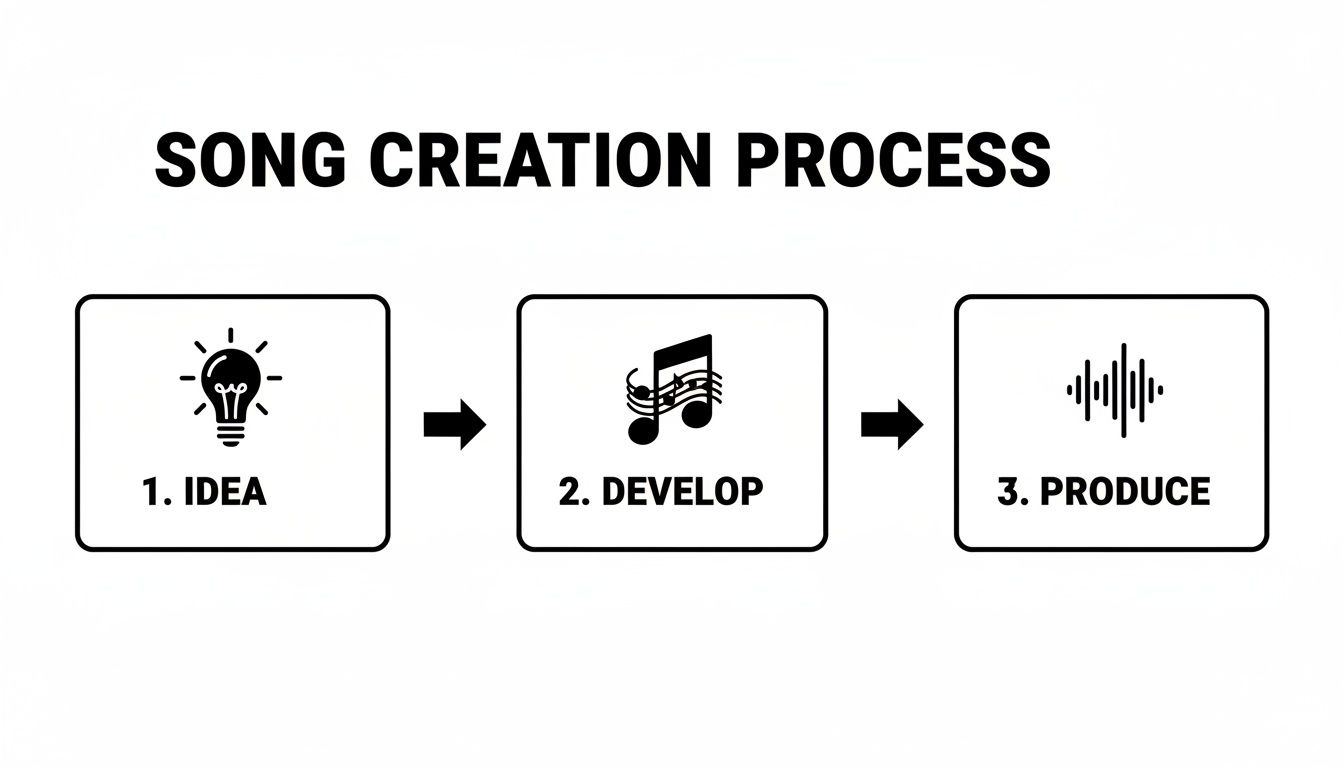
It doesn't matter if you're writing a pop banger or a quiet folk tune; the path is the same. It starts with a concept, grows through creative choices, and gets polished in production.
The old-school way of writing music often felt like a slow, painful grind. But today? We have tools that can get us into a creative flow state faster than ever. Here's a quick look at the traditional songwriting path versus the modern, AI-assisted approach to help you find your best workflow.
| Songwriting Stage | Traditional Method (The Grind) | AI-Assisted Method (The Flow) |
|---|---|---|
| Idea Generation | Waiting for inspiration, staring at a blank page, "writer's block." | Generating endless concepts, themes, and titles in seconds. |
| Lyrics & Melody | Hours with a rhyming dictionary, trial-and-error with a piano. | Brainstorming verses and choruses, getting instant melody ideas. |
| Chords & Arrangement | Fumbling with music theory, manually building song structure. | Instantly creating chord progressions that fit your song's mood. |
| Production & Mixing | Years of learning a DAW, expensive plugins, and technical know-how. | Generating a fully produced, mixed, and mastered track in minutes. |
The point isn't that one way is "better" than the other. The goal is to use whatever tools you have to get the music out of your head and into the world. AI just happens to make that process a whole lot faster and more fun.
Let's be real: there has never been a better time to be a musician. The global recorded music industry is on a tear, hitting an incredible $29.6 billion in revenue—that’s ten straight years of growth. A huge chunk of that, $20.4 billion to be exact (or 69%), comes from streaming, fueled by 752 million paid subscribers around the globe.
What does that mean for you? It means the audience is massive and hungry for new music. You don't need a million-dollar studio to get in on the action anymore.
The old barriers are gone. Your creativity is the only currency that matters now. Forget the expensive gear; the most powerful thing you have is a unique idea and a story to tell.
Tools like SendFame's AI Music Generator can be your secret weapon. Think of it as a tireless co-writer, producer, and engineer all rolled into one. It can help you brainstorm lyrics when you're stuck, cook up cool chord progressions, or even produce a fully mastered song in just a few minutes.
And if you’re staring at a completely blank page? Even that initial spark can be AI-powered. Fire up an AI-powered song ideas generator and get the creative juices flowing.
This guide is your roadmap. Let's get started.
Every great song starts as a tiny spark—a random thought, a phrase you overheard at a coffee shop, or a story you just have to tell. The real magic isn't about waiting for some mythical lightning bolt of inspiration to strike. It’s about learning to pan for lyrical gold in the river of your own life. Your experiences, your perspective? That's the most authentic stuff you've got.
Seriously, a song is just a story with a soundtrack. So, what stories are burning inside you? That disastrous first date, the sheer joy of blasting music with the windows down on a perfect summer day, or the quiet frustration of a project that just isn't coming together. Those are the moments that resonate with people because they're real.
Your first mission is to become an idea hoarder. Don't judge, don't filter. Just grab everything that glitters.
Keep a Log: Whether it’s a physical journal or a voice memo app on your phone, get in the habit of capturing things. Overheard conversations, weird dreams, a sudden wave of emotion—if a line pops into your head, snag it before it disappears. This becomes your personal treasure chest of ideas. Try ‘Object Writing’: This is a classic trick for a reason. Pick a random object—that beat-up guitar in the corner, a favorite coffee mug, an old photo. Set a timer for ten minutes and just write about it, focusing on all your senses. This simple exercise is like weightlifting for your descriptive muscles and can lead you down some surprisingly creative paths.
None of this is about writing a perfect song right out of the gate. It's about making a glorious mess and gathering raw material to sculpt later. Trust me, most first drafts are a disaster, and that’s exactly how it should be.
A great song tells a truth, but it doesn't have to be a literal diary entry. The trick is to find the universal feeling hiding inside your personal story. That's what makes a listener nod and think, "Yeah, I've been there."
Once you've got a core idea, you need a blueprint. Most of the songs you love follow a structure that acts as a road map for the listener. The most reliable and common one is the classic Verse-Chorus structure.
The verse is your storytelling real estate. This is where you set the scene, introduce characters, and push the narrative forward with each new section.
Then comes the chorus, which is your song's mission statement. It’s the emotional core, the big hook, and the part you repeat to drill it into your listener's brain. Make it count.
If you really want to add some dynamic flair, bring in a bridge. Think of it as a detour that offers a change of scenery—a new perspective, a different musical feel—before you slam back into that final, epic chorus. For a deeper dive, check out our guide on how to create song lyrics for more pro tips on song form.
Writer's block happens. It's not a sign you're a fraud; it's a sign you're a writer. But you don't have to just sit there and suffer. This is where modern tools can be an incredible creative partner.
Think of something like SendFame’s Lyric Generator as your personal co-writer. You can toss it a theme, a mood, or even just a single line you're stuck on, and it will spit back verses, rhyme schemes, and fresh concepts you hadn't considered.
Here’s an idea of how you can get the ball rolling with just a simple prompt.
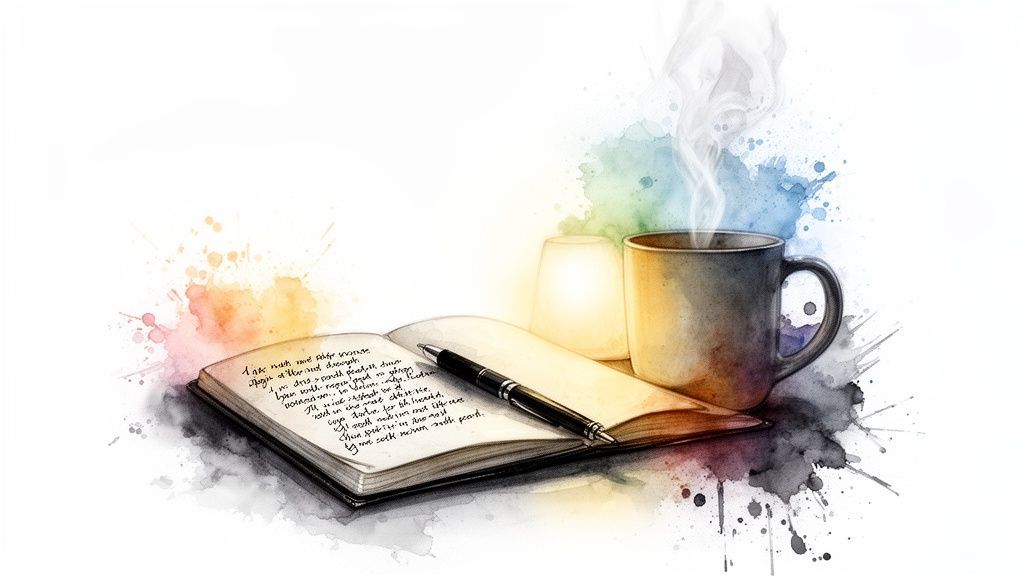
The point isn't to let AI write your song for you. It's about giving your own creativity a jumpstart. Use it to explore different angles, find a rhyme that doesn't sound clunky and forced, or just get a fresh take when you feel like you're chasing your own tail. It’s an amazing way to keep the creative momentum going when you hit a snag.
Alright, you've got some lyrics scribbled down. Now for the fun part: making them sing. This is where you breathe life into the words on the page, crafting the melody and the chord progression that will carry your story. And no, you don't need a music degree to pull this off. The best ideas are probably bouncing around in your head already.
A great melody is more than just a tune; it’s the emotional heartbeat of your song. It’s what makes the chorus feel like an explosion of joy or the verse feel like a whispered secret. The melody is how you tell the listener how to feel.
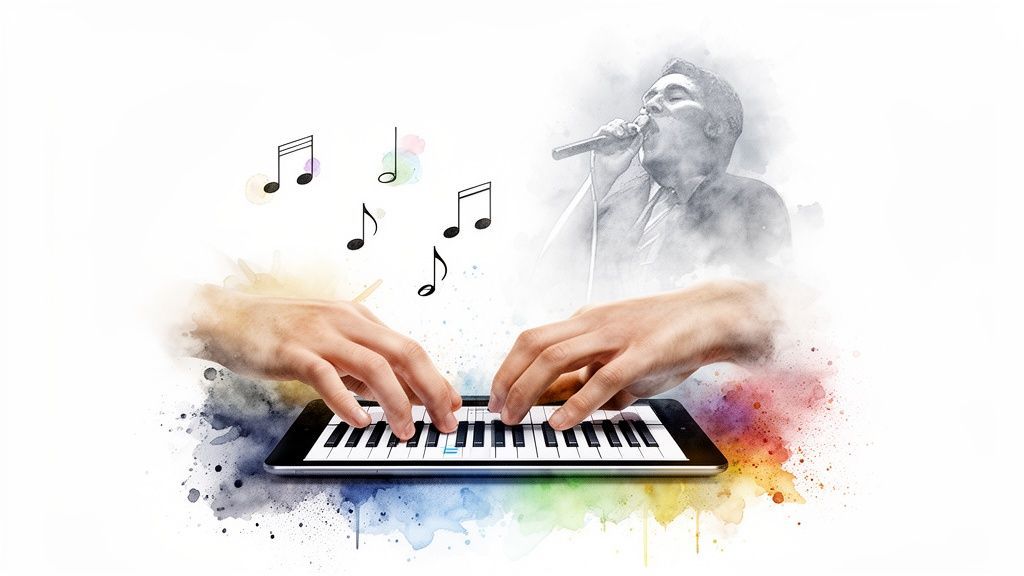
Forget about the piano for a second. Your most powerful instrument is your voice. Seriously. Just start speaking your lyrics aloud. Feel the natural rhythm, the rise and fall of your voice. Now, try singing them. Go high, go low, experiment. You're basically just doodling with sound.
Pull out your phone and hit record. Record everything—even the mumbles and half-baked hums. That one little phrase you almost deleted could be the hook your entire song hangs on. The point isn't to be perfect; it's just to play.
Here’s a secret from the pros: the catchiest melodies are often incredibly simple. Think about "Twinkle, Twinkle, Little Star." It’s stuck in your head for life because it’s simple. Don't tie yourself in knots trying to be clever; a killer hook might only be three or four notes.
Chords are the landscape your melody lives in. They set the scene and tell your listener what kind of emotional journey they're on. Even if you can't tell a C major from a car door, just knowing what a few basic chord progressions feel like is a massive advantage.
Think of chord progressions as recipes for moods. A handful of them are behind literally thousands of hit songs.
Here are a few classic "mood recipes" to mess around with:
The Happy-Go-Lucky (Pop/Rock): G - C - D - G The Moody Ballad (Singer-Songwriter): Am - G - C - F The Timeless Classic (Folk/Country): C - G - Am - F
You don’t even need an instrument to hear these. Just hop on YouTube and search for those progressions. Hum your melody over them. Which one clicks? Which one feels right for your words? Trust your gut.
What if you could jump straight to hearing your ideas as a finished song? Technology gives us an incredible shortcut here. Instead of fumbling for the right chords for hours, you can get an AI to do the heavy lifting.
This is where you can take your completed lyrics and feed them into an AI music generator like SendFame. In a matter of moments, it can spit out a complete track—your words, a catchy melody, a professional-sounding singer, and a full band backing it all up. It's an insane way to hear your song come to life instantly.
This isn't just about speed; it's about creative freedom. You can test-drive your lyrics in different genres in a flash. Is that breakup song better as a quiet acoustic number or a pulsing synth-pop banger? An AI can show you both options in less time than it takes to make a cup of coffee, letting you focus on the part that matters most: your story.
Alright, you've got the raw materials: a melody that’s stuck in your head and some chords that feel right. Now for the fun part. We're going to take that simple loop and build it into a real song, a journey with ups and downs that grabs a listener and doesn't let go. This is where arrangement and production come in—think of it as being the director of your own musical movie.
Arrangement is really just about storytelling. You wouldn't start a movie with the final explosion, right? You build up to it. The same goes for music. You decide when instruments pop in, when they drop out, and how you create those moments of tension and sweet release that make a song so satisfying.
The classic verse-chorus structure is your skeleton. Let's add some muscle and personality to it. You don't need a million-dollar studio for this, just a little bit of imagination.
The Hook: Your Intro. How do you want to say "hello"? It could be a lonely guitar riff, a stripped-back drum beat, or maybe a muffled, filtered version of your main chorus melody that hints at what's to come. This is your first impression. The Breather: Instrumental Breaks. After a big, emotional chorus, give your listener a second to process it. A short musical section without vocals can be a powerful way to reset the energy before diving into the next verse. The Grand Finale: Your Outro. How does the story end? You could fade out on the main hook, letting it drift away. Or you could strip everything back down to just one instrument, leaving a single, lingering thought. Maybe you just end it—BAM!—on a final, powerful chord. Make it memorable.
The key is to keep the listener engaged. If you have two verses that are musically identical, try adding a tiny new detail to the second one—a subtle harmony, a quiet tambourine, a new synth pad swelling underneath. It’s like a little reward for anyone paying close attention.
Think of your song as a conversation. You don't just scream your main point on repeat. You set the stage, you build your argument, you add supporting details, and you give the other person moments to breathe and think. Your arrangement is the art of pacing that conversation.
"Production" sounds like a scary, technical word, but it's really just about making cool creative choices to make your song sound better. You can start doing this with literally just your phone and a quiet closet.
A classic trick is layering. Let's say you're recording vocals for your chorus. Record yourself singing it three times on three separate tracks. Pan one a little to the left, one a little to the right, and keep the main one right down the middle. Instantly, your vocal sounds huge and professional. You can do the same with percussion—try snapping your fingers on one track and clapping on another. You'd be surprised at the killer groove you can build.
This kind of accessible creativity is more important than ever. Streaming now accounts for a massive 69% of the $29.6 billion global recorded music industry, and with 752 million paid subscribers out there, the hunger for new music is constant. You can get the full picture by checking out the latest RIAA mid-year report. This demand has opened the door for amazing tools that can seriously speed things up.
Let's be real: for a lot of us, the technical side of production is a massive roadblock. This is where AI tools have become an absolute game-changer, basically acting as your personal audio engineer. Platforms like SendFame can take your core idea and spit out a fully polished, radio-ready song without you ever having to learn what a compressor does.
The process couldn't be simpler. You feed it your lyrics, pick a genre you're vibing with, and choose a vocalist style. The AI does the rest.
Here’s a peek at the SendFame AI Music Generator interface. It's about as straightforward as it gets.
As you can see, you're just making the fun creative choices, not getting lost in a sea of confusing knobs and sliders.
The AI builds a complete arrangement with pro-sounding instruments, delivers perfectly tuned vocals, and creates a dynamic structure that ebbs and flows just like a hit song. This isn't just a rough sketch; it's a finished product, mixed, mastered, and ready to share. This tech obliterates the barrier between your brilliant idea and a polished track, making the entire process of creating a song faster and more accessible than ever before.
You've wrestled with lyrics, tamed melodies, and arranged a story in sound. The heavy lifting is done. Now it's time for the fun part: adding that final professional sheen that takes your song from "hey, that's pretty good" to "wow, I need this on my playlist." This is where we get into the nitty-gritty of mixing, mastering, and finally, unleashing your creation on the world.
Not too long ago, these final steps were a kind of dark art, practiced by audio engineers in windowless rooms with intimidatingly large mixing boards. But just like every other stage of making music, technology has kicked the door wide open for everyone.
So, what's the deal with mixing versus mastering? They sound similar, but they're two very different beasts.
Let's break it down.
Mixing is like being the conductor of your musical orchestra. You're taking all those individual tracks—the vocals, the drums, the bass, the synths—and making them play nicely together. It’s all about adjusting volumes, panning sounds to create a wide stereo image, and making sure the lead vocal sits perfectly on top of everything without getting lost. Every single element gets its own space to shine. Mastering, on the other hand, is the final quality check before your song goes out the door. This is what makes your track sound loud, crisp, and consistent, whether someone's listening on cheap earbuds, in their car, or on a massive club sound system. It’s that final coat of polish that screams "finished and professional."
For creators who’d rather just focus on making music, this is where AI can be a real game-changer. When you generate a song with a tool like SendFame, it comes out the other end fully mixed and mastered. This saves you a ton of time and spares you the technical headaches.
Alright, your song is finished, polished, and sounding incredible. Now what? You can't just email it to Spotify! You need a way to get it onto all the major streaming platforms—Spotify, Apple Music, Amazon Music, you name it.
That’s where a music distributor comes in. Think of them as the middleman who takes your finished song and pushes it out to all the digital stores and services. For a deep dive, you should definitely check out our guide on the best music distribution tools for independent artists.
But before you hit upload, you'll need some killer artwork. Your album cover is the visual handshake for your music; it's the very first thing people see. Don't sweat it if you're not a graphic designer. Platforms like SendFame even have AI tools built specifically for whipping up eye-catching album art that perfectly captures your song's vibe.
Your release plan is just as creative as your song. Think about how you’ll tell your story visually and share your music with an audience that’s waiting to discover you. The song is the main event, but the release is the party.
The music industry is absolutely booming, with projected revenues expected to hit a staggering $110.8B by 2032. This isn't just big labels; it’s being fueled by the creator economy, where independent artists can finally build a career on their own terms. AI tools are right at the heart of this shift, letting you create not just the song, but the album art and promo videos in a few clicks.
Once your track is ready, promoting it effectively is the final piece of the puzzle. For visual-heavy platforms, learning the ropes of creating viral Instagram Reels can give your music's reach a massive boost. After all the love and effort you've poured into your song, a smart release strategy ensures it finds the audience it truly deserves.
Even with a perfect roadmap, the path from idea to finished song is never a straight line. It's full of detours, potholes, and a few "what on earth am I doing?" moments. It’s totally normal to have questions bubble up.
Think of this as your personal songwriting hotline, where we tackle the most common creative roadblocks. Let's get these sorted so you can get back to making music.
Heck no. Some of the greatest songs ever were sketched out on a cheap, beat-up acoustic guitar in a noisy apartment. Today, you’ve got a surprisingly powerful recording studio sitting right in your pocket: your smartphone.
Seriously, start with the voice memo app to catch those fleeting melody ideas. When you're ready to build on them, free apps like GarageBand or BandLab give you a full-blown digital audio workstation (DAW) without costing a dime.
The magic is in the song itself—the story you tell, the melody that sticks, the chords that hit just right. Fancy gear can't save a boring song, but a great song will cut through even on a basic recording.
Look, the most powerful tool you have is your own creativity, not your credit card. If you've got an idea and a story, you've got everything you need to start.
Ah, writer's block. The songwriter's mortal enemy. It feels like a concrete wall, but I promise you, it's not permanent. The first thing to do? Change your environment. If you've been glued to your computer, get up and go for a walk. If you've been wrestling with lyrics, put the words away and just hum a melody for a bit.
Sometimes, all you need is a little jolt from the outside world. This is where AI tools can be a secret weapon. Fire up an AI Lyric Generator and toss it a simple prompt like "a song about a rainy Monday morning." It might spit out a line or an angle you never would have thought of. It's not cheating; it's just getting a friendly nudge when you're stuck in a rut.
If you're just getting started, make the Verse-Chorus-Verse-Chorus-Bridge-Chorus structure your best friend. It’s the blueprint for literally thousands of hit songs for one simple reason: it just works.
This structure feels natural to listeners. You tell the story in the verses and hit them with the big, catchy idea in the chorus. The bridge offers a little twist or a new perspective before you bring it all home with that final, satisfying chorus. Don't overthink it—just start by writing one verse and one chorus. That's the core of your song right there.
This is where making music in today's world gets really exciting. If you have incredible ideas rattling around in your head but can't play a G-chord to save your life or sing in key, AI music generators are your new bandmates.
You become the creative director. You provide the lyrics, pick the genre, and set the mood. The AI then handles the actual performance, becoming your virtual session musician and vocalist. It completely demolishes the technical barriers that used to stop so many creative people in their tracks. It means anyone can learn how to create a song and bring their vision to life.
Ready to stop wondering and start creating? The SendFame AI Music Generator can turn your lyrics into a fully produced, radio-ready track in minutes. Give it a try and hear your song come to life today.
Create Epic

SendFame

Create Epic with SendFame!
Questions: info@sendfame.com