How to Create a Song From Idea to Finished Track

how to create a song
Welcome offer — 56% OFF



Learn how to scale content creation using smart workflows, AI assistants, and proven repurposing tactics to multiply your output and reclaim your time.
Feel like you're stuck on a content treadmill that just won't stop? We've all been there. The secret to scaling your content isn't just about working harder or pulling more all-nighters—it's about building a smarter system. It's time to combine a laser-focused strategy, killer workflows, and the right tech to crank out more content without burning out.
If you’re constantly churning out content just to stay relevant, you’re in good company. The pressure to publish, post, and share is relentless. But the “more is always better” mindset is a one-way ticket to burnout and crappy results.
The real truth? Scaling your content has almost nothing to do with brute force. It’s all about building a well-oiled machine that runs on strategy, not just pure adrenaline and caffeine.
This guide is your official exit ramp off that hamster wheel. We're about to bust the myth that scaling means trading your sanity for more volume. Instead, you'll learn how to build an engine that actually produces better content, more consistently.

The first big leap you need to make is mental. Stop thinking of yourself as just a creator and start seeing yourself as the architect of a content ecosystem. An architect doesn't lay every single brick, do they? Nope. They design the blueprint that makes sure the whole building is solid, efficient, and ready to grow.
Your job is to design the systems that let creativity flow, even when you're producing a ton of stuff.
This means putting clear processes in place that kill decision fatigue. When you've got a solid framework, you don't wake up every morning in a panic, wondering what on earth to create. The system guides you, which frees up all that precious brainpower for the fun, creative parts of the job. And if you do hit a wall, it helps to know how to blast through it. Check out these tips for overcoming creative block to keep the ideas coming.
A huge part of escaping the hamster wheel is mastering content workflow management—it’s absolutely essential for cranking up production without creating total chaos. Think of your workflow as the backbone of your entire scaling strategy.
Scaling content isn't about doing more things; it's about getting more from the things you do. The goal is to build an asset that works for you, not a job that works you into the ground.
Okay, so what is this magical "engine" I keep talking about? It’s not one thing, but a few key parts humming along together:
Strategic Planning: This is your foundation. You'll define core content pillars that tie directly back to your business goals, making sure every single piece you create has a real purpose.Efficient Workflows: We're talking templates, batching your work, and repurposing everything. It's the art of creating more with way less effort.Smart Automation: Let the robots do the boring stuff! This means using AI tools, like those from SendFame, to handle repetitive tasks and even spark new creative ideas.
When you nail these elements, you create a powerful flywheel. Each piece of content becomes easier and more impactful to produce than the last. This is exactly how today's top creators and brands get massive reach without needing a massive team. And thanks to platforms like SendFame, this kind of power isn't just for the big media giants anymore.
Trying to scale content without a solid system in place is a recipe for disaster. It’s like revving a flashy sports car with no engine—plenty of noise, but you’re not going anywhere. Before you even dream of pumping out a mountain of new content, you have to build the machine that actually creates it.
This "machine"—your content engine—doesn't need to be some overly complicated, Rube Goldberg-esque contraption. It's a simple, powerful system designed to kill the daily "what the heck should I post today?" panic. More importantly, it ensures every single thing you create is actually doing a job for your brand.
Get this right, and you're not just making more stuff. You’re building a strategic asset that works for you around the clock.
Your content pillars are the handful of big-picture themes your brand is going to own. Think of them as the 3-5 massive subjects you want to be known for, period. These aren't just random ideas you pull out of a hat; they're strategically chosen to intersect with what your audience is desperate to know and what your business actually sells.
Pillars give your entire content strategy a backbone. Instead of frantically chasing every shiny new trend, you focus your energy where it'll have the biggest impact. This creates a rich, interconnected web of content that screams "expert" to both people and search engines.
Let’s say you’re a solo consultant who helps people get more done. Your pillars might look something like this:
Time Management Frameworks: Everything from the Pomodoro Technique to the gospel of deep work. Productivity Tech & Tools: Honest reviews and comparisons of apps like Notion, Trello, and Asana. Beating Burnout for Good: Actionable advice on setting boundaries, managing energy, and staying sane.
Each pillar is a deep well you can draw from over and over again, meaning you’ll never run out of genuinely useful things to talk about. Every blog post, video, and tweet suddenly has a clear, undeniable purpose.
A well-defined content pillar is your creative filter. If a new idea doesn't neatly fit under one of your pillars, you just don’t make it. That ruthless focus is the secret sauce to building a brand that feels cohesive and authoritative.
Want to know the real secret to scaling? It’s consistency. When your audience knows what to expect from you, they don’t just follow—they become fans. Templates are your express lane to getting this done without sacrificing your sanity.
Whip up some simple, reusable outlines for the content you make most often. This could be a blog post template with pre-built sections for your hook, the main points, and a call-to-action, or a script template for your short-form videos.
Blog Post Template: Killer Intro Hook -> The Big Problem -> 3-5 Key Points with Juicy Examples -> Wrap-Up -> The "Do This Now" CTA. Video Script Template: 3-Second Hook -> Quick Tip or Story -> The "How It Works" Breakdown -> Call to Engage (Comment/Follow/Share).
This isn't about boxing in your creativity; it's about eliminating friction. When the structure is already decided, you free up all that precious brainpower to focus on what really matters: delivering knockout information that wows your audience.
Just as critical is defining your brand voice. Are you the witty, slightly irreverent friend? Or the trusted, authoritative professor? Whatever it is, write it down. A simple one-page guide covering your tone, go-to phrases, and even your emoji philosophy ensures everything you publish sounds like it came from the same person (even when it doesn't).
So, what does this look like in the real world? Let's go back to our productivity consultant. They decide to create a cornerstone piece of content based on one of their pillars: a definitive guide to "Mastering the Weekly Review."
With their content engine fired up, they don't just write a blog post and call it a day. They atomize that single idea into a whole content ecosystem:
The Pillar Piece: The blog post, "The Ultimate Guide to Performing a Powerful Weekly Review," goes live. Short-Form Video: They film a 3-part Reel series on "My Top 3 Weekly Review Questions." Super snackable. LinkedIn Carousel: A 10-slide visual breakdown of the steps from the guide. Perfect for the professional crowd. Twitter Thread: They craft a thread on the "10 biggest mistakes people make during their weekly review (and how to fix them)." Email Newsletter: They send out a summary of the guide, but add a personal story about how the weekly review changed their own business.
Boom. One core idea just spawned a month's worth of diverse content, all pointing back to the main asset. This is exactly how you learn how to measure content performance in a meaningful way—by seeing which formats and channels pop off.
This whole process is getting supercharged by AI, too. The global AI-powered content creation market is on a rocket ship, projected to hit a staggering $8.31 billion by 2030. Why? Because businesses are realizing they can turn one idea into a thousand assets in minutes. If you want to dive deeper into that explosion, check out the full research on the AI-powered content creation market at nextmsc.com. Building your engine now is how you get ready to ride that wave instead of being drowned by it.
Okay, let's talk about the secret weapon. If building your content engine is like designing a high-performance car, then mastering batching and repurposing is like hitting the nitrous button. This is where you stop creating one piece at a time and start thinking exponentially.
Seriously, this is the ultimate hack for scaling content without cloning yourself.
It’s time to kill the old, soul-crushing method: wake up, brainstorm, create, edit, and publish a single piece of content, all in one dreadful day. That’s a one-way ticket to Burnout City. We're going to build a creative assembly line instead.
The idea behind content batching is beautifully simple. You just group similar tasks together and crush them all in one focused block of time. Your brain absolutely loves this. It gets to stay in one "mode"—like "writing mode" or "filming mode"—without the mental whiplash of switching gears every hour.
The efficiency gains are insane. Instead of playing the part of a one-person media company every single day, your entire week gets a makeover.
A real-world batching schedule could look something like this:
Monday (Strategy & Scripting): You're the Head Writer. Spend the day brainstorming and scripting out every video, podcast, and blog post for the week. Tuesday (Production Day): You're the Director and the Star. Get in front of the camera or mic and record everything in one go. Pro tip: change your shirt a few times, and no one will ever know you filmed five videos in three hours. Wednesday (Post-Production): You're the Editor. All that raw footage and audio from yesterday gets chopped, polished, and finalized. Thursday (Distribution Prep): You're the Social Media Manager. Write all the captions, design the graphics, and schedule everything to go live.
This whole system is built on the foundation we talked about earlier—your core pillars and templates. They make this kind of workflow not just possible, but natural.
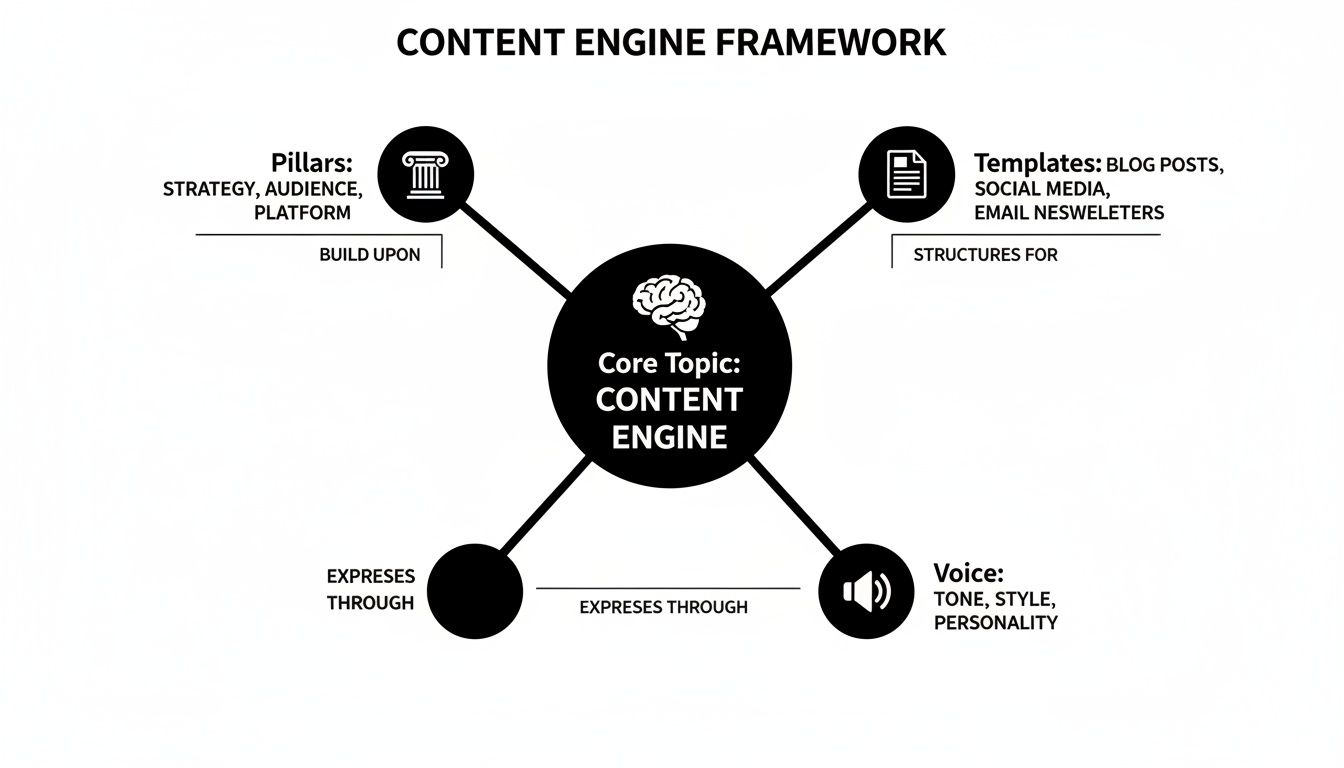
This map just reinforces the idea. A solid system where your core topics feed into predefined pillars and templates is what makes batching click into place.
Once you've batched your content, it’s time to multiply it. Repurposing isn't just lazily reposting the same link everywhere. It’s the art of deconstructing a big "pillar" piece of content into a whole fleet of smaller, native assets designed for different platforms.
Think of it like this: your big, in-depth webinar is the Thanksgiving turkey. You don't just plop the whole bird on everyone's plate. You carve it up into delicious, bite-sized pieces that are perfect for each guest—or in our case, each platform.
Your one deep-dive blog post isn't just a blog post. It's the raw material for ten tweets, a five-minute YouTube tutorial, an Instagram carousel, and two email newsletters.
This approach lets you dominate multiple channels with a fraction of the effort it would take to create something new for each one. You’re not just saving time; you’re building a cohesive content ecosystem where every little piece reinforces the others, driving people back to your most important stuff. For a deeper dive, check out our guide on powerful content repurposing strategies.
Here’s a practical look at how you can slice and dice one major content piece. This table breaks down how a single long-form blog post can spawn a whole family of content across your channels.
| Original Content Piece | Repurposed Format | Target Channel | Key Action/Goal |
|---|---|---|---|
| 2,000-word blog post | 10-Tweet Thread | Spark conversation, drive clicks to the full post | |
| 2,000-word blog post | 5-slide Carousel | Instagram / LinkedIn | Educate with key stats and takeaways, build authority |
| 2,000-word blog post | 60-second video script | TikTok / Reels | Highlight one shocking fact or tip, generate views |
| 2,000-word blog post | Email Newsletter | Email List | Provide exclusive context and a link, nurture subscribers |
| 2,000-word blog post | Infographic | Pinterest / Blog | Visualize data for easy sharing, earn backlinks |
As you can see, the possibilities are huge. You're not just creating more content; you're creating smarter content that meets your audience where they are.
Let’s visualize this. Imagine your pillar content—say, a 30-minute podcast episode—at the center of a spiderweb. Now, look at everything we can spin from it:
Full-Length Video: Upload the entire audio to YouTube with a simple, branded background. Easy. Short Video Clips: Pull out 3-5 of the juiciest one-minute highlights. These are gold for TikTok, Instagram Reels, and YouTube Shorts. Quote Graphics: Turn the most powerful lines into sharp-looking graphics for Instagram and Facebook. Use a tool like Canva with a premade template and you can crank these out in minutes. Blog Post Summary: Write a quick blog post summarizing the key takeaways, and embed the full audio player right at the top. Twitter Thread: Break down the core argument into a compelling 10-tweet thread, with the last tweet linking to the full episode. Email Newsletter: Share a personal story related to the podcast topic with your email list, teasing them to listen for the full scoop.
And just like that, a single 30-minute recording session has filled your content calendar for an entire week, maybe more. You're everywhere, providing value in different formats, all while hammering home a consistent message. This is the engine of scalable content.
Let’s get one thing straight: AI isn’t here to replace your creative genius. It’s here to be your ridiculously efficient sidekick.
Think of it as the tool that handles all the grunt work, freeing you up to do the cool, strategic stuff that actually matters. Anyone who tells you to let AI take over completely is setting you up to create bland, soulless content that sounds like a robot wrote it.
Instead, view AI as your creative co-pilot. The real goal is to delegate about 70% of the repetitive, time-sucking tasks that bog you down. You’re not automating your personality; you’re automating the boring parts so you have more time for genuine storytelling.

We’ve all been there—staring at that blinking cursor on a blank page. It’s the universal symbol for creative dread. This is exactly where your AI co-pilot shines.
Instead of agonizing over where to start, you can use AI to spit out initial ideas, rough outlines, or even a full first draft in seconds.
For example, I'll often feed it a simple prompt like, "Give me a blog post outline on the benefits of content batching for busy entrepreneurs." Boom. I instantly have a solid structure to work with. The AI handles the basic framework, and I jump in to inject my unique voice, add personal stories, and polish it into something actually worth reading.
This simple shift changes the entire game. You’re no longer creating from scratch; you’re refining and enhancing. To get a feel for this, check out our guide on using AI for content creation for more ways to supercharge your workflow.
Imagine creating hundreds of personalized outreach videos in a single afternoon. That isn’t some far-off sci-fi concept. It’s something small businesses are doing right now to stand out.
Take a B2B company trying to connect with high-value prospects. Instead of another generic email that gets deleted on sight, they can use an AI Celebrity Video Generator from a platform like SendFame. Just upload a list of names and companies, and the AI generates a unique, personalized video for each person, featuring a familiar face. The impact is immediate.
Forget generic tips. Modern AI lets you do things that were once impossible for anyone but a massive studio. The real magic happens when you use these tools to scale not just volume, but connection.
This kind of accessibility is why we're seeing massive adoption. The cloud segment in AI-powered content creation is on track to grab around 65% of the market share by 2035. Why? Because platforms like SendFame, now with over 200,000+ users, are making powerful tools available without any technical headaches.
Scaling isn't just about the big blog posts or videos. It’s about efficiently knocking out the dozens of small, annoying tasks that eat up your day. Your AI co-pilot can be a fantastic virtual assistant for this stuff.
Here’s a quick look at how you can put it to work:
Brainstorming Hooks: Stuck on an intro? Ask your AI for ten catchy hooks. You’ll have them in three seconds. Designing Thumbnails: Use an AI image generator to create a dozen eye-catching thumbnail variations for your YouTube videos or blog posts. Writing Social Captions: Turn a long-form article into ten witty, platform-specific social media captions with a single command. Generating Custom Music: A podcast host can use an AI Music Generator to create unique, royalty-free intro music that perfectly matches their brand’s vibe.
By offloading these smaller (but still essential) tasks, you can reclaim hours every single week. This is the practical reality of scaling content creation today. You don’t need a massive team—you just need a smart partnership with your AI co-pilot.
Let's be real. Scaling your content operation isn't about finding some magical growth hack. It’s about getting your people and processes in order.
Whether you're a one-person army or a growing team, trying to scale without clear roles is like trying to stage a play where everyone thinks they're the director. It's a fast track to chaos.
Defining who does what is the single most important thing you can do to turn that chaos into a well-oiled production line. This isn’t about building a stuffy corporate org chart; it’s about giving people ownership so bottlenecks disappear and they can do their best work.
When you’re flying solo, you are the entire content team. The secret isn't to magically do everything at once, but to consciously switch hats throughout the week. This mental shift stops you from getting pulled in a million different directions at the same time.
Try thinking of your week like this:
You, The Strategist (Monday): This is your big-picture day. You're digging into what worked last week, mapping out themes for the upcoming month, and outlining those big pillar content pieces. No creating allowed, just pure planning. You, The Creator (Tuesday & Wednesday): Time to get in the zone. This is when you batch-create your content—writing the blog posts, filming the videos, recording the podcasts. You're the artist, focused solely on getting it made. You, The Distributor (Thursday & Friday): Now you put on your promoter hat. You’re scheduling social media, banging out email newsletters, and actually talking to your community. Your only job is to make sure the amazing stuff you just created gets seen.
This stops you from trying to be a strategist, creator, and promoter all in the same afternoon—which is a surefire recipe for doing all three jobs poorly.
Scaling as a solopreneur isn't about finding more hours in the day. It's about dedicating the hours you have to a single, focused role at a time.
Once you're ready to bring on some help, your first few hires are absolutely critical. You don't need a huge team right out of the gate; you need a couple of strategic players who can take a huge weight off your shoulders. The goal is simple: hire for the roles that are causing your biggest headaches right now.
A common (and smart) first hire is a versatile writer or content creator. This person can take your grand ideas and strategic outlines and transform them into polished blog posts, video scripts, and social copy. That frees you up to think bigger.
Another game-changer is a savvy social media manager or distributor. You want someone who lives and breathes the platforms. They know exactly how to slice and dice your pillar content into a dozen engaging formats and can manage the community so you don't have to.
Here’s where it gets really interesting. You don't actually have to hire a human for every single role anymore. AI can step in as a ridiculously powerful force multiplier, filling crucial gaps and letting a tiny team punch way, way above its weight class.
Think of AI as your new virtual team member—one who never sleeps or asks for a coffee break. It can be your:
Virtual Video Editor: Tools that can gobble up a long video and instantly spit out a dozen viral-worthy clips. Graphic Designer: AI that generates stunning thumbnails and social media graphics from a simple sentence. Junior Copywriter: An assistant that can draft your initial blog outlines, social media captions, or a bunch of email subject lines to test.
There's a reason the AI content creation tool market is absolutely exploding—it's projected to grow by an incredible $60.47 billion between 2025 and 2029. Big companies are already using these tools to automate up to 70% of their repetitive grunt work, and there's no reason you can't, too. If you want to go down that rabbit hole, check out the full analysis on why the AI content tool market is expanding so rapidly on technavio.com.
This lets your human team members focus on high-level strategy and pure creativity, helping you achieve an output that just a few years ago would have required a much larger agency.
Stepping up your content game always brings a fresh batch of questions. It's one thing to talk about frameworks in a blog post, but what happens when you hit a real-world snag? Let's dive into some of the most common hurdles people run into when they start trying to create more content, more often.
Ah, the classic question. The fear that "more" automatically means "worse." But here's the truth I've learned from years of doing this: scaling quality is all about having killer systems, not just trying harder.
It all starts with obsessively detailed brand guidelines and content templates. Think of these as the bumpers on a bowling lane for your brand's voice and style. They aren't there to stifle creativity; they're there to kill the guesswork and lock in a consistent, high-quality foundation for every single thing you publish.
Next, you need a simple but non-negotiable review process. This could be as easy as a quick self-edit followed by a once-over with a tool like Grammarly. The trick is making it an unskippable part of your routine. The best system I've found is letting AI do the heavy lifting for a first draft, but always—and I mean always—reserving the final 20% for a human to get their hands on it.
That final human touch is where the magic happens. It's where you inject the nuance, the empathy, and the specific brand voice that AI just can't fake. It's what keeps your content from sounding like it came from a soulless robot.
Finally, you have to embrace the power of batching. By editing all of this week's blog posts in one focused session, for example, your brain gets into a groove. You start spotting inconsistencies and can elevate the quality of everything at once.
If you're flying solo, the absolute first step is a mental one. You have to stop thinking piece-by-piece and start thinking in campaigns. You need to be a strategist first and a creator second.
Here’s a simple, five-point game plan I give to every solopreneur I coach:
Pick Three Core Pillars: What are the three topics you could talk about in your sleep? These are the bedrock of your expertise. Create One 'Pillar' Piece: Go ridiculously deep on one of those pillars. I'm talking an ultimate guide, an in-depth video workshop, or a comprehensive webinar. 'Atomize' Your Pillar: This is where you get all the leverage. You methodically break down that one massive piece into 15-20 micro-assets. Think shareable quotes for Twitter, short video clips for Reels, and key stats turned into sharp-looking LinkedIn posts. Batch Your Time: Block off one day a month to create your next monster pillar piece. Then, block off another day just to chop it up and schedule all the micro-content that comes from it. Integrate One AI Tool: Don't try to boil the ocean. Just pick one AI tool that solves your biggest bottleneck. Is it writing first drafts? Creating social media images? Find one tool and master it.
This approach gives you a repeatable system that turns one huge burst of effort into a month's worth of consistent, high-value content. It’s a game-changer.
The cost can swing from practically free to thousands of dollars a month. It completely depends on where you are in your journey and what you're trying to achieve.
When you're on a shoestring budget, your main investment is your own time. You can make that time go a lot further with free tools like Google Sheets for your content calendar and by taking advantage of the free tiers on many powerful AI platforms. You can get surprisingly far without spending a single penny.
Once your content engine starts humming and you see results, you can start putting some money back into it. A premium subscription for a good scheduler ($20-$50/month) or a powerful AI content suite ($30-$100/month) can give you an incredible return on that investment.
The key is to start lean. Measure the impact of every dollar and only upgrade your tools or hire help when you can point to actual revenue or a serious uptick in leads from your content. Don't spend money you don't have; reinvest the profits your content generates back into the machine.
Likes and follower counts are nice for the ego, but they won't pay the bills. To know if your scaling efforts are actually working, you have to track the metrics that connect directly to your business goals.
Here’s what you should be obsessed with:
Efficiency Metrics: Is your process getting smoother? Watch your 'Content Velocity' (how many assets you ship per week) and 'Time to Publish' (how long it takes an idea to go live). Engagement Metrics: Go deeper than likes. Track things like 'Shares,' 'Saves,' and video 'Watch Time.' These tell you what content is genuinely valuable to your audience. Conversion Metrics: This is where the rubber meets the road. Measure the 'Click-Through Rate' from your content to your site, the number of 'Leads Generated' from specific pieces, and the holy grail: 'Sales Attributed' to your content campaigns.
Successful scaling isn’t just about making more noise; it’s about generating more tangible results from every single thing you publish.
Ready to supercharge your content engine with a powerful AI co-pilot? With SendFame, you can create stunning AI celebrity videos, custom music, and eye-catching visuals in just seconds. Stop wrestling with the blank page and start creating content that connects. Explore SendFame today and see what's possible.
Create Epic

SendFame

Create Epic with SendFame!
Questions: info@sendfame.com