Your Guide to Using an AI Song Creator
ai song creator
Welcome offer — 56% OFF


Stuck in a creative rut? Discover how to overcome creative block with actionable mindset shifts, practical techniques, and proven workflows that work.
So you want to beat creative block? The first step is to figure out what’s really going on. Usually, it's just burnout or fear in disguise. Once you know the enemy, you can pick your weapon—maybe it’s a strategic break, a change of scenery, or just looking at the problem from a totally different angle.
The trick is to stop trying to force an idea out. You can't just strong-arm your muse. Instead, you need to create the right environment for inspiration to show up on its own. It turns that hair-pulling, dead-end feeling into a simple problem with a surprisingly simple fix.
We’ve all been there. Staring at a blank screen, the cursor blinking mockingly, while a deadline barrels toward you. It’s a special kind of hell, but trust me, you’re not alone. Creative block is a universal experience, a frustrating rite of passage for everyone from artists and writers to marketers and engineers.
It’s not a sign you’ve lost your touch or that you're a fraud. Think of it as a check-engine light for your brain.
That little blinking light is trying to tell you something. Maybe you’re just plain exhausted. Maybe the pressure to be brilliant is crushing you. Or maybe your well of inspiration has just run dry. Figuring out the why is the secret to unlocking the how. Most of the time, the culprits fall into a few usual-suspect categories:
Internal Pressures: This is that nasty inner critic, the one whispering about perfectionism, the fear of judgment, or the soul-crushing weight of self-doubt. External Pressures: We're talking tight deadlines, impossible client expectations, or a workload so massive it smothers any spark of creativity. Burnout and Exhaustion: Let’s be real—you can’t pour from an empty cup. A serious lack of sleep, running on caffeine and fumes, and chronic stress are absolute creativity assassins. Lack of Stimulation: Your brain craves novelty. If you're stuck in the same routine, in the same room, day after day, your mind goes stale. It needs new inputs to make new connections.
One of the best ways to keep creative blocks at bay is to get ahead of the stress. Learning and using some solid workplace stress management techniques can be a total game-changer, acting as your best defense against that mental fog.
Alright, time for a little self-diagnosis. Getting unstuck starts with figuring out what’s really wrong. Are you genuinely fried, or just bored out of your mind?
This little guide can help you figure out your next move.
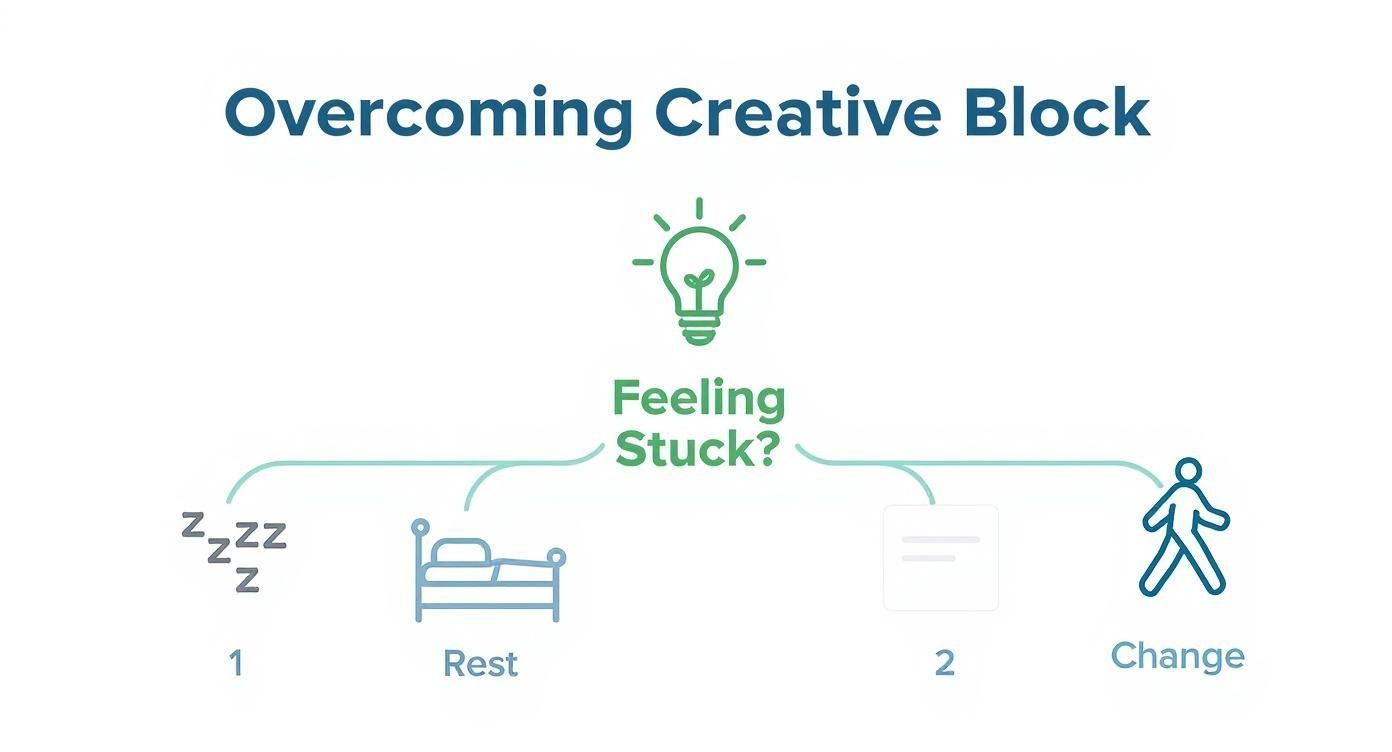
See? The solution is often deceptively simple. If you’re tired, rest. If you’re uninspired, go find some inspiration.
Sometimes, a quick-reference guide is all you need to jolt yourself back into action. Here are some of the most common causes of creative block I've seen, paired with an immediate action you can take.
| Common Cause | Immediate Action |
|---|---|
| Perfectionism Paralysis | Set a timer for 15 minutes and just "doodle." Write nonsense, sketch poorly, or brainstorm terrible ideas on purpose. Lower the stakes to zero. |
| Decision Fatigue | Stop making decisions. Go for a walk without a destination, listen to a random playlist, or ask a friend to pick what you do for the next hour. |
| Information Overload | Unplug completely. No screens, no podcasts, no news. Just sit in silence or do a simple, manual task like washing dishes or folding laundry. |
| Fear of Failure | Reframe the task. Instead of "I have to write this chapter," try "I'm just going to explore this character's motivation for one page." |
| Boredom/Stale Environment | Change your physical location. Work from a coffee shop, a library, or even just a different room in your house. |
| Physical Exhaustion | Take a 20-minute nap or do 10 minutes of light stretching. Sometimes your body just needs a reset. |
This isn't about finding a magic bullet, but about having a few go-to moves when you feel that wall go up. It puts you back in control.
Once you know what trips you up, you can start building habits that make you tougher and more resilient to future blocks. This isn’t about one-time fixes; it's about crafting a sustainable creative practice that works for you. Consistency, for example, is everything if you’re trying to build an audience. (For more on that, you should check out our guide on building a sustainable TikTok presence that actually converts.)
The goal isn’t to never have a creative block again. The goal is to get better at recognizing it early, treating it with kindness, and moving through it faster each time.
By learning your personal patterns, you can build a toolkit of strategies that you know will work. Maybe it’s scheduling non-negotiable breaks into your calendar, keeping a running list of random shower thoughts, or dedicating time to passion projects with zero stakes. These small actions create a powerful foundation, so the next time you feel stuck, you'll have a roadmap instead of just sitting there waiting for lightning to strike.
That soul-crushing feeling of creative block? It feels like an external force, some invisible wall that just popped up out of nowhere. But let's be real—most of the time, the call is coming from inside the house. The block isn't a true lack of ideas; it’s a series of mental traps we've unwittingly laid for ourselves.
The good news? You can absolutely dismantle these barriers by shifting your perspective. This isn’t about chanting hollow “think positive” mantras in the mirror. It's about using some practical, battle-tested mental jujitsu to change how you approach your work and finally tell your inner critic to take a hike.
Self-doubt is a creativity assassin. It turns every task into a high-stakes test you’re probably going to fail. It’s that little voice whispering, "What if this is garbage?" until you're too paralyzed to even start. The trick is to reframe that fear into genuine curiosity.
Instead of staring at a blank page like it’s your final exam, treat it like a mad scientist's laboratory. Start asking playful questions instead of debilitating ones.
Instead of: "Can I possibly write a good headline?" Try: "What are ten of the absolute weirdest, most ridiculous headlines I can come up with right now?" Instead of: "Ugh, will the client even like this design?" Try: "What would this design look like if I used a color palette I personally can't stand?"
This tiny switch turns immense pressure into a fun game. It drops the stakes from a pass/fail grade to a simple "let's see what happens," which gives you the freedom to explore without that constant fear of judgment breathing down your neck.
The goal isn't to nail a masterpiece on your first go. It's to just create something. Anything. When you embrace the messy, experimental, "this might be terrible" phase, you give the good ideas the oxygen they need to actually show up.
Ah, perfectionism. The sneakiest creativity killer of them all. It demands a flawless final product from the get-go, an expectation so unrealistic it’s almost laughable. The best antidote I’ve found is to intentionally, purposefully, create something awful. Seriously. Give yourself explicit permission to make a complete mess.
Let's say you're a designer completely stuck on a new logo. Instead of trying to create the perfect logo, set a timer for 15 minutes and brainstorm the absolute worst logo concepts imaginable. I’m talking clashing neon colors, unreadable fonts, and imagery that makes zero sense.
This little exercise is magic for two reasons:
It shatters the paralysis. It’s pretty hard to be a perfectionist when your stated goal is to be terrible. It actually sparks ideas. You'd be shocked at how often a sliver of a brilliant concept is hiding inside a "bad" idea you never would have allowed yourself to explore otherwise.
Sometimes the problem is just that our brains are too dang loud. An endless stream of to-do lists, anxieties, and random thoughts about what to have for dinner can make it impossible to hear our own creative voice. Mindfulness isn't about achieving some enlightened state of an empty mind; it's just about observing all that noise without getting carried away by it.
Try this before your next work session: a simple five-minute breathing exercise. Just close your eyes and focus on your breath—the physical sensation of air coming in and going out. Your mind will wander. That’s what minds do. When it does, just gently guide your attention back to your breath without beating yourself up.
This small act of mental decluttering creates a pocket of calm in your head. It helps you detach from the frantic panic and approach your work from a place of focused clarity. When you treat creativity like a muscle you can train with these mindset shifts, you build resilience. Soon, those massive walls start to look more like tiny speed bumps.
Ever feel like you're just staring at a blank page, and the only idea in your head is the faint sound of crickets? We've all been there. When you're stuck in a creative rut, the biggest problem is often the echo chamber between your own two ears.
The best escape route? Stop trying to solve it alone. It’s time to bust down the door and invite some people in for a little structured chaos. Collaboration isn't just a corporate buzzword; it's about deliberately engineering those "aha!" moments.

When your personal well of inspiration feels completely tapped out, plugging into the collective energy of a group feels like finding a hidden spring. The vibe instantly shifts from a lonely struggle to a fun, shared exploration.
One of my favorite tricks for shaking things loose is a fantastic little exercise called reverse brainstorming. Forget asking, "How do we make this great?" That question is loaded with pressure.
Instead, get your team together and ask something far more entertaining:
"What are all the ways we could make this project fail spectacularly?"
This simple flip does a couple of brilliant things. First, it kills the pressure to be "right" or "innovative." The goal is to come up with hilariously terrible ideas, which is way more fun and frees everyone up. Second, by mapping out every possible pitfall, you accidentally create a roadmap for success. Each terrible idea shines a spotlight on what a great idea actually is.
Let's say you're blocked on a new marketing campaign. Your team might come up with failure-guaranteed ideas like "use confusing jargon," "make the checkout button impossible to find," or "target people who hate our product." Suddenly, the path forward—clear messaging, a simple user experience, and precise targeting—becomes crystal clear.
The real magic happens when you start mixing up the guest list. Don't just brainstorm with the same people you always do. The key is to get different kinds of brains in the same room.
Grab someone from finance. Their analytical, numbers-first mindset might poke a hole in a creative concept that the rest of the team is too in love with to see. Pull in a customer support rep. They're on the front lines, hearing what customers actually complain about, wish for, and love. That's pure gold. Ask the newest intern. They haven't yet learned "how we do things around here," so their perspective is fresh, unfiltered, and incredibly valuable.
Creating a safe space where no idea is too weird is crucial. You want to build an environment where structured chaos can thrive. It's no wonder that creative block hits around 75% of creative professionals. But the good news is that teams embracing these collaborative sparks can see their creative output jump by as much as 40%.
To keep these sessions from going completely off the rails, you can bring in some modern help. Check out our guide on the top AI tools for content creation to see how they can organize your ideas or even generate a few weird thought-starters to get the conversation going.
By inviting new voices to the party, you turn a lonely roadblock into a collective breakthrough.
We’ve all been there. That paralyzing feeling when you’re staring at a blank page, and every idea feels... meh. It’s not always a true lack of ideas that causes creative block. Sometimes, it’s a crisis of confidence.
You've got a dozen half-baked concepts floating around, but none of them seem good enough to pursue. So you just stop.
The antidote? Good old-fashioned insight. Real confidence doesn't come from a magical lightning strike of inspiration; it comes from grounding your creativity in something solid. Weak insights make you play it safe, and playing it safe is the fastest route to boring, predictable work.
Instead of sitting around waiting for a muse to show up, you need to become a cultural detective. The truly great ideas aren't dreamed up in a vacuum. They’re built by understanding what people are actually thinking, feeling, and talking about right now.
This means you have to get out of your own head and start paying attention.
Dive into Subcultures: Forget mainstream trends for a minute. Go deep into niche communities on Reddit, TikTok, or obscure forums related to your craft. What are their inside jokes? What are the recurring complaints? That's where the good stuff is. Listen to the Language: Pay close attention to the specific words and slang people use. The way they describe their problems and desires is pure creative fuel. This is gold if you're writing copy or lyrics. If you find yourself stuck, our guide has some fun ways to make words rhyme and get your flow back.
Developing this kind of awareness takes serious focus. You have to shut out the noise and really listen. It can be a challenge, so it helps to learn how to keep focus on work and master your attention.
It’s one thing to see what's happening out there; it's another thing entirely to act on it. So many creators and brands are just too slow to connect with cultural moments, leaving them stuck on the sidelines while others innovate.
A recent report exposed a huge confidence gap: only 13% of companies feel they are "creative risk-friendly." Even more telling, half admit their insights are too weak to support bold ideas, and a staggering 57% of brands can't react quickly to cultural shifts. You can read the full research about the state of creativity in 2025.
This hesitation is exactly where creative block thrives.
When you’re armed with sharp, relevant insights, you have the proof you need to back up your wildest ideas. You’re no longer just taking a shot in the dark—you're making a calculated, creative leap based on real-world evidence.
Make cultural research a habit. Build a deep well of knowledge you can draw from anytime. The next time you feel that dreaded block coming on, you won't be starting from zero. You'll be starting from a place of power, ready to turn what's happening in the world into creative gold.
Let's be real for a second. Sometimes, that creative block you're feeling isn't some mystical artistic crisis—it's your brain’s equivalent of a flashing "check engine" light. It's a symptom of operational chaos.
When your workflow is a dumpster fire and your team is stretched thinner than a sheet of tracing paper, creativity is always the first thing to go. So, think of this less as an inspiration problem and more as a logistics problem screaming for a fix. You can't come up with brilliant ideas when you spend all day putting out fires.
By treating your creative process like a system you can actually tune up, you build a powerful defense against burnout. This isn't about boxing yourself into a rigid, soul-crushing routine. It's about building a sturdy container where your best ideas can actually thrive instead of getting steamrolled by preventable stress.
A messy, unpredictable workflow is a major source of creative friction. If nobody knows who’s doing what, when it’s due, or where the heck the latest file version is, all that precious energy gets wasted on confusion, not creation. The goal here is simple: bring some clarity and predictability to the process so everyone can just focus.
First, map out your current process from the initial idea to the final "ship it!" moment. Pinpoint the bottlenecks. Is it the vague briefs? The never-ending review cycles? Once you can see where things get stuck, you can start to un-stick them.
A few small changes can have a massive impact:
Standardized Briefs: Create a single, mandatory template for every new project. This simple step ensures creatives get all the info they need from the jump, cutting out that frustrating back-and-forth. Defined Roles: Make it crystal clear who owns each stage. When people know what they're responsible for, tasks stop falling through the cracks and decision fatigue plummets. Centralized Assets: Pick one place for all project files and stick to it. Wasting 30 minutes hunting for a logo is the fastest way to kill a creative vibe.
These aren't sexy fixes, but they work. They declutter the mind, freeing up valuable brainpower for the work that actually moves the needle.
By optimizing your operations, you’re not just managing projects better—you’re actively protecting your team’s most valuable resource: their creative energy. It's a proactive strategy to keep the well of ideas from running dry.
The demand for new content is absolutely relentless. Creative teams that were once a scrappy handful of people are now managing dozens of contributors, which sends the risk of overload through the roof. As more brands bring creative work in-house for more control, figuring out how to manage this scale is no longer optional. You can learn more about how creative operations are evolving right here.
Your best defense is smart resource management. Overloading your top performers is a guaranteed recipe for burnout and a team-wide creative drought. You need a clear, honest view of who has the bandwidth for new work and who is already red-lining.
Even simple project management tools can give you this visibility, helping you spread the workload more evenly. And seriously, don't be afraid to push back on unrealistic deadlines or "urgent" requests that aren't actually urgent. Protecting your team's time is a non-negotiable part of the job.
A focused, well-rested team will always outperform a frantic one. This also frees you up to spot smart wins, like exploring different content repurposing strategies to squeeze more value out of one great idea without having to start from zero every single time.
Alright, so you’ve got the toolkit. You have the strategies. But let's be real—creative block is a slippery beast, and sometimes you just need a straight answer to a specific question. It’s not always a clear-cut problem, and what works today might feel useless tomorrow.
Let's dive into some of the most common questions I hear from fellow creatives who are stuck in the mud.

Think of this as your personal cheat sheet for those moments when you feel like you're yelling into the void.
This is a big one, because mistaking one for the other is like trying to fix a flat tire with more gas. They feel similar, but the root cause is totally different. The real tell is your desire to create.
Creative Block: You’re sitting at your desk, wanting to make something cool, but your brain is serving up nothing but static. You’re frustrated, maybe even a little desperate, but the spark of motivation is still in there somewhere. It’s like the engine is on, but you’re stuck in neutral. Burnout: You couldn't care less about creating. The very thought of opening that laptop or picking up that brush feels exhausting. You’re detached, drained, and have zero drive to even try.
A block is usually tied to a specific project or task. Burnout, on the other hand, is a deep, soul-level exhaustion that infects everything. If you think it's burnout, the answer isn’t another productivity hack—it's genuine, serious rest.
Ah, the million-dollar question. And the brutally honest answer? It depends. A minor snag could clear up in an hour. A more stubborn block, especially one tangled up with stress or burnout, might hang around for weeks, maybe even months.
Here's the secret: the duration doesn't matter nearly as much as how you react to it. Instead of just sitting around and waiting for inspiration to strike, get proactive. Try the techniques we've talked about—go for a walk, feed your brain something new, switch up your workspace.
The goal isn't to become immune to blocks. It's to get so good at navigating them that they feel less like a dead end and more like a detour.
It’s a classic dilemma. My rule of thumb? Try a gentle nudge first.
Set a timer for 15 minutes. That's it. For those 15 minutes, just mess around with no expectations. Scribble, write absolute garbage, try the "worst idea first" game. The simple act of doing something can sometimes be enough to jolt your brain back online.
But if that gentle push feels like you’re punching a concrete wall, then it's time to stop. Seriously. Your brain is waving a white flag. Forcing it now will only make things worse, digging you deeper into a frustration pit. Step away. Go for a walk, wash the dishes, call a friend. Your breakthrough will often arrive the second you stop looking for it.
Look, feeling stuck is part of the creative process, but you don't have to stay there. The AI tools at SendFame are designed to be your creative defibrillator. Need a weird song concept, a wild image, or a hilarious celebrity message to shake an idea loose? We've got you.
Stop staring at that blank page. Break through the block and start creating again in seconds at https://sendfame.com.
Create Epic

SendFame

Create Epic with SendFame!
Questions: info@sendfame.com