7 Unforgettable Personalized Corporate Gift Ideas for 2025

personalized corporate gift ideas
Welcome offer — 56% OFF


Discover the world of AI voice actors. This guide explains how synthetic voice technology works, its uses, the ethics, and how to create amazing audio content.
Forget everything you know about those clunky, robotic voices from old GPS systems. AI voice actors are something else entirely—they're synthetic voices, crafted by artificial intelligence, that can read scripts with genuine, human-like emotion and intonation.
Think of them as a powerful, incredibly fast, and always-available alternative for creating professional-grade audio for just about anything you can dream up, from marketing videos to a personalized birthday shout-out.
We're in the middle of a creative revolution, one where your best ideas can find their voice in a matter of seconds. The world of AI voice actors isn't about replacing human talent; it's about amplifying it. It’s about giving everyone—marketers, indie game devs, YouTubers, you name it—the kind of tools that used to be locked away in expensive recording studios.
This guide is your all-access pass to this exciting new world. We're going to pull back the curtain on the tech behind text-to-speech and voice cloning, showing you just how easy it is to bring incredible speed and personalization to your projects.
The real game-changer has been the leap from monotone, robotic narration to fluid, emotionally rich performances. Early text-to-speech (TTS) systems could get the words out, but they had zero soul. Today’s AI models are worlds apart. They're trained on massive datasets of human speech, which allows them to understand and replicate the nuances that make a voice feel real.
Emotional Inflection: They can deliver a line with genuine happiness, a touch of sadness, or pure excitement. Pacing and Pauses: The AI knows how to use timing to build suspense or land a punchline, just like a seasoned actor. Unique Cadences: They capture the subtle rhythms and flows of speech that make a voice sound authentic and keep you listening.
This massive jump in quality is fueling an industry explosion. The global AI voice generator market, currently valued at around USD 4.9 billion, is on a rocket ship trajectory, projected to hit over USD 54 billion by 2030. That kind of growth tells you this isn't just a gimmick; it's a technology with serious real-world value.
The true magic of AI voice actors is how they open up the playing field. A solo creator can now produce a multi-character audio drama, a global brand can localize an ad campaign in dozens of languages, or a game developer can prototype dialogue—all from a single laptop.
To really get a feel for where this technology shines, it helps to see a side-by-side comparison. This table breaks down the core differences between AI voices and their human counterparts.
| Attribute | AI Voice Actors | Traditional Voice Actors |
|---|---|---|
| Speed | Near-instantaneous audio generation | Can take days or weeks for recording and editing |
| Cost | Low, often subscription-based | Higher, based on per-project or hourly rates |
| Scalability | Easily produce massive volumes of audio content | Limited by the actor's time and availability |
| Consistency | Perfect consistency across all recordings | Performance can vary slightly between takes |
| Emotional Nuance | Can simulate a wide range, but may lack deep subtlety | Delivers authentic, deeply nuanced human emotion |
| Revisions | Simple and immediate; just edit the script | Requires re-booking sessions, adding time and cost |
| Originality | Can create unique voices or clone existing ones | Each actor brings a unique, inimitable voice and style |
While human actors will always be the gold standard for projects demanding deep emotional complexity, AI offers an unbeatable combination of speed, cost-effectiveness, and scalability for a massive range of applications.
As we dive into this new audio frontier, it's clear that voice is just one piece of the puzzle. The landscape of the best AI tools for content creators is bigger and more exciting than ever. So get ready to step into the director's chair and discover how you can craft incredible audio with stunning realism and efficiency.
Ever wonder how a line of text gets turned into a rich, emotional vocal performance? It’s not magic, but it’s pretty close. The whole process is a fascinating journey that transforms simple words into a voice that can captivate an audience. At the heart of almost all AI voice actors is a technology called Text-to-Speech (TTS).
You probably remember the old-school TTS systems. Think of them as a meticulous librarian with a huge dictionary of phonetic sounds. When you fed it a script, it would look up each word, grab the corresponding sound file, and stitch them all together. It worked, sure, but it's why old GPS voices sounded so choppy and, well, robotic.
Today’s AI voices are a different breed entirely. They run on neural networks—complex systems modeled after the human brain—to power what's known as neural TTS. Instead of just playing back pre-recorded sound bites, these networks have been trained on massive libraries of human speech. They've learned the rhythms, patterns, and subtle inflections that make a voice sound genuinely human.
So, how does an AI actually learn to talk? It’s a multi-stage process where raw data is sculpted into a believable vocal performance. The system doesn't just read words; it learns context, emotion, and timing from the ground up.
This whole learning process is built on a field of AI you’ve likely heard about. If you want to dive deeper into the basics, our guide on machine learning for beginners is a fantastic place to start. The main idea is that the AI isn't just following a rigid set of rules; it's discovering them on its own by listening.
Three key technologies make this all happen:
Text-to-Speech (TTS): This is the foundational engine that turns a written script into audible speech. Modern neural TTS models can actually predict how a sentence should sound based on context, punctuation, and even subtle emotional cues. Voice Cloning: This takes TTS a step further into the uncanny valley. By analyzing a small audio sample of a specific person's voice, the AI can build a digital replica that can say anything in that unique voice. It’s not just mimicking—it’s capturing the pitch, timbre, and cadence that makes a voice one-of-a-kind. Generative AI Models: These are the creative brains of the whole operation. Instead of just gluing together existing sounds, they generate brand-new, original audio waveforms from scratch. This is exactly why modern AI voices sound so smooth and don't have those weird robotic artifacts of the past.
The real game-changer was applying deep learning to the problem. Neural networks are able to process both text and audio simultaneously, letting them figure out the intricate relationship between words on a page and the subtle ways we speak them out loud.
For instance, the AI learns that a question mark at the end of a sentence means the pitch should rise. It understands that an exclamation point probably calls for a bit more energy and volume. This knack for context is what separates a sterile, robotic reading from a genuine performance.
Instead of just converting text to sound, neural TTS generates the sound itself. It’s the difference between a musician playing notes from a sheet and a composer creating an original melody—one follows instructions, while the other creates something entirely new.
This handy map breaks down the core benefits this technology brings to the table for creators.
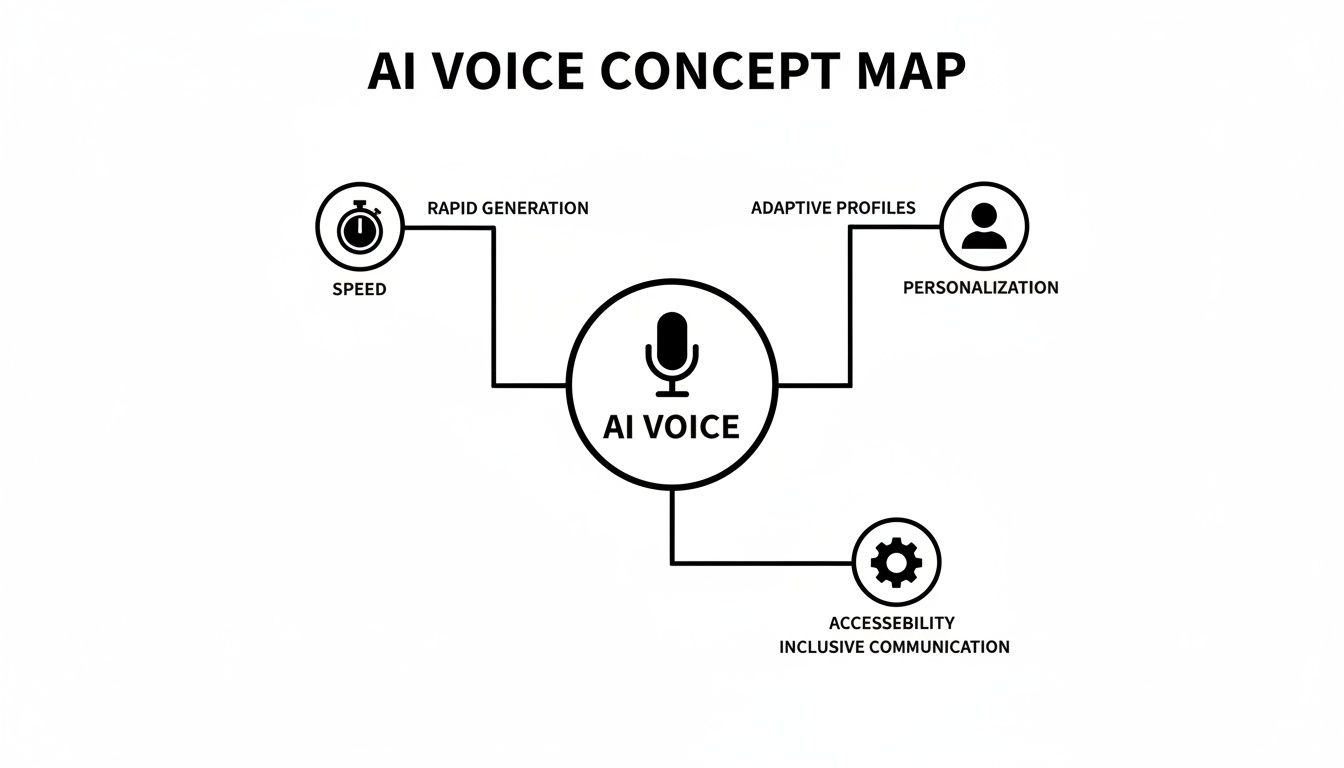
As you can see, AI voice tech delivers a powerful mix of speed, personalization, and accessibility for just about any project you can dream up. This same core technology is also the engine behind other amazing tools. To really get the full picture, check out how AI video translator technology works; it offers a great look into how speech is analyzed and re-synthesized across different languages. By connecting these dots, you can see just how versatile and powerful modern voice AI has become.
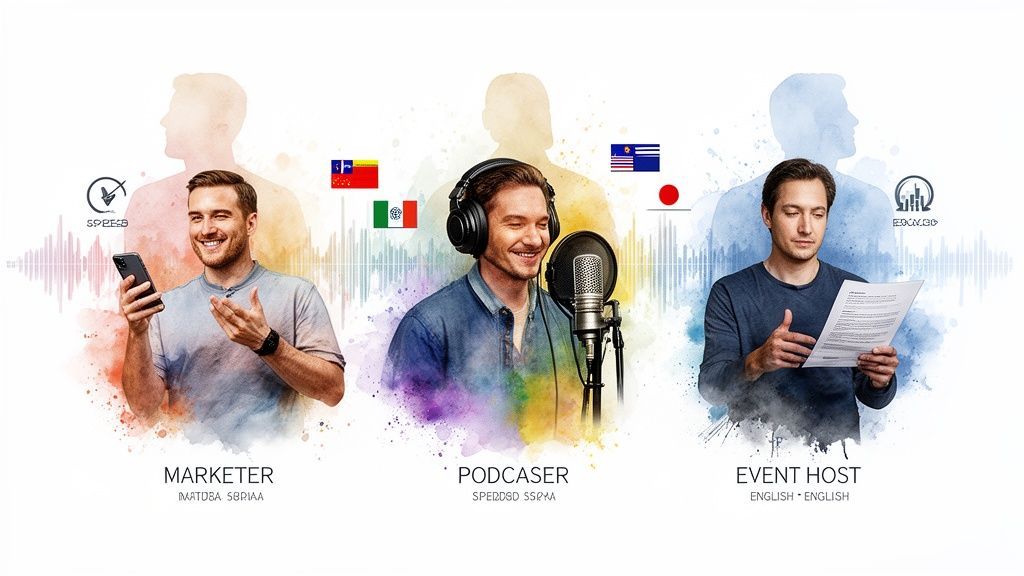
Alright, we’ve peeked under the hood at the tech. Now for the fun part: seeing what AI voice actors can actually do in the real world. This is where theory gets thrown out the window and we see how these tools are solving real, everyday problems for everyone from solo creators to massive global brands.
Let's be honest, most creative projects hit the same old walls: sky-high costs, agonizingly slow production timelines, and the logistical headache of trying to wrangle human talent. AI voices offer a surprisingly elegant way to sidestep these issues, often unlocking more creative freedom in the process.
Picture this: you're a marketer at a booming e-commerce company. You've just launched a video ad that’s absolutely crushing it in your home market. The next logical step is to take it global, but that means translating and re-recording the ad for a dozen different countries.
Historically, this is where campaigns grind to a halt. You'd have to find, hire, and direct twelve different voice actors, praying each one captures the original tone. The budget would balloon, and the turnaround time could drag on for weeks, killing your momentum.
This is exactly where AI voice actors become a marketer’s secret weapon.
Go Global in an Instant: Forget the drawn-out casting calls. You can generate top-notch voiceovers in a handful of languages in the time it takes to grab a coffee. This lets you test new markets at a speed that was unthinkable just a few years ago. Keep Your Brand's Vibe: You can use a single AI voice model that speaks multiple languages, which is huge for keeping your brand’s personality consistent no matter where you are in the world. Personalize Everything: Need to crank out 50 versions of an ad, each with a different city name or a unique promo code? AI can do it in minutes. Trying that with a human actor would be a logistical and financial nightmare.
This knack for producing localized content at scale is fueling a massive boom. The global AI voiceover market, currently valued at USD 5.4 billion, is expected to rocket to USD 36.43 billion by 2032. This explosion is being driven by industries like advertising and e-learning that need fast, flexible audio solutions.
Now let's think about a YouTuber or a podcaster. You've written a brilliant script for your next documentary-style video, but let's face it, your own narration sounds a bit... amateur. Hiring a professional for every single episode drains your budget, and trying to schedule studio time is a constant battle.
AI voice actors give you a powerful studio right on your laptop. You can find that perfect voice for your brand—whether it’s a deep, authoritative narrator or a quirky, upbeat host—and use it consistently across all your content. And when you spot a typo in the script at the last minute? No need to re-book anyone. Just fix the text and hit "generate" again.
The biggest win here is total creative control. You're the director. You can play with different voices, tweak the pacing, and adjust the tone until the audio is exactly how you heard it in your head, all without ever leaving your desk.
This freedom opens the door to bigger, bolder projects. You could produce an entire audio drama with a full cast of distinct AI character voices—a feat once reserved for big-budget production studios.
This isn't just about ads and videos. Think about planning a huge corporate conference or even just a milestone birthday bash. You want your announcements and invitations to have some real punch.
Instead of a boring, forgettable email, what if every attendee got a personalized video message from a celebrity sound-alike, welcoming them to the event? Or imagine a famous historical figure's AI-generated voice acting as the emcee for an awards night. It’s these kinds of unique touches that create experiences people actually remember and talk about.
AI voices make these "wow" moments completely doable on a normal budget. You can whip up custom audio for all sorts of things:
Event Announcements: Use an energetic, booming voice to build some serious hype. Personalized Greetings: Record custom welcome messages for VIPs, speakers, or special guests. Interactive Phone Menus (IVR): Ditch the robotic system and create a fun, on-brand menu for your event hotline.
Ultimately, the only limit is your imagination. What used to be a standard piece of communication can now be a genuinely creative and memorable part of the experience.
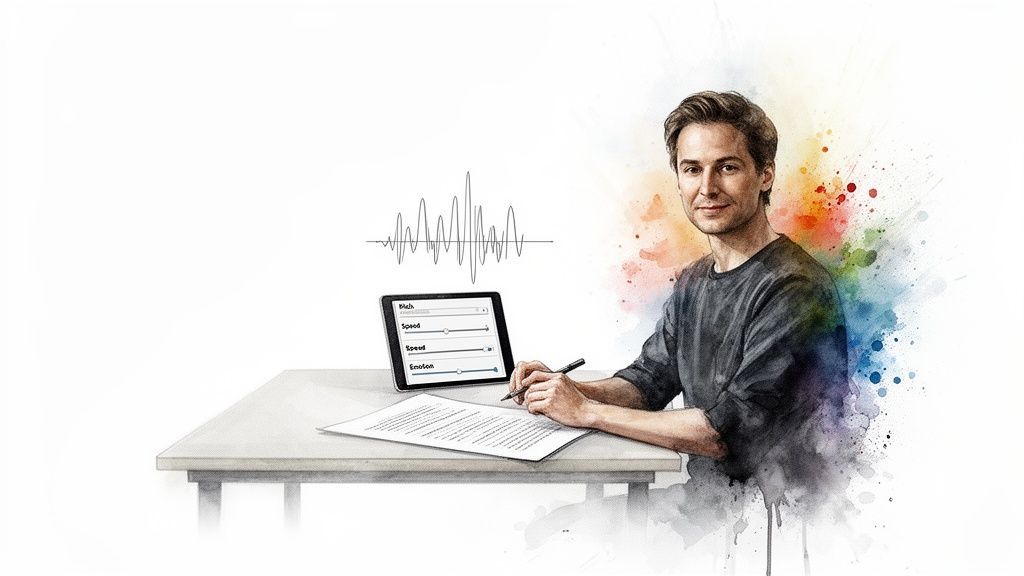
Just dropping a wall of text into an AI voice generator and hitting "go" is like handing an Oscar-winning actor a script with no direction. Sure, you'll get the words out, but you’ll miss all the magic. To really get a performance that sizzles, you need to put on your director’s hat and guide your AI voice actor with a bit of finesse.
Don't worry, this isn't about learning to code or becoming a sound engineer overnight. It’s all about learning how to talk to the AI through your script and a few simple controls. A few smart tweaks can be the difference between a flat, robotic read and a polished, professional performance that actually connects with people.
Everything starts with the script. When you're writing for an AI, you have to be painfully, wonderfully clear, because the machine takes everything you write literally. Think of your script as a direct line to your digital talent—every comma, every period is a stage direction.
Punctuation is your secret weapon for controlling pace. A comma is a little breath, a quick pause. A period is a full stop, a moment to let a thought land. And an ellipsis…? That’s how you build drama, creating a longer, more thoughtful beat in the delivery.
You can even get creative with spelling to nail tricky words. If the AI keeps tripping over a brand name or a bit of jargon, just spell it out phonetically. For instance, if the AI can’t pronounce "Loughborough" correctly, feeding it "Luff-bur-oh" in the script will get it right on the money.
Choosing a voice is easily the most important decision you'll make. It sets the whole mood. Don't just scroll through and pick the first one that sounds nice. Close your eyes, really listen, and ask yourself a few questions:
Does this voice feel like my brand? If your brand is a trusted authority, you probably don’t want a bubbly, upbeat voice. The voice should be an authentic snapshot of your company’s personality. Is it easy to listen to? Pay attention to how clear the enunciation is. A mumbly or overly breathy voice will have your audience tuning out in seconds. Does it sound… human? Listen for any leftover robotic twang or weird intonations. The best AI voices are the ones you’d never guess were AI.
Here's a simple way to think about it: You wouldn't cast a deep, booming voice for a lullaby app, and you wouldn’t use a soft, gentle narrator for a high-energy car commercial. Context is king, and the right voice makes your message hit home instantly.
Okay, you've got a killer script and the perfect voice. Now it's time for the fun part: fine-tuning the delivery. Most of the top-tier AI voice platforms give you a control panel to dial in the performance with surprising precision.
Pitch: A tiny tweak to the pitch can add a sense of authority or, conversely, a touch of warmth and excitement. Lowering the pitch can convey seriousness, while nudging it up can signal energy. Speed: This is all about pacing. Need to get people hyped for a flash sale? Crank up the speed. Explaining a complex idea? Slow it down to give people time to process. Emphasis: The best tools let you highlight certain words or phrases that you want the AI to punch. This is absolutely critical for making sure your most important points land with real impact. Pauses: Don't just rely on commas and periods. You can manually insert pauses of a specific length (say, 0.5 seconds) to create a more natural rhythm and let powerful statements really sink in.
Getting a fantastic performance from an AI voice isn't about luck; it's about being a good director. This little checklist can help you guide your digital actor every step of the way.
| Technique | Description | Example |
|---|---|---|
| Phonetic Spelling | Spell out tricky words the way they sound to guarantee perfect pronunciation. | Instead of "Segue," write "Seg-way." |
| Strategic Punctuation | Use commas, periods, and ellipses to master the natural flow and rhythm of speech. | "Wait... are you kidding?" lands with more punch than "Wait, are you kidding?" |
| Parameter Adjustments | Use the platform's sliders and controls to tweak speed, pitch, and volume for emotional tone. | Bump up the speed and pitch slightly to make a promotional voiceover sound more exciting. |
Once you start using these simple directorial tricks, you'll stop being someone who just uses an AI voice tool and become someone who truly creates with it. You’re not just generating audio anymore—you’re crafting a performance.
Let's be honest: the rise of AI voice actors has kicked up a storm of complicated ethical questions. This isn't just about cool new tech. It's a full-blown conversation about identity, creativity, and who gets to control a person's voice in a world where everything can be copied. The most obvious starting point is the fear many human voice actors have about their jobs, and that’s a very real concern.
But the rabbit hole goes much deeper than just economics. Voice cloning technology throws a massive spotlight on consent and intellectual property. Think about it: what happens when someone's unique vocal fingerprint is lifted and used to make them say things they never actually said? This isn't some far-off sci-fi scenario; it's a real problem, right now.
The legal system is scrambling to keep up. As it stands, there's no single, clear-cut federal law in the U.S. that says, "You can't clone someone's voice." This has led to a messy quilt of state-level laws, leaving both creators and actors navigating a confusing gray zone. We're already seeing lawsuits where voice actors claim their recordings were used to train AI models in ways that blew right past their original contracts.
These legal fights expose a core problem. Traditional copyright law protects a specific recording—the final WAV or MP3 file—not the fundamental voice that created it. This is why many are now pushing for stronger "right of publicity" laws, which are designed to protect a person’s name, image, and likeness from being commercially exploited without their permission.
At the end of the day, it all boils down to consent. Ethical AI platforms are built on a bedrock of getting explicit permission and providing fair pay to the voice talent who make their models possible. Anything less isn't innovation—it's just exploitation.
The conversation gets even more serious when we wade into the territory of deepfakes and misinformation. The same tool that can create a hilarious celebrity-impersonated birthday message can be twisted to pump out malicious audio clips designed to spread lies or destroy a reputation. This puts an immense amount of responsibility squarely on the shoulders of the companies building and hosting these tools.
The good news is that the industry leaders are taking this seriously. They're fighting back by:
Enforcing strict usage policies that outright ban creating harmful, deceptive, or defamatory content. Demanding clear consent from any person whose voice is cloned for their library. Building in technical safeguards to stop the tech from being used for political hit jobs or targeted harassment.
For any creator looking to use AI voices, picking a platform that lives and breathes these ethical rules is non-negotiable. The convenience of a cool tool should never, ever trump integrity. Our guide on celebrity text-to-speech technology goes deeper into why using only authorized and ethically sourced voices is so crucial for your projects.
While the worries are completely valid, the whole "AI vs. Human" narrative is a bit too simplistic. It's more helpful to think of this as the beginning of a new, hybrid creative ecosystem. Despite the explosion of AI tools, the market for traditional dubbing and voice-over work is doing just fine—in fact, it’s valued at over USD 3.5 billion and is expected to more than double by 2033. You can dig into the dubbing market's continued growth yourself to see the projections.
What does this tell us? It says that the demand for authentic, emotional human performances in high-stakes projects is as strong as ever. AI voices are carving out a niche as the perfect solution for high-volume, scalable work—think thousands of e-learning modules or countless variations of a digital ad. Meanwhile, human actors will continue to be the go-to for roles that require that irreplaceable spark of nuanced, human emotion. This isn't a hostile takeover; it's a rebalancing of the creative world, opening up new kinds of work for everyone.
Alright, enough with the theory. The real magic happens when you actually start creating. So, let’s roll up our sleeves and walk through your first project with an AI voice actor. You’ll see just how easy—and fun—it is to bring an idea to life.
We're going to start with a classic: a personalized celebrity birthday message. It’s the perfect way to get your feet wet and see what this technology can do without getting tangled up in technical stuff. With a tool like SendFame, the whole process is ridiculously straightforward.
First up, the fun part: casting your talent! Forget scrolling through headshots and agent listings. Here, you're browsing a library of AI voices and personas to find the one that just clicks for your message.
Who's it going to be? A silver-screen legend from Hollywood's golden age? A modern pop icon? Maybe even a famous figure from history? Each choice has its own vibe. Just think about who’s getting the message. Would your friend get a bigger kick out of a warm, heartfelt greeting from a classic actor or a high-energy shout-out from a chart-topping singer?
Once you've made your pick, it's time to write the script.
This is where you step into the director's chair. Writing for an AI voice is pretty simple, but a few little tweaks can make all the difference between a good performance and a great one.
Here’s a quick-and-dirty recipe for a birthday message they'll never forget:
Nail the opener. You need to grab their attention right away. A simple "Hey [Name], it's [Celebrity Name] here!" is a classic for a reason. Make it personal. This is the secret sauce. Drop in an inside joke, a shared memory, or a nod to something they just accomplished. That’s what makes it feel real. Keep it conversational. Write the way people actually talk. Use simple language and short sentences. Your punctuation is your best friend for controlling the pace. End with a punch. Wrap it up with something warm and clear, like, "Have an amazing day and celebrate in style!"
Remember, the AI takes your script literally. A well-placed exclamation point pumps up the energy. An ellipsis (...) creates a perfect dramatic pause. Think of it as giving your AI actor direct stage directions right in the script.
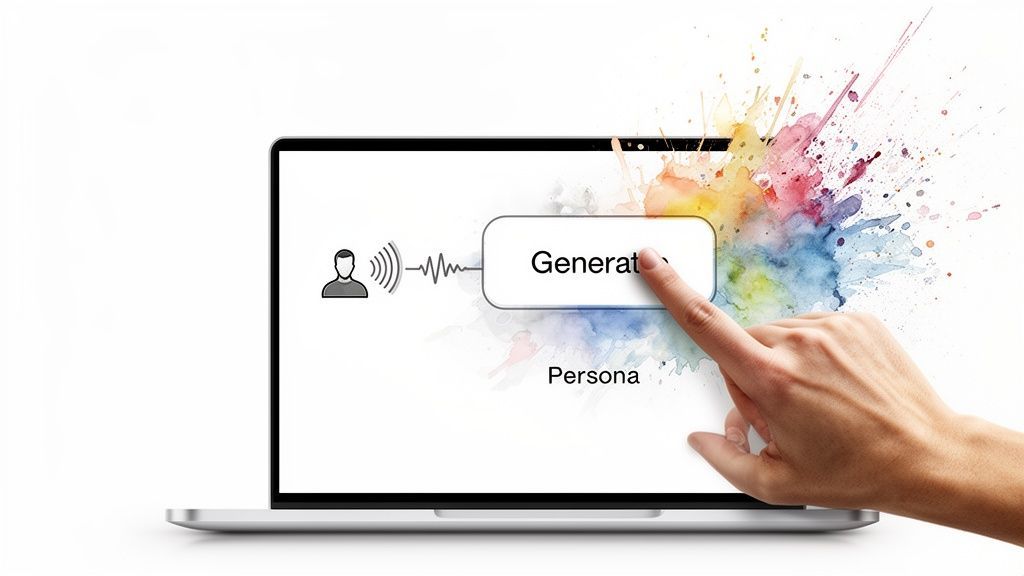
You’ve picked your star and polished your script. The final step is almost comically easy. On a platform built for this, there's no messing with audio engineering or complicated rendering settings. You just hit a button.
The AI instantly gets to work, turning your text into a fully produced audio or video file, complete with the voice and likeness of your chosen celebrity. In just a few seconds, you have a polished, totally personalized birthday message ready to send. That one-click process gets all the technical hurdles out of your way so you can just focus on being creative.
Ready to see for yourself? You can create your first text-to-speech project right now and get a feel for the power you're wielding. This little project is just scratching the surface of what’s possible when you have a full cast of digital talent waiting for your command.
The world of AI voice actors is moving at a breakneck pace, and if you’ve got questions, you’re not alone. It feels like every week there’s a new development. So, let’s cut through the noise and tackle some of the biggest questions creators and businesses have about this tech.
Think of this as your cheat sheet. We'll cover everything from legal stuff to whether a robot can actually sound happy.
This is the million-dollar question, isn't it? The short answer is: yes, but only if you stick with an ethical platform. The legal system is still playing catch-up with voice cloning technology. In the U.S., there's no single federal law protecting a person's voice, which has created a messy patchwork of state laws and high-profile lawsuits.
Some companies have landed in hot water for allegedly training their AI on actors' voices without getting the right permissions. To keep your project safe and your conscience clear, you absolutely have to choose a service that can prove it has the rights and consent for every single voice it offers. The last thing you want is for your project to be at risk because you accidentally used an unauthorized voice clone.
You bet. We’re way past the era of that flat, robotic voice you hear in old sci-fi movies. Today's neural TTS models are trained on mountains of human speech, which means they learn all the little things that make a voice sound real—the excitement in an ad, the serious tone in a documentary, or the warmth in a friendly message.
The AI isn’t just reading words off a page; it’s interpreting the context behind them. It knows an exclamation point means more energy is needed, and a question mark requires a change in inflection. You can even act as the director, adding notes to your script or tweaking settings like speed and pitch to nail the exact emotional delivery you’re after.
This is a huge concern, and a valid one. But the future is looking less like a robot takeover and more like a collaboration. It’s not a battle of AI versus humans; it’s about a new creative toolkit where both have a role to play.
AI is an absolute beast for jobs that demand speed and scale. Need to generate 5,000 personalized ad reads? Or translate an entire e-learning course into 20 languages overnight? AI is your best friend.
But for those top-tier projects that need a truly unique, deeply nuanced performance—we're talking lead roles in animated blockbusters or emotionally charged audiobooks—human actors will always be the heart and soul of the craft. In fact, the traditional voice-over market is still growing, which suggests AI is carving out its own new space rather than just paving over the old one.
Ready to direct your own cast of digital stars? With SendFame, you can create stunning, personalized content with AI voice actors in just a few clicks. Bring your creative vision to life today at https://sendfame.com.
Create Epic

SendFame

Create Epic with SendFame!
Questions: info@sendfame.com