The 12 Best AI Video Generator Free Tools of 2025
ai video generator free
Welcome offer — 56% OFF


Learn how to create engaging social media content that captivates audiences. Unlock pro strategies, visual tips, and AI workflows to elevate your brand.
Look, before you even think about what to post, you have to get your strategy straight. Creating awesome social media content that actually works boils down to a clear plan built on three core ideas: knowing your audience inside and out, setting goals that matter, and spying on your competition.
This isn't just busywork. It's the foundation that stops you from just shouting into the void and helps you build a real, engaged community. It’s the difference between guessing and knowing what will land.
Posting on social media without a strategy is like trying to build a house without a blueprint. Sure, you can throw some walls up, but you'll probably end up with a crooked, leaky shack nobody wants to visit.
The same goes for your content. Just "winging it" is a recipe for burnout and mediocre results. A solid plan is your secret weapon for creating content that consistently hits the mark. This planning stage isn’t about getting bogged down in boring spreadsheets; it's about asking the right questions before you ever hit publish.
Forget basic demographics like age and gender. To create content that feels like a magnetic pull, you need to understand your audience on an almost personal level. Think of it like a detective building a profile of their ideal follower.
What keeps them up at night? What are their secret ambitions? What stupid meme format makes them laugh out loud? Answering these questions is how you go from creating generic junk to content that feels like it was made just for them.
Their Pain Points: What’s a daily frustration you can help them with? A fitness brand shouldn't just post workout routines; it should talk about the struggle of finding time to work out in the first place. Their Aspirations: What are their biggest dreams? A financial advisor gets way more traction talking about the feeling of financial freedom than just rambling about investment tips. Their Content Diet: What other accounts are they obsessed with? Looking at their favorite creators shows you the exact styles, tones, and topics they already love.
"Engagement" is one of those fluffy buzzwords that means nothing without context. You need to decide what specific actions you actually want people to take. If you don't define success, how can you measure it?
Not every post needs to go viral. Sometimes a small, meaningful interaction is a thousand times more valuable.
For example, what's your primary goal?
Sparking Conversation? Then you live and die by the comments section. Driving Website Traffic? Your north star metric is link clicks. Building Authority? You’re chasing post saves and shares. Generating Leads? You need to be tracking form submissions from your social campaigns.
Setting these crystal-clear goals for your content will guide every decision you make, from the hook you write to the call-to-action you slap on at the end.
Checking out what your competitors are doing isn't about copying their work. It's about finding patterns, spotting their weaknesses, and swooping in on the opportunities they’ve completely missed.
Look at their best-performing posts. What topics are blowing up for them? More importantly, what questions are their followers asking in the comments that are going completely unanswered? That right there—that’s your opening.
This simple flow shows you how to build a powerful social content strategy, starting with your audience and ending with a sharp eye on the competition.
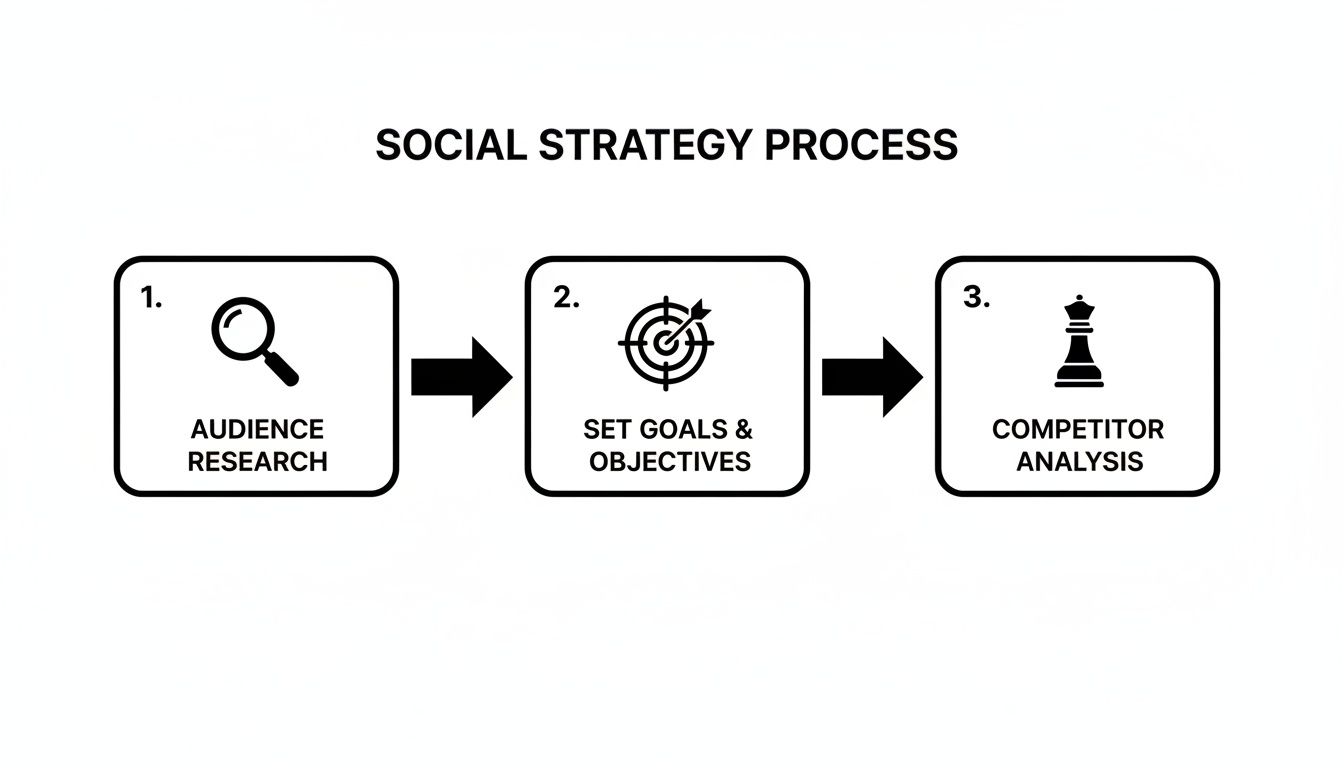
Here's the thing: all these steps feed into each other. Knowing your audience helps you set smarter goals, and watching your competitors helps you find a unique angle to achieve them. As you sketch out your blueprint, getting familiar with the principles of effective social media marketing is a huge leg up.
You can also put this whole process on easy mode by checking out the top 12 AI tools for social media marketing that help with everything from brainstorming ideas to analyzing the data. With a real strategy in place, you’re finally ready to stop planning and start creating.
You’ve got about three seconds. That's it. That’s the entire window you have to stop someone's thumb mid-scroll and pull them into your world. If you can’t win that battle, nothing else matters.
It all boils down to the hook—that first line, that opening shot, that initial sound that makes someone jolt to a halt. A great hook doesn't just politely ask for attention; it grabs it by poking at a powerful emotion or sparking a wildfire of curiosity.
Think about it. When did a post last truly stop you? I’m willing to bet it wasn’t a generic "Happy Friday!" message. It was probably something that rattled your assumptions, made a claim so bold you had to see if they could back it up, or asked a question that your brain couldn't just ignore.

So, how do you crank out hooks that actually work, time and time again? It’s not some dark art. It’s about understanding a little bit of human psychology. We’re all wired to pay attention to things that are surprising, controversial, or speak directly to our biggest headaches.
This means every killer hook you write needs to do one of these three things, and do it fast:
Challenge a Belief: Kick things off with a statement that flips conventional wisdom on its head. A hook like, "Stop setting goals if you actually want to succeed," is infinitely more magnetic than "Here's how to set better goals." Promise a Solution: Get right to the point by addressing a pain your audience knows all too well. Something like, "This is the exact script I use to land 5 new clients a week on LinkedIn" is a direct lifeline to a struggling freelancer. Create a Knowledge Gap: Pose a question or make a statement that makes people feel like they’re missing out on a secret. "You're probably using your air fryer all wrong" works every time because it creates an instant itch that needs to be scratched.
Key Takeaway: The best hooks don't just introduce your content; they trigger an immediate emotional reaction. You need to make your audience feel something—intrigue, disbelief, validation—in that very first second.
A slick hook is useless without a solid idea behind it. But just sitting and staring at a blank screen, waiting for inspiration to strike? That's a recipe for burnout. The pros build a repeatable system for coming up with ideas that truly matter to their audience.
One of my favorite methods is what I call Pain Point Brainstorming. Grab a notebook (or open a new doc) and just brain-dump every single problem, frustration, and minor annoyance your ideal customer deals with. Don't censor yourself. Write it all down.
If you were a fitness coach, your list might look something like this:
"I have zero time to work out." "Healthy food is way too expensive." "I feel so awkward and judged at the gym." "My motivation completely fizzles out after a week."
See? Each one of those is a goldmine. You can now build content that directly solves these problems, making your feed not just marketing, but an indispensable resource. The real trick is learning how to structure these ideas so they have the best chance to take off, which is the entire science behind how to create viral content.
Let's be honest, dreaming up killer hooks and concepts day in and day out is exhausting. This is where AI tools can become your secret weapon—not to replace your creativity, but to amplify it. Think of it as a creative partner that never gets tired.
The key is to stop giving AI vague prompts like "give me post ideas." You have to be the strategist. Treat the AI like a junior copywriter who needs clear, sharp direction to do their best work.
For instance, you could use a tool like SendFame to do more than just brainstorm; you can execute an entire concept. Imagine generating a video where an AI-powered celebrity avatar calls out a specific problem your audience has.
Here’s a quick prompt workflow I’d use with an AI assistant:
Define the Core Problem: "My audience is full of remote workers who feel unproductive and unfocused at home." Request Hook Formulas: "Give me 10 scroll-stopping hooks for this pain point using the 'Unpopular Opinion' and 'Problem-Agitation' frameworks." Generate a Script: "Perfect. Now take the best hook—'Your WFH routine is secretly killing your focus'—and write a 30-second video script for an AI celebrity to deliver. Make the tone empathetic but direct, and end it with one surprising, actionable tip."
This simple process turns a fuzzy idea into a sharp, attention-grabbing piece of content in minutes. By blending your human strategy with AI’s speed, you can build a content engine that never, ever runs out of gas.
In the chaotic, never-ending scroll of social media, everyone's obsessed with motion. For years, the mantra has been "video, video, video." But a funny thing is happening on the way to total video dominance—it turns out the humble static image is making a massive comeback.
That’s right. While everyone else is pulling their hair out over complicated video edits and chasing viral audio, a striking, well-designed image can stop a scroller dead in their tracks. It’s clean, direct, and cuts through the noise like a hot knife through butter.
It sounds almost backward, doesn't it? But the data doesn't lie. While short-form video is fantastic for getting discovered, static images are quietly crushing it when it comes to genuine engagement.
Why? Because they ask less of the user. There's no sound to turn on, no timeline to scrub, just a single, powerful message to absorb in an instant.
The numbers really tell the story. In 2025, static image posts on Instagram are pulling in a whopping 6.2% engagement rate, leaving trendy Reels behind at just 3.5%. This comeback for simple visuals completely flips the script on the video hype we've been hearing for years. It's a huge opportunity.
This means you can create a week's worth of truly engaging content in the time it takes to produce one polished video. It's all about working smarter, not harder.
Creating an image that yanks people out of their scrolling stupor isn’t luck; it’s about a few core design principles. And no, you don't need a design degree to pull these off.
One Bold Idea: Your image needs to communicate one thing. A wild statistic? A powerful quote? A jaw-dropping product shot? Pick one and stick to it. Don't clutter the frame. Embrace the Void: Negative space (or just empty space) is your absolute best friend. It gives your main subject room to breathe and yanks the viewer's eye right where you want it. Master Color and Contrast: Use bold, contrasting colors that feel like your brand. A simple, punchy color palette almost always beats a chaotic rainbow of confusion. Typography is Everything: The font you pick sets a mood. Use clean, readable fonts and create a clear visual hierarchy—your main headline should be the biggest and baddest thing on the screen.
Pro Tip: When in doubt, simplify. A clean, minimalist design with a single focal point will outperform a busy, cluttered mess nine times out of ten. The goal is instant understanding.
Okay, this is where things get really fun. Creating unique, on-brand artwork used to mean expensive software and specialized skills. Now, AI image generators can be your personal in-house designer, working 24/7.
With a tool like SendFame, you can finally ditch the generic stock photos and produce completely custom visuals in seconds. Imagine creating a hyper-realistic image of a celebrity AI avatar holding your product or a series of surreal, eye-catching graphics for a new campaign. The only limit is your imagination.
For example, a real estate agent could generate a series of stunning, futuristic home designs to get people talking. A local coffee shop could create quirky images of historical figures sipping a modern latte. The possibilities are absolutely endless and let you build a visual identity that nobody else can copy.
And hey, if a static post is performing so well that it deserves a little extra oomph, you can always use a top-tier image to video maker online to animate it with just a few clicks. You get the best of both worlds: high-engagement static posts with an easy option to turn them into dynamic video later on.
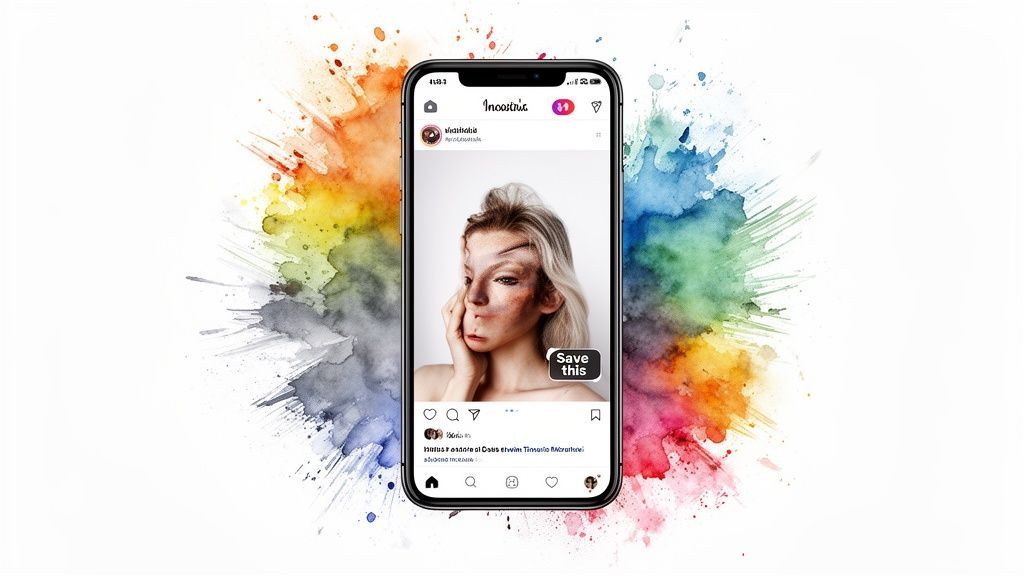
Look, a powerful, scroll-stopping static image is fantastic. It can rack up likes and comments from your followers like nobody's business. But if you want to get in front of new eyeballs? Short-form video is the undisputed king of the jungle.
Think of it as the engine of discovery. It’s the tool that blasts your content beyond your bubble and into the feeds of people who don't even know you exist yet.
If you want a simple way to look at it, images are for building deep connections with your current audience, while video is for explosive, top-of-the-funnel growth. This isn't just a gut feeling; the data is screaming it from the rooftops. A whopping 78% of consumers prefer short-form video for discovery. And when it comes to raw organic engagement, TikTok is a monster, pulling in an average of 2.5% per post—a number that can jump to a staggering 7.5% for smaller accounts. These social media marketing statistics don't lie.
This reality calls for a two-pronged attack: killer images to nurture your community and high-reach videos to constantly expand it.
Viral videos might feel like catching lightning in a bottle, but they almost always share the same DNA. They're built from the ground up to game the algorithm and hijack human attention. If you can master these elements, you’re well on your way.
The Three-Second Rule Is Not a Myth: You have to land your hook and state the video's core promise within the first three seconds. No exceptions. If you fail here, you've already lost them to the next video. Embrace Manic Editing: Think quick cuts, sudden zooms, and text popping up on screen. You need to keep the viewer's brain firing on all cylinders. A static shot that lingers for too long is a death sentence. Audio is 50% of the Experience: Seriously. A trending sound can do most of the heavy lifting for you. It instantly plugs your content into a massive, ongoing conversation and signals to the algorithm that you're relevant right now.
Here's a pro tip: The goal of a great short-form video isn't just to be watched once; it's to be rewatched. Things like looping audio, blink-and-you'll-miss-it visuals, and on-screen text that requires a second look are all clever tricks to get people watching again. That rewatch behavior is pure gold to the algorithm.
Jumping on a trend is crucial, but doing it blindly is a fast track to Cringetown. The real magic happens when you find a trend that's on fire and filter it through your brand's unique point of view.
Don't just do the dance. Adapt the format to tell a story about your industry, a customer's problem, or your product's benefit.
For instance, that trending audio clip with a "Eureka!" moment? A financial advisor could use it to show a client realizing they can finally afford a down payment on a house. The format is instantly recognizable, but the application is all theirs—and it actually provides value. This is how you stay culturally relevant without selling your brand's soul.
Let’s be real: the biggest roadblock for most of us is the sheer time and effort video production demands. Scripting, shooting, and editing can be a soul-crushing time suck.
This is where AI tools are completely rewriting the rules, shrinking a multi-hour production process down to just a few minutes. You don't have to start from a blank slate anymore. A platform like SendFame can basically become your creative co-pilot.
Here’s how you can make it work for you:
Animate Your Greatest Hits: Got a static post that absolutely crushed it? Use an Image-to-Video feature to bring it to life with a bit of motion, some animated text, and a great music track. Bam. You’ve just created a brand-new piece of content with almost zero effort. Generate Something Wildly Unique: Imagine creating a short video where a hyper-realistic AI celebrity avatar shares a "secret tip" about your niche. This is the kind of unexpected, attention-grabbing content that's almost impossible for people to ignore.
By blending the authentic, user-generated feel of trending formats with the insane speed and novelty of AI, you create a perfectly balanced strategy. You'll have high-engagement images strengthening your community, all while a steady stream of high-reach videos keeps bringing new people into your world.
Look, creating amazing content is like building a gorgeous race car—it's powerful, sleek, and turns heads. But without a skilled driver and a race strategy, it’s just going to collect dust in the garage. Your publishing schedule and analytics? That’s your strategy. It’s what turns your creative horsepower into consistent wins.
This is exactly where so many brands drop the ball. They pour their heart and soul into making the content but give zero thought to how or when it actually goes live.
Let's fix that.
The million-dollar question is always, "How often should I post?" I'll tell you right now, there’s no magic number. It's a delicate dance between what the algorithm wants and what your audience (and your own sanity) can actually handle. Sure, posting five times a day might make the algorithm happy, but it’s a surefire way to exhaust your team and probably annoy your followers.
A much smarter starting point is to aim for consistency over sheer volume. Trust me, it’s far better to post three high-quality pieces per week, every single week, than to blitz your audience with content for seven days and then vanish for a month.
Here are some solid baselines to get you started:
Instagram: Try for 3-5 feed posts a week, but keep the conversation going with 4-7 Stories sprinkled throughout the week. TikTok: This platform is hungry for content. If you've got the creative pipeline for it, aim for 1-3 short videos per day. LinkedIn: This is a quality-over-quantity game. 2-3 thoughtful posts per week will almost always beat out shallow daily updates.
Your visual is what makes them stop scrolling, but the caption is what starts the conversation. Too many people treat it like a chore, but it’s your golden opportunity to add context, show some personality, and tell people what to do next.
A simple but killer framework for your captions is Hook, Story, Action.
Hook: Lead with a bold statement or a question that’s impossible to ignore. Make it connect to your visual. Story: Add a short, punchy sentence or two that gives a little backstory or context. Don't write a novel. Action: End with a crystal-clear Call-to-Action (CTA). Ask a question, tell them to hit the link in your bio, or nudge them to tag a friend.
And what about hashtags? Think of them as filing cabinets for your content. You want a healthy mix of broad, niche, and branded tags. A good rule of thumb is 3-5 highly relevant hashtags on a platform like Instagram. It’s enough to get you discovered without looking desperate or spammy.
Here’s the secret: The best metric for a great caption isn't likes. It’s the number of meaningful comments it sparks. If people are taking the time to write a real response, you’ve struck gold.
Alright, let's have a real talk about analytics. Likes feel good, but they don't pay the bills. If you want to truly understand if your content is working, you have to look at metrics that signal genuine interest and intent.
For one month, I challenge you to forget your follower count. Instead, obsess over these data points that tell a much richer story about your content's health:
| Metric | What It Really Tells You | Why It Matters |
|---|---|---|
| Shares | "This is so good, my friends need to see it." | This is the ultimate stamp of approval and the engine of organic reach. |
| Saves | "This is so valuable, I need to come back to it." | Saves show your content is a resource, building authority and trust. |
| Comment Sentiment | The quality and emotion behind the comments. | Are people just dropping fire emojis, or are they asking legit questions and starting debates? |
| Click-Through Rate (CTR) | The percentage of people who clicked your link. | This proves your content is driving action and moving people off the platform. |
Interpreting this data is the final, crucial step. It's not about staring at numbers; it’s about turning those numbers into your next great idea. See a spike in saves on your "how-to" carousels? Make more of them. Notice a high CTR from a video that mentioned a specific customer pain point? Boom—that's your next campaign theme.
This feedback loop is everything. For a much deeper dive into this, our complete guide on how to measure content performance breaks down exactly how to turn raw data into a smarter strategy.

Even with the best playbook in hand, questions are going to pop up. Let's be real, creating social media content that actually connects can feel like trying to bottle lightning.
But don't sweat it. We're going to dive into some of the most common head-scratchers that creators and brands face. Think of this as your cheat sheet for getting past the hurdles and back to creating stuff people love.
A small budget isn't a dead end—it's a detour that forces you to be more creative. When you can't just throw money at a problem, you get scrappy, resourceful, and laser-focused on what truly works.
Your first move should be to embrace User-Generated Content (UGC). Think up a simple, catchy branded hashtag, build a little campaign around it, and watch your community become your content creators. You get authentic posts for free, and they get the spotlight. It's a classic win-win.
Don't sleep on high-quality static images either. Free tools like Canva are unbelievably powerful for this. And as we've already seen, the right AI tools can be your secret weapon for cranking out visuals that look like they cost a fortune.
A tight budget forces creativity. Focus on high-impact, low-cost strategies like encouraging User-Generated Content (UGC) with a branded hashtag.
Finally, invest your time where it pays the highest dividends: community engagement. Replying to every comment and DM doesn't cost a dime, but it builds the kind of loyalty and trust that ad spend can only dream of.
This is the million-dollar question, but the answer is surprisingly simple: as short as possible, but as long as necessary. The platform and the story you're telling should be your only guides.
For the blink-and-you'll-miss-it world of TikTok and Instagram Reels, you're playing in the 7-15 second sandbox. That's the sweet spot to grab attention, hold it, and—most importantly—get people to rewatch, which is pure gold for the algorithm. For YouTube Shorts, you can stretch your legs a bit, all the way up to 60 seconds.
But on platforms like Facebook or LinkedIn, where people are in a different mindset, longer videos (think 1-3 minutes) can be your ticket to establishing authority. A detailed tutorial or a quick industry deep-dive can work wonders. The universal rule? No matter the length, jam your hook and most important message into the first 3 seconds. You have to stop the scroll.
If you want to get discovered, you have to ride the waves. Staying on top of trends, especially with video, is non-negotiable. Luckily, the best trend-spotting tools are right at your fingertips.
TikTok is your crystal ball: Seriously, just scroll the 'For You' and 'Discover' pages. The sounds, formats, and jokes that you see over and over are your roadmap.Instagram gives you hints: The platform's 'Reels Trending' feature is a gift. It literally points you to rising audio tracks and popular video styles.Look beyond the apps: Tools like Google Trends are great for spotting broader topics bubbling up. Also, keep an eye on what creators and competitors in your niche are doing. They're often the canaries in the coal mine for new trends.
The trick isn't just to copy-paste a trend. It's to see it, understand why it's working, and then put your own unique spin on it. That's how you stand out.
Ready to stop brainstorming and start creating? SendFame gives you the AI-powered tools you need to generate stunning images, dynamic videos, and even hyper-realistic celebrity messages in seconds. Ditch the creative block and start making content that gets noticed. Create your first masterpiece for free.
Create Epic

SendFame

Create Epic with SendFame!
Questions: info@sendfame.com