The 12 Best Software for Event Planners in 2025
best software for event planners
Welcome offer — 56% OFF


Learn how to get brand deals with our guide. We cover building your brand, crafting media kits, pitching sponsors, and negotiating like a pro.
So, you want to land a brand deal? It's more than just having a bunch of followers. It's about building a genuine presence online, crafting a killer media kit, and knowing how to pitch brands that actually fit your vibe. At its core, you need to prove you have real influence with an engaged audience. Your high-quality content isn't just content—it's your resume, showing brands you can get them the results they're paying for.

Before you even think about sliding into a brand's DMs, you have to build a brand worth their time. It's a tough pill to swallow, but sponsors aren't just looking for a walking billboard. They want a trusted voice who can connect with a real community. Forget the vanity metrics for a second. The real money is in authentic influence, not just a flashy follower count.
Picture this: a brand manager is scrolling through dozens of potential creators. They need to get who you are and what you're about in five seconds flat. Your social profiles, your content, your whole online vibe—it all needs to scream "I know my audience." Think of it as your digital storefront; you need to have the shelves stocked and the place looking sharp long before you send that first pitch.
Brands want to partner with specialists, not generalists. A "lifestyle" creator is fine, but it’s a bit vague. A creator who focuses on "sustainable living for city apartment dwellers"? Now that's a laser-focused asset for the right company.
Your niche is your superpower. It’s what makes you memorable and tells sponsors exactly who their marketing dollars are going to reach.
Get real with yourself and ask these questions:
Who exactly is my audience? Go deeper than just age and location. What do they love? What keeps them up at night? What problem am I solving for them? Are you their go-to for expert advice, a daily laugh, or a dose of inspiration? What makes my take on this unique? Is it your sharp humor, your nerdy-deep knowledge, or your drop-dead gorgeous visual style?
The answers to these questions are the bedrock of your value proposition. You're not just making stuff; you're serving a specific community that hangs on your every word.
Let me tell you, an army of 5,000 followers who are actually listening, commenting, and sharing is worth so much more than 100,000 silent lurkers. Brands know this. High engagement is the ultimate proof that your audience trusts you enough to act on your recommendations.
A thriving, engaged community is the only social proof that matters. It shows brands you're not just shouting into the void—you're leading a conversation with people who trust you. That trust is the real product you're selling.
Make your page a two-way street. Ask questions in your captions. Actually reply to comments. Run polls in your stories. Every interaction is a signal to both the algorithm and potential sponsors that you've got a real connection with your people. If you're struggling here, we've got a guide on how to improve your social media engagement that can help.
Every single post, video, or story is a piece of your professional portfolio. The first thing a brand manager will do is scroll through your feed to see if you’re professional, creative, and a good fit for their brand. A chaotic posting schedule or sloppy content screams "unreliable partner."
The influencer marketing world is absolutely exploding—it's expected to hit an estimated $33 billion by 2025. Instagram alone is set to rake in over $22 billion of that. With platforms like TikTok still on the rise, brands are throwing money at creators who can deliver polished, effective content.
To get a slice of that pie, your work has to be top-notch. That means investing in decent lighting, learning some basic editing skills, and developing a consistent look that’s uniquely you. Your content doesn't just entertain your audience; it's what sells your skills to your future brand partners.
Think of your media kit as your personal hype man. It’s that slick, professional document you slide into a marketing manager’s inbox that makes them stop scrolling and think, “Okay, this creator knows what’s up.”
A generic, text-heavy PDF is the digital version of a limp handshake—completely forgettable. A great media kit, on the other hand, is your resume, highlight reel, and sales pitch all rolled into one beautiful package.
It’s your shot to tell your story, show off your best numbers, and prove to brands why partnering with you is one of the smartest moves they can make. This isn't just about follower counts; it's about building an undeniable case for your influence. To build something that screams professionalism, check out this guide on creating a perfect content creator media kit.
Ditch the stuffy, third-person bio. This is where you connect with a real human on the other side of the screen. Your bio should be a short, punchy intro that instantly tells them who you are, who you talk to, and what makes you, well, you.
Lead with that killer one-sentence pitch you worked on earlier. Then, sprinkle in some personality. Are you the hilarious tech reviewer who makes geek-speak sound simple? The go-to sustainable living guru for apartment dwellers? Let that shine. It’s not just about what you do, but why your audience trusts you.
Numbers don't lie, but you have to show them the right ones. Brands are sharp—they see right through vanity metrics and want the data that proves you have a real, engaged community.
Make sure your media kit includes these essentials:
Audience Demographics: Don't just stop at age, gender, and top countries. If you have data on audience interests, include it! This lets a brand know in a heartbeat if your followers are their future customers. Key Performance Metrics: Focus on your average engagement rate, reach, and impressions over the last 30-60 days. For video, things like average view duration are gold. These are the stats that prove your content actually hits home. Website or Blog Traffic: Got a blog? Show off your monthly unique visitors and page views. It proves you own an audience off-platform, which is a huge asset.
Here’s the thing: Your metrics tell the story of your influence. A high engagement rate with a smaller, niche audience is often way more valuable to a brand than a massive account with crickets in the comments. It shows your community is paying attention and ready to take action.
Nothing screams "I get results" louder than proof of past wins. A case study doesn't need to be a ten-page dissertation; it can be a single, powerful slide in your media kit. Even if you've only done gifted collabs so far, you can frame them to look incredibly professional.
Pick one or two of your absolute best-performing posts, especially if they featured a product.
For each one, lay it out simply:
The Goal: What were you trying to do? (e.g., "Showcase the everyday versatility of a new blender.") The Content: Pop in a screenshot of the post, reel, or video. Make it visual. The Results: Hit them with the numbers. "This Instagram Reel earned 15,000 views, a 6% engagement rate, and sparked over 50 comments asking where to buy the product."
These little success stories prove you understand how to generate real ROI for your partners. Plus, smartly showcasing your past work is a magnet for more opportunities. You can even get more mileage out of every project by using smart content repurposing strategies.
Let’s be real. Sitting around and waiting for brands to slide into your DMs isn’t a strategy—it’s a lottery ticket. Sure, it happens, but you can’t build a career on luck. If you want to land amazing brand deals, you have to stop waiting and start hunting.
The good news? The game has changed. Brands aren't just chasing massive follower counts anymore. They're on a desperate search for creators with real, authentic connections to a niche audience. Your mission is to find the right ones and make yourself impossible to ignore.
Your ideal partners are probably hiding in plain sight. The trick is to start looking at the world less like a consumer and more like a potential collaborator. The absolute best place to start is with the products and services you already use and genuinely geek out about.
Here are a few of my favorite ways to build a "dream brands" list:
Look in Your Own Fridge (and Closet, and App Folder): What brands do you use every single day without even thinking about it? A partnership built on genuine enthusiasm is a thousand times more powerful than a forced, awkward ad read.Do Some Friendly "Spying": Check out other creators in your niche, especially those who are just a few steps ahead of you. Who are they working with? This isn't about copying them; it's smart market research. It tells you which brands are already sold on the value of your specific audience.Go to the Marketplace: Influencer marketing platforms like PartnerStack, Impact, and Awin are essentially giant bazaars where brands list their partnership and affiliate programs. Signing up is a great way to browse who's actively looking for creators right now.
No matter where you find them, your media kit is your professional handshake. This infographic nails the essential elements you need to include.
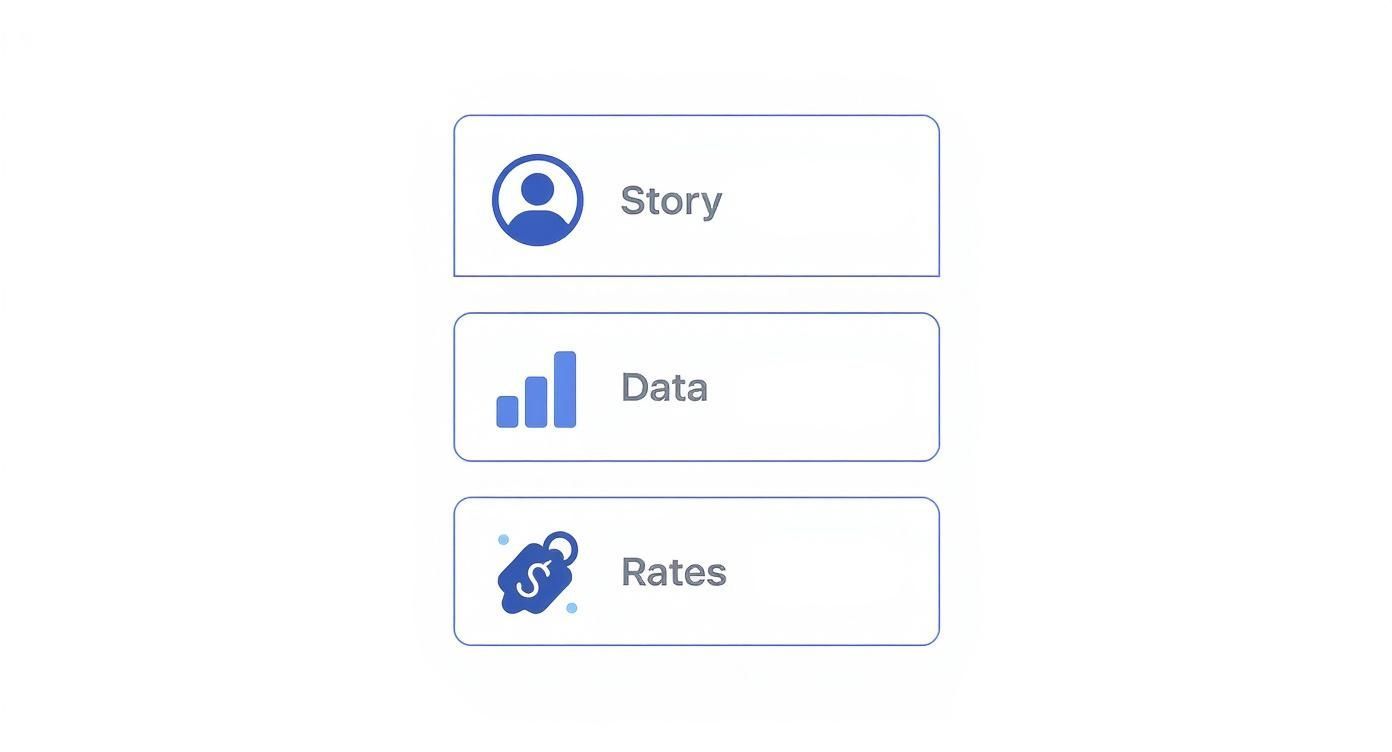
Think of it this way: your media kit needs to tell a compelling story about your audience, back it up with hard numbers, and make it crystal clear what you offer.
Okay, you've got a list. Now the real work begins. Firing off a generic pitch to a brand you know nothing about is a massive waste of everyone's time. A thoughtful, well-researched pitch is what makes you stand out from the sea of "Hey, collab?" DMs.
Before you even think about typing up an email, do a little digging.
Run every potential partner through this simple checklist:
Do Your Values Vibe? If you're all about sustainability, partnering with a notorious fast-fashion brand will give your audience whiplash and tank your credibility. Is There Audience Overlap? Does their ideal customer look a lot like your ideal follower? Snoop on their social media, see who follows them, and pay attention to the language they use in their ads. Check Their Collaboration History: Look at their tagged photos and past campaigns. Do they work with creators of your size? This is a huge clue that they actually have a budget and a process for these kinds of partnerships.
Vetting isn't just about finding a brand with a budget. It's about finding a partner whose story makes sense next to yours. The best collaborations feel less like commercials and more like a "you have to try this" recommendation from a trusted friend.
To see just how powerful that alignment can be, take a look at our breakdown of some of the most successful celebrity endorsement examples. The core principles of authenticity and audience match are exactly the same, no matter the follower count.
So, how do you actually get in touch? You've got options, and each one has its pros and cons. Choosing the right channel can be the difference between getting noticed and getting lost in the noise.
This table breaks down the most common methods for reaching out to brands.
| Channel | Pros | Cons | Best For |
|---|---|---|---|
| Direct Email | Professional, allows for detailed pitches, easy to track. | Can be hard to find the right contact; easily ignored if not compelling. | Formal pitches to mid-size or large brands where you've identified the specific marketing manager. |
| Social Media DMs | Casual, quick, and direct; good for smaller or creator-led brands. | Can feel unprofessional; gets lost in a crowded inbox; character limits. | Initial, low-stakes outreach to smaller brands or to build a relationship before a formal pitch. |
| Excellent for finding specific job titles (e.g., "Partnerships Manager"). | Outreach can feel sales-y; requires a professional profile. | Connecting with the exact decision-maker at a corporate brand before sending an email pitch. | |
| Marketing Platforms | Brands are actively looking for partners; streamlined application process. | Highly competitive; often lower payouts (especially for affiliates). | Creators who want to find multiple opportunities quickly and are open to affiliate-style deals. |
Ultimately, a mix-and-match approach often works best. You might connect with someone on LinkedIn, follow up with a detailed email, and maintain the relationship through social media.
Your perfectly crafted pitch is completely useless if it ends up in the info@brand.com black hole. You need to find the actual person whose job it is to work with creators like you.
Their job title will usually be something like "Partnerships Manager," "Influencer Marketing Lead," or "Creator Community Manager."
LinkedIn is your secret weapon here. Hop on and use the search bar to type “Influencer Marketing” AT [Brand Name]. This simple query will often point you directly to the person you need to talk to.
Once you have a name, you can often figure out their email with a little educated guesswork (e.g., firstname.lastname@brand.com or firstinitial.lastname@brand.com). This tiny bit of detective work transforms a cold, generic email into a direct, personal inquiry that’s much harder to ignore.
Let's be real—in a world of overflowing inboxes, a generic, copy-paste message is a one-way ticket to the trash folder. Your pitch needs to be a knockout. It has to be personal, strategic, and so ridiculously compelling that the brand manager stops everything to read it.
So, let's break down how to craft an outreach email that doesn’t just get opened—it gets an enthusiastic "yes."
Think of your subject line as the gatekeeper to your brilliant idea. Its one and only job is to get the email opened. Forget snoozers like "Collaboration Inquiry" or "Partnership Opportunity." They’re boring, and they blend right in with the fifty other emails that look just like them.
Instead, you need a subject line that feels personal and gives them a juicy little hint of the value waiting inside.
Here are a few formulas I’ve seen work wonders:
The Specific Idea: "[Your Brand Name] x [Their Brand Name] Idea for the New [Product Launch]" The Mutual Connection: "Quick Question About [Their Recent Campaign]" The Value Proposition: "Content Idea to Reach [Their Target Audience]"
The goal here is simple: spark curiosity. Show them you've done your homework before they’ve even clicked. A little effort here goes a very long way.
Okay, they opened it! The first few lines are now your audition. You have about five seconds to prove you’re not just spamming a list of contacts. This is where all that research you did earlier pays off big time.
Kick things off with a genuine, specific compliment.
"I loved your recent campaign highlighting local artists—the visual storytelling was fantastic." "I've been using your [Product Name] for the past six months, and it's completely changed my [routine/workflow]."
This immediately shows you're a real fan who actually understands their brand. Right after that personalized hook, briefly introduce yourself with your one-sentence value proposition. Connect your audience directly to theirs. For example, "I create weekly tutorials for an audience of 15,000 freelance designers who are always looking for better productivity tools."
The whole game of brand deals has shifted. It’s all about authentic, data-supported partnerships now. In fact, 73% of brands prefer collaborations with micro and mid-tier influencers because they deliver a much better engagement-to-cost ratio. Your personalized pitch is the first step in building that authentic connection.
This is your chance to really separate yourself from the pack. Don't just say, "I'd love to work together." Show them how. Present a concrete, creative idea that goes way beyond a single sponsored post. This proves you’ve actually thought about their marketing goals and are ready to be a true partner.
Brainstorm one or two specific concepts to get their wheels turning.
For a camera brand: "A 3-part Instagram Reel series on 'Mastering Low-Light Photography for Beginners,' featuring your new Z-1 model." For a sustainable snack brand: "A 'Day in the Life' YouTube video showing how I incorporate your snacks into my busy, eco-conscious routine, with a dedicated segment on your ethical sourcing."
When you offer a clear vision, you make it incredibly easy for the brand manager to picture the collaboration's success. This is also the perfect spot to subtly mention your knack for creating highly shareable posts. Need a little inspiration? Check out our guide on https://sendfame.com/blog/how-to-create-viral-content.
So, what happens if you send the perfect pitch and hear… crickets? Don't panic. Marketing managers are juggling a million things. A polite and strategic follow-up isn't annoying; it's professional.
My rule of thumb is to wait about 5-7 business days before sending your first follow-up.
Keep it short and sweet. Simply reply to your original email with something like:"Hi [Name], just wanted to gently bump this to the top of your inbox. Let me know if you have any questions about the ideas I sent over!"
If another week goes by with no response, send one more follow-up, but this time, add new value. Maybe you mention a recent win, like a post that got unusually high engagement, or a new idea you had. If you still hear nothing after two or three attempts, it's time to move on. Knowing the best practices for how to ask for PR packages and get a yes can also give you a huge edge. Trust me, your persistence will pay off.
You did it. The pitch landed, the brand loves you, and they want to make it official. The hard part is over, right?
Almost. Before you celebrate, it’s time to handle the most important part of the deal: getting the contract right and making sure you get paid what you’re worth. This is the moment you stop being a hobbyist and start running a business.
Negotiating can feel awkward, but it’s just a conversation. The goal is to make sure everyone is happy, protected, and totally clear on what’s expected. Think of it as setting the rules of the game so you can both win. This isn't about playing hardball; it’s about valuing your time, your talent, and the community you’ve built.
Before your pen even thinks about touching paper (or your mouse clicks "e-sign"), you need to get comfortable with a few key contract terms. These clauses are the nuts and bolts of the deal, and skipping over them is a rookie mistake.
Seriously, don't just scan for the dollar amount and call it a day. Keep an eye out for these big ones:
Exclusivity: This is a biggie. Does the contract stop you from working with competitors? For how long? A 30-day exclusivity clause for another coffee company is pretty standard. A six-month ban on working with any beverage brand? That's a major overreach. Make sure the scope is tight and the timeline is fair. Content Ownership & Usage Rights: Who actually owns the brilliant content you’re about to create? Typically, you (the creator) own the copyright. The brand is just licensing it. The contract must spell out exactly where and for how long they can use your work. Letting them use your video in paid ads for six months is way more valuable than a single organic post on their feed—and it needs to be priced that way. Deliverables & Revisions: Get crystal clear here. How many posts? What platforms? How many Stories? This section also needs to define the editing process. One or two rounds of reasonable tweaks are normal. A clause allowing for "unlimited revisions" is a giant red flag and a one-way ticket to burnout.
Then comes the question every creator dreads: "So, what are your rates?" Whatever you do, don't respond with, "What's your budget?" That's like showing up to a poker game and handing your cards to the other player. You instantly lose all your leverage.
You need to walk into this conversation with a number in your head. Your rate isn't just pulled from thin air; it’s a calculated figure based on your audience, engagement, the effort involved, and the real-world value you’re providing.
Never be the first one to say a number if you can avoid it, but always be prepared with one. When you state your rate with confidence, you anchor the entire negotiation around your value, not their budget.
A great strategy is to offer tiered packages—a "Good, Better, Best" approach. This guides the brand toward a preferred option and often bumps up the final deal size. For instance, a single video might be your "Good" package, while a multi-platform campaign with extended usage rights is your "Best."
Sometimes, a brand's budget is just set in stone. But that doesn’t mean the negotiation is over. A deal's total value isn't just about the direct payment.
Think about the bigger picture and what else you can get:
Affiliate Commissions: Ask for a unique code that gives you a cut of the sales you drive. This is a win-win. It shows the brand you’re confident in your ability to convert, and it gives you a long-term earning opportunity. Additional Product: Can they send extra products for you to host a giveaway for your audience? It’s an easy way for both of you to drum up excitement and engagement. Cross-Promotion: Will the brand feature you on their own social media channels or in their newsletter? Getting that kind of exposure to a new audience can be incredibly valuable for your own growth.
In 2025, influencer marketing is no longer a niche tactic; 86% of marketers globally are using it. Creators are getting smarter, moving beyond simple flat-fee deals. Brands are more willing than ever to offer true affiliate partnerships with real-time sales data. For a deeper dive, you can read the full report on influencer marketing statistics. This shift gives you the power to negotiate for performance-based deals that can seriously boost your total income.
Still got some question marks floating around in your head? You're in good company. Trying to land brand deals can sometimes feel like trying to solve a puzzle without the picture on the box. Let's pull back the curtain and get you some straight answers to the most common head-scratchers creators face.
We’re getting into all of it—from the eternal "how many followers" debate to handling rejection like the pro you are.
Okay, let's just bust this myth wide open. The magic number isn't about the size of your audience; it’s all about the strength of your connection with them. Brands are now actively chasing down nano-influencers (1k-10k) and micro-influencers (10k-50k), and for one simple reason: their communities are ridiculously engaged.
Think about it. An audience of 5,000 ride-or-die followers who genuinely trust what you say is infinitely more valuable to a sponsor than 100,000 passive followers who just scroll on by. So, stop obsessing over the follower count and start nurturing your engagement rate. Anything in the 3-6% ballpark is fantastic and proves you have real influence.
Once you have the data showing your audience actually listens to you, you're ready to pitch. The proof is in the engagement, not the number at the top of your profile.
First things first: take a breath. Rejection is just part of the game, and it’s almost never personal. The best way to look at it is as pure data. A "no" from a brand is just a piece of information that helps you sharpen your strategy for the next time.
If a brand actually gives you feedback, treat it like solid gold. That's free consulting that can make your next outreach ten times stronger. It’s also totally fine to send a polite, professional reply asking if there was a specific reason your pitch wasn't a fit. Just frame it as wanting to improve for any future opportunities.
Remember, a "no" today often just means "not right now." Keep creating killer content, grow that engagement, and circle back in six to twelve months with fresh stats and new wins. A professional response now can leave the door wide open for a "yes" down the road.
Ah, the classic creator dilemma. A product-only deal, often called "gifting," can be a smart move when you're just starting out. It’s a fantastic way to build up your portfolio and get a real-world case study to pop into your media kit.
But you have to be brutally honest with yourself before you say yes. Ask these questions:
Is this a product I'd actually buy with my own money? Your authenticity is your currency. Don't cheapen it. Is the product's value a fair trade for my work? Factor in the time it takes to shoot, edit, write, and post. Your time is valuable. Are there strings attached? A true gifting collaboration should be a no-pressure deal.
Here’s a simple rule to live by: if a brand sends you a detailed creative brief, dictates when you have to post, and demands to approve everything, they are a client. And clients pay. As you grow, your main goal should be to shift from gifted opportunities to paid partnerships.
The secret is a simple formula: polite persistence + new value. Once you send that initial pitch, give it about a week of business days before you even think about poking them. Marketing managers are juggling a million things.
Your first follow-up can be a short, friendly "bump" to your original email. Just reply in the same thread to bring it back to the top of their inbox. Simple. If you're still hearing crickets after another week, it’s time for round two. This time, bring something new to the table. Mention a recent post of yours that crushed it, share an updated audience stat, or toss out a fresh campaign idea you had for them.
If two or three follow-ups go unanswered, it's a sign to gracefully bow out and focus your energy elsewhere. Just always keep it positive and professional.
Ready to stop guessing and start creating content that gets you noticed? The AI-powered tools inside SendFame can help you generate stunning visual assets—from slick videos to hyper-realistic images—that will make your next brand pitch impossible for them to ignore. Explore how SendFame can elevate your content and impress sponsors today.
Create Epic

SendFame

Create Epic with SendFame!
Questions: info@sendfame.com