How to Get Brand Deals and Impress Sponsors

how to get brand deals
Welcome offer — 56% OFF


Discover how to write a song or rap with a practical guide to lyric writing, structure, flow, and recording to help you craft music that connects.
Writing a song, whether it's a heartfelt ballad or a hard-hitting rap verse, really just boils down to grabbing an idea and giving it some shape and rhythm. It’s this cool mix of pure, raw inspiration and the nuts-and-bolts techniques that make a song work.
Every legendary track you've ever loved started as a tiny flicker of a thought. A lot of new artists make the mistake of just waiting around for inspiration to strike like lightning, but the pros know that's not how it works. They’re constantly on the hunt for ideas, turning everyday life into their own personal goldmine of creative fuel. You don't just stumble upon great song concepts; you train yourself to see them everywhere.
This is all about paying attention—like, really paying attention—with the goal of finding material. That weird phrase you overheard at a coffee shop? The flash of anger you felt in a traffic jam? That wild daydream you had about a sci-fi love story? Those are all seeds for a song. The trick is to snag them the second they pop into your head.
Think of your brain as a muscle. Brainstorming is its gym session. Instead of just sitting there waiting for magic, you have to get your hands dirty and play around with your own thoughts and feelings. Treat it like an experiment where, at least in the beginning, there are no bad ideas.
Here are a few ways to get the juices flowing:
Mind-Mapping: Scribble a core feeling, like "loneliness" or "excitement," in the middle of a page. Now, just spiderweb out from there with any related words, memories, images, or even smells that come to mind. Don't censor yourself, just connect the dots. Freewriting Frenzy: Set a timer for five minutes and just write. Don't stop, don't edit, don't think. Let whatever random nonsense is in your head spill onto the page. This is a great way to sneak past your inner critic and dig up some unexpected gems. Character Improv: Try writing from a completely different perspective. What’s life like for the cashier at the grocery store? What's on the mind of that old man on the park bench? This little acting exercise can break you out of your own head and open up a whole new world of stories.
Look, the point here isn’t to land on the perfect idea right out of the gate. It's about creating a stockpile of options. Build yourself an "idea vault"—a note on your phone, a messy notebook—and you'll never have to face the terror of a blank page again.
Of course, sometimes the well just feels dry, no matter what you do. For moments like that, a little outside help can be a lifesaver. If you're really stuck, our guide on how to use a song ideas generator has some killer tips for getting the engine revving again.
Once you’ve got a nice messy pile of raw ideas, it's time to sift through them for the "big idea"—the central theme of your song. What's the one thing you're really trying to say? Is this a story about that first gut-wrenching heartbreak? A rap verse about finally beating your own self-doubt? An anthem about an injustice that makes your blood boil?
Nailing down this theme gives your song a clear destination. It's the North Star that guides every single word you write and every note you choose. A song about "love" is way too generic. But a song about "the awkward silence on a first date that's going horribly wrong"? Now that's specific, relatable, and loaded with juicy details. And for those looking to push the envelope, tools like Auralume AI's tools can be a fascinating way to spark new musical directions and flesh out concepts.
Think about this: modern songwriting is becoming a team sport. Gone are the days of the lone genius locked in a room. The average hit song today has 3.2 credited songwriters, a jump from just 2.1 a decade ago. It just goes to show that bouncing ideas off others and combining skills is how the best stuff often gets made.
An idea without a solid plan is just a daydream floating away. This is where you grab that idea and give it a skeleton—a blueprint that turns a cool concept into a cohesive track that hooks a listener from the first note to the last. This framework is the difference between a random collection of lines and a powerful, memorable song.
Think of song structure as the map for your listener's emotional journey. For songwriters, the most classic and effective map is the Verse-Chorus structure. It’s popular for a reason—it works. The verse tells the story, painting a picture with specific details, while the chorus delivers the main emotional punch, the big idea you want everyone singing along to.
Here’s a look at how that creative flow actually works, from a spark of an idea to a finished piece.
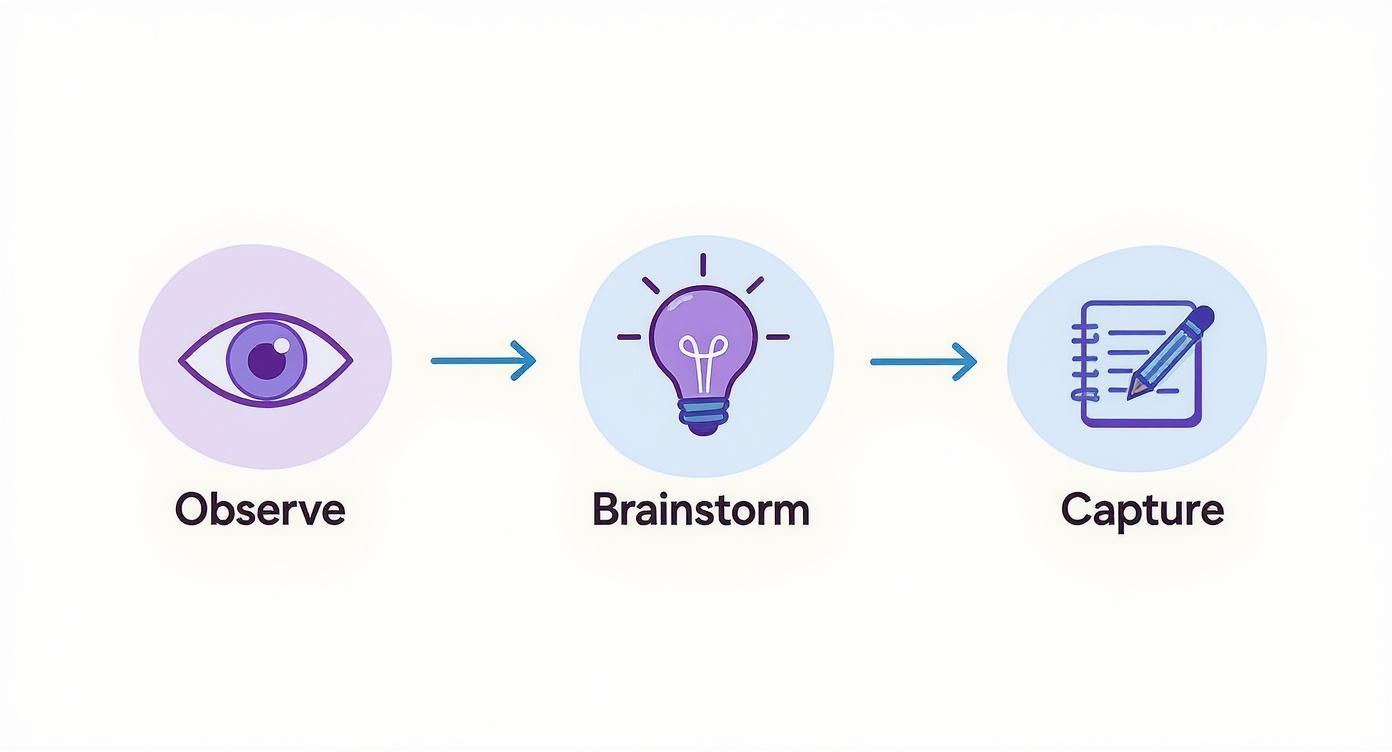
As you can see, great songs start long before you write a single lyric. It all begins with observation and brainstorming before you even try to capture the final idea.
The most common structure you'll run into is Verse-Chorus-Verse-Chorus-Bridge-Chorus. Let's break down what each part is actually doing:
Verse: This is your storytelling section. Each verse should push the narrative forward, revealing new details or perspectives. If Verse 1 introduces a problem, Verse 2 might explore the consequences. Chorus: This is your hook, the song's central message. The melody and lyrics here should be catchy and simple, designed to be the most memorable part of the track. It's the same every time it appears, reinforcing your core theme. Bridge: This is the game-changer. The bridge offers a shift in perspective, a change in melody, or a moment of reflection before the final chorus hits. It breaks up the repetition and adds a powerful emotional climax.
Don't feel trapped by this formula. It's a starting point, not a rulebook. Many incredible songs play with this structure or throw it out entirely. The goal is to understand why it works so you can use its principles to build tension and release in your own unique way.
To really get under the hood of how successful songs are put together, using transcription services for analyzing song structure can be a huge help. Seeing the lyrics laid out in text can reveal patterns and tricks you might miss just by listening.
Before we dive into the rap side of things, it's helpful to see how these structures compare. While there's a ton of overlap, the focus can be a bit different.
| Element | Role in a Song (e.g., Pop/Rock) | Role in a Rap Track | Common Placement |
|---|---|---|---|
| Intro | Sets the musical mood and key. | Establishes the beat's vibe and tempo. Often includes ad-libs or a simple hook. | Beginning of the track. |
| Verse | Tells the story, builds the narrative. | The primary storytelling space. Showcases lyrical skill, wordplay, and flow. | Typically 2-3 per track. |
| Chorus/Hook | The main, catchy, repeatable idea. | The central theme or catchphrase. Often simpler and more melodic to be memorable. | Repeats 2-4 times after verses. |
| Bridge | A melodic and lyrical departure. | Provides a change of pace; might feature a different flow, a melodic part, or a beat switch. | Usually after the second chorus. |
| Outro | Fades out the music, often repeating a key phrase. | Often used for final thoughts, shout-outs, or letting the beat ride out. | End of the track. |
This table just scratches the surface, but it highlights how both genres use similar building blocks to create a compelling journey for the listener.
If you're writing a rap, the beat isn't just background music; it's your entire world. It’s the sonic canvas you’ll paint on with your words, flow, and delivery. The beat you choose will dictate your energy, your rhythm, and the overall mood of your track. Choosing the right one is arguably half the battle.
When you're searching for a beat, don't just listen for what sounds cool. Listen for how it makes you feel. Does it match the emotion of your lyrics? A hype track about success needs an energetic, confident beat, not a slow, somber piano loop.
Pay close attention to these key elements:
Tempo (BPM): The speed of the beat, measured in Beats Per Minute, will define your flow. A faster BPM (like 140-160) is great for energetic, double-time flows, while a slower BPM (70-90) gives you more space for complex wordplay and storytelling. Instrumentation: What instruments are used? A gritty, distorted 808 bass creates a much different vibe than a smooth jazz sample or an orchestral string section. The sounds themselves should align with your song's theme. Mood: Close your eyes and listen. Is the beat aggressive, melancholic, reflective, or celebratory? Your lyrics need to live in the same emotional space as the instrumental to feel authentic.
Finding the right beat can feel overwhelming, but there are countless resources out there. YouTube is a goldmine for free-for-non-profit beats, while producers on platforms like BeatStars offer leases for more professional projects. When you find one that clicks, you'll know. The words will start flowing almost effortlessly.
Once you have your song structured and recorded, you'll need the right software to bring it all together. Our guide on the best music production programs for beginners can help you find the perfect tools to mix and master your track.
Alright, let's get to the heart of it: the words. This is where you grab a listener by the collar and make them feel something. It’s the moment you move past just stringing rhymes together and start telling a story that connects.
Your goal is to tap into the senses. You're not just writing words; you're painting a picture, creating a soundscape, and evoking a memory.
Sight: Paint a vivid picture. Think "cracked leather dashboard" instead of just "old car." Sound: Weave in sounds. The "hiss of the radiator" or the "click of her heels on the pavement." Smell/Taste: These are powerful. A hint of "rain on hot asphalt" or the "taste of cheap coffee" can transport someone instantly.
Sensory details are your secret weapon. They anchor your abstract feelings in a concrete world your listener can step into. Describing a worn denim jacket isn't just a description; it’s a shortcut to nostalgia, comfort, or a long-lost memory.
Every line becomes a tiny, potent experience instead of just filler to get to the next rhyme.
“Real lyrics aren’t fluff. They’re a map of memory in motion.”
This is what separates the amateurs from the pros. Once you start thinking in images and sensations, you can start playing with how you structure those lines.
Your rhyme toolkit is your signature. Anyone can do a simple AABB couplet, and honestly, sometimes that’s all you need for a killer hook. But there's a whole world of rhythm and flow waiting for you when you experiment.
Don't be afraid to mix it up. Think about:
Couplets: Great for delivering a punchy, memorable message. Nail the final words, and they'll stick. Internal Rhymes: Dropping a rhyme in the middle of a line? That's how you make heads nod. It adds an unexpected bounce and shows you’ve got command of the craft. Multisyllabic Rhymes: This is where you can really flex your lyrical muscles. Rhyming "insomnia" with "Tropicana" shows a level of agility that makes people sit up and listen.
Weaving in an AAXA or ABAB pattern can guide the listener through a feeling of tension and release, all without them even realizing it. In a rap about perseverance, you could drop "hustle" and "muscle" mid-verse to land that feeling of strength. Or in a ballad, a line like "silver screen dreams" followed later by "torn at the seams" adds a beautiful, poetic touch.
Here's the raw truth: honest lyrics mean being vulnerable. Ditch the clichés. We’ve all heard about a "heart of gold" a thousand times. What’s your story? Talk about a specific fear, not just "sadness."
Honesty in lyrics turns lines into lifelines for both writer and listener.
Your own experiences are the richest well you can draw from. That cringey thing you said last week? That moment of pure, unexpected joy? That’s where the gold is.
Try this: describe your last argument in three vivid lines, without any judgment. Just the facts, the feelings, the details. See what comes out.
Your authentic story is your strongest lyrical weapon.
If you want to dive deeper into polishing your verses and finding that perfect imagery, we've got a whole guide on it. Check out how to refine your song lyrics in our article for more advanced tips.
Wordplay is the seasoning. It's what keeps your lyrics from sounding bland. Metaphors, similes, alliteration—these are the tools that add layers and rhythm.
Swap a common word for something unexpected. Twist a common phrase to give it a fresh angle. Use alliteration ("perfectly poisonous promises") for a punch that just rolls off the tongue.
A great song is more than just a collection of cool lines; it has an arc. Think like a filmmaker. Each verse is a scene, building momentum and telling a piece of the story. Show, don't just tell. Instead of saying a character is nervous, describe their "thumb picking at a loose thread on their jeans."
We all fall into them, but awareness is key. Steer clear of clichés unless you can put a fresh spin on them. Ditch filler words ("baby," "yeah," "oh") unless they serve a real emotional purpose. And for the love of music, never force a rhyme. If it sounds clunky or twists the meaning of the line, find a better word. The song will thank you for it.
Want to get better, faster? It's all about reps.
Two-a-Days: Write just two lines every single day on a random topic. Voice Memo It: Record yourself rapping or singing your drafts. Your ears will catch awkward phrasing your eyes miss. Tag Team: Find a collaborator. Send a four-bar snippet back and forth and build on each other's ideas.
| Good Line | Weak Line |
|---|---|
| "Smoke curls from my scars as memories trace" | "I feel pain inside and it hurts" |
Integrate these practices, and you'll stop hoping your lyrics resonate and start knowing they will. Your lines will hit harder because they come from a place of vivid truth, not empty fluff.
Don't just read this and walk away.
Set a Deadline: Give yourself 24 hours to finish a complete verse. Don't overthink it, just get it done. Get Feedback: Share your raw drafts. Find a trusted friend (or a brave online community) and ask for honest reactions. Stay Curious: Pay attention to conversations, billboards, and the world around you. Your next great line is waiting out there.
Consistency, honesty, and a willingness to take creative risks are your best allies.
Now, go write something that matters.
Think of lyrics as seeds—they need your voice to truly bloom. When you step up to the mic, you’re the one who injects personality into every syllable. In rap, that magic spark is your flow: the unique rhythm you carve out in the space between beats.
Flow isn’t just about tossing out rhymes; it’s your musical fingerprint. It’s how you cruise on a mellow beat, swerve through rapid-fire bars, or slam the brakes with a well-timed pause. Picture the instrumental as an open road—you decide whether to speed up, take a detour, or coast with ease.
Your cadence is the heartbeat of your delivery. Tweak it, and you can reshape the entire mood of a verse without swapping a single word.
Imagine saying, “I walk this lonely road alone at night” in two ways: one, as a steady march; two, speeding through “lonely road” then stretching out “alone” like a sigh. That shift in emphasis? Pure cadence.
Here are a few ways to experiment:
Pocket Rapping: Anchor your words right on the kick and snare. This approach feels grounded and bold—ideal for statements that demand attention. Off-Beat Flow: Push or pull your lines a bit ahead or behind the beat to create tension, urgency, or a laid-back swagger. Pacing Shifts: Mix rapid-fire bursts with slower, deliberate bars. The contrast can turn a routine verse into a highlight reel.
Pause with purpose. Silence can be as powerful as any bar you spit. Hold back for a moment, then let your next line land like a punch.
If you write songs, the melody is your hook—what sticks in everyone’s head long after the track ends. And guess what? You don’t need to be a pianist or virtuoso vocalist. Your raw instinct is enough.
Grab a simple chord progression or even just a drum loop and start humming your lyrics. Don’t obsess over perfect pitch; focus on finding a melodic contour that matches the emotion of your words.
The chorus deserves special treatment. Aim for a question-and-answer structure: let the first phrase climb in pitch, building tension, then resolve it by stepping back down. That little climb-and-fall makes melodies addictive.
Authenticity is non-negotiable. If you sound like someone else, listeners will sense it immediately. Explore other artists, but don’t mirror them—learn what resonates with you and build from there.
Analyze different rap deliveries. Some artists lean into melodic, sing-song flows; others go hard with percussive, staccato bars. Record yourself freestyling over a variety of beats—slow, uptempo, minimal, maximal. Listen back to spot the styles that feel most natural. Embrace your accent, your quirks, your everyday speech patterns. They aren’t flaws; they’re the foundation of your signature sound.
For those moments when inspiration runs dry or you’re itching to test fresh rhythmic ideas, trying an AI rap generator can spark new directions you might never have imagined.
Ultimately, whether you’re crafting a tight rap cadence or humming a catchy chorus, it all comes down to performance. Your delivery is the bridge between your written words and the audience’s ears. Nail it, and you’ve got yourself a song that sticks.
That fire you just wrote? It deserves to be heard. But before you can blast it from car stereos, you have to actually capture the magic. Let's pull back the curtain on recording your track and then talk about something just as crucial: getting paid.
Making music is an art, no doubt. But building a career from it is a business, and you need to be the CEO.
Good news: you don't need a million-dollar studio anymore. The days of needing a record label's budget just to get a clean take are long gone. Getting a pro-sounding recording from home is easier and cheaper than ever.
Forget the intimidating gear lists. You can get started with just three key pieces of equipment. This is your ticket to writing a song or rap that sounds polished right out of the gate.
A Decent Microphone: Start with a solid USB condenser mic. Something like an Audio-Technica AT2020 or a Blue Yeti is perfect. They’re basically plug-and-play and deliver crisp, clear vocals without a ton of extra gear.An Audio Interface: If you decide to go with a more traditional XLR microphone, you'll need an interface. A box like the Focusrite Scarlett 2i2 is the industry standard for home studios. It’s the bridge that connects your mic to your computer, turning your analog sound into digital gold.Software (DAW): Your Digital Audio Workstation is your new command center. You can start for free with surprisingly powerful tools like GarageBand (for Mac) or Audacity. When you're ready to level up, industry giants like FL Studio or Logic Pro X are waiting.
Armed with these tools, you have everything you need to lay down vocals over a beat or track your own instruments. The next trick is making it sound good in a room that wasn't designed for recording.
Your bedroom closet is your secret weapon. I'm serious. All those clothes act as natural sound absorbers, killing the nasty echo that instantly screams "amateur recording." Hang a heavy blanket behind you, and you've just built yourself a free vocal booth.
Okay, your track is recorded, mixed, and sounding amazing. Congratulations! You're not just an artist anymore—you're a business owner with a product. This is the part where so many creators stumble, but it's where careers are truly built.
The music business is a massive financial engine. Think about it: the global music publishing market hit €15.8 billion in 2025, with streaming now accounting for over half of that. Just in the United States, the industry's revenue shot up to $8.7 billion that same year.
The money is out there. You just have to know how to claim your slice. You can dig into more stats about the music publishing industry's growth on ibisworld.com.
Every time your song gets played, you're owed money. It's that simple. These payments are called royalties, and they come in a few different flavors. The one you need to know about right now is performance royalties.
These are generated any time your song is performed "publicly." That sounds fancy, but it includes everyday stuff like:
Radio play (your local station or SiriusXM) Streams on services like Spotify and Apple Music Getting played during a live show at a bar or concert hall Being used in a TV show, movie, or even a YouTube video
So, how do you get this cash? You can't just send Spotify an invoice. This is where Performance Rights Organizations (PROs) come into the picture. They’re the muscle. In the U.S., the big three are ASCAP, BMI, and SESAC.
You sign up with one of them as a songwriter, and they become your global collection agency. They have systems to track when and where your music is played, they collect the money from thousands of sources, and then they cut you a check.
Registering your songs with a PRO is absolutely non-negotiable if you ever want to see a dime. It's the first real step to turning your passion into a paycheck.
Stepping into the songwriting world can feel a bit like trying to solve a puzzle with half the pieces missing. We've all been there—you're in a creative groove, and suddenly a question pops into your head that completely grinds things to a halt.
Let's clear up some of the most common mental roadblocks that pop up when you're learning how to write a song or a rap. My goal is to get you past the hang-ups and back to making music.
First, let's bust a huge myth: you do not need to be a Juilliard graduate to write a song.
Good! You don't need to. Seriously. Your voice, your ideas, your unique perspective—those are your real instruments. Some of the greatest rappers and songwriters in history started by just banging on a table or humming a melody into a cheap recorder.
Today, you've got it even easier:
Beats on Tap: You can dive into an endless ocean of instrumentals on sites like YouTube and BeatStars. There are thousands of free and affordable beats just waiting for your lyrics.Simple Music Apps: Tools like GarageBand on your phone let you lay down chords and build a vibe with zero music theory knowledge. It's all about feel.
Your job is to bring the fire—the story, the flow, the emotion. The background music is easier to find than ever.
Ah, the million-dollar question that plagues every artist. It’s the one that keeps us up at night, tweaking a snare hit for three hours straight.
Here's the real talk: a song is finished when it says what you wanted it to say. The biggest trap you can fall into is chasing some mythical idea of "perfection." That path leads to a hard drive full of unfinished projects and a whole lot of frustration.
A finished song you're 80% happy with is infinitely better than a "perfect" song that nobody ever gets to hear. Get it done, get it out there, and start the next one. You get better by finishing things, not by polishing one idea to death.
Writer's block feels like a brick wall, but it's usually just a sign that you're putting way too much pressure on yourself. The quickest way out? Stop trying so hard. Make it a game again.
Give yourself a stupidly low-stakes assignment. I'm talking really silly. Write a rap about the weird stuff in your fridge. Pen a dramatic power ballad about your favorite pair of sneakers. The point isn't to write your magnum opus; it's to get the gears turning and remind yourself that this is supposed to be fun.
This is the ultimate chicken-or-the-egg debate in music. The truth is, there's no right answer. It’s all about what hits you first.
Some days, you'll be walking down the street and a line will smack you in the face with so much power you have to write it down right now. Other days, a melody will just appear in your head while you're doing the dishes.
The best artists learn to let the two dance with each other. A lyrical idea might shape the melody, or a melodic rhythm might suggest a certain phrasing for your words. Try both! Write a song starting with a full page of lyrics, and for the next one, start with nothing but a hummed tune. Finding out which method sparks your creativity is a huge part of developing your unique voice.
Ready to stop overthinking and start making music? The SendFame AI Music Generator can help you build beats, brainstorm lyrics, and even get a full track ready to go in just a few minutes. Turn your ideas into songs today at https://sendfame.com.
Create Epic

SendFame

Create Epic with SendFame!
Questions: info@sendfame.com