The 12 Best AI Image to Video Tools to Try in 2026

ai image to video tools
Welcome offer — 56% OFF


Learn how to write rap lyrics that stand out. This guide covers brainstorming, rhyme schemes, finding your flow, and using AI tools to create your next hit.
Every great rap song starts with one thing: a powerful idea. Before you even think about rhyme schemes or sick flows, you need to lock down a story—your story. It’s about digging into your own experiences to find a theme that will grab listeners by the collar and refuse to let go.
This is the real work. Finding your message before you even write a single bar.
Let’s be real. The world doesn't need another generic track about money, cars, or parties. The best songs—the ones that stick with you—come from a genuine place. They offer a perspective that only you have. This is where you have to get honest with yourself and find what you really want to say.
Your life is a goldmine. Seriously. Think about that one memory you can’t shake, a challenge that knocked you down but didn't knock you out, a strong opinion you'd argue about for hours, or even something weird you saw on the bus today. That raw, unfiltered energy? That’s what hooks an audience.
Inspiration rarely just shows up at your door. You have to hunt it down. Here are a couple of tried-and-true ways to kickstart your creativity and get the ideas flowing.
Freewriting: Grab a notebook or open a doc, set a timer for ten minutes, and just write. Don't edit, don't judge, don't even think about whether it makes sense. The goal is a pure brain dump. You can sift through it for gold later. Mind-Mapping: This is a classic for a reason. Put your core idea in the middle of a page—say, "Moving to a New City." Then, just start branching out with everything that comes to mind: feelings, smells, people, fears, hopes. It’s a great way to visually connect scattered thoughts into a real story.
At this stage, it’s all about quantity. Get as much raw material on the page as you can. The more you have, the more you can shape into something incredible.

Okay, you've got a pile of killer ideas. Now what? It's time to give them a skeleton to hang on. The most reliable structure in hip-hop is the classic verse-chorus-verse format. It gives the listener a roadmap, making your song easy to follow and hard to forget.
You can’t argue with the power of a personal story. One linguistic study found that songs about personal struggles were a huge predictor of commercial success. That same study found that the average hip-hop track contains a whopping 3,869 unique words—a testament to the genre's lyrical depth. Audiences crave authenticity.
Your story, no matter how small you think it is, has the potential to be someone else's anthem. Authenticity is the one thing that can't be faked, and it's your greatest asset as a lyricist.
Structuring your song turns your brainstorm into a narrative. Think of your verses as chapters, each one dropping new details and pushing the story forward. The chorus? That’s your hook. It’s the central theme, the one thing you want stuck in everyone's head.
If you’re aiming for a track that really takes off, knowing the fundamentals of how to create viral content can give you a massive edge. And it all starts with a solid structure.
To give you a clearer picture, here’s a quick-reference table breaking down the most common song structures. This isn't a rigid rulebook, but it's a fantastic starting point for building a professional-sounding track.
| Song Section | Purpose | Typical Length (Bars) |
|---|---|---|
| Intro | Sets the mood and grabs the listener's attention. | 4-8 Bars |
| Verse 1 | Tells the first part of the story; introduces details. | 16 Bars |
| Chorus | The main message or hook; catchy and repeatable. | 8 Bars |
| Verse 2 | Continues the story, often with a new perspective. | 16 Bars |
| Chorus | Repeats the hook to reinforce the main theme. | 8 Bars |
| Bridge | A switch-up in melody or rhythm; offers a new take. | 8 Bars |
| Chorus | The final, powerful repetition of the hook. | 8-16 Bars |
| Outro | Fades out the song, often with ad-libs or a beat. | 4-8 Bars |
Think of this table as your blueprint. Once you know the standard layout, you can start bending the rules to fit your own unique style.
If your song’s structure is the skeleton, then rhymes are the muscle that makes it move. They give your lyrics that satisfying rhythm and punch, the stuff that makes people smash the replay button. But let's get one thing straight: just rhyming "cat" with "hat" is like playing piano with only your index fingers. You're missing all the good stuff.
To really get a handle on writing rap lyrics, you have to think beyond the obvious. Think of it like weaving a sonic tapestry, not just matching words at the end of a line. Legends from Rakim to Eminem treat rhyming like a complex puzzle, constantly finding slick ways to fit words and syllables together in places you’d never expect.
The first rhyme scheme most people learn is the simple AABB couplet, where the end of one line rhymes with the end of the next. It’s a solid starting point, for sure.
"Let me tell you about the time / I was hanging out with a friend of mine"
It works. But lean on it too much, and your track starts sounding like a children's book. To really elevate your bars, you need to get a little more sophisticated. The magic happens when your rhymes feel both unexpected and perfectly placed.
An instant upgrade? Sprinkle in some internal rhymes. These are the rhymes that pop up inside the lines, not just at the tail end. This one move immediately makes your lyrics sound more complex and musical.
For example: "I drop bombs, but I stay calm when the beat is on."
See how "bombs" and "calm" create that little rhythmic echo within the bar? That's what gets heads nodding.
Ready to really step up your game? Let’s get into the techniques that separate the hobbyists from the heavy hitters. These aren't just for showing off; they add a ton of texture and musicality to your delivery.
Multi-Syllable Rhymes: Forget rhyming simple one-syllable words. Go for the whole phrase. Think "hesitation" and "dedication" or even "lyrical miracle." It just flows so much smoother and sounds way more impressive. Slant Rhymes (or Near Rhymes): These are your best friends. They're words that don't rhyme perfectly but sound close enough, like "shape" and "hate" or "water" and "afar." They open up your vocabulary and stop your lyrics from sounding forced. Assonance & Consonance: These are the secret sauce. Assonance is when you repeat a vowel sound ("try to light the fire"), while consonance is repeating a consonant sound ("the slippery serpent slid"). It's a subtle way to tie your lines together with sound.
The best rhyme isn’t always the perfect rhyme. Sometimes the most powerful word is the one that almost fits, making the listener lean in a little closer to catch what you said.
This isn't just about sounding slick—it can actually affect a song's success. A wild project back in 2015 created an algorithm that could out-rhyme human rappers by a whopping 21%. The study found that while the average human rapper throws down about 2.5 rhymes per line, the sweet spot for top-selling tracks was a moderate complexity of 2.1-2.4 rhymes per line. You can even find videos about this rap science stuff on YouTube.
A punchline is the knockout blow of your verse. It's that one line that's so witty, clever, or profound that it makes someone say, "Ooooh!" and immediately hit rewind. It’s all about impact.
A truly great punchline needs a solid setup. You use the first few bars to paint a picture or build an idea, and then the last bar delivers a twist that makes it all click into place.
The Punchline Formula:
The Setup: Build some anticipation. Set a scene. "My competition is all talk, no action / They stay frozen on the screen..." The Misdirection: Lead your listener down one path. Make them think they know what's coming next. The Punch: Hit 'em with the final line that flips the whole meaning. "...like a buffering fraction."
The key here is wordplay. Double meanings, clever comparisons, and surprising imagery are your tools. If you’re feeling stuck, diving into a guide on how to make words rhyme can be a great way to find that perfect, hard-hitting line you're looking for.
You can write the most brilliant, mind-bending lyrics ever, but if they're just words on a page, that's all they'll ever be. What truly brings a song to life is flow. It’s the rhythm, the bounce, the personality you inject into your delivery. Flow is what makes people feel your music, not just hear it.
Think of the beat as a playground. Your flow is how you move on it. Are you going to sprint across the bars like a chopper, or are you going to casually swing from one line to the next? Nailing this is the secret to making a track that actually slaps.
So, what even is flow? It's not just about staying on beat. It's a cocktail of a few key ingredients that, when mixed right, create your signature sound.
Get these three pillars down, and you’ll have total control over how your lyrics hit.
Speed (Pacing): Pretty straightforward—this is how fast or slow you rap. A lightning-fast delivery can amp up the energy and show off your technical chops. On the other hand, slowing it down can add some serious weight and emotion to your story. Pause (Rhythm): Don't sleep on the power of silence. A well-placed pause can create insane tension, make a punchline land ten times harder, or just give the listener a split second to catch their breath and process a killer line. Syllable Placement (Cadence): This is the magic sauce. Cadence is all about how you fit your words into the beat's pocket. It's the art of stretching, squeezing, and syncing your syllables with the drums and melody, making your voice feel like another instrument in the mix.
The GOATs are masters of this. They don't just pick a speed and stick with it; they weave between fast and slow, punchy and smooth, keeping you hooked from the first bar to the last.
Okay, ready to find your pocket? First things first: put the pen down.
Before you write a single word, just listen to the instrumental on a loop. Vibe with it. Nod your head. Feel where that snare snaps and how the bassline grooves. You have to internalize the beat's pulse before you can even think about riding it.
Once you’ve got the feel, start mumbling. Seriously. Just make rhythmic sounds and nonsense words over the track. This frees you from the pressure of writing brilliant lyrics and lets you focus purely on finding a cadence that feels natural. You're essentially sketching out the rhythm of your vocals.
Your flow isn't some rigid thing you have to stick with forever. The best artists switch it up. A laid-back, jazzy beat calls for a completely different approach than an aggressive trap banger. Let the music tell you how to rap on it.
When you've found a rhythmic pattern you dig, then you can start plugging your lyrics into it. You’ll probably need to swap out words or rephrase things to make them fit snugly. This is the real craft—making the words and the music become one. If you want to get better at finding these pockets on the fly, practicing how to write freestyle rap lyrics will sharpen those instincts like nothing else.
Look, nobody is born with a perfect flow. It's a skill you build through pure repetition and practice. It’s all about developing that muscle memory until finding the pocket becomes second nature.
Try these exercises to kickstart your journey.
Pick a verse from a rapper you admire. Your mission is to mimic their flow exactly—every stutter, every pause, every shift in speed. The point isn't to become a clone. It's to reverse-engineer what makes their flow so dope, so you can start using those techniques in your own unique way.
Find a beat and write a solid 16-bar verse. Got it? Cool. Now find another beat that's way faster or way slower and try to make the same exact verse work. This will force you to get creative, stretching and squishing your cadence to fit entirely new rhythmic puzzles.
This is non-negotiable. Always record yourself, even if it’s just a quick voice memo on your phone. Listening back is the only way to get an honest assessment of your flow. Are you rushing the beat? Does your delivery sound flat? Be ruthless. Your voice is your instrument—learn how to play it.
If you want to break the rules, you first have to know what they are. Rap didn't just pop up overnight—its lyrical DNA has been twisting, turning, and leveling up for decades. Getting a handle on this journey isn’t just a boring history lesson; it’s your secret weapon for writing verses that feel both classic and completely new.
The OGs of hip-hop built the whole damn thing on a simple, powerful foundation. Picture the straight-up, AABB rhyme schemes from the late '70s and early '80s. They were all about being direct, catchy, and making the crowd move. The mission was clarity and rhythm, and they absolutely crushed it.
But art never sits still. Soon, artists like Rakim showed up and flipped the entire script. He saw the 16-bar verse not as a box to fill, but a canvas to paint on, dropping complex internal rhymes and intricate thoughts that went way beyond simple rhymes at the end of a line. That moment changed everything. Lyrical wizardry became just as crucial as the beat itself.
This evolution isn't just a vibe—you can actually see it in the data. The lyrical game in hip-hop has gotten incredibly complex. A deep dive into thousands of songs from 1980 through the 2020s uncovered some wild trends. Vocabulary diversity shot up by 23.7%, and the sheer density of rhymes exploded by a staggering 34.2%.
The study also tracked a huge shift away from basic end-rhymes (which once made up 82% of the game) toward more sophisticated patterns. Multi-syllable rhymes went from a tiny 8.3% to a massive 27.6% of all rhymes used. If you're a data nerd, you can dig into the full lyrical trend research here.
The numbers don't lie: as hip-hop grew up, its artists kept pushing the envelope on what you could do with words. What was groundbreaking then is standard now, and today's standard will be old-school tomorrow.
The greatest to ever do it have always been students of the game. They soaked up the styles of the greats before them, then bent, broke, and rebuilt the rules to cook up something all their own.
So what's the takeaway for you, sitting there trying to craft a killer verse? It means you've got an entire arsenal of styles to choose from. You can tap into the raw, punch-in-the-gut energy of the pioneers or weave the poetic, multi-layered flows of today's chart-toppers.
Knowing this history helps you make deliberate choices with your pen.
Classic Couplets: Need a hook that gets stuck in everyone's head? Those simple AABB or ABAB schemes are still undefeated for creating unforgettable choruses. Internal Rhymes: Want to make your verses flow like water? Sprinkling rhymes inside your lines—a trick perfected in the '90s—adds a layer of craftsmanship that real heads will always respect. Modern Melodies: A lot of today's rap blurs the line between rapping and singing. Playing with melody, weird rhyme placements, and conversational cadences will make your sound feel current.
This next chart breaks down the three core pillars of flow—speed, pauses, and syllables—and how they've evolved.
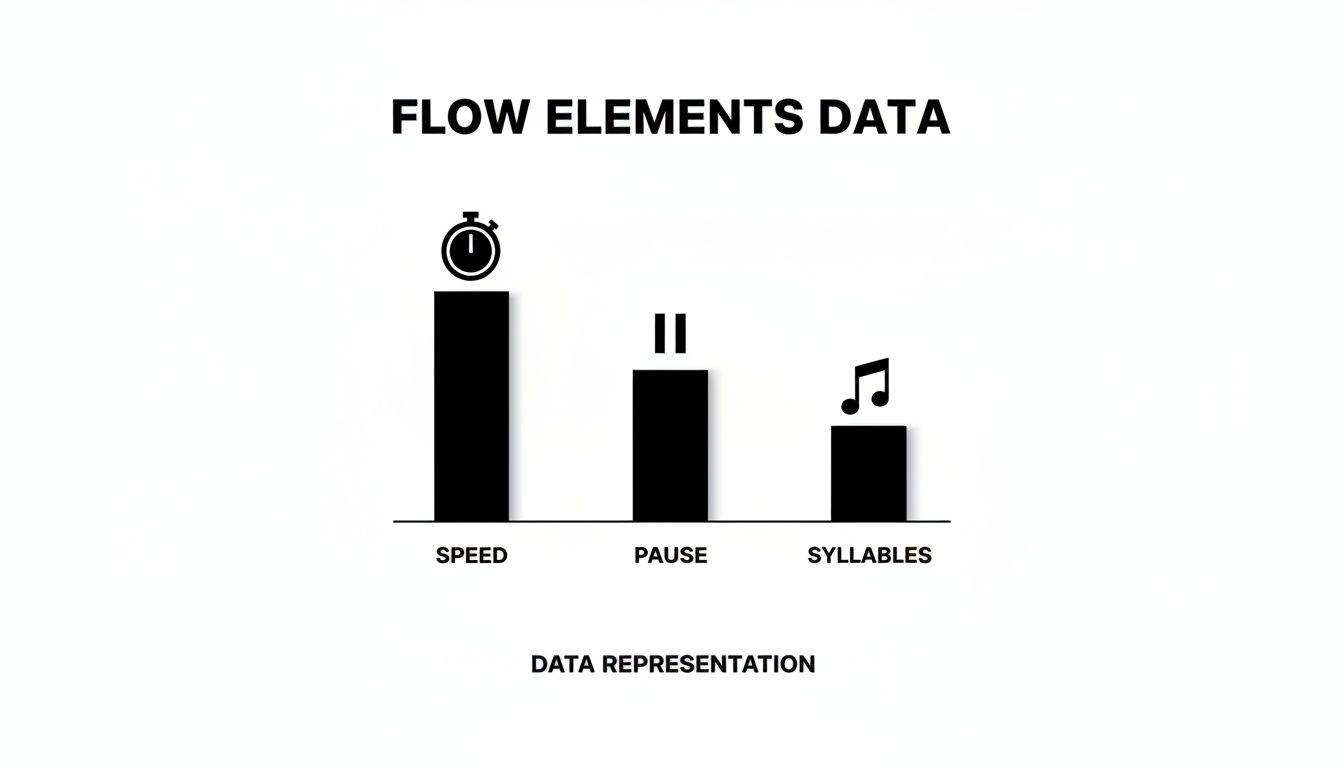
This shows you exactly how playing with speed, silence, and syllable count gives you total control. By seeing how different eras balanced these ingredients, you can bring a ton of new flavor to your own delivery, making sure every line lands with the perfect impact.
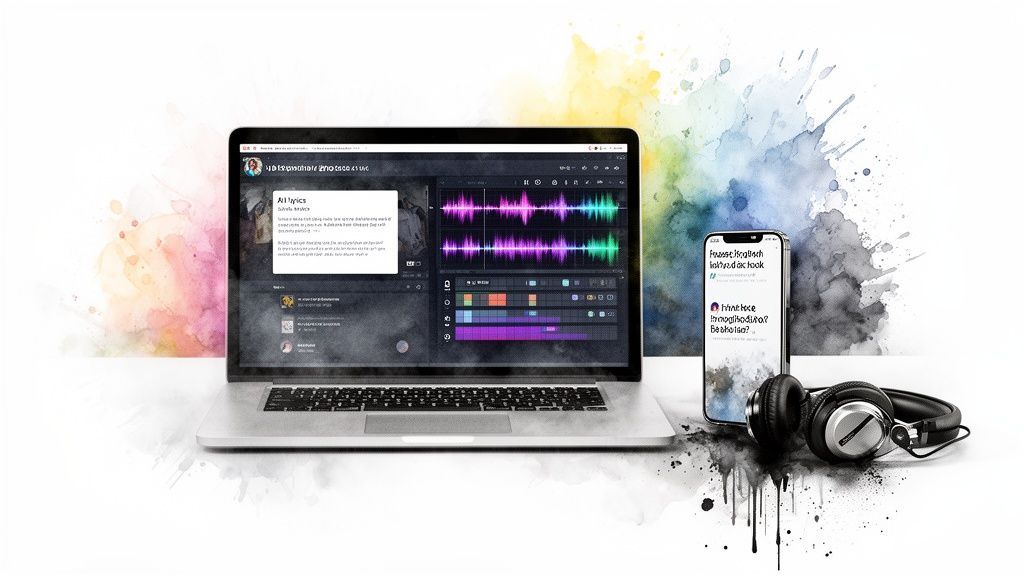
Alright, you’ve put in the real work. The brainstorming, the rhyme schemes, the flow—it’s all there on the page. Now comes the fun part: taking those bars from your notebook and turning them into a legit track that's ready for Spotify.
This is where things get interesting. Modern tools aren't here to replace your genius; they're here to amplify it. Think of AI as your personal production assistant, ready to build a beat, polish a line, or even cook up a music video while you stay locked in your creative zone. It’s all about bringing your vision to life before that spark of inspiration flickers out.
We’ve all been there. Staring at a verse that’s almost perfect but missing that one killer line. Writer's block is a creativity killer, but an AI assistant can be the perfect sparring partner to break through it. The trick? It's all in how you ask.
Throwing a vague prompt like "write a rap about success" at an AI is a recipe for generic, forgettable rhymes. You have to feed it the good stuff—the context, the vibe, the little details that make your style yours.
A truly powerful prompt has a few key ingredients:
Theme and Emotion: What’s the core message and the feeling you're trying to nail? Think, "A confident, motivational verse about crushing self-doubt." Key Imagery and Words: Got specific metaphors or slang you want to use? Tell it. "Include metaphors about climbing a mountain and imagery of city skylines at night." Desired Flow and Rhyme Scheme: Give it some direction. "Needs a fast-paced flow with a mix of internal and multi-syllable rhymes, something like Kendrick Lamar would do."
When you get this specific, you're not asking the AI to write for you. You're asking it to collaborate with you, spitting back ideas that feel like they came straight from your own head. For a deeper dive, check out our complete guide on using an AI lyrics generator to get the best possible results.
Your lyrics need a home, and the right beat is everything. It’s the foundation that sets the mood and dictates the energy of your entire delivery. In the past, this meant spending ages digging for beats online or dropping serious cash on a custom one. Not anymore.
AI music generators let you cook up a custom instrumental just by describing the vibe you're after. Need a dark, aggressive trap beat with heavy 808s? You got it. How about a chill, lo-fi instrumental for a more narrative track? Done.
The real game-changer is crafting a beat that perfectly fits the lyrics you’ve already written, instead of awkwardly trying to cram your words into a pre-made instrumental.
The magic happens when the beat and the vocals feel like they were born for each other. That synergy is what turns a good song into a great one, creating something totally immersive for the listener.
On top of that, more advanced tools can help you generate music with AI from the ground up, letting you build out entire tracks around your lyrics. You’re in the driver's seat for the whole process, from the first rhyme to the final mix.
Let’s be real—in 2024, a song isn't really finished until it has some kind of visual to go with it. To get noticed on TikTok, Instagram, or YouTube, you need a video. This used to be the most expensive, time-consuming part of releasing music. Now, it's just another step in the workflow.
AI video tools have completely flipped the script. You can whip up professional-looking visuals for your music without needing a camera crew or a complicated editing suite.
Here’s a quick and dirty workflow to pull it all together:
Generate Your Core Visual: Start by creating a central image that captures your song's essence. Think of it as an AI-generated album cover or a piece of art that just feels like the track. Bring It to Life: Use an image-to-video tool to animate that static image. You can add effects that pulse with the kick drum or subtle movements that sync with the beat. Add Your Track: Layer your final audio mix over the animated visual. Boom—you’ve got a hypnotic music visualizer ready to share with the world.
This whole process lets you keep the momentum going, taking you from a simple idea to a full-blown, professional release in minutes, not months. This is how you go from just learning how to write rap lyrics to actually getting your music heard.
So, you’re getting into the rap game. You've probably figured out the basics, but a few nagging questions keep popping up and killing your momentum. It happens to everyone. Let’s clear up some of the most common roadblocks so you can get back to what matters: making music.
Honestly? There's no stopwatch for creativity. One day, you might get struck by lightning and crank out an entire banger in an hour. The next, you could spend a whole week wrestling with a single verse until it’s perfect.
Forget about the clock. Some of hip-hop's most legendary tracks were scribbled on a napkin in 15 minutes, while others were meticulously pieced together over months. The real secret is consistency, not speed. Writing for 30 minutes a day, every day, will build your skills way faster than waiting around for a rare eight-hour marathon session.
A song isn't finished when a timer goes off. It's finished when the story hits right and the vibe feels complete. The only deadline that matters is the one you set for yourself.
A great beat is like the perfect scene partner for your lyrics—it sets the mood and brings out the best in your performance. Back in the day, finding instrumentals was a serious mission. Now? You’re swimming in options.
Here are a few go-to spots to find your sound:
YouTube: This is still the undefeated champion for free beats. Just search for "type beats" of artists you admire (like "J. Cole type beat" or "Travis Scott type beat") and you'll find endless inspiration.Beat Marketplaces: Sites like BeatStars and Airbit are the real deal. Producers upload their work, and you can lease or buy beats when you're ready to get serious and release your tracks commercially.AI Music Generators: This is the new frontier. A tool like the one we've built at SendFame lets you literally describe the beat you hear in your head—the vibe, the instruments, the tempo—and it creates a totally original track for you. It’s like having a producer on call, 24/7.
First off, relax. Writer's block isn't a sign you've lost your touch; it's just your brain telling you to switch things up. The absolute worst thing you can do is sit there, staring at a blinking cursor, trying to force a rhyme. That’s a one-way ticket to frustration city.
When the well runs dry, try one of these moves:
Flip the Script: If you're stuck on a deep, emotional track, just start writing something stupid. Write a few bars about your favorite sneakers or the best burrito you ever ate. The point isn't to write a hit, it's just to get the words moving again. Use a Random Prompt: Pull up a random word generator online. Whatever word pops up, you have to build a quick four-bar scheme around it. This trick takes the pressure off of finding the "perfect" topic and just gets you rhyming. Work in Reverse: Instead of trying to come up with that killer opening line, start with the punchline. Think of the dopest, most memorable line you can, and then build the rest of the verse leading up to it. It’s a great way to give your verse direction. Change Your Scenery: Get up. Walk away. Seriously. Go for a walk, put on some music you’d never listen to, or just go do the dishes. Sometimes all it takes is a new environment to shake an idea loose.
Getting unstuck is all about breaking your own patterns. The goal is just to write something, anything, to get past that initial mental hurdle.
Ready to turn those lyrics into a full track? The SendFame AI Music Generator can cook up the perfect beat for your bars in seconds. Stop hunting and start creating. Give it a try right now.
Create Epic

SendFame

Create Epic with SendFame!
Questions: info@sendfame.com