How to Make AI Generated Images a Beginner's Guide

how to make ai generated images
Welcome offer — 56% OFF


video marketing for small businesses: a practical guide to boost growth with strategies, affordable tools, and ideas that engage and convert.
So, you're thinking about video marketing for your small business. Good. Forget calling it a "growth hack"—that's selling it short. Think of video as your secret weapon, the most powerful tool you have to forge real connections and actually grow your business.
It’s the one employee who never sleeps, working around the clock to tell your story, build trust, and show people why they should care about what you do.
Let's cut through the fluff. Adding video to your marketing isn't just another box to check on your endless to-do list. It’s a complete game-changer in how you talk to your customers. For a small business, it's the closest you can get to having a one-on-one chat with every single person who stumbles upon your brand.
Think of your business like a shop on a busy street. Your website and social media profiles are the sign out front and the display in the window. They look nice, but they're static.
Video is like swinging the door open, stepping onto the sidewalk, and personally inviting people inside with a huge smile. It gives your brand a pulse, a personality people can actually connect with.
People buy from people they know, like, and trust. That's the golden rule. While text and photos are fine, video builds that trust at lightning speed.
Seeing is Believing: A quick demo video showing your product in action beats a wall of text every single time. People can instantly see how it works and imagine it in their own lives. Meet the Real You: Putting a face to the name makes your brand feel instantly more authentic. When customers see the real people behind the business, you're no longer just another logo—you're human. That's a massive edge over bigger, faceless competitors. The Ultimate Scroll-Stopper: Our brains are hardwired to notice movement. A well-made video can stop a mindless scroller dead in their tracks and keep them hooked way longer than a static image ever could.
"Video puts a face to your business. When people can see you, hear your voice, and get a sense of your personality, they feel more comfortable buying from you."
This isn’t just some passing trend; it's the new normal. By 2025, a whopping 89% of companies worldwide will be using video in their marketing. Sure, that's a tiny dip from its 2023 peak, but it’s a gigantic leap from just 61% back in 2016. As you can see from these video marketing stats on Wix.com, video has firmly cemented itself as a must-have tool for business.
The best part? The playing field has been completely leveled. Modern tools, especially those running on AI, mean you no longer need a Hollywood budget or a full-on production crew to make amazing videos. You can learn more about how to use AI for marketing in our guide. Let's dive in and get you started creating videos that build a loyal following and turn curious viewers into happy customers.
Jumping into video without a plan is like starting a road trip with no map. Sure, you'll go somewhere, but you’ll burn a ton of fuel, take a bunch of wrong turns, and probably wind up in the middle of nowhere. A solid video strategy is your GPS, making sure every single video you create has a clear purpose and a final destination.
Let's be real: random videos are just noise. Strategic videos, on the other hand, are conversations. The whole point is to stop shouting into the void and start talking directly to the people who actually need to hear from you. This is the foundational work that turns scattered efforts into a reliable engine for growth.
Before you even think about cameras, lighting, or scripts, you have to answer one critical question: What do I want this video to actually do? Your answer is the bedrock of your entire strategy. Vague goals like "get more views" are basically useless. You need specific, measurable objectives.
Are you trying to:
Boost brand awareness? Here, your goal is a simple introduction. You want to get your business in front of people who’ve never heard of you, so the video needs to be engaging, shareable, and stick in their minds. Generate leads? The video has to grab a viewer's interest and then guide them to take a specific next step, like signing up for your newsletter or downloading a free guide. Drive sales? This is all about showing your product or service in action and making a rock-solid case for why someone should buy it. A crystal-clear call-to-action isn't just a good idea here—it's mandatory. Educate your audience? Think how-to guides, quick tutorials, and explainer videos. This kind of content builds massive trust and positions you as the go-to expert, which makes future sales a whole lot easier.
Pick one primary goal for each video. Trying to do everything at once will just confuse your audience and water down your impact.
Okay, so you’ve got your mission. Now, who are you talking to? Creating a "video persona"—a detailed profile of your ideal viewer—is a total game-changer. This isn't just about dry demographics like age and location. It's about getting inside their head.
What are their biggest headaches? What problems are keeping them up at night? What kind of humor do they actually find funny? Knowing this stuff helps you create content that feels like it was made just for them. It's the difference between getting a generic sales pitch and having a helpful chat with a friend who gets it.
A video made for everyone is a video that truly connects with no one. The more specific you can be about your target viewer, the more powerful your message will become.
This whole process really boils down to three simple steps that take you from first contact to real business growth.
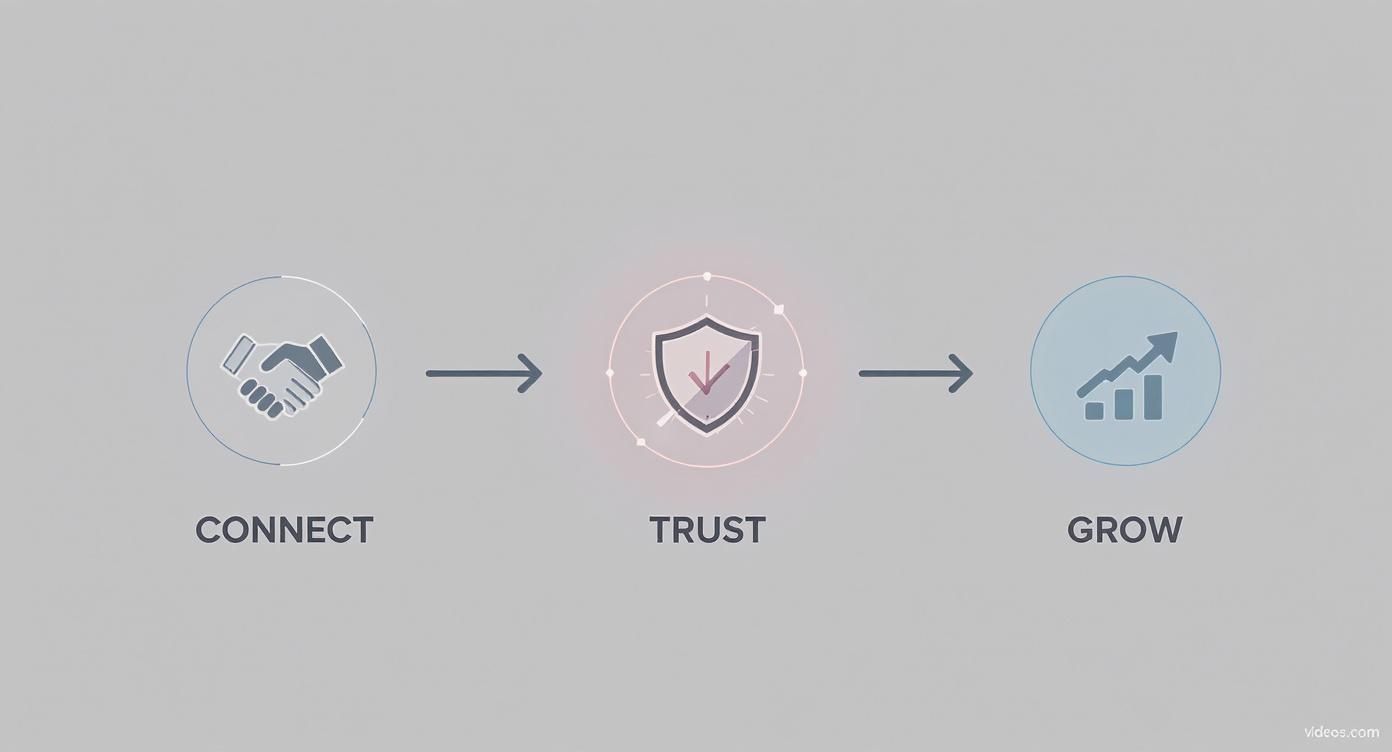
As you can see, every great video strategy starts by making a connection. From there, you build trust. And that trust is what ultimately leads to measurable growth.
Now for the fun part. Let's mix your goal with your audience knowledge to brainstorm some killer video topics. Say your goal is to generate leads and you know your audience struggles with time management. Bam! A video series on "5-Minute Productivity Hacks for Busy Entrepreneurs" is a perfect fit.
Don't overcomplicate it. Start by mapping out three or four core "content pillars"—big themes that directly solve your audience's problems and tie back to what you sell. If you need a little inspiration, check out these digital marketing campaign examples to see how others are structuring their content.
As you get your strategy in place, you’ll also have to decide if you're going to manage it all yourself or get some help. For some businesses, exploring the pros and cons of outsourcing social media marketing is a worthwhile step. This groundwork is what ensures every video you make has a purpose and moves your business forward, one view at a time.
Let's kill the biggest myth in video marketing right now: you do not need a Hollywood budget to make killer videos. You don't even need a fancy camera. The most powerful video creation tool you have is probably sitting in your pocket this very second.
The real magic isn't in spending a fortune on gear; it's about knowing which tools to use to make your content pop. This is your no-fluff guide to the gear and software that actually matters. We'll go from simple smartphone hacks to editing apps so easy you’ll feel like a pro overnight. Forget the intimidating tech talk—we're focused on smart, affordable solutions that get you results.
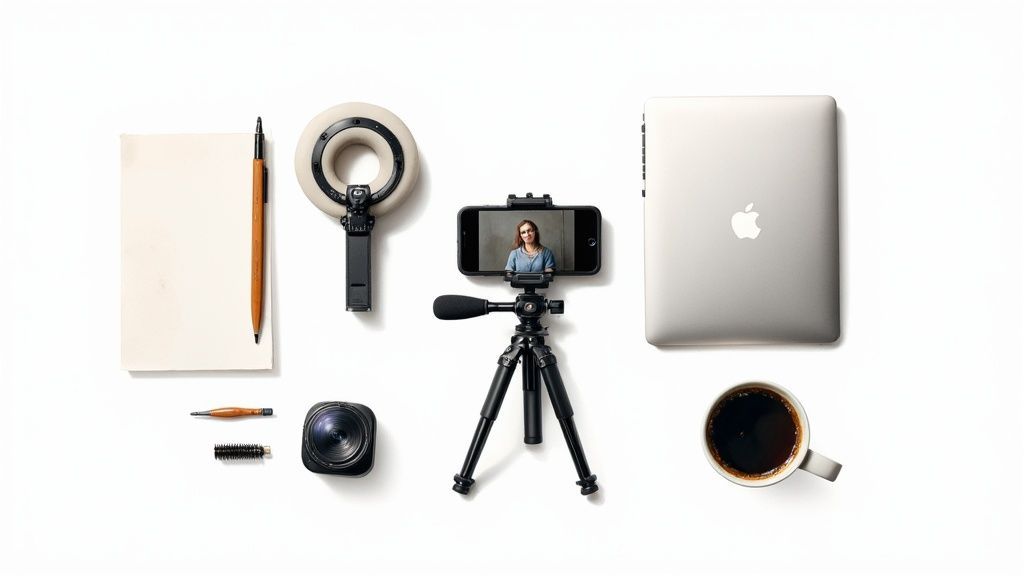
This is all it takes. Good lighting and a steady shot will beat an expensive camera any day of the week.
Your phone is a video production powerhouse. Modern iPhones and Androids shoot in glorious 4K, which is more than enough resolution for any social media feed, website, or ad campaign.
The trick is to accessorize. A few cheap add-ons can fix the most common mistakes that scream "amateur."
A Solid Tripod: Nothing kills a video faster than shaky, handheld footage. A simple tripod instantly makes your shots look stable, intentional, and way more professional. An External Mic: Your phone’s built-in microphone is designed to pick up everything, including the wind, your air conditioner, and the dog barking next door. A tiny clip-on lavalier mic isolates your voice, delivering crisp, clear audio. Honestly, good sound is often more important than the video itself. Good Lighting: You don't need a pro lighting rig. A simple ring light provides soft, flattering light that gets rid of weird shadows. Or, even better, just film near a big window. Natural light is free and looks fantastic.
Editing used to be the part where everyone gave up. It was complicated, expensive, and took forever. Not anymore. Today’s tools are so intuitive, you can trim clips, add text, and drop in music without wanting to throw your computer out the window.
Plenty of amazing options are free or have super cheap plans:
CapCut: This is your go-to for social media. It's built for creating trendy TikToks and Reels, loaded with effects and templates that are ready to go. Canva: Yep, the same tool you use for graphics has a surprisingly robust video editor. It’s perfect for creating branded videos with slick text overlays and simple animations. Descript: This one is a legitimate game-changer. It transcribes your video, then lets you edit the footage by just editing the text. Want to cut a sentence? Just delete it from the transcript, and poof—it's gone from the video.
The best editing software is the one you’ll actually open and use. Don’t get stuck in an endless loop of "research." Pick one, watch a five-minute tutorial on YouTube, and just start making stuff.
Alright, let's talk about the ultimate cheat code for busy entrepreneurs: AI-powered video creation. These tools are built to handle the most draining parts of the process, from writing a script to editing the final cut. This isn't some far-off future tech; it’s a seriously practical way to pump out high-quality content without the grind.
Platforms like SendFame are leading the charge here. Imagine generating a personalized video message from a celebrity persona, whipping up a custom song for your new campaign, or turning a boring product photo into a slick, animated ad. And you can do it all in seconds.
This technology is a massive leg-up in video marketing for small businesses. Instead of blocking out entire days to script, shoot, and edit, you can generate unique, engaging content with a few clicks. It lets you create more personalized videos at a much higher volume—perfect for targeted outreach or just keeping your social media feeds fresh.
If you want to see what else is out there, you can dive into some of the best AI video creation tools on the market. These tools do the heavy lifting, so you can get back to thinking about the big picture.
Okay, you've got your strategy mapped out and your tools are ready to go. Now for the really fun part—making videos that don't just rack up views, but actually get people to care. Creating content that someone actively chooses to watch is an art, but trust me, it's one you can master without ever setting foot in a film school.
The big secret? Ditch the stiff, corporate sales pitch. Instead, focus on creating something that's genuinely useful, wildly entertaining, or truly inspiring. Your mission isn't to interrupt what people are doing; it's to become the thing they want to watch.

Think of this section as your playbook for producing videos that forge a real connection. We'll get into everything from simple scripting hacks to slick editing tips that will keep your audience glued to the screen from the very first frame.
If you sell a product or service that takes a little explaining, an explainer video is about to become your new best friend. It’s your elevator pitch on steroids—a short, snappy video that instantly answers the question, "So... what is it you guys actually do?"
The magic formula for a killer explainer is the classic Problem-Solution-Result framework.
Start with the Problem: Don't you dare lead with a boring list of features. Kick things off by describing a nagging pain point that your ideal customer knows all too well. You want them nodding along, thinking, "Yep, that's my life." Introduce Your Solution: Now that the problem is fresh in their mind, bring in your product or service as the hero of the story. Show—don't just tell—exactly how it swoops in to save the day. Show the Happy Result: Finally, paint a vivid picture of what their life looks like after using your solution. Show the relief, the success, the newfound freedom. This is the part that makes people pull out their wallets.
Keep it short and sweet. The most effective explainer videos usually work their magic in under 90 seconds.
Let's face it, people are nosy. We love seeing how the sausage gets made. Pulling back the curtain with behind-the-scenes (BTS) content is one of the easiest and most potent ways to humanize your brand and build a tribe of loyal fans. It’s a powerful reminder that you're not some faceless corporation, but a team of real people who are nuts about what they do.
You don't need a polished script for this. Just whip out your phone and show people:
The care and detail that goes into packing an order. A sneak peek of a new product you’re tinkering with. A "day in the life" at your office, workshop, or store. Your team celebrating a small win together.
Authenticity is your superpower. In a world drowning in perfectly curated, glossy content, showing the unpolished, genuine side of your business is what builds deep, lasting trust.
These videos don't have to be epic productions. In fact, the boom in short-form videos (think 30 seconds to two minutes) has been a total game-changer. An incredible 73% of consumers say these quick snippets are the most effective. Better yet, video is a sales machine; a whopping 89% of viewers report being convinced to buy something after watching a brand's video. You can find more eye-opening video marketing stats on Wix.com.
You can shout from the rooftops about how amazing your business is, but it will never be as powerful as a happy customer saying it for you. Customer testimonials are social proof in its purest, most believable form. They instantly melt skepticism and build the kind of credibility money can't buy.
Getting a fantastic testimonial is way easier than you think. Ditch the long, boring list of questions. Instead, just ask one simple, open-ended question: "What was life like before you found us, and what has changed since?"
Then, shut up and let them talk. Their natural enthusiasm and authentic story will do all the heavy lifting. Just edit their response down to the most powerful 30-60 seconds, and you've got a golden marketing asset you can use for years.
This isn't just about creating powerful social proof; it gives you a treasure trove of raw, authentic content. And if you're looking for more tips on making your content impossible to ignore, check out our guide on how to create viral content.
https://www.youtube.com/embed/80N8cBp2LvU
Making a killer video is like baking an amazing cake. You can spend hours getting the ingredients just right and following the recipe perfectly, but if you just leave that beautiful cake sitting on your kitchen counter, no one's ever going to taste it. Creating the video is only half the job; getting it in front of hungry eyes is where the real work begins.
The good news? You don't need a Hollywood-sized ad budget to get noticed. A smart distribution plan is all about putting your video in the right places, at the right time, so the right people can't help but stumble upon it. Think of it less like shouting into a megaphone and more like whispering a secret to a friend who you know really wants to hear it.
This means going way beyond just dumping your video onto YouTube and hoping for the best. A solid strategy uses every digital asset you have to its full potential.
Your videos need homes all across the web, not just one single address. Each platform gives you a unique way to connect with your audience, so let's break down the prime real estate for your content.
Your Website Homepage: This is your digital storefront, the first thing many people see. Placing a compelling brand story or a punchy explainer video here immediately shows visitors who you are and what you do. It's the ultimate welcome mat. Social Media Feeds: This one’s a no-brainer, but you have to be strategic. A polished, professional demo video might be perfect for your LinkedIn audience, while a fun, fast-paced behind-the-scenes clip is practically built for Instagram Reels or TikTok. Always tailor the content to the platform. Email Newsletters: Your email list is pure gold. These are people who have already raised their hands and said they want to hear from you. Embedding a video in your newsletter can dramatically boost click-through rates and get people re-engaged with your brand. Product Pages: Got a video showing your product in action? Put it right there on the product page! Seeing is believing, and for a whopping 8 out of 10 people, watching a video has directly influenced their decision to buy.
The goal isn't just to post your video everywhere; it's to place it where it solves a problem or answers a question for the viewer in that specific context. A "how-to" video on a relevant blog post is incredibly helpful; a random product ad is just noise.
Never forget that YouTube is the world's second-largest search engine, right behind its parent company, Google. Optimizing your videos for search (what we call video SEO) helps people find you when they're actively looking for the solutions you provide. It’s like putting a giant, flashing sign on your video that says, "Hey, Google! I'm right here!"
Here’s a quick-start checklist to get you going:
Use Keywords in Your Title: Put yourself in your customer's shoes. What would they type into the search bar? Get those words right into your video title. Write a Detailed Description: Don't be lazy here. Use the description to explain what the video is about, sprinkle in relevant keywords, and always include links back to your website. Create an Eye-Catching Thumbnail: Your thumbnail is your video's book cover. Make it bright, clear, and compelling enough to make someone stop their endless scrolling and click.
While distributing your videos through social media and your own website is vital, don't overlook other channels. Targeted video content can also help you succeed with strategies for boosting sales on platforms like Fiverr. Each distribution channel, from your social feeds to niche marketplaces, is a fresh opportunity to connect with a new segment of your audience. By thinking strategically about where your videos live, you turn each piece of content into a hard-working asset for your business.
Making cool videos is fun, but let's get real—you're in business to make money, not just to go viral. You absolutely have to know if your hard work is paying off. Measuring your video marketing success isn't about drowning in a sea of spreadsheets; it's about seeing a clear line from your videos to your business's growth.
Think of it this way: your video is a fishing lure. You toss it into the vast ocean of the internet, but you have no idea if you've caught anything until you start reeling it in. Analytics are how you reel in that line. They tell you if you're getting bites, who's nibbling, and whether it’s time to change the bait.
The first number everyone gets obsessed with is the view count. Sure, it feels great to watch that number go up, but it’s mostly an ego boost. A "view" can be as short as three seconds before someone scrolls past. It just tells you your lure hit the water, not that any fish were interested.
To get the real story, you've got to look under the hood.
Watch Time and Audience Retention: This is where the gold is. It tells you how long people are actually sticking around. If you see a massive drop-off after 10 seconds, your hook is weak. If they watch all the way to the end, you've got them hooked. Click-Through Rate (CTR): You did put a link or a call-to-action in there, right? The CTR shows you what percentage of viewers actually clicked it. This is a direct measure of how compelling your video was.
Your goal isn't just to get views; it's to earn attention. High watch time and a solid click-through rate are the true signs that your video marketing is hitting the mark.
Alright, let's connect these numbers back to what actually matters: your bottom line. How do you prove your video budget is delivering a real return on investment (ROI)? You do it by tracking the metrics that feed directly into your business goals.
There are a few ways to slice this. The most popular metrics marketers track are leads and clicks (49%), followed closely by brand awareness (40%), customer engagement (36%), and straight-up sales performance (30%). You can dive deeper into how marketers measure video success on siegemedia.com.
What this tells us is there’s no single “right” way to measure success. It all comes back to what you were trying to achieve in the first place.
Want more leads? Track how many people filled out your contact form after clicking the link in your video. Building brand awareness? Keep an eye on shares, comments, and mentions. Is the chatter about your brand getting louder? Driving sales? Use a unique promo code in the video or send viewers to a special landing page where you can track conversions.
By zeroing in on these goal-specific metrics, you stop being just a video creator and become a business builder. You get the hard data you need to ditch what isn't working, double down on what is, and finally prove that your video marketing is one of the smartest moves you can make.
Alright, let's tackle those nagging questions that pop into your head right before you’re about to hit the record button. Jumping into video marketing can feel a bit like staring at a blank page, but trust me, getting started is the hardest part.
Let's clear the air on the most common worries every small business owner has.
First, the elephant in the room: money. There's a common myth that you need a Hollywood-level budget and fancy equipment to even think about making a video. That's just not true. Honestly, the powerful camera sitting in your pocket—your smartphone—is all you really need to get going.
Good lighting (a window works wonders!) and clear audio are way more important than having the latest and greatest camera. Your audience wants to see and hear you clearly; they don't care about the brand of your gear.
Okay, so the gear isn't a problem, but what about time? You're already wearing a dozen different hats, and "filmmaker" probably wasn't on the job description. The secret is to start small and work smart, not hard.
You can plan, shoot, and post a quick, punchy video for social media in less than an hour. Seriously. Don't fall into the trap of thinking you need to produce a new blockbuster every single day. Consistency is king, not volume. Focus on creating one or two really good videos a week. Once you find your groove, you’ll get faster, and you can ramp things up without burning out.
Key Takeaway: The biggest roadblock is usually overthinking it. Your first video won't be perfect, and that's completely fine! The goal here is connection, not an Oscar nomination. People respond to authenticity, not slick, over-produced perfection.
Sooner or later, it happens to everyone: the creative well runs dry. But don't panic! Your daily business operations are a goldmine of fantastic video ideas. You just need to know where to look.
Here are a few places to start digging for gold:
Solve a Problem: What's the one question customers ask you all the time? Turn the answer into a quick, super-helpful video. Boom. You're a problem-solver. Pull Back the Curtain: People are nosy—in a good way! Give them a behind-the-scenes peek at how you create your product or deliver your service. It builds trust and a real connection. Pass the Mic: Let your happy customers do the talking for you. Feature a testimonial or a success story (just make sure you get their permission!). Nothing is more powerful than a real person vouching for you.
Ready to create stunning videos in seconds without all the hassle? SendFame uses AI to generate everything from celebrity messages to custom music videos, giving your marketing an instant boost. Create your first video with SendFame today
Create Epic

SendFame

Create Epic with SendFame!
Questions: info@sendfame.com