Make Songs with ai: A Quick Guide to AI-Powered Music
make songs with ai
Welcome offer — 56% OFF


Discover the best text to speech software for your creative projects. We compare top AI voice generators on realism, features, and use cases to help you choose.
Figuring out the best text to speech software really depends on what you're trying to accomplish. For mind-blowingly realistic voice cloning, ElevenLabs is the name on everyone's lips. If you're working with a team and need a bunch of different voice styles, Murf AI is a powerhouse. And for a massive, diverse library of voices for any project you can dream up, Lovo.ai is hard to beat. These tools have gone way past the robotic voices of yesteryear, offering up audio with real emotion that can completely change the feel of your content.

Welcome to the new world of content, where your words can quite literally speak for themselves. The tech behind text-to-speech (TTS) has taken a quantum leap forward, leaving those clunky, monotone computer voices in the dust. Today's AI voices are startlingly realistic, full of nuance, and can genuinely hook an audience.
This is exactly why so many top-tier marketers, creators, and influencers are ditching the hassle of recording sessions for instant, studio-quality audio. It's a massive win for anyone who values their time and wants to scale up. The market numbers tell the same story: the global text-to-speech software market was valued at USD 3.19 billion in 2024 and is expected to rocket to USD 12.4 billion by 2033. This isn't just a niche tool anymore; it’s becoming a fundamental part of modern content strategy. You can read more about the TTS market's incredible growth on straitsresearch.com.
We're often told that video is king, but let’s be honest—audio is the secret sauce that makes it all work. Have you ever tried watching an explainer video on mute? It just doesn't land. A great voiceover is what grabs and holds attention, breaks down complicated topics, and forges a genuine emotional connection with your audience.
Modern TTS software hands creators a powerful set of tools to:
Boost Engagement: A crisp, professional voice can turn a simple marketing video, podcast, or social media clip into something truly compelling, far beyond what silent text or a shaky DIY recording can do. Increase Accessibility: Offering audio versions of your work opens the door to a much wider audience, including people with visual impairments or different learning preferences. Scale Content Production: Think about it. You could produce dozens of narrated videos, each in a different language, without ever booking a studio or hiring a voice actor. TTS makes that possible.
The explosion of AI voices is part of a much bigger picture, as artificial intelligence continues to shake up creative industries. For a look at how this is playing out elsewhere, check out these insights on AI integration in publishing.
So, with all these options, how do you pick the right tool? It's not just about finding a voice that sounds human. It’s about finding one that sounds like your brand. The best text to speech software gives you granular control, letting you tweak everything from emotional inflection to pacing and tricky pronunciations.
If you're curious about where this is all heading, our guide on how AI voice actors are changing the industry is a great read. For now, let's lay out the key things you need to look for when comparing the top players and show you how to tap into the massive potential of AI-powered audio.
Let’s be honest: not all AI voices are created equal. When your brand's reputation is on the line, you can't afford a robotic, monotone narrator. To really find the best text to speech software, you have to look past the marketing hype and dig into what actually works for real-world creative and marketing projects.
That’s why we came up with a solid framework for putting these tools to the test. It’s a five-pillar system we use to see how each platform holds up under pressure. We’re not just looking for a "human-sounding" voice; we’re looking for the right voice and the right tool for high-stakes jobs, like a viral video or an engaging podcast. Every comparison in this guide is built on this foundation, so you can see the subtle differences and pick a winner with confidence.
First things first: how does it actually sound? We’re listening for more than just a lack of robotic stiffness. We focus on the little things that make a voice feel real, like the natural rise and fall of intonation, the rhythm of its cadence, and its overall pacing. A truly great AI voice can convey excitement, seriousness, or even a bit of empathy without sounding like it’s just reading a script.
Can it navigate a long, tricky sentence without fumbling? Does it know which words to hit for emphasis? This is all about the performance—judging how well the AI can capture the genuine art of human speech.
Key Takeaway: Realism isn't just about sounding human. It's about sounding emotionally right for the moment. The best tools have voices that can shift their delivery to match the mood you're going for.
Your audience is all over the world, so your voiceovers should be, too. This pillar is all about the depth and quality of a platform’s language library. We don’t just count how many languages are on the list; we check the authenticity of the regional accents.
It’s one thing to offer "English." It’s another thing entirely to provide distinct, high-quality American, British, Australian, and South African accents that actually sound like they come from those places. This is a game-changer for localizing marketing campaigns or making content that connects with specific international audiences.
A great voice is just the start. The real magic happens when you can step in and direct the performance. Here, we get into the nitty-gritty of the fine-tuning features each platform offers. This includes things like:
Speed and Pitch Adjustments: Simple controls to speed things up, slow them down, or change the vocal tone. Emphasis and Pauses: The ability to add a dramatic pause before a big reveal or put stress on a specific word for impact. SSML Support: For the power users, Speech Synthesis Markup Language (SSML) offers code-level control over every little detail of pronunciation and inflection.
This kind of control is what separates a decent voiceover from a perfectly polished one. For anyone serious about audio, exploring different AI content creation tools can open up a world of possibilities for refining your work. The more control you have, the closer you can get to your creative vision, making sure every word lands exactly as you intended.
Alright, let’s get down to the main event. Picking the best text to speech software can feel like trying to find the perfect actor for a lead role. Each one has its own style, a unique set of skills, and a crowd of die-hard fans. Instead of just rattling off features, we’re going to frame this as a strategic showdown, digging into the real differences between the heavyweights: Murf AI, Lovo.ai, ElevenLabs, and Play.ht.
We'll look at why you’d pick one over the other for actual, on-the-ground projects. Because let’s be honest, the most realistic voice in the world might not be the right choice if another platform offers an integration that saves your team ten hours a week. It's all about finding the right tool for the job.
This little flowchart can help you map your project needs to the right kind of tool before you even start looking.
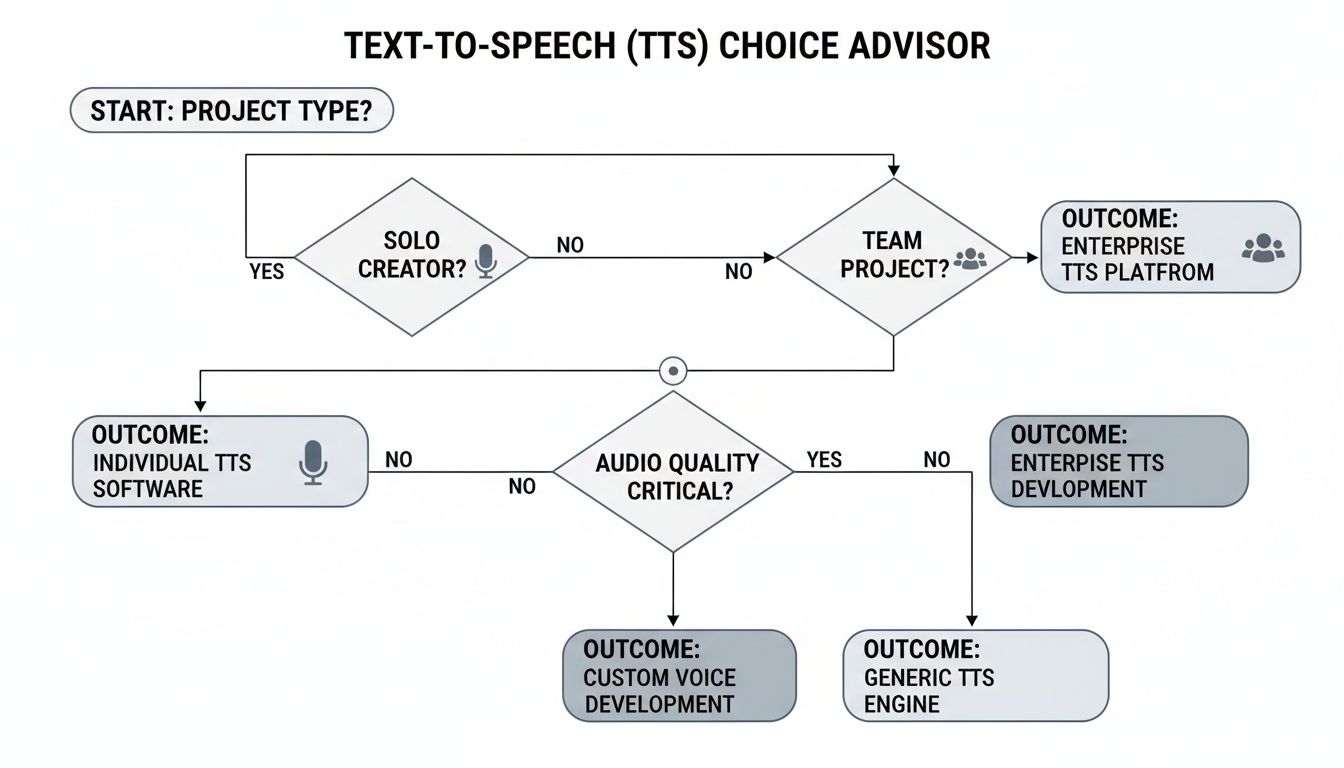
As you can see, where you're starting from—whether you're a one-person show or a big creative team—makes a huge difference in which platform will feel like it was built just for you.
Think of Murf AI as a complete audio production suite that just happens to live in your browser. It’s not just for generating a voiceover; it’s for crafting a fully finished audio track. Murf throws in tools for adding background music, syncing voice to video, and even has a built-in grammar checker, making it a true one-stop-shop.
Best For: Corporate Trainers and Video MarketersIf you're cranking out polished e-learning modules, slick marketing videos, or corporate presentations, Murf AI is your workhorse. Its magic lies in its consistency and its robust toolset for projects that need more than just a raw audio file. The voices are consistently clear, professional, and reliable.
The collaboration features are where it really shines. You can spin up team workspaces, share projects, and gather feedback right on the platform. For marketing agencies or corporate training departments, that streamlined workflow is a game-changer.
Firing up Lovo.ai, particularly its Genny platform, is like stepping into a vocal library of Alexandria. The sheer variety is staggering. With a massive collection of voices spanning countless languages, accents, and emotional tones, it's a creative playground.
Best For: Content Creators and Podcasters at ScaleFor YouTubers, podcasters, or anyone who needs a wide array of vocal styles for different characters or show segments, Lovo is a dream come true. The platform is always adding new voices, so your content never gets stale. Their API is also rock-solid, making it a fantastic choice for developers looking to bake voice generation into their own apps.
Key Differentiator: Lovo.ai bets it all on its absolutely massive voice library. While others are chasing a handful of hyper-realistic voices, Lovo focuses on giving you an ocean of options, ensuring you can find the perfect voice for practically any wild idea you come up with.
ElevenLabs didn't just enter the scene; they kicked the door down and completely reset our expectations for voice realism. This platform uses some seriously advanced AI to generate audio that is often impossible to distinguish from a human speaker, complete with natural hesitations, emotional weight, and subtle vocal quirks. When realism is the only thing that matters, this is where you go.
Best For: Audiobook Narrators and High-End Voice CloningThe voice cloning tech is the crown jewel here. Give it a small audio sample, and it can create a digital replica of a voice that is stunningly accurate. This is a godsend for creators who want to narrate projects in their own voice without spending days in a recording booth, or for audiobook producers who need an absolutely consistent narrator.
This relentless push toward hyper-realism is powered by major leaps in neural TTS technology, which dominated the market revenue share in 2023. This innovation is fueling a projected market explosion of USD 3.99 billion by 2029, all thanks to its ability to deliver customizable accents and emotions. You can read the full research about the text-to-speech market on technavio.com to see just how fast this space is moving.
While Play.ht has a fantastic library of high-quality voices, its real superpower is how well it plays with other software. The platform was clearly built with developers in mind, boasting a robust, well-documented API that makes it the go-to for businesses building scalable, automated audio solutions. Think of it as the high-performance engine you can drop into your own product.
Best For: Developers and Businesses with Custom WorkflowsIf you're building an app that reads articles aloud, creating automated IVR systems for a call center, or plugging voice into any custom software, Play.ht was made for you. Their laser focus on seamless integration makes them a reliable partner for tech-heavy projects. They also pack in great features for podcasters, including a slick embeddable audio player.
If you want to get a better sense of the different vocal personalities out there, be sure to dive into our detailed breakdown of the best AI voices available today.
Here's a side-by-side look at how these platforms stack up, helping you pinpoint the best fit based on what matters most to your project.
Platform Best For Voice Realism (Score/10) Key Customization Features Pricing Model Murf AI Corporate Trainers & Marketers 8/10 Voice changer, video syncing, grammar check, collaboration tools Subscription, Free Trial Lovo.ai Content Creators at Scale 8.5/10 Massive library (500+ voices), emotional styles, producer mode Subscription, Free Plan ElevenLabs Audiobook Narrators & Cloning 9.5/10 Hyper-realistic voices, voice cloning, speech-to-speech Freemium, Pay-as-you-go Play.ht Developers & Custom Workflows 9/10 Robust API, podcasting tools, ultra-realistic voices, team access Subscription, Pay-as-you-go
This table cuts through the noise, showing that the "best" tool really depends on whether you value an all-in-one studio, a massive library, pure realism, or developer power.
So, who takes the crown? The boring but true answer is: there's no single winner. The best platform is the one that’s best for your specific job.
Choose Murf AI if you need a polished, all-in-one production workflow with killer team collaboration features. Go with Lovo.ai when your project demands a massive and diverse library of voices to match any creative brief you can dream up. Pick ElevenLabs when your number one goal is mind-blowing vocal realism or you need to clone a specific voice. Opt for Play.ht if you're a developer or business that needs a powerful API and deep integration capabilities.
Each of these leaders in the text to speech software world has masterfully carved out its own territory. Your job is to figure out which territory your project lives in.
Knowing which TTS platform sounds the most human is great, but let's be real—the goal is to put that voice to work. We're here to save time, scale our content, and ultimately, make money. The magic of the best text to speech software really comes alive when you plug it into specific, high-impact workflows.
So, let's move past the theory and get our hands dirty. These aren't just vague ideas; they're practical plays where these tools become absolute game-changers for creators and businesses alike. It's all about matching the right tool to the right job to unlock efficiencies you didn't even know were on the table.
Picture this: you're launching a hot new product and need video ads for five different countries. The old way? Hire five voice actors, juggle recording sessions across time zones, and pray the audio quality is somewhat consistent. It’s a logistical migraine that can grind your campaign to a halt.
Now, imagine doing it all from one place. A TTS tool with a deep bench of high-quality international voices and accents, like Lovo.ai, becomes your mission control.
Here’s how that frantic week of work turns into a single afternoon:
Script It: Lock down your master script in English. Translate It: Get it professionally translated for your target markets (German, Spanish, Japanese, you name it). Generate It: Hop into your TTS platform, pick a killer voice for each language, and generate the audio files. Boom, done in minutes. Sync It Up: Drop the new audio tracks into your video.
Just like that, you've gone global. Your brand sounds authentic in every market, the quality is perfect across the board, and you did it all before lunch.
Key Insight: For marketers, the best TTS software isn't just about a pretty voice. It's about the depth and authenticity of its language library. The power to instantly generate ten different accents for an A/B test? That's a massive competitive edge.
The content treadmill for TikTok, Reels, and Shorts never stops. As a social media manager, the daily grind of scripting, shooting, editing, and narrating a new video is a one-way ticket to burnout city. This is where tools with freakishly realistic voice cloning, like ElevenLabs, step in to save the day.
Instead of hitting record every single day, you clone your own voice (or a chosen brand voice) just once. From that point on, your workflow is simple: type the script, hit generate, and get a perfect narration in that same familiar voice. This completely decouples audio from video production, letting you batch-record a week's worth of voiceovers in under an hour. You keep that personal, human touch without being handcuffed to a microphone. Want to go deeper? Check out our guide on using AI for content creation.
In the world of corporate learning and development, consistency is king. Nothing screams "unprofessional" like a training library with a jumble of different narrators and shoddy audio. It's distracting and undermines the material. This is a problem tailor-made for a platform like Murf AI, which is built for collaboration and studio-grade output.
Imagine the L&D department selecting one polished AI voice as the official "voice of company training." Every new module, every compliance update, every onboarding video is narrated by this same, consistent voice. The experience is seamless. Better yet, if a regulation changes and you need to update one sentence in a 30-minute course, you don't have to re-hire a voice actor. You just edit the text, regenerate that one clip, and you're done.
This isn't just a niche trend; it's part of a massive market shift. The consumer electronics sector is a huge driver, valued at USD 4.42 billion in 2024, thanks to the explosion of smart devices that rely on voice. This demand for hands-free interaction is spilling over into cars, healthcare, and education, making TTS a core technology. You can discover more insights about the TTS market on researchandmarkets.com. When you zoom in, you see how specialized tools like an English to Bengali voice translator are solving very real, practical problems.
The best text-to-speech software is a game-changer, no doubt. It gives you a crystal-clear audio file that can elevate any project. But let's be real—that voiceover is often just the first domino. Now you have the perfect audio, but you still need a video to go with it, some background music, and maybe even a recognizable face to deliver the message.
Before you know it, you're drowning in browser tabs, juggling three or four different tools. You’ve got one for the voice, another for video editing, a third for royalty-free music, and maybe a fourth for graphic design. This is the exact moment where brilliant ideas get stuck in technical mud and creative momentum grinds to a halt.
So, what if generating a voice wasn't the end of the process? What if it was the very beginning of a seamless, all-in-one creative experience?
Imagine this: you go from a simple script to a fully produced video message, delivered by an AI celebrity persona, in just a few minutes. That’s the quantum leap platforms like SendFame are making. Instead of just handing you an audio file, SendFame acts like a complete AI-powered content studio, where the voice is just one ingredient in a much bigger recipe.
The whole idea is to obliterate the bottlenecks. You’re not exporting an MP3 from one app just to import it into another. The entire workflow, from concept to finished video, happens in one place.
You start with a script: Just type out what you want to say. You choose a persona: Pick from a roster of AI-generated celebrity personalities to be the face of your message. You get it all, instantly: The platform smashes together the voice, a dynamic video of the persona, and even background music into a single, ready-to-share asset.
This integrated approach is a massive win for anyone who needs to pump out content quickly without it looking cheap. It's not just about finding a good voice; it's about creating an entire, engaging package around that voice.
The Big Shift: The future of content creation isn't about mastering a dozen different tools. It's about finding platforms that handle the entire production pipeline, letting you focus on the message, not the mechanics.
For marketers and influencers, speed and impact are the name of the game. The pressure to feed the content beast on social media with a constant stream of high-quality ads and promotions is intense. Juggling multiple software subscriptions and learning different interfaces is a productivity killer.
An integrated platform like SendFame completely flattens that process. Just think about the old way of making a short promo video:
The Old Way: Write script → find TTS software → generate voiceover → find stock video → find a video editor → sync audio and video → find royalty-free music → mix everything → export. (Phew.) The New Way: Write script → choose your celebrity → click "Generate."
This approach fundamentally changes the economics of content production. It's not just about saving time; it's about making high-quality, personality-driven video accessible to everyone, not just people with editing skills.
It transforms content creation from a multi-step, technical nightmare into a simple, creative act. Need a personalized birthday shout-out? A viral marketing clip? A unique event invitation? You can now do it all without any technical headaches.
While dedicated TTS tools will always have their place for pure audio work, platforms like SendFame show us what's next for creators who need the whole package—voice, video, and a dash of star power—all in one click.
Diving into AI voice generation can feel a little overwhelming at first. You've seen the magic, you've heard the results, but a few practical questions are probably still rattling around in your head. Let's cut through the noise and get straight to the answers you're looking for.
Think of this as your personal FAQ for getting started with TTS, from the legal stuff to getting that perfect, human-like sound.
Honestly, the "most realistic" crown gets passed around depending on what you're trying to do. If you're after those subtle, human-like breaths and emotional shifts, a generative AI powerhouse like ElevenLabs is usually at the top of the list. They're incredible at capturing the tiny imperfections that trick our brains into thinking we're hearing a real person.
But "realistic" isn't always about sounding like a dramatic audiobook narrator. For a punchy marketing video, a super clear, energetic voice from a tool like Murf AI might actually perform better. The best advice? Grab a few lines from your own script and run them through the free trials of a couple of different platforms. You'll know the right one when you hear it.
Yes, you absolutely can! In fact, some of the biggest channels out there are built entirely on AI voices. The one non-negotiable rule you have to follow is having a commercial license.
The secret is sticking with a professional, paid TTS service. When you subscribe, you're not just buying access to the tech; you're buying the commercial rights to use every single audio clip you create. That means you're clear to use them in monetized YouTube videos, podcasts, advertisements—you name it.
The cost of TTS can be all over the map. Most services have a free plan that lets you kick the tires and test out different voices, which is a great starting point. When you're ready to get serious, paid plans generally start around $15 per month and can climb to over $100.
What's the difference? It usually comes down to a few key things:
Audio Output: How many hours of voice generation you get each month. Voice Quality: Access to the ultra-realistic, premium AI voices. Voice Cloning: The tech to create a digital copy of a specific voice (with permission, of course). Team Features: Tools for sharing projects and working with others.
If your projects are more sporadic, look for platforms that offer a pay-as-you-go option. It can be a much more cost-effective way to get high-quality voiceovers without a monthly commitment.
For sure—as long as you play by the rules. When you use a legitimate TTS provider, you're in the clear. These companies have done the legal legwork to secure the rights to their voice models, and your subscription is your license to use the audio commercially.
Where you run into serious trouble is with unauthorized voice cloning. Creating a copy of someone's voice without their explicit, written permission is a huge ethical and legal minefield. Stick with established platforms that are upfront about their commitment to ethical AI, and you'll be fine.
Ready to create content that goes beyond just a voiceover? SendFame integrates voice, video, and celebrity personas into one seamless AI-powered studio. Generate fully produced videos from a simple script in minutes. Start creating with SendFame today!
Create Epic

SendFame

Create Epic with SendFame!
Questions: info@sendfame.com