Finding the Best Text to Speech Software for Content Creation
best text to speech software
Welcome offer — 56% OFF


Learn how to write a great song with our ultimate guide. Discover actionable tips on lyrics, melody, and structure to turn your ideas into unforgettable hits.
So you want to write a song that sticks. Something that people can't help but hum in the shower. What’s the secret sauce?
It's simpler than you think. Writing a great song really boils down to three things: a killer central idea, a melody you can't forget, and a solid song structure to hold it all together. Nail this workflow, and you can turn those fleeting moments of inspiration into a finished track that genuinely connects with people.
Ever listen to a song and wonder why it just works? It’s not some mystical, unattainable creative genius. The reality is, most hit songs are built from the same DNA. They stand on a foundation of a strong concept, an earworm melody, and a time-tested structure. Getting a handle on these pillars is your first real step toward writing songs that stick.
Think of it like building a house. You need a blueprint before you start swinging a hammer. In songwriting, your core idea is the blueprint, the structure (verse, chorus, etc.) is the frame, and the melody is what makes people want to move in and live there for a while.
Every truly great song has these three elements working together in perfect harmony. Before you even think about writing a line, get these in order.
A Killer Concept: What’s the point? Seriously, what is this song about? Is it a gut-wrenching breakup story, a feel-good anthem about a road trip with friends, or a sharp take on something you see in the world? A focused concept is your North Star. It guides every single choice you make, from lyrics to chords. A muddy idea just leads to a song that wanders aimlessly. An Irresistible Melody: This is the part that gets stuck in everyone’s head. The melody is the voice of your song, carrying all the emotion on a sequence of notes. The best melodies are often surprisingly simple and singable, a perfect match for the mood of the lyrics. It's the reason you find yourself humming a tune you heard hours ago. A Solid Structure: Structure is the listener's roadmap. It guides them on a journey from the first note to the last. The most common one you'll hear everywhere is the classic Verse-Chorus-Verse-Chorus-Bridge-Chorus format. This pattern works because it’s familiar. It builds anticipation and delivers a satisfying payoff, making your song easy to latch onto.
This simple flow shows how you get from a spark of an idea to a fully-formed song.
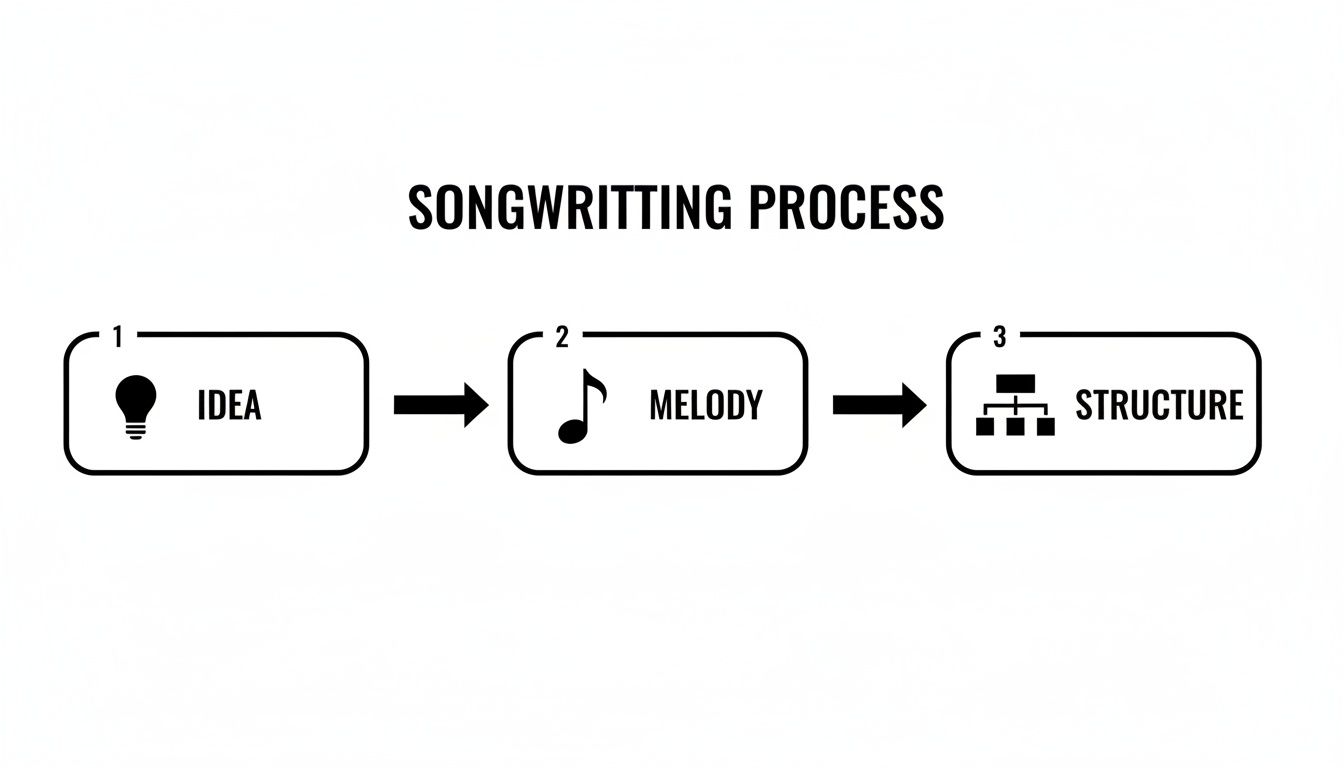
As you can see, the core idea is the seed. From there, you explore melodies to bring it to life, and then you organize those melodic parts into a structure that hits with maximum impact.
The old-school way of writing a song can be a long, winding road. You might spend days, even weeks, just trying to get from a flicker of an idea to a rough demo. It's a grind of brainstorming lyrics, fumbling for chords on a guitar or piano, and manually piecing every section together. This process gave us countless classics, but let's be real—it can also be a massive source of writer's block.
The modern songwriter’s toolkit looks a lot different. AI is changing the game, and it’s not about replacing artists; it’s about giving them superpowers.
AI music generators don’t replace your creativity; they accelerate it. Think of them as a way to instantly audition ideas, blast through writer's block, and hear a polished version of your song in minutes, not weeks.
Here's a quick look at how the two approaches stack up.
Songwriting Stage Traditional Method (Hours/Days) AI-Powered Method (Minutes) Idea & Concept 1-4 Hours 5-10 Minutes Chord Progression 1-3 Hours 1-2 Minutes Melody & Topline 2-8 Hours 5-15 Minutes Lyric Writing 3-10 Hours 10-20 Minutes Arrangement 4-12 Hours 2-5 Minutes Demo Production 8-24 Hours 1-2 Minutes Total Time 20-61 Hours 25-55 Minutes
The difference is staggering, right?
With tools like SendFame's AI Music Generator, you can ditch the guesswork. Instead of spending hours searching for the right chords, you can generate a full instrumental track from a simple text prompt. Stuck on a line? An AI can spitball dozens of creative options in seconds.
This doesn't take you out of the driver's seat. It puts you in a faster car. It lets you focus your energy on refining the core idea and the emotional delivery, while the AI handles the heavy lifting. The result? You can experiment more, fail faster, and ultimately create more music than ever before.
Lyrics are the heart of your song, the thing that makes someone stop what they're doing and really listen. It's what transforms a cool riff into an anthem people scream at the top of their lungs. The magic isn't just about finding clever rhymes; it's about telling a story and hitting on a universal truth that makes your personal experience feel like theirs, too.
Your unique point of view is your superpower. The goal is to translate what's in your head and heart into words that paint a picture, pulling your audience right into the scene with you. This is how you stop writing generic lines and start writing lyrics that stick.
The best songs feel real because they are. Listeners have a built-in phoniness detector, but they will latch onto genuine emotion for dear life. So, your starting point should always be something true—a memory, a feeling, a weird observation you made while waiting for the bus.
Don't be afraid to get personal. Think about the moments that actually left a mark:
That electric feeling of a first crush. The gut-punch of a betrayal. A quiet, middle-of-the-night epiphany. A dumb inside joke that still makes you laugh.
These specific, tiny moments are lyrical gold. They’re packed with the raw details that make a story feel authentic and emotionally charged.
The most powerful songs are born from the most personal stories. When you write with total honesty, you create a direct line to the listener's heart, turning your individual experience into a shared one.
Here's the trick: take that intensely personal story and find the bigger, universal truth hiding inside it. A song about your specific breakup isn't just about you and your ex; it's about the universal ache of loss. A song about your sleepy hometown isn't just about that one stoplight; it's about the universal idea of where we come from.
This isn't just a hunch—it's what makes songs blow up. Emotional authenticity is a massive driver for chart-toppers, with a staggering 68% of Grammy-winning songs since 2010 being pulled straight from the artist's life. It’s why the 50-year partnership between Elton John and Bernie Taupin worked so beautifully; Taupin wrote diary-like lyrics about what he felt, and Elton turned them into music the entire world felt. This kind of honesty is proven to boost streams by an average of 45% because fans are starving for that genuine connection. If you're curious, explore the fascinating history of legendary songwriting teams to see this dynamic in action.
"Show, don't tell" is the golden rule for any kind of great writing, but it's everything in songwriting. Instead of just saying you were sad, describe the rain streaking down the window or the untouched, cold cup of coffee on the table. Use sensory details to put the listener in the room with you.
Sight: "The flickering neon of the 'Open' sign." Sound: "Heard the floorboards creak upstairs." Smell: "Smelled like summer rain on hot asphalt." Touch: "Felt the worn-out vinyl of the passenger seat." Taste: "The bitter coffee and the sweet goodbye."
Dropping in concrete details like these makes your lyrics immersive and unforgettable. It lets the listener build the scene in their own mind, which creates a way deeper emotional impact than if you just told them how to feel. To really master this, check out our complete guide on how to write song lyrics for beginners.
Once you've got your core idea and a few good images, it's time to just play. Seriously, don't aim for perfection on the first go. Just get words on the page. It's a creative mess, and that's exactly what it should be.
Then, you start tinkering. Look for stronger verbs, more interesting adjectives, and rhymes that feel like they belong, not like you forced them in. Rhyme schemes are important—around 80% of hit songs use simple, memorable patterns like AABB—but never sacrifice the emotional truth of a line just to make a rhyme work.
And for those moments when you're staring at a blank page and absolutely nothing is coming? Modern tools can be an amazing creative partner.
Platforms like SendFame’s AI Lyrics Generator can take your starting prompts—a theme, a mood, a few key phrases—and spin up verses that feel surprisingly human. This isn't about letting a robot write your song. It's about getting a fresh perspective, breaking through writer's block, and finding new angles to polish your raw ideas until they truly shine.
Let’s be real: the chorus is the main event. It's the part people will scream from their car windows, the bit that gets stuck in their heads for days. It’s the emotional bullseye of your entire song, and your one best shot at making a lasting impression. In today’s fast-paced streaming world, building a hook that grabs a listener from the get-go isn’t just a nice-to-have; it's everything.
Your job is to make that chorus the undisputed star. It needs to be simple enough to catch on the first listen but emotionally powerful enough to carry the whole track. This is where you boil down your big idea into its purest, most potent form.

In an age of endless scrolling and zero attention span, you don't have three minutes to win someone over. You have about 30 seconds. A 2023 Spotify analysis of 100 million tracks laid it bare: a song needs to hit its chorus within the first 30 seconds to hold on to 85% of its listeners.
The Beatles were absolute masters of this. Think about "Hey Jude"—that legendary hook arrives just 19 seconds in, helping it sit at the top of the charts for a staggering nine weeks.
This isn't some old-school fluke. Billboard confirms that a whopping 92% of top-10 hits in the 2020s drop their chorus before the 20-second mark. Legendary songwriters knew this in their bones. Carole King and Gerry Goffin’s "(You Make Me Feel Like) A Natural Woman" lands its unforgettable chorus at 28 seconds. ABBA's "Dancing Queen"? A mere 15 seconds. These patterns aren't accidents; they're a masterclass for anyone learning how to write a truly great song.
So, how do you actually build a chorus that connects? It boils down to a few key ingredients that, when mixed just right, create something undeniable. Let's break down what makes a chorus work.
Element Why It Matters Pro Tip Melodic Lift It creates a sense of release and energy, making the chorus feel like an event. Try jumping your melody up a few notes—or even a full octave—from where the verse sits. Think bigger, higher. Lyrical Punch This is the core message. It needs to be direct, memorable, and repeatable. Repeat the song's title or the most important phrase. Don't be shy; hammer it home so people can't forget it. Rhythmic Hook A distinct rhythm makes the chorus physically compelling and instantly recognizable. Create a simple, syncopated rhythm that feels different from the verse. Give people something to nod along to.
Getting these elements right is the secret to a chorus that doesn’t just sound good, but feels good. It’s the difference between a song people hear and a song people remember.
Knowing the theory is one thing; pulling a killer hook out of thin air is another. When you’re staring at a blank page, try these moves to get the ball rolling.
Build Around the Title: Start by writing a melody only for your song's title. Make that phrase the star and then build the rest of the chorus melody around it. Keep It Short and Sweet: Hooks with 3-5 syllables have a reported 75% higher sing-along rate. Think simple. Think chantable. Tap into Universal Truths: ASCAP data shows that around 70% of hit songs are about universal themes like love (52%) or empowerment (28%). Writing about shared human experiences gives your song an instant "in" with the listener.
If you find yourself stuck in a creative rut, a great way to break out is to explore different starting points. For a ton of fresh starting points, check out our guide with more ideas for writing songs.
The perfect chorus is the song's core message delivered in the most direct way possible. This isn't the time for subtle poetry or winding narratives—it's time for the big, bold, undeniable truth.
Ultimately, don't overthink it. Some of the biggest hooks in music history are brilliantly simple. The goal is to craft something that feels effortless, like it was always meant to exist. If you can do that, you've written a chorus that people won't just hear—they'll feel it in their bones.
Okay, you've got some lyrical ideas and maybe even a killer chorus taking shape. Now for the fun part: giving your song its soul. The music is the engine that drives every bit of emotion, and it all starts with two key players: chords and melody.
This might sound like a massive hurdle if you've never touched an instrument, but here's a secret: you don't need to be a guitar god or a piano virtuoso to make this work. Seriously. The magic is in how chords—just simple groups of notes played together—create a mood. A few basic chord changes are all that separates happy from heartbreaking. Your melody is the voice, the hook that gets stuck in everyone's head.
Think of chords as the emotional paint you're using. It's wild, but a massive chunk of popular music—from folk anthems to stadium rock—is built on the exact same handful of simple chords.
You can get unbelievably far by learning just four basic chords on a guitar or piano: G, C, D, and E minor. That combo alone is the key to unlocking hundreds of famous songs and gives you a perfect canvas for your own ideas.
Happy and Upbeat: Progressions in a major key, like C - G - Am - F, just feel bright and optimistic. It’s the sound of a summer road trip playlist. Somber and Reflective: Minor chords bring in a touch of melancholy or tension. A progression like Am - G - C - F has a more thoughtful, introspective vibe.
Don't own an instrument? No sweat. The goal right now is just to hear how these chords feel. Fire up a free virtual piano app on your phone and just play them. What's the mood? Does it fit the story you're telling with your words? If you get hooked and want to go deeper, you can always increase your musical skills with guitar lessons and start building these progressions like a pro.
Once you've got a simple chord progression looping, it's time to find that unforgettable melody. Your ear is your best friend here. The most timeless melodies often just follow the natural rhythm and flow of speech.
Here’s a trick that works wonders: just sing your lyrics over the chords you picked. Don’t try to "write" a melody—let it fall out of you. Hit record on your phone so you can catch any of those happy accidents.
Your melody is there to serve the lyrics, not show off. You’ve won when the tune and the words feel so connected that it's impossible to imagine them apart.
If you're stuck, just hum. Seriously. Hum different patterns and rhythms over your chords until something clicks. This takes all the pressure off getting the words right and lets you focus purely on the musical shape. Think about the "melodic contour"—does it soar and get more energetic in the chorus? Does it drop down to a more intimate whisper in the verses? These are the shifts that pull a listener in.
What if you could bypass all the trial and error and instantly hear your lyrics brought to life in a fully produced track? This is where modern songwriting tools can be an absolute game-changer.
An AI music generator can become your personal composer and producer. You feed it your lyrics, tell it the vibe you want ("upbeat indie pop" or "somber acoustic ballad"), and it spits out a complete song with chords, melody, and instruments in seconds.
This isn't about replacing your creative spark; it’s about pouring gasoline on it. This lets you:
Experiment at Lightning Speed: Hear what your song sounds like in a dozen different genres without touching an instrument. Leap Over Technical Hurdles: Create complex arrangements even if you don't know a lick of music theory. Smash Through Writer's Block: Get a flood of new melodic ideas when you're feeling completely uninspired.
Using a tool like this frees you up to focus on what really matters: the story and the heart of your song. To see this in action, you should learn more about how to create AI music and discover how it can turn hours of frustrating guesswork into minutes of pure creation.
Let’s bust a myth right now: the romantic idea of the lone genius, locked away in a cabin, single-handedly writing a masterpiece… it’s mostly just that, a myth. The reality? Even the most iconic solo artists rarely create in a total vacuum. Some of the greatest songs ever written exploded into existence when two creative minds collided.
Think of it this way: writing a song by yourself is like having a conversation in your own head. You can come up with some brilliant stuff, sure, but you’re limited by your own perspective. Bringing in a collaborator is like inviting someone else into that conversation. Suddenly, you have fresh ideas, different skills, and another set of ears to tell you when you’re onto something gold—or when you’re chasing a dead end.
This dynamic is a creative block’s worst nightmare. It can jolt your ideas out of a rut and send them careening in exciting directions you never would have found on your own.

History doesn't lie. Look at the charts, and you’ll see they’re dominated by legendary songwriting teams. The most obvious example? Lennon and McCartney. From 1962 to 1970, that powerhouse duo cranked out an insane 20 No. 1 hits on the Billboard Hot 100. Their secret sauce was a perfect clash of personalities: Paul’s melodic genius met John’s raw, cynical edge, and the rest is history. We got timeless tracks like 'Yesterday,' which is now the most covered song of all time with over 2,200 official versions.
And they're not the only ones. The Elton John and Bernie Taupin partnership, which kicked off back in 1967, has given us 30 top-10 singles in the US alone. The numbers are staggering—RIAA stats show that co-written songs account for roughly 70% of Billboard year-end No. 1s since 1958. The advantage of teamwork is crystal clear. Want to dive deeper? Discover more fascinating insights about iconic songwriter collaborations and see how they literally changed music.
A great collaborator is the missing piece of your puzzle. Are you a lyrical wizard who can't write a melody to save your life? Find someone who hums tunes in their sleep. Are your chord progressions amazing but your lyrics sound like they came from a greeting card? Team up with a poet.
A songwriting partnership isn’t about finding your creative twin. It’s about finding someone whose skills complete yours, creating something way bigger and better than what either of you could do alone.
Alright, so where do you find this person? Don't worry, you don't need to put a classified ad in the paper. The best creative partnerships often spring up from the people already around you.
Raid your friend list: Got a buddy who’s a killer guitarist? A bandmate who always drops the cleverest one-liners? Start there. You already have trust and a shared vibe, which makes the whole process way less awkward. Haunt open mic nights: These are the perfect scouting grounds. You get to see local musicians in their natural habitat, giving you a real feel for their style before you even have to say hello. Jump into online communities: There are tons of forums and social media groups packed with songwriters desperate to connect and create. This is a fantastic way to find talent outside your own zip code.
When you do connect with someone, keep the first session chill. The goal isn't to write a Grammy-winner on day one. Just jam. Trade ideas. See if the chemistry clicks. If it feels more like a job interview than a fun hang, they’re probably not the one.
But what if you can't find the right person, or you’re a night owl who gets their best ideas at 3 AM? Welcome to the future, my friend. Meet your new AI collaborator. Technology has given every songwriter an on-demand, tireless creative partner that’s ready to write a great song whenever inspiration strikes.
Tools like SendFame's AI Music Generator are basically the ultimate digital co-writer. You can feed it your lyrics or a simple vibe, and it will spit out a complete, professional-sounding track in seconds—full melody, harmonies, and instrumentation included.
This isn't about letting a robot do all the work. It’s about having an incredible tool that can instantly mock up your ideas and serve up a bottomless well of inspiration.
Annihilate writer's block: Stuck for a melody? Generate ten different versions in a minute. Pick the one that sparks an idea and run with it. Become a genre-hopper: Ever wonder what your sad folk lyrics would sound like as a thumping synth-pop anthem? An AI can show you instantly, throwing open creative doors you didn't even know were there. Get a full band, right now: Instead of spending hours building a backing track from scratch, you can have a full arrangement to write over. It makes the process feel less like a solo grind and more like you’re jamming with a full band.
With over 200,000 users already making unique music, AI is democratizing the creative process. It’s like having that Lennon-McCartney magic on tap, even when you're the only one in the room.
Alright, so you’ve got a workflow down, but let’s be real—the road to a killer song is paved with potholes and creative roadblocks. It’s part of the game. Let's dig into some of those nagging questions that pop up and threaten to derail your progress.
Knowing how to handle these moments is just as crucial as nailing a perfect bridge. These are the doubts that can stop a great idea cold, so let's get you unstuck.
First off, take a deep breath. Writer's block isn't a sign you've lost your touch; it’s a totally normal part of being a creative person. The absolute worst thing you can do is force it, staring at a blinking cursor until your eyes glaze over. You’ve gotta shake things up.
The secret is to take the pressure off and trick your brain into playing again.
Try a "freewriting" sprint. Seriously. Set a timer for 10 minutes and just scribble down any and every lyric that pops into your head. Don't judge it, don't edit it. The point isn't to write gold; it's just to get the pen moving. Pivot to something else. Stuck on lyrics? Mess with the melody. Chords feeling stale? Focus on the rhythm or a bassline. Just change your point of attack. Use an AI as your co-writer. Firing up an AI lyric generator can be like having a brainstorming partner on call 24/7. It can spitball ideas and angles you’d never think of on your own.
And sometimes, the best move is to just walk away. Go for a walk, put on some music that’s completely different from what you’re writing, and come back with a fresh perspective.
Let's kill this myth right now: absolutely not. This is one of the biggest misconceptions in music, and it holds so many talented people back. Think about it—some of the greatest songwriters ever, like Paul McCartney, never learned to read music in the traditional sense.
Your ear is your greatest asset. Your gut instinct for what feels right and what moves a listener is way more important than any textbook. Trust it.
Music theory is a fantastic language for describing music, but it’s not a set of ironclad rules for creating it. It’s a tool, not a prerequisite. Concentrate on the emotion and the story you want to tell. If you’re looking for more practical advice, we've got a whole guide on how to write a good song that doesn’t get bogged down in technical jargon.
Ah, the million-dollar question. The short answer? It's done when adding anything else starts to feel like clutter. The goal isn't some mythical "perfection"—it's completion.
Ask yourself one simple question: Does this song do the job I wanted it to do? Does it tell the story? Does it hit the emotion? Play it for a friend you trust. Do they get it?
The second you find yourself obsessing over a tiny detail that no one but you (and maybe your dog) will ever notice, it's probably time to call it. It's far better to finish a great song and start the next one than to get stuck in an endless loop chasing a "perfect" version that doesn't exist.
So you’ve poured your soul into a song, and it's finally done. Now what? Getting it heard is the next big adventure. A lot of independent artists get stuck wondering how to fund their next step, whether it’s a professional recording or a music video.
One of the most effective ways to build momentum and get funded is by exploring strategies for crowdfunding for musicians. It's a fantastic way to build a real community around your music and get the cash you need to bring your vision to life.
Ready to stop thinking and start making? With SendFame's AI Music Generator, you can transform your song ideas into fully-produced tracks in seconds. No music theory, no fancy gear needed. Just bring your creativity, and let our AI handle the heavy lifting. Start writing your next hit today!
Create Epic

SendFame

Create Epic with SendFame!
Questions: info@sendfame.com