How to Write a Great Song From Idea to Anthem
how to write a great song
Welcome offer — 56% OFF


Discover how an AI song writer turns your ideas into original music. This guide covers how the tech works, creative uses, and a step-by-step creation process.
Think of an AI song writer as your personal music producer, a creative co-pilot ready to turn your ideas into fully finished songs in just a few minutes. It's like having a brilliant musical partner who's a master of composition and theory, just waiting for your creative spark—a mood, a genre, a theme—to get to work.
Ever wish you had a recording studio in your pocket? Or a collaborator who never sleeps, knows every musical style imaginable, and can spin a simple idea into a polished track on the spot? That’s exactly what an AI song writer brings to the party. Forget any intimidating images of complex algorithms or robotic code; this is all about creative freedom.
Let's say you're a marketer who needs a catchy, upbeat jingle for a new social media campaign, and you need it yesterday. Instead of shelling out thousands for a production studio and waiting weeks, you just describe the vibe: "upbeat indie pop with an acoustic guitar and a happy feeling." A few moments later, you’ve got a unique, royalty-free track ready to roll.
But this isn't just a tool for the pros. It's for anyone with a flicker of an idea.
Aspiring Artists: You can quickly sketch out demos and play around with new sounds without needing to know how to play every single instrument. Content Creators: Generate custom background music for your videos and podcasts, completely side-stepping the nightmare of copyright strikes. Small Businesses: Cook up a memorable brand anthem or some slick promotional music, even on a shoestring budget. Anyone with a Creative Itch: Have some fun turning poems, stories, or even just random shower thoughts into original songs.
To give you a better idea, here's a quick rundown of what an AI song writer really is.
Feature What It Means for You Generative AI Model The "brain" that understands music theory, genres, and styles to compose original tracks. Text-to-Music You type in a description (a "prompt"), and it generates a song based on your words. No instruments needed. Genre & Mood Control You can specify exactly what you want, from "sad cinematic piano" to "energetic 80s synth-pop." Instrument Selection The AI intelligently picks and arranges instruments that fit your requested genre and mood. Instant Production It handles the composing, arranging, and mixing, delivering a ready-to-use audio file in minutes. Royalty-Free Output The music it creates is typically yours to use commercially without worrying about licensing fees.
Essentially, you get all the power of a music studio without any of the traditional headaches.
Tools like SendFame’s AI Music Generator are built to do all the technical heavy lifting. You bring the vision, and the AI acts as your personal composer, arranger, and producer, piecing everything together based on your input. This isn't about replacing human creativity; it's about making it bigger, faster, and more accessible.
An AI song writer helps you leapfrog the traditional barriers of making music—cost, time, and technical skill. It truly levels the playing field, making it possible for anyone to become a music creator.
The whole process is surprisingly simple and feels more like a conversation than a command. You’re not programming a machine; you’re guiding a creative partner. The clearer you are with your instructions, the closer the final track will get to that sound you're hearing in your head. It turns music production from a daunting task into a fun, exciting exploration of what’s possible.
What once required a room full of expensive gear, years of training, and a team of experts is now right at your fingertips. This shift is throwing the doors of music creation wide open, putting incredibly powerful tools directly into your hands. Your next great brand jingle, podcast theme, or personal soundtrack is no longer a distant dream—it’s just a simple text prompt away. Welcome to your new studio.
Ever wondered how a few descriptive words can magically morph into a complete song—with harmonies, instruments, and a professional sheen? It's not sorcery, though it sure feels like it. The process behind an AI song writer is a lot like commissioning a piece of art from an incredibly fast and talented artist. Your text prompt is the creative brief.
Think about hiring a painter. You wouldn't just say, "paint something." You’d give them the vibe: "I want a vibrant, abstract cityscape at sunset, with bold orange and purple, in an impressionist style." The artist then uses their training and experience to bring that vision to life. An AI song generator does the exact same thing, but with sound waves.
Your prompt is the crucial first step. It’s the creative North Star for the AI. When you type in something like, "A chill, lo-fi hip hop track with a gentle piano melody and soft, vinyl crackle," you’re handing the AI a blueprint. This is the same basic idea that powers all sorts of the amazing AI-generated content you see today.
Behind the sleek interface of a tool like SendFame, a complex network of generative models fires up. Picture these models as a band of virtual session musicians who are absolute masters of every genre. One is a world-class drummer, another a virtuoso pianist, and another a bassist with impeccable timing. They've "listened" to and deconstructed millions of songs, absorbing the patterns, structures, and emotional feel of music.
When your prompt hits their system, these digital musicians get to work:
Melody and Harmony: The AI sketches out a core musical idea that fits your description, laying down a catchy melody and the chords that make it sing. Instrumentation and Arrangement: It then picks the right instruments for the job—maybe a warm electric piano for that lo-fi track, or a fuzzed-out guitar for a rock anthem. From there, it arranges everything into a coherent structure with verses, choruses, and bridges. Production and Mixing: Finally, the AI puts on its sound engineer hat. It balances the levels of each instrument, adds effects for texture, and masters the final track so it sounds polished and ready for listeners.
This whole jam session, which would take human artists hours or even days, unfolds in just a few minutes.
This diagram gives you a bird's-eye view of how your idea becomes a finished track.
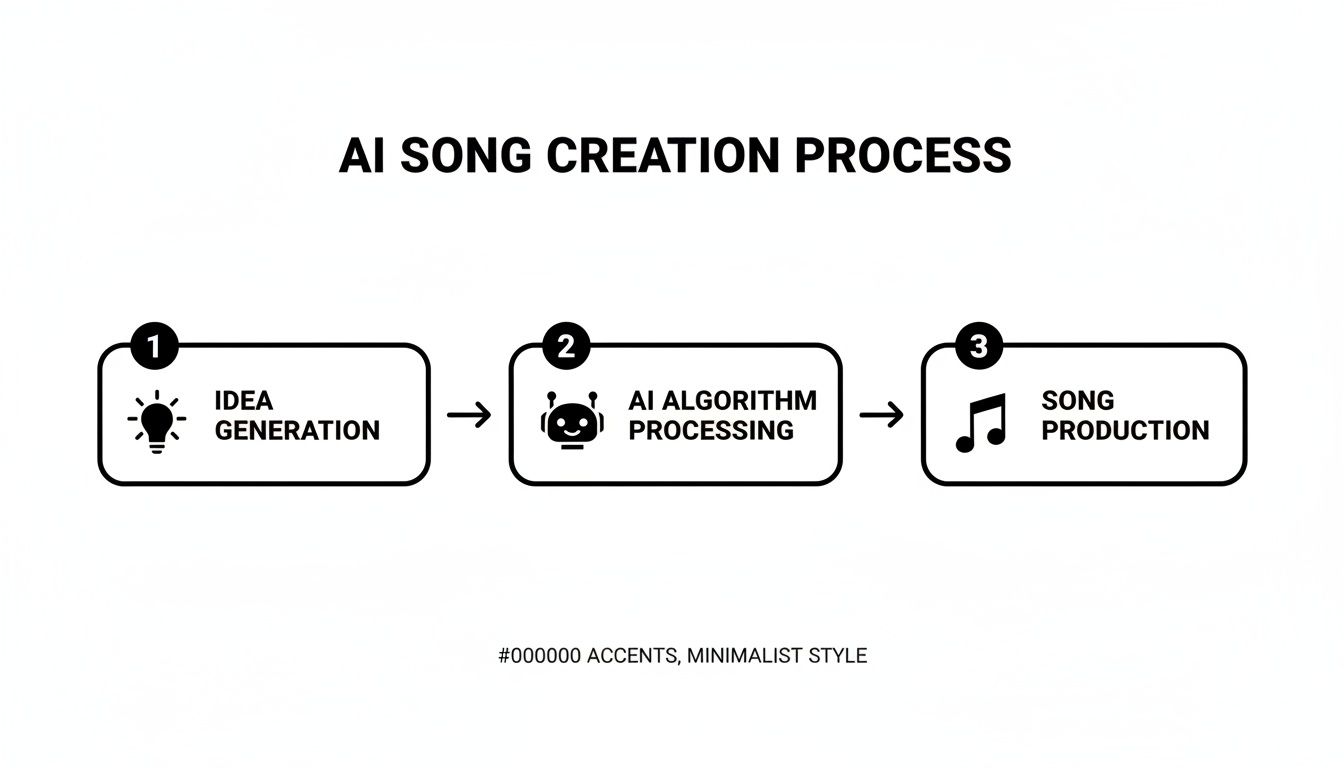
It really highlights the seamless journey from a simple concept to a fully produced piece of music, all driven by the AI's creative engine.
The real magic is how the AI translates abstract words like "melancholy," "hopeful," or "energetic" into actual musical elements. Through its deep training, the AI has learned to connect these emotional concepts with specific musical traits.
For instance, the word "melancholy" might trigger the AI to use:
Minor keys and slower tempos Instruments like a cello or a sparse piano A simpler arrangement with more breathing room
On the flip side, a prompt with "energetic" would probably result in faster tempos, major keys, and a thumping drum beat. The AI isn't just throwing notes at a wall; it's making deliberate creative choices based on the massive library of human-made music it has studied.
An AI song writer is essentially a translator—it converts the language of human emotion into the universal language of music. It's the bridge between your imagination and a ready-to-play audio file.
This sophisticated process is what makes a platform like SendFame's AI Music Generator feel so intuitive. You don't need a degree in music theory or a background in audio production. You just need to know how you want your song to feel. The AI handles all the technical heavy lifting, freeing you up to focus purely on the creative vision.
It’s your idea, amplified by technology—a powerful partnership where your creative spark directs a world-class virtual studio.
Alright, ready to jump into the producer's chair? Here's the good news: making your first track with an ai song writer is more like a creative game than a technical chore. Forget wrestling with complicated software or cramming music theory. If you can describe a feeling, you can make a song.
Let's walk through it and turn that idea buzzing in your head into a finished track in just a few minutes.
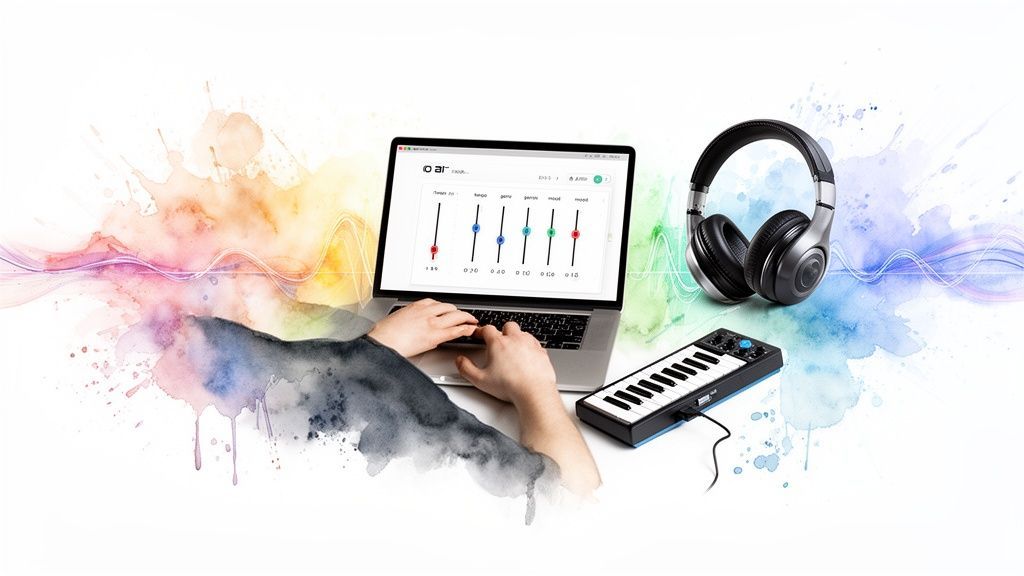
The whole journey kicks off with a simple thought. You don't need a fully-formed symphony in your mind. Just ask yourself: what’s this music for?
Are you a social media manager who needs an upbeat, positive jingle for a product launch video? A podcaster hunting for a mysterious, synth-heavy intro to set the mood? Or maybe you just want a chill, lo-fi beat for your late-night study playlist.
That initial idea is the seed. Everything else grows from there. The more specific you are upfront, the better the AI can read your mind and bring your vision to life.
Your text prompt is the single most important part of this whole process. It's your direct line to the AI—your creative brief, your director's notes. A great prompt is like giving a chef a detailed recipe; a vague one is like telling them to "make some food." You get the picture.
To get those jaw-dropping results, you need to give clear instructions. Think about these core elements when you’re writing:
Genre: Get specific! Instead of just "rock," try "90s alternative rock" or "energetic garage rock." Mood: How should the song feel? Use words that paint a picture, like "optimistic," "melancholy," "adventurous," or "relaxing." Tempo: Do you want people to tap their feet or chill out? Use terms like "upbeat," "slow tempo," or "fast-paced." Instruments: Naming a few key instruments helps anchor the sound. "Acoustic guitar," "heavy 808 bass," "dreamy synth pads," and "jazzy saxophone" are all great starting points.
When you mix these elements together, you're handing the AI a rich palette to work from. The more detail you pack in, the closer the final track will be to what you imagined.
To make it even easier, here are a few cheat codes for different creators. Think of these as proven recipes you can use and tweak with an ai song writer like the SendFame AI Music Generator. If you want to dive right in and get your hands dirty, the lunabloomai starter app is a fantastic playground for your first creation.
Creator Role Goal Prompt Recipe Example Social Media Manager Background for a travel reel "Uplifting, adventurous tropical house with a light steel drum melody and a driving beat." Podcaster Intro for a true crime show "Mysterious, dark synthwave with a slow, pulsing bassline and atmospheric pads, tense mood." Small Business Owner Music for a product ad "Happy, upbeat indie pop with a catchy acoustic guitar riff, claps, and a positive vibe." Event Planner Walk-in music for a gala "Elegant, cinematic orchestral music with sweeping strings and a grand, inspiring feel."
See how just a few well-chosen words can guide the AI to create something perfect for the job?
The art of using an AI song writer isn't in knowing music theory; it's in knowing how to describe what you want to hear. Your words are the instrument.
This shift in creative control is already sending ripples through the industry. Let's be real: AI's grip on music is becoming undeniable. One study predicts that by late 2025 into 2026, a staggering 87% of musicians and producers will be using it in at least one part of their workflow—from lyrics and demos to mixing and mastering. At the same time, 79% of them are worried about AI-generated music competing with their work, which just shows how deeply this tech is embedding itself.
So, what happens if the first track isn't quite right? That's all part of the fun. This is an iterative process, not a one-shot deal. Just tweak your prompt and generate a new version instantly. Maybe that "acoustic guitar" needs to be an "electric guitar," or the "happy" mood should be more "energetic."
And don't be afraid to get weird with it! What does "cyberpunk jazz" even sound like? Or "medieval folk metal"? The AI is your creative sandbox, a place to explore sonic territories that would take ages to create by hand.
The more you play, the better you'll get at writing prompts that hit the nail on the head. For even more tips, check out our deep-dive guide on https://sendfame.com/blog/create-ai-music that truly stands out.
With every new track you generate, you're not just making a song. You're learning how to communicate your creative ideas more effectively and turning a simple tool into a powerful extension of your own imagination.
Let's get down to brass tacks. An ai song writer isn't just a novelty toy for tech enthusiasts; it's a seriously practical tool that's already changing how people create content. This isn't some far-off future concept—it's happening right now, with creators, marketers, and business owners using this tech to solve real-world problems.
Think about the owner of a local coffee shop. She needs a catchy little jingle for a local radio spot but doesn't have thousands to drop on a production studio. With an AI music generator, she can cook up a warm, inviting tune that perfectly captures her shop's cozy vibe—all for a fraction of the cost.
This isn't just a one-off story; it’s a sign of a much bigger shift. AI music is rapidly moving from an experimental plaything to a core production tool. Some experts even predict that by 2026, AI tracks could be going head-to-head with human-made songs on the major charts. When a technology starts competing at that level, you know it's here to stay.
If you're a YouTuber, TikToker, or podcaster, you know the eternal struggle: finding good music. Stock libraries are often a sea of generic, overused tracks, and daring to use a popular song is like begging for a copyright strike. An ai song writer blows this problem to smithereens.
Imagine you're a travel vlogger. For your latest video on Brazil, you could instantly generate a custom bossa nova track that fits the sun-drenched scenery like a glove. Next week, when you're editing your Tokyo footage, you can create a high-energy city pop anthem to match the neon-lit streets. This is a massive creative upgrade.
100% Copyright Safe: The music is brand new and royalty-free. Kiss those takedown notices and demonetization fears goodbye. Perfect Mood Matching: You're not just settling for "close enough." You can dial in the exact emotional tone your content needs to really connect with viewers. Unlimited Options: Forget endlessly scrolling through limited libraries. You have a bottomless pit of unique, custom-made tracks ready whenever inspiration strikes.
This kind of power levels the playing field, giving smaller creators the ability to produce polished, professional-sounding content that can stand up against the big studios.
In the hyper-speed world of digital marketing, you need to be fast and you need to be original. Custom audio is an incredibly potent way for a brand to carve out its own unique identity and get noticed.
An AI song writer is like having an in-house music studio on standby, but without the crippling overhead. It's your secret weapon for creating a unique sonic brand on demand, from catchy jingles to epic brand anthems.
A social media manager could whip up a dozen short, snappy tracks for different ad campaigns in a single afternoon. This makes it easy to A/B test which musical hooks actually grab the audience's attention and drive clicks. The cost savings are a game-changer, freeing up budget that would have been sunk into music licensing for other critical marketing efforts.
Looking to craft that unforgettable brand jingle? The ability to rapidly iterate and test different versions is a huge leg up on the competition. If you want to dive deeper into this, check out our guide on how to make memorable commercial jingles that stick in customers' heads.
The magic of an ai song writer isn't just for businesses and influencers. It's a fantastic creative partner for musicians and a blast for hobbyists. An aspiring songwriter can generate unique backing tracks to spitball lyrics over, helping them smash through creative blocks and explore genres they've never tried before.
Even if you don't play a single instrument but have a melody stuck in your head, you can now describe the vibe and hear your idea come to life. These tools are tearing down the technical walls that have kept so many great ideas locked away, making music creation a far more open and accessible world for everyone.
Jumping into the world of an AI song writer is a blast, but it definitely cracks open a can of worms. With all this creative firepower, you’re probably asking yourself: who actually owns this stuff? Is it even ethical to use it?
These aren't just minor questions; they're the big ones. And getting a handle on the answers is the key to creating without looking over your shoulder.
The honest truth? The law is still playing catch-up with the tech. Most of the debate boils down to copyright. For centuries, copyright has been about protecting things made by people. So when an AI spits out a track, the ownership lines get fuzzy. Is it the person who typed the prompt? The company that built the AI? Does the AI get a vote?
This legal gray area is exactly why picking the right platform is so important. A good service, like SendFame, is built to slice right through that confusion. They're set up to give you the rights you need for the music you create, making it completely royalty-free and safe for commercial use.
The legal status of AI-generated art is very much a "watch this space" situation. As you get into AI music, it’s smart to understand the basics of intellectual property protection, especially copyright. The trick is to stick with platforms that have crystal-clear terms of service, handing you a license to use what you make without any legal drama.
Platforms like SendFame are trained on data that’s either licensed or ethically sourced. That means they aren't just scraping the internet and ripping off artists without permission. This clean-data approach gives you an output you can confidently use for:
Marketing campaigns that need a fresh sound. Social media content for your YouTube or Instagram channels. Personal projects like a podcast intro or a presentation soundtrack.
When you use a tool designed for commercial safety, you get to skip the entire legal debate and just focus on making cool stuff. If you're curious about how music rights work on social media in general, our guide on Instagram and music copyright has some great insights.
The other side of the coin is how these AI models learn their craft. An AI song writer gets smart by analyzing gigantic libraries of existing music. The most responsible companies make sure this data is sourced ethically, so they're not infringing on artists' rights. This keeps the AI from just spitting out cheap knock-offs and helps it learn the actual patterns and language of music.
It also helps to think of AI as a collaborator, not a replacement for human artists. Many musicians are already using it to bust through creative blocks, whip up a quick backing track to jam over, or produce a demo fast enough to pitch an idea. The AI handles the heavy lifting, but the human provides the creative spark and the soul.
Think of an AI song writer less like a robot artist and more like a wild new instrument. It still needs a human to play it, to shape its sound, and to give the final piece a real purpose and a genuine feeling.
This partnership mindset is key, especially as this technology gets more powerful. Let's be real—there are legitimate fears in the creative community about what AI means for their jobs.
A recent landmark report on AI in music painted a sobering picture: by 2028, a shocking 23% of music creators' revenues—that's over AUD$519 million—could be at risk because of generative AI. This really drives home the need for ethical AI development and responsible use that actually values human creativity, not just automates it.
By sticking with platforms that focus on ethical data and clear usage rights, you’re not just making music—you're being a good citizen in this new creative world. You're helping build a future where tech gives human talent a boost, rather than trying to replace it.
So, we've pulled back the curtain on the whole AI music thing. You've seen what these AI songwriters are all about, how to coax a killer track out of them with the right prompt, and even waded through the tricky ethical questions. The path from a spark of an idea to a fully-produced song used to be a long, bumpy road that only a handful of people could travel.
Not anymore. That road is now a superhighway, and the on-ramp is wide open for you. Forget the old gatekeepers of music creation—the crazy expensive gear, the years of music theory, the soul-crushing studio rental fees. All of that? Gone. You're in the driver's seat now, with a powerful virtual studio ready and waiting. The only thing you need to bring is your imagination.
The barrier to entry for making music has officially crumbled. You no longer need to be a musician to be a music creator; you just need an idea.
This is your official invitation to jump in and start playing. Stop thinking "what if" and start creating. That slick podcast intro you've been dreaming of, the catchy jingle for your brand, or just a personal anthem for your morning run—it's all right there, waiting for you to bring it to life. It's time to experiment, have some fun, and discover the sounds that have been stuck in your head.
Your next banger is just a few clicks away. Here’s how to get started this very second:
Dream Up an Idea: What’s the vibe? Think of a mood, a scene, or a feeling you want to turn into sound.Head Over to SendFame's AI Music Generator: Dive right in and write your first prompt. Don't overthink it—the goal here is to have fun and see what happens.Join the Crew: Share what you make and connect with a massive community of creators who are all figuring this out together, one prompt at a time.
Welcome to the new age of making music. The studio is open 24/7.
Got a few more questions rattling around? Good. That means you're thinking like a creator. Diving into an AI song writer is a blast, but it's smart to get the full picture first. Let's tackle some of the most common questions we hear.
Nope. Not even a little bit. And frankly, that's the magic of it.
Tools like SendFame were built from the ground up for everyone, from Grammy-winning producers looking for a spark to small business owners who wouldn't know a C-sharp from a car key. You can forget all about music theory, chord progressions, and complicated studio software.
Your only job is to have an idea. You bring the vision—the vibe, the genre, the feeling you're trying to capture—and the AI does all the heavy lifting. If you can describe what you want to hear, you can create it.
Yes, absolutely. As long as you're using a service specifically designed for commercial use, you're in the clear.
When you generate a track on a platform like SendFame, it's made for you. These tools are built to give you the rights you need, so you don't have to spend your days worrying about copyright strikes and legal letters.
This means you can confidently use your custom-made tracks in:
Video ads and marketing campaigns TikTok, YouTube, and Instagram content Podcasts, presentations, and any other project you can dream up
Just make it a habit to glance over the terms of service for whatever tool you choose. A quick check will confirm the exact rights you get and keep your projects totally worry-free.
It’s not just "good"—it's often shockingly good, and the technology is leaping forward every single day. For the vast majority of uses like background music, jingles, and online content, AI-made tracks are often completely indistinguishable from music made by human artists.
Today's AI models can whip up complex arrangements, pull from a library of hyper-realistic instruments, and even generate vocals in just about any style imaginable. For marketers, creators, and entrepreneurs, the quality is already there to make your work sound incredibly polished.
An AI song writer isn't just a shortcut; it's a tool for producing professional-grade audio that makes your content stand out. We've moved way past the era of robotic, soulless tunes. This is the real deal.
Highly unlikely. It's much more probable that AI will become an indispensable partner in the creative process, not a replacement. Think of it as a new instrument, like the synthesizer was in the '80s—it didn't replace guitarists, it just opened up a new world of sound.
Musicians are already folding AI into their workflows to brainstorm ideas, smash through writer's block, or quickly flesh out a demo. It’s a collaborator that never gets tired.
While an AI song writer is a master of patterns, production, and music theory, it can't go to a concert, fall in love, or experience heartbreak. That raw, messy, beautiful human experience is what gives music its soul, and that's something only an artist can provide.
Ready to stop wondering and start creating? SendFame's AI Music Generator is your personal studio, ready to turn your ideas into incredible, royalty-free songs. Create your first track in minutes at https://sendfame.com.
Create Epic

SendFame

Create Epic with SendFame!
Questions: info@sendfame.com