Turn Image Into Video AI and Animate Photos Like a Pro

turn image into video ai
Welcome offer — 56% OFF


Learn how to write song lyrics for beginners with this guide. Discover how to find your theme, structure your song, and craft unforgettable lines.
Ah, the dreaded blank page. It’s the songwriter’s equivalent of a silent stage, just staring back at you, waiting. But here's a secret every seasoned writer knows: you’re not actually starting from scratch. You’re sitting on a goldmine of material—your own life.
Before you even think about what rhymes with "love," let's find the story you need to tell. This is the real first step.
Every song that’s ever gotten stuck in your head started with a single, tiny spark. It wasn’t some lightning bolt of divine inspiration. More often than not, it was a feeling, a memory, or a weird thought that just wouldn't go away. Your job, right now, is to become a collector of these sparks.
Think about the little moments. That gut-punch feeling of seeing an ex with someone new. The weirdly specific smell of your grandma's kitchen. The silent, comfortable drive home with a friend. These aren't just memories; they're songs waiting to happen.
The goal here isn't to find the perfect idea. It’s to find any idea. We're going for quantity, not quality, so turn off that nagging inner critic for a bit.
Here are a couple of my favorite, no-pressure ways to get the ball rolling:
The 10-Minute Brain Dump: Grab a notebook, set a timer for 10 minutes, and just write. Don't stop, don't self-edit, don't even worry if it makes sense. Jot down feelings, overheard phrases, random words, memories—anything. You’d be amazed what tumbles out when you just let go. Mind Mapping: This one's for the visual thinkers. Plop a core idea, like "Regret" or "First Kiss," in the middle of a page and circle it. Now, just start drawing lines branching off from it with anything that comes to mind—related words, specific images, people's names, places. It’s a great way to see connections you might have missed.
Think of the process like this: you start with a wild storm of ideas, then you find the one that hits you the hardest and build your song around that core theme.
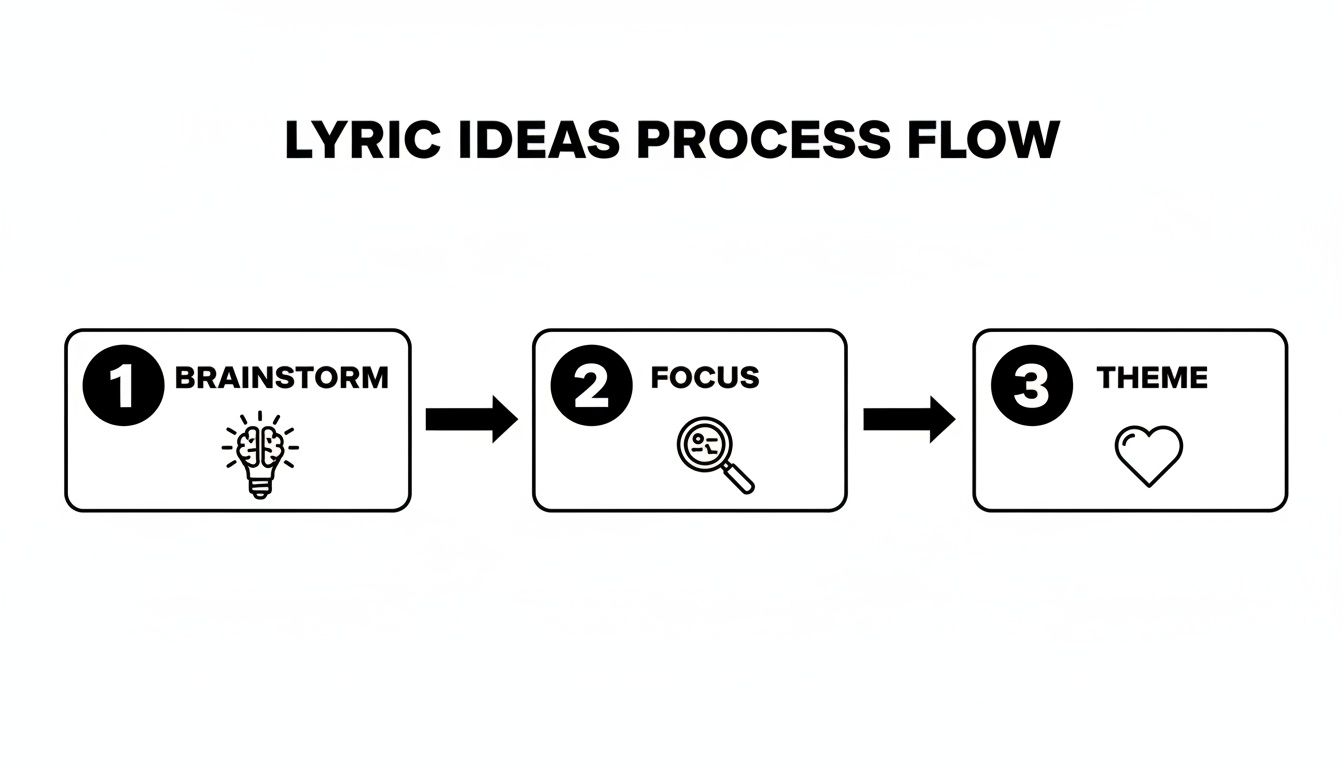
This simple flow takes you from a chaotic mess of thoughts to a single, powerful concept that can actually carry a whole song.
If you’re worried your ideas are too “simple,” relax. A study that looked at over 350,000 songs found that pop lyrics have actually gotten simpler and more repetitive over the last 50 years. Why? Because simple, relatable ideas connect with people on a massive scale.
Key Takeaway: You don’t need a dramatic, life-altering event to write a great song. The most powerful stories are usually hidden in the smallest, most personal moments. It’s your perspective on an ordinary experience that makes it extraordinary.
Okay, now look at your page of raw material. Find the one idea that gives you a little jolt of emotion or paints the clearest picture in your mind. That’s your north star. That’s where you begin.
If you're still feeling stuck, don't sweat it. We've got a whole guide on finding compelling ideas for writing songs that can give you an extra push.
This little table is designed to get you from "I have no idea what to write about" to "Okay, I think I've got something" in no time.
| Brainstorming Method | What to Do | Why It Works |
|---|---|---|
| The "Five Senses" Memory | Pick a strong memory. Write down what you saw, heard, smelled, tasted, and touched. Don't tell the story, just list the sensory details. | It bypasses the pressure of storytelling and drops you right into a tangible, image-rich scene—perfect for a verse. |
| "What If?" Scenarios | Ask a "what if" question. What if I'd never left my hometown? What if I told them how I really felt? Freewrite the answer for five minutes. | This creates instant narrative tension and emotional stakes, giving your song a natural story arc to follow. |
| Object Focus | Choose a random object in the room (a coffee cup, an old photo, a keychain). Write down its "story" or the memories attached to it. | It forces you to find meaning in the mundane, a classic songwriting trick for creating relatable and powerful metaphors. |
Use these as warm-ups. The goal isn't to write a finished song from them (though you might!), but to get your creative gears turning and prove to yourself that you have plenty to say.
The best songs feel like they just… happened. A lightning strike of pure emotion and melody that fell right out of the sky. But pull back the curtain on almost any hit, and you'll find a solid blueprint holding it all together. That's its song structure—the skeleton that gives your story shape and takes the listener on a ride they'll want to take again and again.
Thinking about structure isn't about putting your creativity in a cage. Far from it. It's about giving your ideas a roadmap so they build on each other, create momentum, and land with a real emotional punch instead of just wandering off into the woods.

Most of the music you love, whether it’s pop, rock, or folk, is built from a handful of key parts. Getting to know what each piece does is your first step toward writing lyrics that sound like they were written by a pro.
Let’s meet the main players:
The Verse: This is your storyteller. The verses are where you spill the details, set the scene, and move the plot forward. Each verse should add a new layer to the narrative. Think of them as the chapters in your mini-story. The Chorus: This is the soul of your song. It’s the big idea, the emotional core, the one thing you want stuck in everyone’s head. The lyrics and melody here are usually the same each time, making it the catchiest, most memorable part by design. The Bridge: This is your plot twist. The bridge is a detour—it offers a new angle, a shift in perspective, or a different emotional flavor. It deliberately breaks the verse-chorus pattern to create a moment of tension or release before you slam back into that final, powerful chorus.
Pro Tip: Don't get hung up on the "lyrics or music first?" debate. Some of the best songs start with a killer title scribbled on a napkin, while others are born from a moody chord progression that just begged for words. There’s no right way. Just find what works for you.
One of the most battle-tested structures in modern music is the Verse-Chorus-Verse-Chorus-Bridge-Chorus format. It’s popular for one simple reason: it just works. It strikes the perfect balance between storytelling (verses), singalong moments (choruses), and a dynamic twist (the bridge).
Here's how that journey usually plays out for the listener:
Verse 1: "Okay, I'm listening. You're setting the scene." Chorus: "Ah, I get it! This is the main point. And it's catchy." Verse 2: "Cool, now we're digging deeper. The story is evolving." Chorus: "I know this part! I can sing along now." Bridge: "Whoa, hold on. A totally new thought. This changes things." Chorus: "And we're back home, but this big idea feels even bigger now."
This structure is a fantastic starting point because it gives you a clear job for each section you need to write. It provides a familiar and satisfying emotional arc that listeners intuitively understand.
Once you’ve got these basics down, you can start thinking about how they mesh with melody and rhythm. If you're curious about the whole shebang, our guide on how to create a song from scratch covers the entire process, which can really help clarify the lyric-writing phase.
Look, while knowing the classic structures is essential, they are guidelines, not gospel. Some of the most iconic songs ever written are just one long, rambling verse. Others use a pre-chorus to build anticipation leading into the chorus or an outro to fade things out with style.
When you're just starting out, stick to the basics. Try mapping out a simple Verse-Chorus structure. Literally write it down: "Verse 1 will be about the rainy Tuesday we broke up. The Chorus will be about how I've been colorblind ever since." That one simple trick turns a big, scary task into a series of small, manageable steps. It gives your creativity the solid foundation it deserves.
Alright, you’ve got your story and a solid structure to hang it on. Now for the really fun part—the alchemy of turning simple words into a movie that plays inside your listener's head. This is where you graduate from being a storyteller to a poet with a killer beat. It’s not just what you say, but how you say it.
Great lyrics don't just state feelings; they create them. This all boils down to one of the oldest rules in writing, and for songwriters, it’s pure gold: show, don't tell.
Telling is the easy way out. "I'm heartbroken." Okay, it’s a fact, but it’s flat. It doesn't give the listener anything to see or feel.
Showing is where the real art happens. Instead of just saying you're heartbroken, you describe the "two coffee cups on the counter, but only one is stained." You paint a picture of the "rain blurring the streetlights into watercolor streaks." See the difference? One is a diary entry; the other is a scene from a film.
The fastest way to pull your audience into your song is to hijack their senses. Don't just make them hear your words; make them see, smell, taste, and feel the world you’re building. This is called sensory language, and it's your absolute secret weapon.
Go back to the details of your story. What did it actually look, sound, and feel like?
Sight: The "flickering neon sign" outside a lonely motel room, or the "faded band t-shirt" he always wore. Sound: The "creak of the old floorboards" as you tiptoed out, or the "static on the radio" between stations. Smell: The "smell of summer rain on hot pavement," or the lingering "scent of cheap perfume." Touch: The "cold leather of the passenger seat," or the "roughness of his unshaven cheek." Taste: The "bitter taste of burnt coffee" on a Monday morning, or the "sweetness of a stolen kiss."
When you weave these kinds of details into your verses, you're not just telling a story—you're building a world. Your song becomes an immersive experience, a place the listener can escape to for three minutes. This is what makes lyrics stick. For specific lyrical themes, digging into resources dedicated to topics like lovelife lyrics can spark incredible ideas for painting those vivid pictures.
Metaphors and similes are your tools for adding layers of meaning. Think of them as lyrical shortcuts that explain a complex feeling in a simple, powerful way. A simile uses "like" or "as" (e.g., "Your voice sounds like a sad song"), while a metaphor makes a direct, bold comparison (e.g., "Your voice is a sad song").
Please, don't just grab the first cliché you can think of—"heart of stone," "eyes like stars." We've heard them all before. Dig deeper. What does that feeling really feel like to you, personally?
Instead of the tired old "I feel trapped," try something more specific and visual. Maybe it's, "This town is a snow globe, and I'm just watching the same scene shake up and settle down again." The more unique and personal the comparison, the more your voice shines through.
This attention to detail has a surprisingly huge impact. It turns out that accurate and engaging lyrics can boost fan engagement by as much as 60%, turning casual listeners into dedicated fans who stream and share. As more platforms integrate real-time lyrics, the words themselves are becoming a key driver for discovery.
Last but not least, never forget that lyrics are meant to be sung, not just read off a page. The rhythm and sound of your words—the meter—matter just as much as their meaning.
Read your lyrics out loud. Seriously, do it. Do they flow naturally, or do they feel clumsy and awkward on your tongue?
Count the syllables: Try to keep the syllable count similar in corresponding lines of your verses or chorus. This isn't a strict rule, but it creates a pleasing, predictable rhythm that the ear loves. Play with word sounds: Use alliteration (repeating starting sounds, like "silent streets") and assonance (repeating vowel sounds, like "rain in Spain") to make your lines more musical and memorable.
You don't need to be a poetry expert to get this right. Just trust your ear. If a line is hard to say, it will probably be even harder to sing. Keep tweaking, swapping words, and moving phrases around until it feels effortless. That’s how you turn good ideas into unforgettable lyrics.
If the verse tells the story, the chorus is the tattoo. It’s the one part of your song that gets permanently inked onto your listener's brain—the part they’ll be humming in the shower and screaming at the top of their lungs in the car. Getting this right is, well, everything. Your chorus is the central pillar holding the whole song up, so it needs to be made of solid gold.
Think of your chorus as the song's mission statement. It boils down the core emotion and the big idea into a ridiculously catchy, easy-to-remember package. While your verses can whisper the details, the chorus needs to shout the main point from the rooftops. It’s that moment of clarity, the emotional peak your listener has been waiting for.
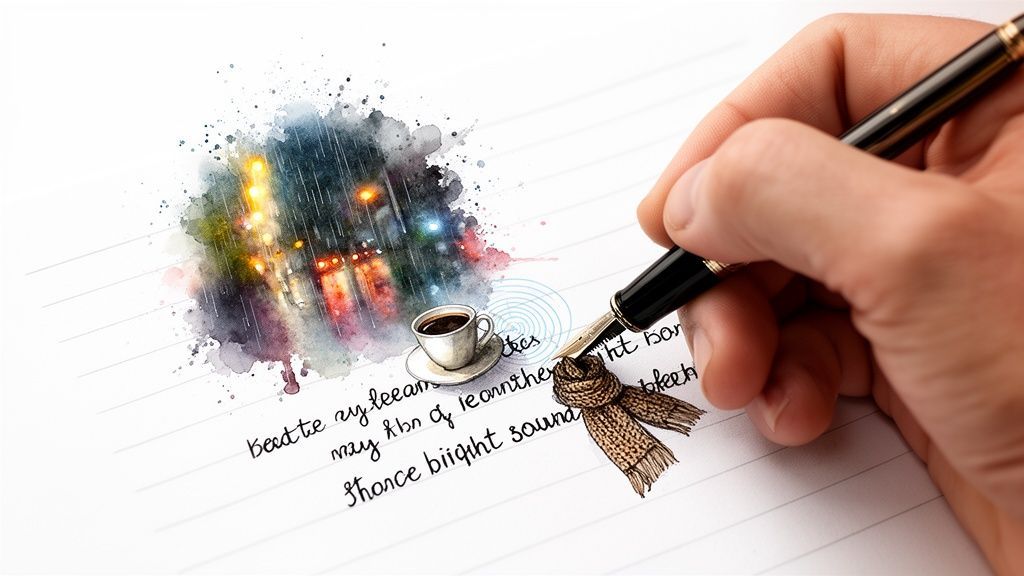
Buried inside every killer chorus is a hook. This is that one irresistible line, phrase, or melodic snippet that grabs your ear and refuses to let go. Often, it's the song's title, and it's almost always the most repeated part of the song.
Finding your hook is like finding the thesis of an essay. Just ask yourself, "If my listener only remembers one thing from this song, what should it be?"
Is it a raw emotional statement? Think "I Will Always Love You." Is it a powerful, unforgettable image? "Like a Rolling Stone." Is it an anthem-like call to action? "Don't Stop Believin'."
Once you’ve nailed that core message, your job is to build the rest of the chorus around it. Every other word should exist to lift that hook even higher.
The Litmus Test for a Great Hook: Can you still remember it an hour after you wrote it? Sing it to a friend and see if they can sing it back to you later. A genuinely catchy chorus is nearly impossible to forget. If it doesn't stick with you, it has zero chance of sticking with anyone else.
Trust me on this: the chorus is not the place for dense, complicated poetry or rambling stories. This is the moment for direct, punchy, and universal language. You're aiming for lyrics that are instantly understandable and ridiculously easy to sing along to, even on the very first listen.
A common rookie mistake is trying to cram way too many ideas into the chorus, which just muddies the water. The best choruses often lean on repetition, simple rhyme schemes, and a clear melodic lift that makes them feel bigger and more open than the verses.
When it comes to the words themselves, strong rhymes are your best friend. They create a satisfying feeling of resolution and make the lines infinitely more memorable. If you're drawing a blank, our guide on how to make words rhyme effectively is a lifesaver for finding fresh options that don't sound like you pulled them from a rhyming dictionary.
Feeling stuck? Don't worry, we've all been there. Here’s a quick-and-dirty cheat sheet with a few battle-tested techniques. Try plugging your core idea into each of these frameworks and see what clicks for your song.
| Technique | How It Works | Simple Example |
|---|---|---|
| Question and Answer | The verse asks a question (literally or emotionally), and the chorus slams down the definitive answer. | Verse: "Wondering why I'm packing my bags..." Chorus: "Because I'm leaving on a midnight train." |
| The Title Drop | You build the entire chorus to lead up to and emphasize a powerful title line, often right at the beginning or the very end. | "Every night in my dreams / I see you, I feel you / That is how I know you go on." |
| Repetitive Mantra | Find a short, potent phrase and repeat it like a mantra, maybe with slight variations, to drill it into the listener's head. | "Let it be, let it be, let it be, let it be / Whisper words of wisdom, let it be." |
At the end of the day, your chorus is the heart of your song. Treat it with the respect it deserves. Make it simple, make it honest, and most importantly, make it something you can't get out of your own head. If you can do that, you're on the right track.
Let's be real: writer's block is a monster. It’s that soul-crushing moment when you’re staring at a blank page, the cursor blinking back at you, taunting you. All those brilliant ideas you had in the shower? Poof. Gone. But what if you had a creative partner on call 24/7, ready to spitball ideas and pull you out of that rut?
That's where AI comes in. This isn't about letting a robot write your magnum opus. Think of it more like a co-writer or a sparring partner. Its job is to throw a bunch of paint at the canvas so you can see what colors you like, what needs to be blended, and what inspires a whole new direction. It’s collaboration, not automation.
The real magic of using an AI to write lyrics isn't just typing "write a sad song" and hoping for the best. Garbage in, garbage out, right? The quality of what you get back is a direct reflection of what you put in. You're the creative director here.
Instead of a vague, one-line request, feed the AI the same juicy details you’d be thinking about anyway. Let's compare:
Vague Prompt: "Write a chorus about a breakup." Specific Prompt: "Write a chorus from the perspective of someone who just got dumped in a crowded coffee shop. I want imagery like a torn sugar packet, the smell of rain on the pavement outside, and the feeling of every single person staring. The mood is quiet devastation, not angry yelling."
See the difference? The second prompt gives the AI a whole scene to play with—a mood, sensory details, a point of view. It transforms the tool from a cliché machine into a surprisingly useful assistant.
One of my favorite ways to use AI is to bust out of a lyrical funk. Say you're writing about "feeling small in a big city." You’re stuck on the same old lines. So, you ask the AI for ten unique metaphors to describe that exact feeling.
It might come back with a few duds, but it could also give you gold like:
"A single unread book on a massive library shelf." "A forgotten ghost in a packed subway car." "A birthday candle trying to outshine a bonfire."
Maybe most of them are junk, but one of those lines could be the spark that ignites the whole song. That’s the goal—generating possibilities you might not have stumbled upon on your own. For anyone curious about the broader landscape, exploring different AI text generator tools can open your eyes to what’s possible.
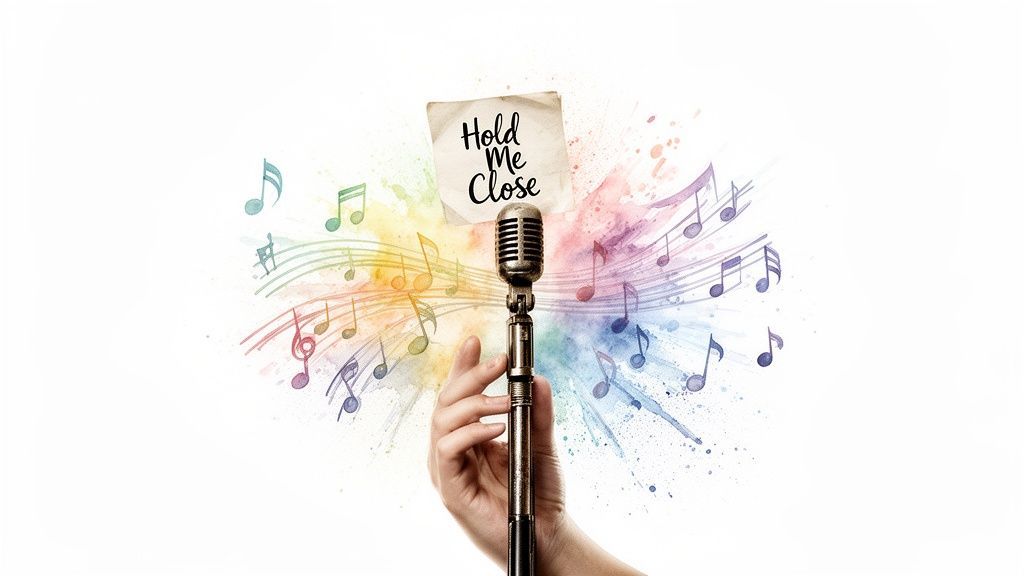
This blend of raw human emotion and creative tech is exactly what we're talking about. It’s about finding new ways to get the feelings in your head out into the world.
And this isn't some niche trend. The AI-Generated Song Lyric market has already hit USD 415 million globally and is growing like crazy. This signals a new era for songwriters, especially beginners. It's not just hype; related markets like Songwriter Collaboration Platforms soared to $1.14 billion in the same timeframe, showing just how much digital tools are changing the game.
Okay, let's get practical. Imagine you’ve nailed your first verse and chorus, but you’re completely stuck on the second verse. The story needs to go somewhere, but where?
Feed Your Work to the AI: First, copy and paste what you already have—your verse and chorus—into an AI lyrics generator.Give It Clear Directions: Don't just ask for a verse. Tell it what you need. Something like, "Based on the lyrics above, write a second verse that introduces a glimmer of hope, maybe through a memory of a better time."Analyze the Output: The AI will spit something out. Don't just slap it into your song. Hunt for the good stuff. Is there one killer line? A cool image? A word choice that surprises you?Rewrite and Make It Yours: Grab that one golden nugget and build the rest of the verse yourself. Weave your own voice, your own story, and your own experience into it.
Key Insight: Use AI for the raw materials, not the finished product. Its output is just a block of marble. You’re the sculptor. It’s your job to chip away, find the shape hidden inside, and polish it until it’s undeniably yours.
This back-and-forth process doesn't just speed things up; it helps you smash through creative blocks and discover lyrical paths you might have never explored. It's your secret weapon for turning that dreaded blinking cursor into a finished song you can be proud of.
Jumping into songwriting is like learning a new language—it’s exciting, a little intimidating, and you're bound to have a ton of questions. That’s a good thing! It means you’re engaged and ready to grow.
Every single songwriter, from bedroom hobbyists to stadium headliners, started out with the exact same uncertainties you’re feeling right now. Let's tackle some of the most common hurdles beginners face, so you can spend less time worrying and more time creating.
Here’s a secret: your voice isn't something you go out and find like a lost set of keys. It's something you uncover. It’s already there in the way you talk, the jokes you tell your friends, and the specific details you notice that others might miss.
Don't try to sound like your favorite artist. That’s a recipe for a bad cover band. Instead, figure out what you love about their style. Is it their clever wordplay? Their raw, emotional honesty? The vivid worlds they build in just a few lines?
Your songwriting voice is simply the authentic you, translated into lyrics. The more you write—even if it feels clumsy at first—the more that unique perspective will naturally start to shine through. Experiment with different tones until you find what feels most true.
The key is to write honestly about what you actually know and feel. Your unique voice will emerge from that authenticity. It’s a process of recognition, not invention.
The path to writing killer lyrics is paved with a few common, easily fixable mistakes. Spotting them early will put you on the fast track. The biggest trap, by far, is leaning on vague emotions and tired clichés.
"I miss you so much" is a statement, but it doesn't make the listener feel anything. Describing the "empty space on the passenger seat" or the "way I still make coffee for two" hits so much harder because it's specific and visual. It shows, it doesn't just tell.
Here are a few other pitfalls to watch out for:
Forgetting to Read Aloud: Lyrics are meant to be sung, not just read on a page. If a line is awkward to say, it will be impossible to sing. Reading your work out loud is the best way to catch clunky phrasing and unnatural rhythms. Seriously, do it. Overstuffing Lines: Trying to cram too many syllables into a single line is a classic rookie mistake. It makes the lyrics feel rushed and confusing. Breathe. Aim for clarity and a natural, conversational flow. Fearing the Edit: Your first draft is just the starting point—a block of clay. The real art happens when you start carving. Be ruthless. Cut lines that don't serve the story, polish the ones that do, and never be afraid to scrap it all and start over if something just isn't working.
Avoiding these simple traps will instantly elevate the quality of your work.
Absolutely. One hundred percent. Some of the most legendary lyricists in music history, like Bernie Taupin—Elton John’s creative partner—were words-first creators. Your primary job as a lyricist is to be a storyteller who writes with rhythm in mind.
Think of yourself as a poet crafting the narrative blueprint for a song. The music can always come later.
There are several paths you can take:
Collaborate: Find a musician or producer who needs great lyrics. This partnership can be incredibly fruitful and is how many of the greatest hits were born. Write to Instrumentals: Find royalty-free beats or instrumental tracks online and write your lyrics over them. This is a common practice in many genres, often called "toplining." Use Modern Tools: AI music generators can now create a musical backing based on the mood and theme of your lyrics, bridging the gap between words and music without you ever needing to pick up a guitar.
Don't let a lack of instrumental skill hold you back. Your ability to craft a compelling story is the most important talent you need.
Ah, the million-dollar question. A song feels "finished" when every line serves a purpose and the emotional journey feels complete. It’s less about a magic formula and more about a feeling of satisfaction and coherence.
When you think you're close, ask yourself these final questions:
Does the story make sense from beginning to end? Does the chorus effectively hammer home the song's main idea? Is there anything left that I could cut without anyone missing it? (Be honest!)
A great test is to put the song away for a day or two. When you return with fresh eyes and ears, you’ll immediately notice what works and what feels out of place. Ultimately, the song is done when you feel proud of it and it says exactly what you wanted it to say.
Feeling inspired to bring your lyrical ideas to life? With SendFame, you can instantly turn your words into a complete song with our AI Music Generator, create stunning visuals, and even generate a realistic celebrity message to announce your new creation. Stop waiting for inspiration and start creating today at https://sendfame.com.
Create Epic

SendFame

Create Epic with SendFame!
Questions: info@sendfame.com