How to Make Professional Looking Videos From Start to Finish

how to make professional looking videos
Welcome offer — 56% OFF


Struggling with how do you write a good song? This guide breaks down songwriting with real-world tips on lyrics, melody, and structure that actually work.
So, you want to write a song. A good song. One that doesn't just fade into the background but actually grabs someone by the ears and makes them feel something.
Forget the myth of the tortured genius waiting for a lightning bolt of inspiration. That’s for the movies. In the real world, writing a great song is a craft. It’s about taking a fleeting moment—a feeling, a memory, a snippet of conversation—and giving it a home. You build a solid structure around that raw idea, then you polish it until it shines.
This guide is your map. We're going to pull back the curtain on the entire process, from that first flicker of a thought to a finished track you can't wait to share.
That blank page staring back at you? It’s the scariest monster a songwriter can face. But here’s the secret: every great song, from a simple folk tune to a chart-topping pop anthem, is built from the same fundamental parts. A killer concept, a smart framework, lyrics that hit home, and a melody that just won’t quit.
We’re going to walk through how to find those ideas in your everyday life and turn them into something tangible. It's less about magic and more about a reliable, repeatable process.
Think of it this way: songwriting happens in three main phases. You catch the idea, you build the house, and then you decorate it. It’s a simple but incredibly powerful workflow.
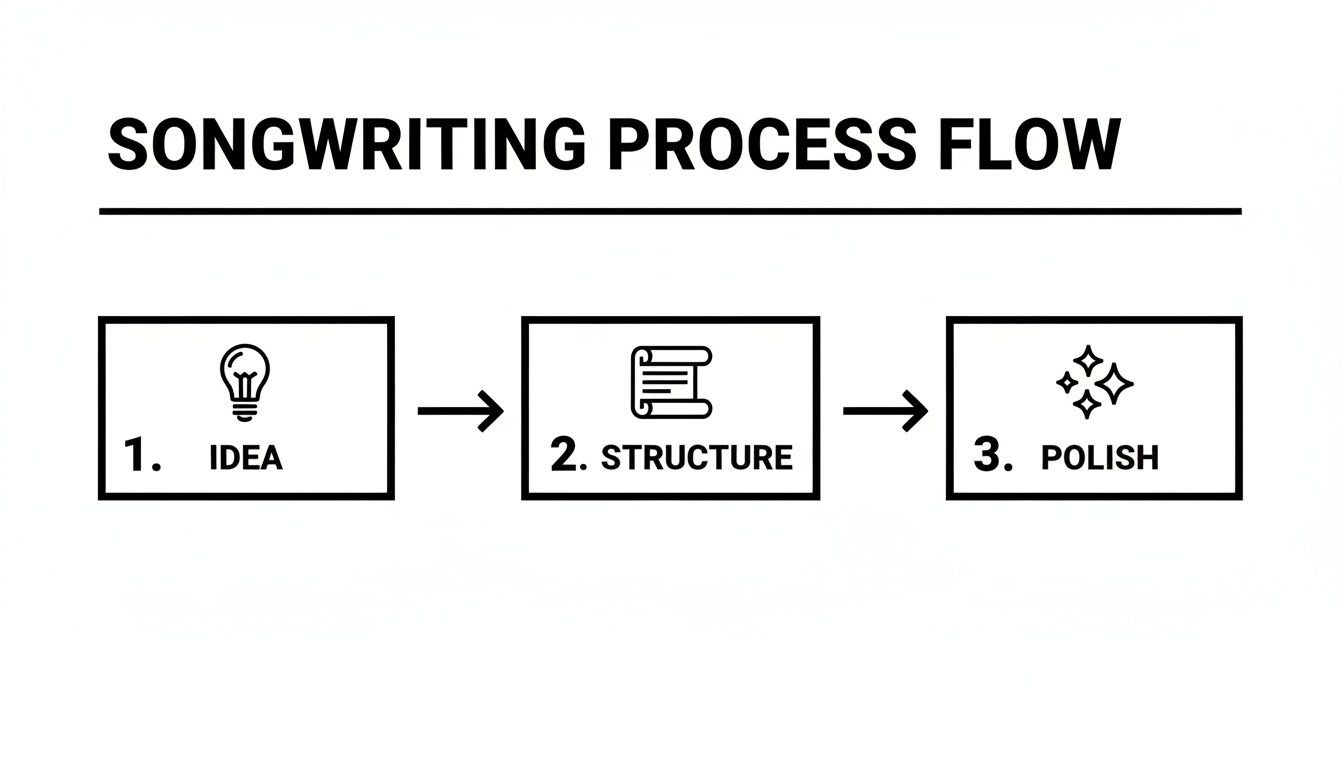
This little flowchart says it all. Great songs aren't accidents; they're built, piece by piece, moving from a creative spark to a well-architected piece of art.
Grammy-winning songwriter Jason Isbell put it perfectly:
"I feel like the rules for writing a good song translate really well to just living a good life...in the process of eliminating things that don’t help you write a better song, you also eliminate things that don’t help you live a better life."
He’s right. The discipline of chipping away at a song, cutting what doesn’t serve the story, and refining your ideas—it’s a lot like personal growth. It’s about making choices that matter.
The industry has noticed this shift toward craftsmanship, too. In 2023, PRS for Music brought over 10,000 new songwriters into the fold and registered a staggering 4.5 million new songs. That's a 74% spike from 2019! This isn't just random noise; it's a wave of creators learning the techniques and putting in the work.
To give you a clearer picture, here's a quick breakdown of what this journey looks like.
| Stage | What It Involves | Key Goal |
|---|---|---|
| 1. The Spark (Idea) | Brainstorming, freewriting, finding a title or concept, humming melodies into your phone. | To capture a raw, authentic feeling or story worth telling. |
| 2. The Blueprint (Structure) | Outlining verses, choruses, and a bridge. Arranging your lyrical and melodic ideas into a cohesive song form. | To create a journey for the listener that builds and resolves tension. |
| 3. The Polish (Refinement) | Rewriting lyrics, tweaking melodies, experimenting with chords, getting feedback, and tightening up the arrangement. | To make every single word and note count, ensuring the final song is as impactful as possible. |
This table lays out the fundamental path every song takes. Whether you're writing a folk ballad or a rap anthem, you'll be moving through these stages.
Speaking of rap, while this guide is for everyone, those focused on hip-hop might want to check out our specific tips on how to write a song or rap.
Ultimately, getting good at this is all about putting in the reps. You’ve probably heard of the 10,000-hour rule for mastering a skill. Songwriting is no different. Consistent practice, learning the fundamentals, and a willingness to tear it all down and build it back up—that’s what turns a fleeting idea into a timeless song.
Every great song starts with a single, potent idea. It's the emotional core, the magnetic north that everything else points toward. Before you even think about chords or rhymes, you have to nail down what you're writing about and, more importantly, why anyone should care.
Forget starting with vague concepts like "love" or "sadness." That’s like trying to paint a masterpiece with a roller brush. The real magic is in the details.
Instead of just "love," how about that jolt of anxiety and excitement when their name pops up on your phone screen? Instead of "heartbreak," what about the crushing silence of dividing up your shared vinyl collection after the split? That’s where the good stuff lives. Those specific, tangible moments are what listeners connect with.
Ready to dig for gold? Here are a few ways I get the ideas flowing:
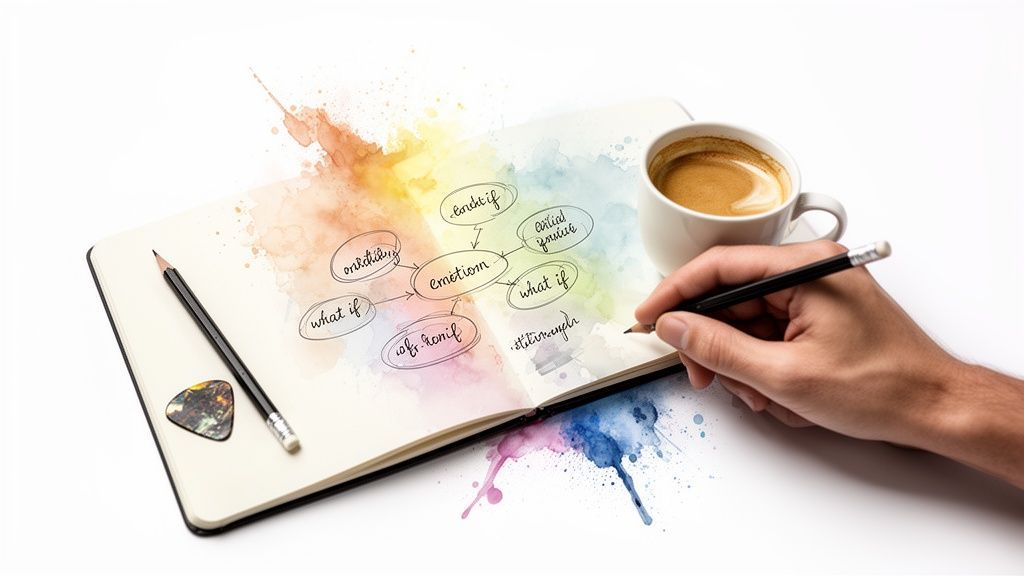
Mind-Map Your Feelings: Grab a notebook. Scribble a feeling like "nostalgia" in the middle of the page. Now, just let your brain go, branching out with every memory, person, scent, or sound that pops into your head. No filter. Play the "What If?" Game: This one is fun. Ask yourself some off-the-wall questions. "What if I could have a beer with my 16-year-old self?" "What if my dog could spill all my secrets?" You'd be amazed at the stories that tumble out. Be a Creative Thief: Real life is your best source material. An overheard line at a coffee shop, a killer quote from a movie, a weird dream—it's all fair game. I have a running list of "song titles" in my phone's notes app for exactly this reason.
If the well feels dry, don't sweat it. It happens to everyone. For a little extra nudge, check out these ideas for writing songs to get the gears turning again.
Once you’ve snagged that killer concept, it's time to give it a skeleton. That’s where song structure comes in.
Think of song structure as the blueprint for your track. It’s what takes your listener on a journey—building tension, delivering that sweet payoff, and making sure your big idea actually lands. A brilliant idea without a solid structure is just a beautiful mess.
Most of the hits you love are built from the same three fundamental parts:
Verse: This is your storytelling real estate. Each verse should peel back another layer of the onion, push the story forward, and set the stage for the chorus. Chorus: The main event. The big kahuna. This is your song's mission statement, wrapped in the catchiest melody you can write. If someone only remembers one part of your song, it’s going to be this. Bridge: The bridge is your secret weapon. It’s a detour, a change of scenery. It can offer a new perspective, a musical shift, or a plot twist right before you slam back into that final, glorious chorus.
This isn't just some dusty old rule from a textbook; it's a proven formula that works.
In the age of streaming, structure is king. Attention spans are brutally short. A predictable, satisfying structure is the invisible hand that keeps a listener hooked from the first note to the fade-out.
The numbers don't lie. Publishers recently earned 47.1% of their $11 billion revenue from digital sources in 16 key markets. And guess what? The chart-toppers that drive those numbers almost all rely on a tight, familiar verse-chorus structure. If you want to connect, borrowing a proven blueprint is one of the smartest moves you can make. You can dig deeper into how digital trends are shaping music publishing to see the data for yourself.
So, which structure is right for your song? It all depends on the story you’re telling. Are you building a slow-burn narrative? Or are you going for a punch-in-the-gut anthem? This little cheat sheet breaks down the most common formats to help you pick your path.
| Structure Type | Section Order | Best For |
|---|---|---|
| Verse-Chorus | V-C-V-C-B-C | Pop, Rock, Country. Perfect for songs with a clear, repeatable message. The chorus is the undisputed star. |
| Verse-Chorus-Verse | V-C-V | Singer-Songwriter, Folk. A simpler, more intimate form that puts the focus squarely on the storytelling. |
| AABA | Verse-Verse-Bridge-Verse | Jazz, Tin Pan Alley, Classic Pop. Creates a classic feeling of tension and release, with the bridge providing contrast. |
| Strophic (AAA) | Verse-Verse-Verse... | Folk, Hymns, Blues. Ideal for lyric-heavy stories where the music acts as a steady foundation for the words. |
Look, rules are made to be broken, but starting with one of these classic structures gives your song a solid spine. It ensures your brilliant idea doesn’t just drift away but follows a clear path that takes your listener right along with it.
Alright, this is where the real fun begins. You've got your big idea and a basic roadmap for your song. Now it's time to pour in the words and music that will make people feel something. Your lyrics are the story, and your melody is the emotional rocket fuel. Let’s get into making both of them impossible to forget.
First things first: forget trying to sound like a poet laureate. The most powerful lyrics are almost always honest, specific, and visual. They don't just tell the listener what you felt; they drop them right into the scene so they can feel it for themselves.
You’ve probably heard it before, but the golden rule of any good writing is doubly true in songwriting: show, don't tell. It’s the difference between a line like "I was sad" and painting a picture of a "Rainy Tuesday, empty coffee cup, your favorite record skipping on the final track." One is a label; the other is a whole mood.
To really nail this, get granular with sensory details. What did you see, hear, smell, or even touch in that moment you're writing about? Weaving these little specifics into your verses builds a world your listener can walk around in. This is pure storytelling. If you're serious about getting better at this, mastering storytelling for impact has some fantastic insights on narrative that can help make your song’s message hit that much harder.
Your secret weapon here is authenticity. Write from your real life, even the parts that feel mundane. That painfully awkward first date, the sheer relief of quitting a soul-crushing job, the quiet pride of fixing a leaky faucet—these are the universal human moments that create a real connection.
Your unique perspective is what makes a song yours. Don't censor the weird, specific details. That's often where the best lines are hiding.
Let's talk rhymes. Nothing tanks a great lyrical idea faster than a forced rhyme. We've all heard them: "I love you so much / my heart you did touch." It sounds clunky and cheap because the need for a rhyme is steering the ship instead of the actual meaning.
Here’s how to sidestep that trap:
Embrace near rhymes (or slant rhymes): "Home" and "stone" are perfect rhymes, sure. But "home" and "alone," or "shape" and "late"? Those are near rhymes. They give you that satisfying chime without boxing you into a lyrical corner. Mix up your rhyme scheme: An AABB scheme, where every two lines rhyme, can start to sound a bit like a nursery rhyme if you're not careful. Try playing with ABAB or ABCB patterns. It feels more like a real conversation and keeps the listener guessing.
Ultimately, the rhythm of your words—what we call cadence—is just as crucial as the rhymes. Seriously, read your lyrics out loud. Do they flow off the tongue? Do they have a groove even without any music? If a line makes you stumble, it'll make your listener stumble, too. For a deeper dive, our guide on how to write song lyrics for beginners is packed with more tricks of the trade.
Now for the soul of the song: the melody. This is what gets stuck in people's heads for days. And no, you absolutely do not need a degree in music theory to write a killer tune. Your greatest tool is your own intuition.
A great way to start is by just singing your lyrics over a simple chord progression on a guitar or piano. Heck, even one repeating chord will work. The key is to not think too hard. Just open your mouth and sing. Record it all on your phone. Most of it will be junk, and that's okay! Somewhere in that freestyle mess, a little nugget of melodic gold is waiting for you.
As you start shaping that melody, think about the emotional journey of your lyrics.
Verse Melody: This part should feel more conversational, like you're leaning in to tell a story. It sets the scene and builds a little tension. Keeping it in a comfortable, lower part of your vocal range is usually a good bet. Chorus Melody: This is your moment to shine. The melody should feel like it's taking off, often by jumping up in pitch to create a huge sense of release and importance. This is your anthem. Make it simple, memorable, and powerful.
Don't forget to play with the rhythm of your melody. How does it dance with the rhythm of your lyrics? You can hold one word out for a long time to give it emotional weight, or you can spit out a bunch of short, punchy notes to create urgency. This dynamic interplay is where a good song transforms into a great one.
Alright, you’ve got a killer melody and lyrics that mean something. That’s the heart and soul of your song, right there. But a soul needs a body to live in, and that’s where harmony and arrangement come into the picture. This is the fun part where we take your core idea and dress it up, turning it from a simple sketch into a full-blown emotional experience for the listener.
Harmony is your song’s emotional engine. Seriously. It's the chords humming along under your melody, and they have the power to make your words feel triumphant, tragic, or tense. Don't get spooked by music theory—some of the biggest hits ever were built on just three or four basic chords.
The real trick is understanding how chords talk to each other. Think of them as characters in a story. Some feel stable, like coming home after a long trip. Others feel restless and create tension, like waiting for a reply to a risky text. A chord progression is just you arranging these characters to guide your listener on an emotional journey.
Look, you don't have to reinvent the wheel. Some of the most famous chord progressions are classics for a reason: they just work. They tap into something fundamental in how our brains process music and emotion.
You've heard these a thousand times before, and for good reason:
The "Four Chords of Pop" (I-V-vi-IV): Think "Let It Be" or "Don't Stop Believin'." This one is pure emotional payoff. It’s uplifting, familiar, and feels like an instant classic. The "Singer-Songwriter" (vi-IV-I-V): A bit more melancholic and thoughtful. This is the go-to for countless acoustic ballads that really pull on the heartstrings. The "Classic Rocker" (I-IV-V): The simple, direct, energetic backbone of early rock and roll and the blues. It just drives.
Grab a guitar or sit down at a piano and play one of these progressions while singing your melody. How does it feel? If the vibe is off, try swapping a chord or changing the order. This part is all about playing around until you find the harmonic foundation that makes your melody and lyrics pop.
The right chord progression doesn’t just support your melody; it elevates it. It’s the difference between telling someone a story and making them feel like they were there.
Once you’ve got your chords sorted, it’s time to think about the arrangement. This is where you become the director of your own little musical movie. You get to decide which instruments play what parts, and more importantly, when they play them. You wouldn't have every actor on screen shouting their lines at the same time, right?
Arrangement is all about creating dynamics—the peaks and valleys that keep a song from getting boring. The goal is to build tension and then give the listener a sweet, satisfying release.
So, how do you pull that off?
Start Small: Kick off your first verse with something intimate. Maybe it's just your voice and a single acoustic guitar or a simple piano line. This pulls the listener close and puts the focus right on your story. Build Gradually: As you head into the pre-chorus, start layering things in. Bring in a bassline to give it some weight. Add a simple drum beat for momentum. Go Big for the Chorus: This is it. This is your moment. The chorus should feel bigger and wider than everything else. Unleash the backing vocals, crash the cymbals, or let a lead guitar line soar. Pull Back and Rebuild: After that massive chorus, strip it back down for the second verse. This creates contrast and gives the listener's ears a break before you build it all up again—maybe even bigger this time around.
This isn’t just about making cool-sounding art; it’s a savvy career move. Knowing how to craft an arrangement that hits hard in a recording and feels massive live is what separates the pros from the amateurs. Globally, songwriter royalties hit a staggering $12.7 billion in 2023, and get this—live performances drove a massive 87.2% of that growth. It just goes to show that writing a song with an anthemic, dynamic arrangement is what truly connects with audiences and builds a career. You can dig deeper into these songwriting industry trends to see just how big the impact is.
Let's get into it—the elephant in the room: artificial intelligence. For a lot of songwriters, using AI feels like cheating. But that’s like telling a carpenter they’re cheating by using a power saw instead of a handsaw. These tools aren't here to replace your soul; they're here to supercharge it. Think of an AI music generator as your ultimate creative partner, one that's ready to jam 24/7.
Seriously, it’s the world’s most patient co-writer. It never has a headache, it’s never creatively blocked, and it can spit out a thousand ideas in the time it takes you to make a cup of coffee. This isn't about laziness. It's about working smarter, moving faster, and saving your brainpower for the stuff that only you can do—bringing your unique vision to life.
We’ve all been there. Staring at a blank page (or a blinking cursor), trying to find that one perfect rhyme that doesn't sound like it belongs in a cheesy greeting card. Before you throw your notebook across the room, you can turn to an AI for a fresh angle.
The trick is to boss it around with specific, creative instructions. Don’t just ask for a word that rhymes with "fire." That's amateur hour. Get specific with a prompt like this:
"Give me five slant rhymes for the word 'fire' that feel desperate and lonely. Avoid the obvious ones like 'desire' or 'higher'."
All of a sudden, you get gold. Words like "liar," "denial," "empire," or "conspire"—stuff loaded with emotional weight that can take your song somewhere completely new and exciting. The same thing works for melodies. If your verse is putting you to sleep, feed the lyrics and mood into an AI and ask for three different melodic ideas in a minor key. You don't have to use what it gives you, but it’s often just the spark you need to find the right idea yourself.
As you can see, a clean interface and a simple prompt are all it takes to turn a blank slate into a playground of musical possibilities.
What happens when you have a killer lyrical concept but no idea where to even start with the music? AI can lay the groundwork for you in seconds. Modern tools let you generate entire chord progressions based on nothing more than a feeling.
Let's say you want to write a song that feels "somber but hopeful." Type that exact phrase in, and an AI might suggest a progression like Am - G - C - F. Bam. You've got an instant emotional palette to start painting with. Now you can just loop those chords and start humming melodies over the top. If you want to go deeper on this, our guide on how to use an https://sendfame.com/blog/ai-song-creator is packed with these kinds of workflows.
Honestly, it’s liberating. It completely removes the technical hurdle of music theory, letting you dive right into the feeling and story you're trying to tell.
This isn't just for bedroom producers and aspiring pop stars. This technology is a massive deal for marketers and content creators. Need a custom, royalty-free track for your next ad campaign? Forget spending hours scrolling through generic stock music libraries. Now you can generate a song that perfectly fits the vibe of your campaign in minutes.
Imagine this workflow for cooking up a viral sound:
Spot a Trend: Find a trending audio style or theme on a platform like TikTok. Create Variations: Use an AI to generate five different 15-second musical hooks inspired by that trend. A/B Test It: Run a few small ad campaigns testing each hook. See which one gets the most shares and saves. Go Big: You've found your winner. Now build the entire campaign around that data-proven audio clip.
This kind of data-driven creativity was pure science fiction just a few years ago. It takes the guesswork out of the equation and seriously boosts your odds of creating content that actually connects with people.
If you want a peek into the wild future of music, check out this AI-written Nirvana song. It’s a trip. Seeing how these tools can mimic iconic styles shows you just how powerful this creative sandbox can be. At the end of the day, AI is a tool—and its true power is always in the hands of the creator using it.
Still have a few questions buzzing around in your head? Good. That’s part of the process. The path from a quiet little idea to a full-blown track is loaded with twists, turns, and a whole lot of "am I doing this right?" moments.
We've heard these same questions from countless songwriters over the years. Let's tackle them head-on and get you moving forward with more confidence and a lot less doubt.
Ah, the million-dollar question. The real answer? A song should be as long as it needs to be to tell its story—and not a second longer.
That said, in today’s world of streaming and short attention spans, the sweet spot for a pop, rock, or radio-friendly track usually lands somewhere between 2 minutes and 30 seconds and 3 minutes and 30 seconds.
This isn't a rule set in stone, but it’s a pretty smart guideline. Shorter songs are an easier "ask" for a new listener and have a better shot at landing on playlists. If you find your track creeping past the four-minute mark, take a hard look and ask yourself: does every single section really need to be there?
First off, your life isn't boring; you just haven't put on your songwriter glasses yet. The most powerful, gut-punching songs often come from the most seemingly mundane, everyday human experiences.
Forget trying to write some epic tale you haven't lived. Write about the quiet rage of a slow internet connection. Write about the secret thrill of finding a forgotten five-dollar bill in an old jacket. The magic isn't in the drama; it's in the details.
It’s your specific take on a "boring" moment that makes it fascinating. Raw honesty will always connect more deeply than a made-up story.
Nope. Not at all.
Think of it this way: knowing music theory is like having a bigger box of crayons. It's helpful, sure, but you don't need 120 colors to draw a beautiful picture. Some of the most legendary songwriters in history couldn't read a lick of music.
Your ears and your gut are your best guides. Do those two chords sound cool together? Awesome. Does that melody make you feel something? Perfect. You can always learn the "why" behind what works later on, but never let a lack of formal training stop you from making something that feels right.
The old saying is that a work of art is never truly finished, it's just abandoned. You could tweak a lyric, a chord, or a mix forever and drive yourself crazy. The real question isn't "Is it finished?" but "Is it ready?"
A song is ready when it effectively lands the emotional punch or tells the story you wanted it to.
Here’s a quick checklist to help you decide when it's time to let go:
The Message Is Clear: Can someone listen once and get the main idea? The Structure Works: Does it have a satisfying arc—a beginning, middle, and end? It's Lean and Mean: Have you trimmed any fat? (Any lines or sections that don't add value?) You Feel It: When you listen back, does it still give you that little jolt?
If you can check off these boxes, it’s time to set it free and start the next one. Finishing songs is a muscle. The more you do it, the stronger you get.
Ready to stop overthinking and start creating? The SendFame AI Music Generator can help you build musical ideas, brainstorm lyrics, and get your songs off the ground faster than ever.
Create Epic

SendFame

Create Epic with SendFame!
Questions: info@sendfame.com