How Do You Write a Good Song That Connects with Listeners
how do you write a good song
Welcome offer — 56% OFF


Create hilarious text to speech famous people videos that go viral. Learn to write killer scripts, refine AI audio, and navigate the ethics of celebrity voices.
Ever scrolled through your feed, stopped on a video of a celebrity saying something completely out of pocket, and thought, “Wait… did they really say that?” Welcome to the wild, wonderful world of AI voice generation. Using text to speech famous people tools, you can now craft hilarious, shocking, or heartwarming celebrity-style messages in just a few minutes.
Not long ago, this kind of tech was locked away in Hollywood sound studios. It was complex, expensive, and definitely not for the average person. But things have changed. Fast.
Platforms like SendFame have torn down those walls, taking sophisticated voice cloning technology and making it dead simple. Forget clunky software or spending weeks learning the ropes. Now, turning a line of text into a message that sounds like it’s coming straight from a superstar is as easy as typing and clicking a button.
This isn’t just a fun party trick; it’s a real game-changer for anyone creating content. We're talking about a whole new way to approach everything from marketing campaigns to birthday gifts. Essentially, you've got a professional audio suite right at your fingertips. This guide is your backstage pass to making it all happen.
Let's be real—the buzz is impossible to ignore. The text-to-speech (TTS) market was valued at a cool USD 3.6 billion in 2023, and it's on a rocket ship trajectory, expected to hit USD 14.6 billion by 2033. A huge chunk of that growth comes from our insatiable appetite for engaging audio. Think about it: how often do you listen to an article or a post instead of reading it?
The real magic of AI celebrity voices is their power to stop the scroll. They blend humor, shock value, and that cozy feeling of familiarity into a perfect recipe for shareable content. When you nail it, these clips feel authentic and hit just right, making them perfect for:
Viral Marketing: Imagine creating an ad that people actually want to send to their friends. Personalized Gifts: A birthday shout-out from your buddy’s favorite action hero? Unforgettable. Social Media Gold: Make your posts pop in a sea of sameness.
The secret sauce isn't just the tech. It's the creativity you bring to the table. The clips that go viral are the ones that perfectly capture a celebrity's vibe while delivering a message that’s clever, funny, or totally unexpected.
Creating a hilarious clip is one thing, but getting it in front of the right people is the other half of the battle. To truly master this, you need to get good at scriptwriting, a little bit of audio editing, and smart distribution. Ready to go from novice to pro? Check out our guide on how to create viral content that people can't help but share.
Let's get one thing straight: even the most sophisticated AI on the planet can't save a terrible script. If you want to create a text to speech famous people message that actually fools people, you have to start thinking less like a tech user and more like a Hollywood screenwriter.
The whole illusion hinges on capturing the celebrity's unique personality and cadence. If you get that wrong, the entire thing falls flat.
This all starts with a deep dive—a bit of method acting, if you will. Before you even think about writing, you need to immerse yourself in their world. Binge-watch their interviews on YouTube, listen to their podcast appearances, and scroll way, way back on their social media feeds. You're listening for how they talk, not just what they say. Are they a fast talker? Do they use big words or keep it simple? Short, punchy sentences or long, winding stories?
Jot down their signature quirks. Every public figure has them. Look for things like:
Catchphrases: Those little soundbites they're famous for. Verbal Tics: Do they say "like," "you know," or "honestly" all the time? What does their laugh sound like? Rhythm and Pacing: Is their delivery high-energy and rapid-fire, or more slow and deliberate?
The goal isn't to create a cheap caricature. You're aiming for an authentic echo—a script that feels so real, you can practically hear them saying it in your head. That's what makes the final audio clip convincing and wildly shareable.
This kind of detail work is becoming non-negotiable. As the use of AI in business skyrockets—projected to jump from just 2% in 2018 to 5.7% by late 2025—the demand for realistic voices is exploding. With 63% of companies planning to adopt AI more broadly, getting this right puts you ahead of the curve. You can see just how AI adoption is accelerating and what it means for creators like us.
Okay, so you've channeled their inner voice and written a killer script. Now you have to format it so the AI can understand your direction. Think of text-to-speech engines as incredibly talented actors who take everything you write literally. Your formatting is their stage direction.
Punctuation is your best friend for controlling rhythm. A comma is a slight breath. A period is a full stop. An ellipsis (...) can create that perfect dramatic pause or thoughtful hesitation. Play around with them to mimic how people actually talk.
For words the AI just can't seem to get right, phonetic spelling is a lifesaver. If it keeps butchering a name like "Siobhan," you can spell it out as "Shi-vawn" to nudge it in the right direction. It's a simple trick that cleans up the final delivery and saves you a ton of editing headaches. You can get way more in-depth on these techniques in our complete guide to using AI character voices.
Here’s a quick formatting cheat sheet to keep in your back pocket:
Punctuation for Pauses: Use commas, periods, and ellipses to direct the flow. Phonetic Spelling: Write out tricky words how they sound (e.g., "See-att-le" for Seattle). Emphasis Cues: Some advanced platforms use bolding or italics to signal a change in tone. Short Sentences: Break down complex thoughts. Shorter lines almost always sound more natural.
When you nail both the research and the formatting, you're not just feeding text into a machine. You're directing a performance. And the result is a celebrity message that sounds shockingly, delightfully real.
Alright, your script is polished and ready to go. Now for the fun part—turning those words into a believable celebrity voice. This isn’t just about copy-pasting text and hitting a button. Think of yourself as a director coaxing a performance out of your AI actor to create truly convincing text to speech famous people audio.
The first move is simple enough. Head over to your chosen AI voice platform, pick your celebrity voice, and drop that perfectly formatted script into the text box. But hold on, don’t slam that "generate" button just yet. The best tools give you a whole control panel to play with, and this is where you can really shape the performance.
These settings are your secret sauce for adding that human touch. You’ll usually find controls for:
Speed: Dialing the words-per-minute up or down can take a line from a frantic rant to a slow, dramatic burn. Pitch: A tiny adjustment to the pitch can make the voice sound much closer to the celebrity’s natural tone. Emotion: Some of the slicker platforms let you inject feelings like "excited," "sad," or "joking" to really color the delivery.
Your first take will almost never be perfect. That's totally normal. Treat it like raw footage from a film shoot. The real artistry comes from refining and polishing that audio until it's ready for its close-up.
With a decent first draft in hand, it’s time to switch hats from writer to audio producer. Your mission is to iron out any of those tell-tale AI wrinkles and add a bit of polish that makes the whole thing click. If you're still shopping for the right tool, this ranking of leading AI voice generators is a great place to start.
First, give it a close listen. Do you hear any weird pauses or words that sound... off? If the AI trips over a name or a tricky word, pop back into your script and try spelling it out phonetically. For example, "Bezos" might become "Bay-zohs." If the timing between sentences feels unnatural, you might need to generate each line separately and then piece them together yourself in a basic audio editor like Audacity.
This is exactly why spending that extra time analyzing, writing, and formatting your script is so crucial.
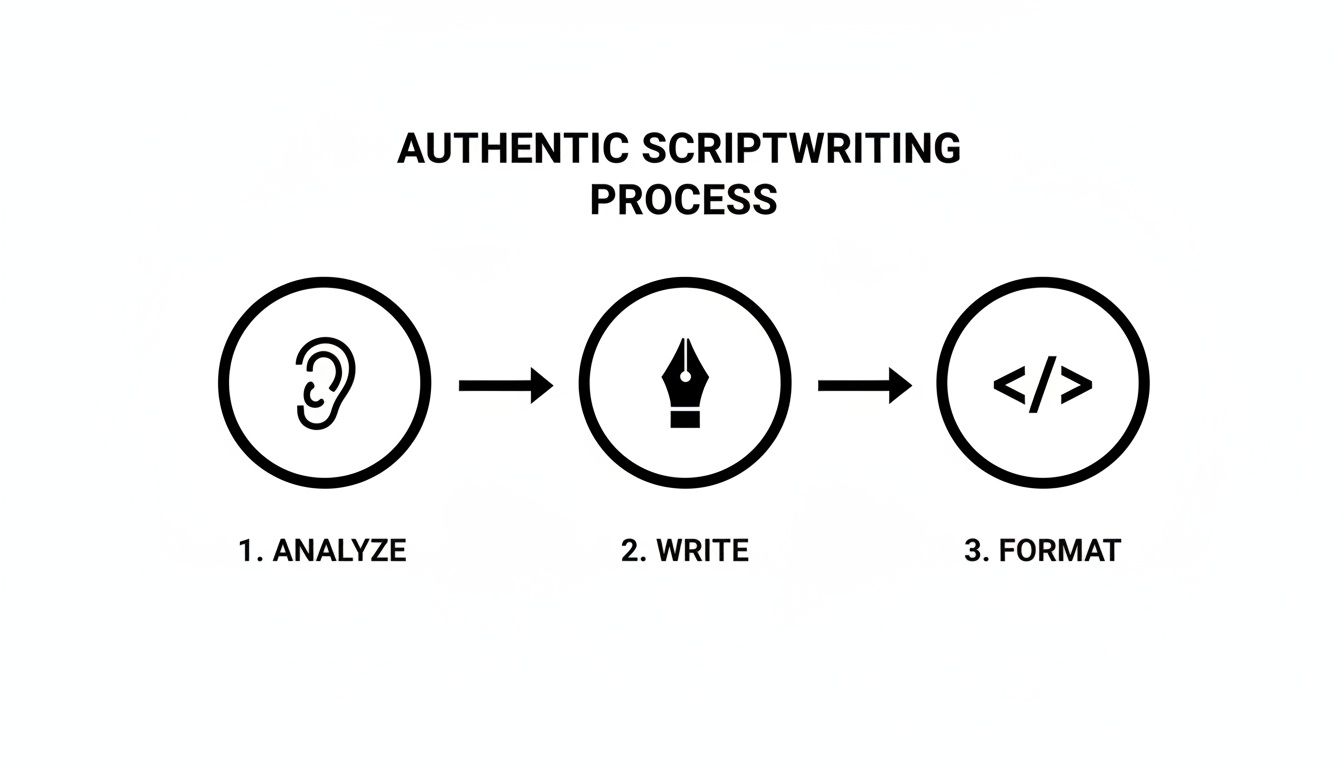
A killer input makes for a killer output, and it'll save you a mountain of editing headaches later on.
Now, let's add some cinematic flair. A little background music or a perfectly timed sound effect can turn a dry voiceover into an immersive experience. Think about hearing a famous action hero's voice—it’s good on its own, but add a faint explosion or a tire screech in the background? Suddenly, it’s 100% more believable.
Seriously, don't hesitate to run the same line through the generator five or ten times. A tiny change to one word or a slight adjustment to the pitch can be the difference between "that sounds fake" and "whoa, is that really them?" This cycle of tweaking and listening is how you get audio that doesn’t just sound like a celebrity—it feels like them.
If you want to get a closer look at the different tools that can help you with this, take a peek at our guide to the best AI celebrity voice generator options out there.
In the end, your ears are the ultimate judge. Close your eyes, play the clip, and ask one simple question: "Do I buy it?" If the answer is a resounding yes, you're officially ready to unleash your creation on the world.
Alright, you’ve done the hard part. You’ve tinkered and tweaked and now you have a masterpiece: a hilarious audio clip using a text to speech famous people generator that sounds almost too real.
But let’s be honest. A brilliant clip that nobody hears is just a file gathering digital dust on your hard drive. Now it's time to put on your viral marketing hat.
Your raw audio needs a visual sidekick to have any chance of survival in the jungle of social media. A plain sound file is a non-starter on visual-first platforms like TikTok, Instagram, or YouTube Shorts. You've got to package your audio for maximum impact.
The easiest way to do this is with an audiogram. All this is is a static image—maybe a goofy picture of the celebrity you’re parodying—with your audio playing over it. Throw in an animated soundwave, and you've got something shareable. It’s basic, but it works.
Want to create a real showstopper? A tool like SendFame’s Image-to-Video feature can animate a still photo of the celebrity, making their mouth move in sync with your AI audio. This is an absolute game-changer. It turns a simple joke into a believable, must-share deepfake parody that people won't be able to ignore.
And please, for the love of all things viral, use captions. On-screen text is non-negotiable for hooking people who are doomscrolling with the sound off. The numbers don't lie: videos with captions see a 91% completion rate, a huge leap from 66% for those without. That’s a 38% boost in keeping people watching. It’s no wonder features that mix audio and visuals are so powerful.
You can't just throw the same video everywhere and cross your fingers. Every platform has its own personality and its own algorithm to appease. You have to play their game.
TikTok: This is the land of trends. See what’s hot. Can you stitch your celebrity voice clip with a trending sound or a popular meme format? To get your content in front of more eyes, people use all sorts of strategies, including those for boosting visibility on platforms like TikTok.Instagram Reels: Things are a little more polished here. Make sure you’re using high-quality images for your audiograms or animations. Reels also loves content that gets people talking, so write captions that ask a question or dare users to tag a friend.YouTube Shorts: Don’t sleep on Shorts. It has a gigantic audience and can help people discover your content for weeks. Pack your description with relevant, searchable hashtags. You can also get away with slightly longer clips here (up to 60 seconds), which is perfect if your joke needs a little more runway.
The secret to going viral isn't just one magic bullet—it's the perfect storm of a funny concept, clever packaging, and smart distribution. Your job is to create that storm.
Finally, your caption is part of the performance. Don't just describe the video; add to the joke! Use a punchline, ask a wild question, or create a call to action that baits people into commenting and sharing. A simple "Tag someone who would fall for this" can light up the comments, signaling to the algorithm that you’ve got something special.
Alright, let's talk about the elephant in the room. Playing with text to speech famous people voices is an absolute blast, but it’s a bit like handling fireworks—exhilarating, but you need to be smart about it to avoid blowing up your own spot. This isn't some lawless digital frontier; using a person's voice, even a synthetic clone of it, has some real-world rules you can't ignore.
The big legal beast you need to understand is called the Right of Publicity. It’s a fancy term, but the idea is simple: a person’s name, face, and yes, their voice, are their property. You can't just slap a celebrity's AI voice onto your new line of crypto-infused dog treats and call it a day. That’s a one-way ticket to a very spicy letter from a very expensive lawyer.
But here’s where the fun begins. The law often makes exceptions for things like parody and satire. This is the creative playground where most of this content lives, but it requires a bit of finesse.
This is the golden rule, the north star, the prime directive: never, ever try to fool your audience. Your goal is a good laugh or a clever commentary, not a con job. You have to make it crystal clear that your creation is a bit of fun, not a genuine message from the star themselves. This is your single best defense if things ever get sticky.
Think about it. A video where an AI Morgan Freeman dramatically narrates the assembly instructions for an IKEA bookshelf? Hilarious, obviously a parody. A clip where that same voice seems to be giving you hot stock tips? That's fraud, my friend. Your intent is everything.
Key Takeaway: Always operate from a place of parody, not deception. If a reasonable person could tell your video is a joke and not a real endorsement, you're on much safer ground. The goal is a laugh, not a lie.
This principle is more important than ever as the tech gets scarily good. As you get deeper into this, it’s crucial to know where the ethical lines are drawn. For a closer look at the tech and how to use it responsibly, our guide on how to make deepfake videos is a must-read.
To keep it simple, here are the do's and don'ts for staying on the right side of the tracks:
DO use celebrity voices for obvious parodies, satire, memes, or personal stuff like a wild birthday message for a buddy. DON'T use a voice to endorse any product, service, or political candidate without their signed, sealed, and delivered permission. That’s commercial use, and it's a huge no-no. DO slap a clear disclaimer in your video or description. Something like, "This is an AI-generated voice for parody purposes only!" goes a long way. DON'T create content that's just plain nasty, defamatory, or spreads harmful lies. That’s a bad look and can land you in a world of hurt, AI or not.
Stick to these guidelines, and you can have a ton of fun making stuff that goes viral for all the right reasons. It's all about being a smart, responsible creator in this wild new field.
Jumping into the world of AI celebrity voices can feel like you've been handed the keys to the kingdom. Suddenly, you can make anyone say anything. But with that kind of power comes... well, a whole lot of questions. Let's clear up some of the common head-scratchers people run into.
The big one, right off the bat, is always about money. "Can I use this Morgan Freeman voice for my new app commercial?" The answer to that is a firm, resounding no—unless, of course, you've got a signed, sealed, and delivered permission slip from the man himself. Trying to use a famous person's likeness to push a product is a one-way ticket to a very unpleasant legal conversation. For everyone else, keep it in the realm of parody, memes, and personal fun.
Another thing I hear all the time is, "How do I make it sound less like a robot?" Even the most advanced AI can sound a bit stiff if you just feed it dry text. The real magic happens in how you write your script. Think like a real person talks. Use contractions ("don't" instead of "do not"), sprinkle in some natural filler words ("like," "um," "you know"), and use punctuation to your advantage. An ellipsis (...) is your best friend for creating a perfect, thoughtful pause that can totally sell the delivery.
Okay, so where do you even go to do this? There are tons of text-to-speech tools out there with generic voices, but if you want a convincing celebrity impersonation, you'll want a platform built for that specific purpose. A tool like SendFame is a great example—it’s fine-tuned specifically for recognizable voices, which means you'll get a much more believable result without having to wrestle with the settings.
Here's the most important thing to burn into your brain: there's a Grand Canyon-sized gap between parody and deception. Your goal is to make people laugh, not to fool them. As long as your content is clearly a joke and isn't spreading lies or faking an endorsement, you're standing on much safer ethical ground.
What about when the AI just can't pronounce a specific word? It happens. If the voice keeps mangling a name like "Siobhan," don't give up. Get creative and spell it out phonetically in your script. Try typing "Shi-vawn" instead. It’s a simple, almost silly-feeling trick, but it works wonders and can save you a ton of time trying to fix it in post-production. Keep these pointers in your back pocket, and you'll be creating awesome, hilarious content while staying on the right side of the line.
Ready to make your own viral celebrity message in seconds? SendFame gives you all the tools to create top-tier, hilarious audio and video without the technical headache. Try SendFame now and bring your wildest ideas to life!
Create Epic

SendFame

Create Epic with SendFame!
Questions: info@sendfame.com