The Creator's Blueprint: Building a Sustainable TikTok Presence That Actually Converts
marketing strategies
Welcome offer — 56% OFF


Learn digital music distribution from upload to royalty. Covers aggregators, metadata, monetization, AI music rights, and best practices for maximum reach.
You can finish a track at 2 a.m., export the final WAV, drop the artwork into a folder, and still feel stuck. The song is done, the file is real, but the path from your laptop to Spotify, Apple Music, YouTube Music, and TikTok can feel like a locked door with a hundred keys and no label on any of them.
That gap is where digital music distribution begins. It's the plumbing between your finished master and the places listeners press play, and it also shapes how your release gets credited, tracked, and paid. For independent artists, that means the distributor is not just a file uploader. It's the piece that connects creative work to a working release.
The hard part is that the modern system isn't just “upload and wait.” Streaming changed the economics, metadata now matters as much as audio quality, and AI-generated music adds a new layer of rights, attribution, and platform rules. If you've ever wondered what all the moving parts are doing, this guide breaks them down in plain language so you can release with fewer surprises and fewer missed royalties.
The Moment Every Creator Hits the Same Wall What changes at release timeWhat Digital Music Distribution Means The three layers most guides skip Why metadata is not optionalWhy Streaming Has Rewritten the Economics What the global picture saysAnatomy of a Modern Release Pipeline From upload to store intake The loudness gate and store deliveryHow Vocuno Can HelpHow to Choose the Right Distributor What to compare before you sign The hidden trade-offBeyond Reach: the Levers That Move Revenue The habits that compoundReleasing AI Generated Music with Confidence What to sort before uploadYour Pre Release Checklist for Every Drop Run the release in order
A producer finishes a song, exports the master, checks the artwork one last time, and opens a folder full of files. The creative part felt direct. The next part feels like business homework with no teacher.
That moment is familiar because the work changes shape right there. Making music is about taste, performance, and technical finish. Getting it into the world is about routing, metadata, platform rules, and timing, all of which sit outside the DAW.
The song is no longer just a file on your computer. It becomes a package that needs to be identified correctly by services, matched to the right rights holders, and delivered to the right stores without breaking along the way. That's why so many first-time artists get stuck after the bounce.
Practical rule: if a release feels “done” in the studio, it's probably only ready for distribution, not ready for delivery.
A lot of confusion comes from assuming distribution means promotion. It doesn't. Distribution is the infrastructure that moves the release, while promotion is the work that gets people to care once it's live.
For an independent creator, that separation matters. You can have a strong song, a polished cover, and a release date in mind, but still miss the platform side if the metadata is incomplete or the distributor doesn't handle the delivery cleanly. That's where the rest of the process starts to matter.
The modern answer is digital music distribution, and it's more useful to think of it as a service layer than a single upload button. It connects the studio to the stores, the stores to the listener, and the listener back to the reporting that eventually becomes royalties.
A release usually starts to make sense when you stop treating it like a single audio file. A song can travel only after it is packaged with the right information, sent through the right channels, and matched to the right rights holders.
The easiest way to understand digital music distribution is to compare it to postal mail. You write the letter and address it properly, then the postal system sorts it and delivers it. The difference is that the “address” for music includes structured data about the recording, the rights, and the format.
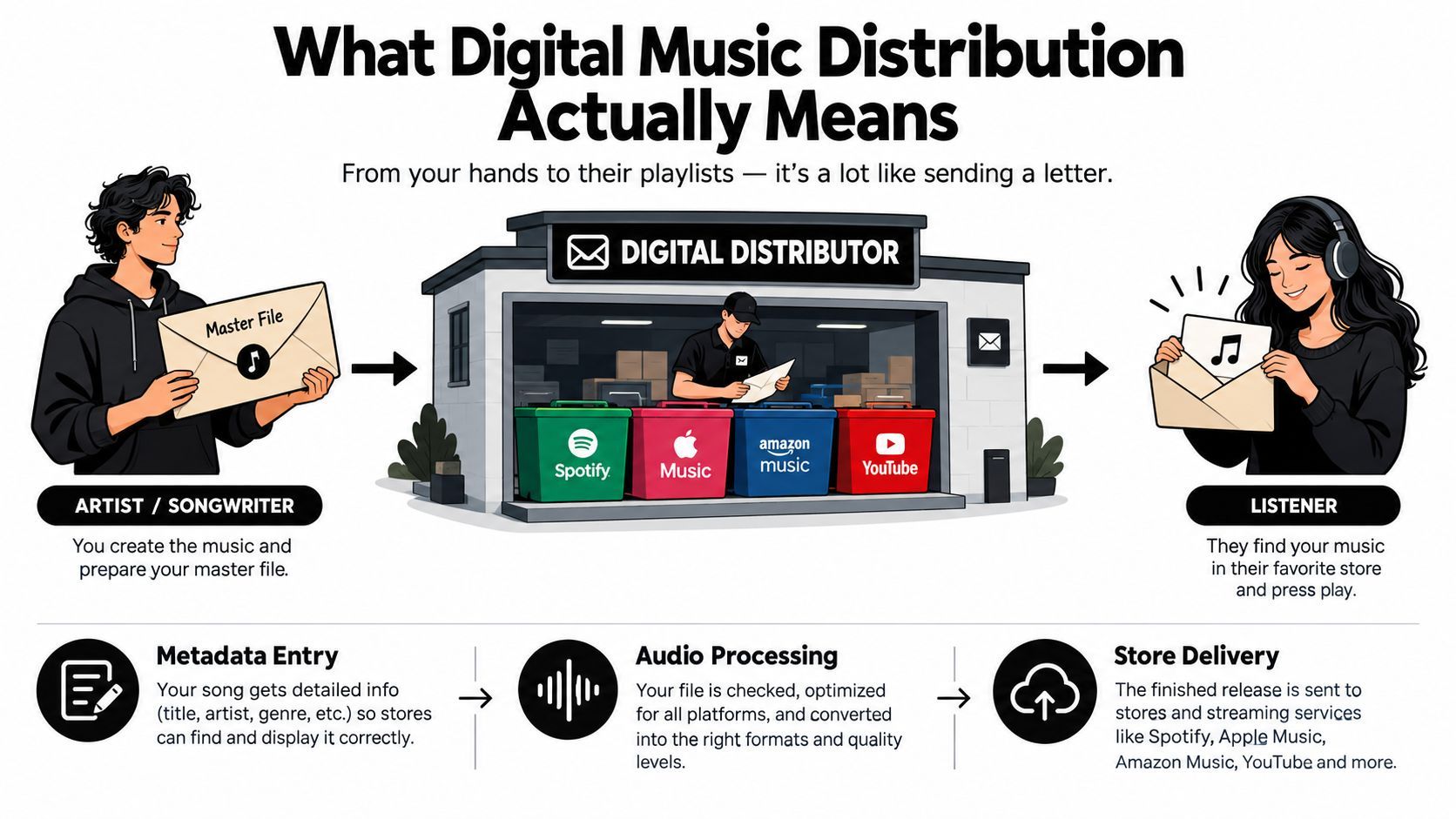
The first layer is the Digital Service Provider, or DSP. This is the listening platform where someone presses play, such as Spotify, Apple Music, Amazon Music, or YouTube Music. These are the storefronts.
The second layer is the aggregator or distributor. Most independent artists do not deliver straight to every DSP at scale, so a middle layer accepts the files, packages the release, and sends it onward in the correct format. That middle layer matters because every platform has its own delivery rules, file checks, and metadata expectations.
The third layer is the metadata envelope around the music. That includes the song title, composer and songwriter credits, release date, territory, ISRC, UPC, and ownership information. If the audio is the product, metadata is the label on the box.
That gives a practical definition: digital music distribution is the process of packaging a recording with the right metadata and delivering it to digital platforms so it can be discovered, played, monetized, and reported correctly.
Metadata tells platforms which recording is which, who owns what, and where the money should go. DDEX's ERN 4.2 framework exists to carry structured release, ownership, and licensing metadata across the supply chain, and its work communication standards handle ownership claims and changes so royalties can be redirected when rights shift, according to the DDEX ERN 4.2 implementation guide.
That is also where AI-generated releases raise practical questions. If a track was made with tools like SendFame, the metadata and rights information still have to match the actual licensing setup, the credited creators, and any platform policy that applies. A distributor is more than a file pipe. It translates creative assets into the structured language the platforms understand.
The music business used to give digital downloads the spotlight. In the U.S., that era is gone. RIAA data show downloads were just 2% of U.S. recorded music revenues in 2024, down from 43% in 2012. The same report says downloaded music revenue fell to US$336 million in 2024 after dropping 18% in 2023, while digital and customized radio music revenues still grew 3% to US$1.4 billion (RIAA 2024 year-end revenue report).
That shift changed what a release needs to do. In the download era, one sale could carry more weight because the purchase itself was the event. In the streaming era, revenue is fragmented across plays, platforms, and reporting systems, so the release has to stay useful over time.
IFPI reported that streaming revenues surpassed US$22 billion in 2025 and made up 69.6% of global recorded music income, with paid subscription streaming alone growing 8.8% and accounting for 52.4% of total revenues in its 2026 report on 2025 data. Global paid subscription accounts reached 837 million by the end of 2025 (IFPI global music report data).
That doesn't just mean “streaming is big.” It means the center of gravity moved from ownership to access. Fans don't usually buy files anymore, they access catalogs, playlists, and algorithmic recommendations.
The release is no longer a one-time sale object. It's a long-tail asset that can keep collecting attention if the metadata, cadence, and catalog structure are clean.
That's why catalog depth matters more than it used to. A single song can still matter, but a release strategy built around retention, playlist placement, and repeat listening fits this market better than the old store-led model. The technical side of distribution now serves a streaming-first economy, which is why the next concern is the pipeline itself.
A clean release starts with the master file, but that file never travels alone. It moves through ingestion, metadata packaging, review, delivery, and platform-side processing before anyone hears it.
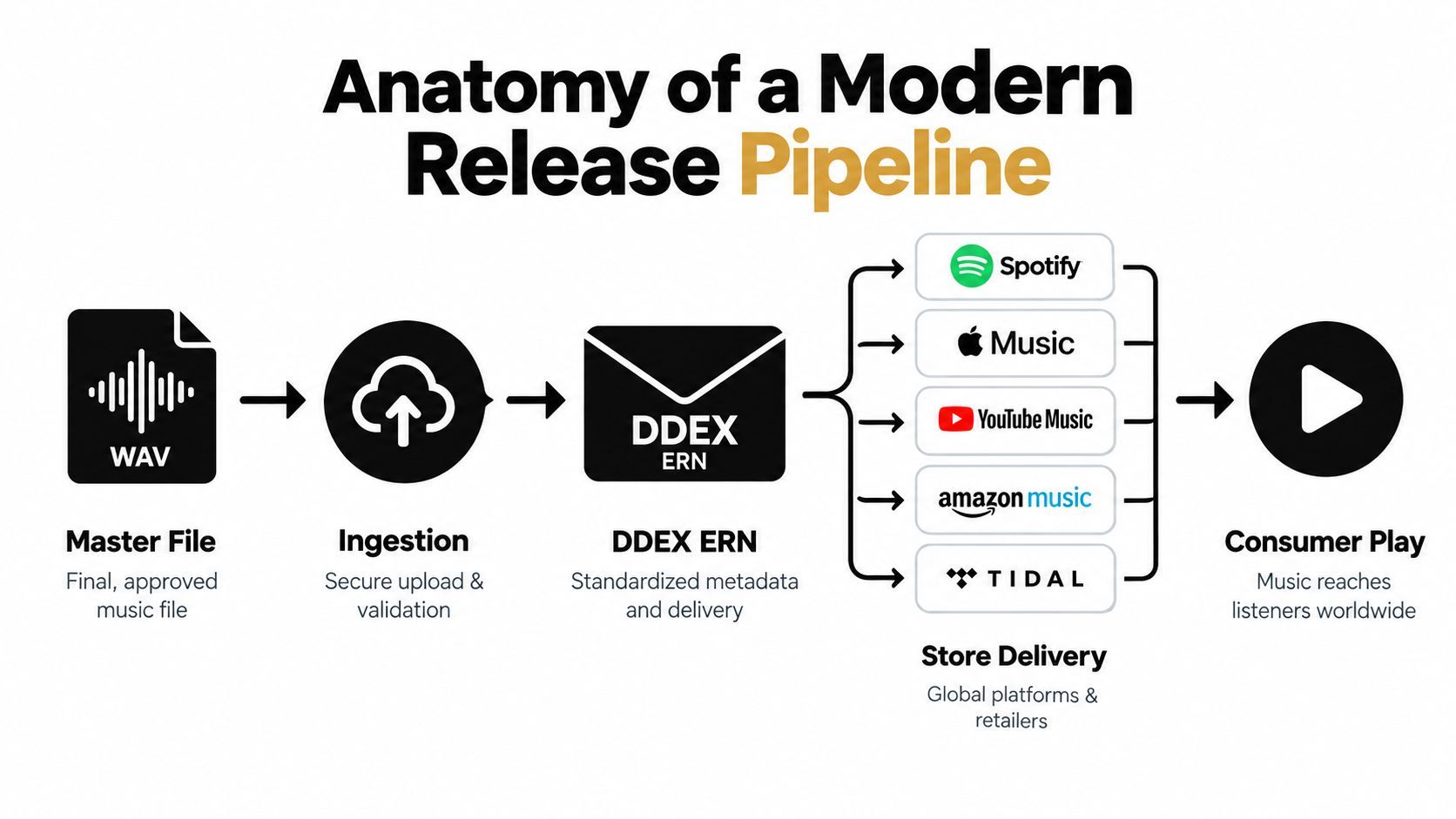
First comes ingestion. You upload the master audio, the artwork, and the release details. If you already have an ISRC for the recording and a UPC for the release, those usually go in here too. The distributor checks file formats, artwork specs, titles, and basic completeness before the release can move forward.
Then the release gets wrapped in the metadata structure the platform side can read. That's where the DDEX-style release envelope matters, because it standardizes hierarchy, resource details, and deal terms instead of leaving everything as a loose spreadsheet. If the release includes collaborators, splits, or rights changes, those fields need to be accurate before the package leaves the distributor.
The next stage is content review and quality control. Manual checks can stall a release here, especially if the cover art is invalid, a title is inconsistent across fields, or the rights information doesn't reconcile. Many aggregators expose status dashboards so you can see whether the release is still processing, waiting on review, or already accepted by stores.
Most major streaming services now use loudness normalization in distribution. The AES notes that services commonly use track normalization or album normalization, and it recommends preserving album-relative levels while avoiding compression or limiting in the normalization stage (AES TD1008 loudness recommendation).
That matters because the platform measures a track's integrated loudness in LUFS and applies linear gain changes at playback to fit its target. In plain English, the platform adjusts volume for playback consistency, not to “improve” the mix. If you've already crushed the track too hard, normalization won't fix that.
After review, the distributor sends the package to store ingestion, where each platform encodes it, schedules it, and prepares it for the live date. If anything is wrong, takedown or correction requests have to propagate back through the same chain. That's why release management is really a queue-management problem.
Operational rule: the distributor's job is to make your release readable, routable, and recoverable when something changes.
For a practical tooling comparison, a release-stack guide such as music distribution tools for independent artists can help you map features to actual workflow needs.
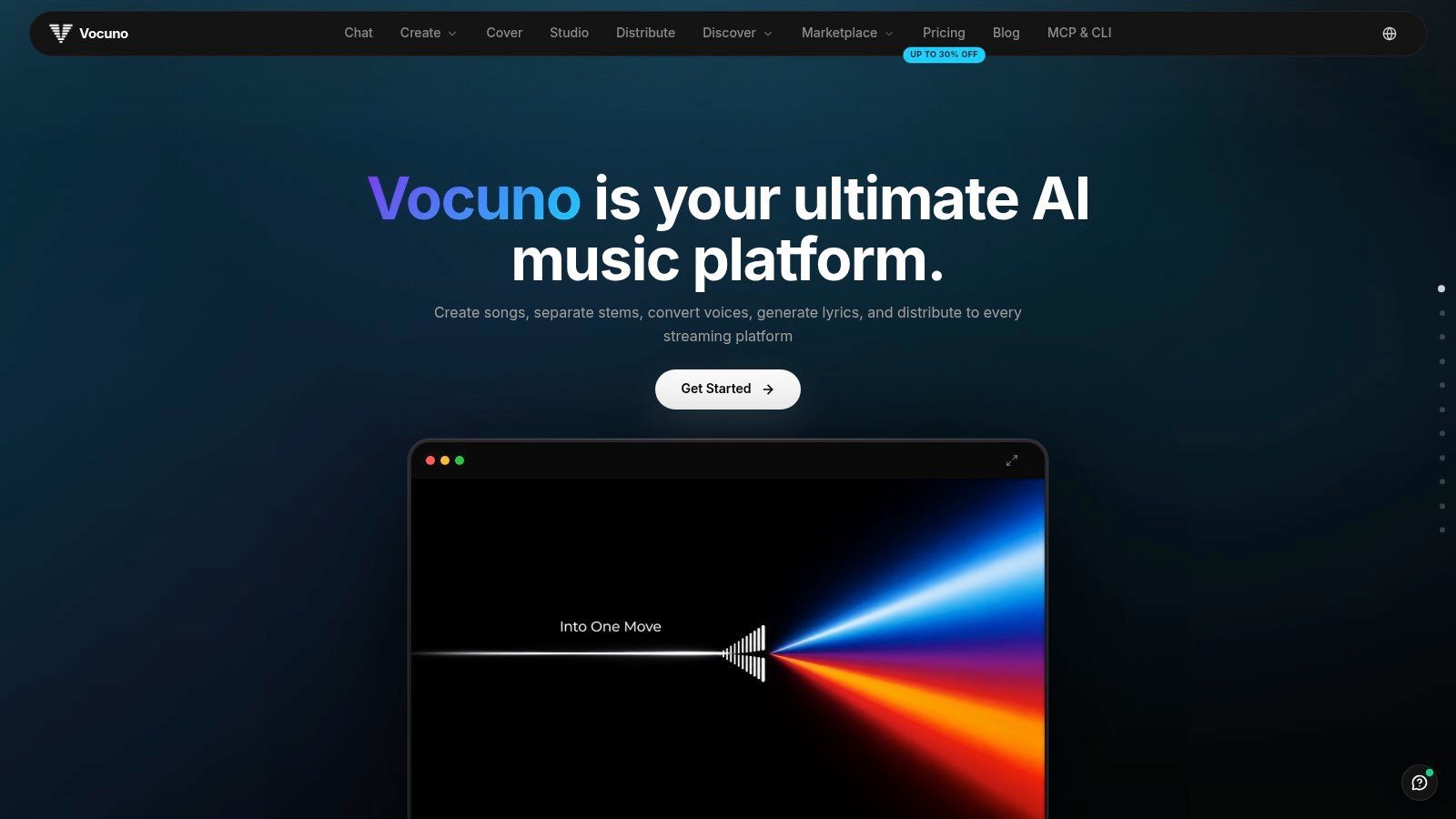
If you want a single workspace that combines creation and delivery, Vocuno is one option to look at. It's an AI-powered music creation and distribution platform that brings together song generation, vocal tools, lyric writing, stem separation, BPM detection, MIDI conversion, file processing, and direct distribution in one browser-based flow, which can reduce the handoff between making a track and preparing it for release.
That kind of setup helps when your main problem is not inspiration, it's friction. If you're moving from prompt to demo to final export quickly, a unified environment can save time because you're not jumping between separate apps for writing, editing, and delivery. You can review the platform details at Vocuno, a digital music distribution platform.
It's also relevant for creators who are experimenting with AI-generated songs and need a process that keeps creation, attribution, and publication in one place. The screenshot below shows the interface context.
The wrong question is “Which distributor has the most stores?” The better question is “Which distributor protects my metadata, tracks my royalties cleanly, and fits how often I release?”
That shift matters because more upload destinations don't automatically create more income. If the data is sloppy, the extra reach can just multiply mistakes. The practical comparison is about fee structure, payout handling, speed, and whether the service helps you move from upload to usable reporting.
Fee model: Flat-fee distributors, commission-based services, and free plans with limits all push costs differently. The right choice depends on how often you release and how much control you want over net take-home. Store coverage: Look for the DSPs that matter to your audience, but also check support for YouTube monetization, regional platforms, and social delivery where relevant. Payout mechanics: Thresholds, payout timing, currency support, and split handling all affect how quickly money reaches you and your collaborators. Speed to live: Some distributors are built for rapid turnaround. Others trade speed for review depth or extra services. Promotional tooling: Pre-save links, smart links, editorial pitching, and release dashboards can help, but only if you'll use them. Policy fit: Some platforms are friendlier to frequent releases, some to catalog management, and some to selective curation.
If you release rarely, a one-time-fee model can make sense because you're not paying every month to keep the catalog live. If you release often, unlimited or subscription-style plans may fit better. If you need hands-on pitching or sync support, that changes the evaluation again.
The open-access model is convenient, but convenience doesn't manage your catalog for you. The more music that enters the system, the more important it becomes to control titles, versions, credits, and split data from the start.
A distributor should reduce admin load, not create a second job inside your release cycle.
That's why I'd ask every distributor the same questions before using them: how do they handle takedowns, how visible is status tracking, how do they manage splits, and what happens when a release needs a correction after delivery? Those answers matter more than a shiny store list.
Uploading to more stores sounds like growth, but it often just widens the surface area for bad data. Revenue usually moves through the boring parts, which is why many artists skip them.
Luminate reported 106K ISRCs delivered to DSPs each day in 2025, up 7% from 99K in 2024, while the share of major distribution fell to 8% in 2025. That points to a more crowded release field, with independent teams carrying more of the load (Luminate year-end music report 2025).
Metadata discipline: Check titles, credits, territory settings, and recording IDs before delivery. Clean metadata helps a release match, search, and report correctly. Royalty tracking: Reconcile distributor statements with platform reports and publishing data. If money is missing, separate matching issues from registration gaps and split errors. Operational hygiene: Keep version names, artwork, and release dates aligned across your workflow so fixes do not turn into takedowns. Smart linking: Use clean release links and pre-save paths so fans reach the right destination, not a dead end or an old version.
Metadata is not paperwork. It is the spine of the release. If that spine is bent, the rest of the system stops moving the way it should.
Cover songs make the point clearly. A cover needs the licensing route sorted before upload, not after. Your PRO registration also has to match the actual writer and publisher details where relevant, and U.S. mechanical matching depends on correct registration from the start.
AI-generated releases add one more layer. If you are using tools like SendFame, rights review comes before delivery, because the model, prompt workflow, voice source, or training corpus can create problems that distribution cannot fix later. For a plain-language review of the ownership side, how to copyright your music is a useful companion read before you distribute.
A release made with AI still enters the same distribution chain, and the pressure points sit in disclosure, training rights, and platform rules. If you're using tools like SendFame, the core question is whether you can explain authorship, rights, and how the track was made before it goes out.
Start with the same release package you would use for any song, then add a rights check on top. If the model, prompt workflow, voice source, or training corpus creates a legal problem, distribution cannot clean that up later.
Platform AI policies are still changing, and they do not read the same way across services. Check the current rules on each platform's official help pages before upload, including Spotify, Apple Music, YouTube, and TikTok. YouTube has been the clearest about disclosure for synthetic or altered media, so that is the kind of requirement you should expect to verify directly rather than assume.
If the model was trained on copyrighted material, you need to know whether that training path creates licensing exposure for your release. If the song uses synthetic vocals, voice conversion, or cloned timbres, the disclosure and attribution fields should say so plainly. Leaving that out can create a mismatch between what the track is and what the paperwork claims it is.
Platform-side content credentials also matter where they are available. Tools like C2PA-style provenance signals and platform labels for AI content do not settle ownership disputes, but they help show how the track was made. That matters because distributors, stores, and listeners are all working from different layers of the same record, like labels on boxes moving through a warehouse.
The practical release form should answer three questions. Who created what, who owns what, and what can be monetized. If any of those answers is unclear, pause before you distribute. The right path may be a commercial release, a sync-ready version, or private use only.
For creators building from prompts and starting with the production side, how to make AI generated music is a useful companion before release planning.
A repeatable release process saves more money than a last-minute rush ever will. The goal is to catch the small problems while they're still cheap to fix. For AI-generated releases, that also means checking credits, rights, and disclosure before you upload, not after a store or distributor asks for them.
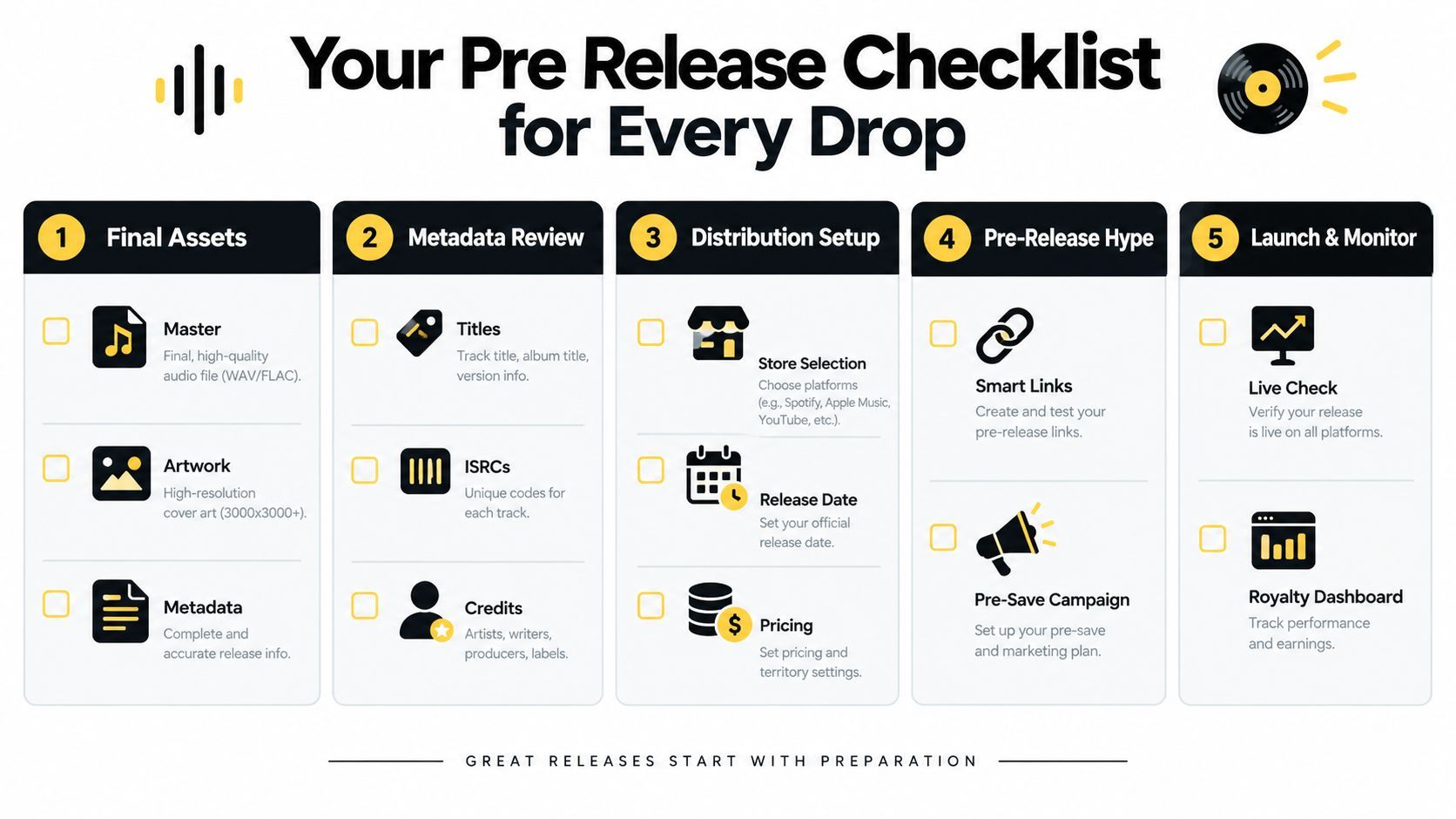
Final assets: Confirm the master export, artwork, and filename structure. If you skip this, you usually lose time later to avoidable re-exports and compliance fixes.Metadata review: Check titles, credits, ISRCs, and collaborator names line by line. If you skip this, matching and royalty routing become unreliable.Distribution setup: Choose the stores, set the release date, and confirm territory choices. If you skip this, the delivery may go live on the wrong schedule or with the wrong reach.Pre-release hype: Build smart links and pre-save flows before launch day. A guide to promoting your music independently covers the promotion layer distribution does not handle. If you skip this, your first listeners have nowhere obvious to go.Launch and monitor: Verify the release is live, then watch royalty dashboards and store status after publication. If you skip this, you won't know whether a problem is a delay, a mismatch, or a reporting gap.
Calendar-based planning matters because distribution isn't instant once collaborators, artwork, and rights are involved. Monthly reconciliation matters because platform reports and distributor reports don't always tell the whole story in the same way.
The artists who stay consistent usually aren't the ones with the loudest launches. They're the ones who keep their release admin clean every month.
If you build the checklist into every drop, release day gets a lot less dramatic. That leaves you with the part that grows a catalog, a steady schedule and a clean paper trail.
If you're ready to tighten your workflow, start with the checklist above, then line up your next release date, clean your metadata, and verify your rights before you upload.
Create Epic

SendFame

Create Epic with SendFame!
Questions: info@sendfame.com