How to Storyboard a Video From Start to Finish
how to storyboard a video
Welcome offer — 56% OFF


Learn how to copyright your music with our clear guide. We break down the process of protecting your songs, registering your work, and getting paid.
You've poured your soul into a track. The melody is perfect, the lyrics hit just right, and the mix is fire. But before you unleash it on the world, there's one critical step that separates the amateurs from the pros: copyright.
Think of it as the official deed to your creative real estate. To properly copyright your music, you first need to "fix" it in a tangible form (like saving it as an MP3 or WAV file) and then formally register it with the right government body, like the U.S. Copyright Office.
Let's get real for a second. Your song is a small business. You wouldn't launch a company without the right legal paperwork, would you? The exact same thinking applies to your music. A registered copyright is the legal muscle that turns your art from a fleeting idea into a solid asset. It's the public record that screams, "This is mine, and I can prove it."
Without that registration, you're essentially shouting your genius from the rooftops while leaving the front door wide open.
This isn't just about dusty legal forms—it's the key that unlocks your ability to actually build a career. Registration gives you the exclusive, legally enforceable rights to:
Reproduce and sell your work, whether it's vinyl, streams, or CDs. Create new versions, like official remixes, or authorize samples. Perform your music publicly and get paid for it. Display your lyrics or sheet music publicly.
This legal foundation is what lets you land those sync deals for movies and TV shows, collect all the royalties you're owed from Spotify and Apple Music, and send a swift cease-and-desist to anyone who tries to rip off your work.
The global music copyright market has ballooned to over $47 billion—it's nearly doubled in the last decade, mostly thanks to streaming. For artists like you, that means there’s more money flowing than ever before.
Here's where it gets serious: in the U.S., registering your music before someone infringes on it makes you eligible for statutory damages up to a whopping $150,000 per violation. If you don't register, you can only sue for "actual damages," which is often a tiny fraction of that amount and much harder to prove.
Securing your copyright is the first real step in turning your creative passion into a sustainable career. It’s the difference between being a musician and being a music professional who owns and controls their creative output.
Once your music is locked down legally, you can start thinking about smart ways to make money from it directly. For artists who want to build a real community and keep more of their earnings, owning your own fan subscription platform is a game-changer. It's just another powerful way to build value from the assets you've protected.
And after your legal house is in order? It's time to get your music heard. You can dive deeper into that with our guide on how to promote your music independently.
Here’s something that trips up a ton of artists: every single song you finish is actually protected by two distinct copyrights. Getting this right isn't just nerdy legal stuff—it's the bedrock of getting paid fairly for your music.
Think of it like a Hollywood movie. There’s the screenplay—the dialogue, the story, the characters on the page. Then there’s the actual film itself—the actors' performances, the director's unique vision, the final cut. Your music works the exact same way.
First up is the composition. This is the core DNA of your track—the melody you hummed into your phone, the lyrics you scribbled in a notebook, the chord progression you worked out on your guitar. It’s the song in its purest form, before it’s ever recorded.
This copyright protects the fundamental musical work. It can exist on a piece of sheet music, as a lyric sheet, or even just as a rough demo. When you register the composition, you're protecting the intellectual blueprint of the song. In the U.S., this falls under a Form PA (for Performing Arts).
Next, you've got the sound recording, which everyone in the biz calls the "master." This is the actual, tangible audio file you bounced from your DAW. It’s that specific, finished performance of your song—the one you upload to Spotify.
This copyright protects that particular version. So, if another artist covers your song, they're creating a brand new sound recording of your original composition. They own their master, but you still own the song underneath it. This is why it gets its own registration, a Form SR (for Sound Recording).
The big takeaway? These two copyrights earn money in completely different ways, from totally different places. Owning and controlling both is the only way to maximize your control and your income.
Let's say you cook up a banger with an AI tool. The melody and lyrics you generate make up the composition. That polished, ready-to-release MP3 file you download? That's your sound recording. You gotta protect both pieces of the puzzle.
To really nail this down, let's break it down side-by-side.
This table clears up the difference between the two core music copyrights, what they protect, and who typically holds the rights.
| Attribute | Composition (The Song) | Sound Recording (The Master) |
|---|---|---|
| What it Protects | The underlying melody, harmony, and lyrics. The song's core structure. | A specific, fixed performance of the song. The actual audio file. |
| Example | The sheet music and lyrics for "Yesterday" by The Beatles. | The MP3 file of the original 1965 recording of "Yesterday." |
| Who Owns It | Typically, the songwriter(s) and their music publisher. | Typically, the recording artist(s), the producer, and the record label. |
| US Copyright Form | Form PA (Performing Arts) | Form SR (Sound Recording) |
Getting your head around this distinction is a massive step forward. To see how this plays out in the real world, check out our deep dive into music copyright rules on Instagram, where both of these rights come into play every time someone posts a Reel.
Alright, you’ve got your song “fixed,” and you understand the whole two-headed beast of composition versus sound recording. Now for the fun part: making it official with Uncle Sam. Registering your work with the U.S. Copyright Office might sound as thrilling as a trip to the DMV, but trust me, it’s the single most powerful move you can make to protect your music.
Let's cut through the government red tape and walk through the process on the eCO (Electronic Copyright Office) portal. This is where your automatic copyright gets its teeth and turns into an enforceable legal weapon.
First things first, you'll need to head over to copyright.gov and create an account in the eCO system. Filing online is a no-brainer—it’s cheaper, faster, and you can actually track your application’s status without waiting for a letter to show up in your mailbox weeks later. Think of it as the FastPass for protecting your creative work.
This flowchart lays out the two main roads your copyright journey can take, one for the song itself and one for the actual recording of it.
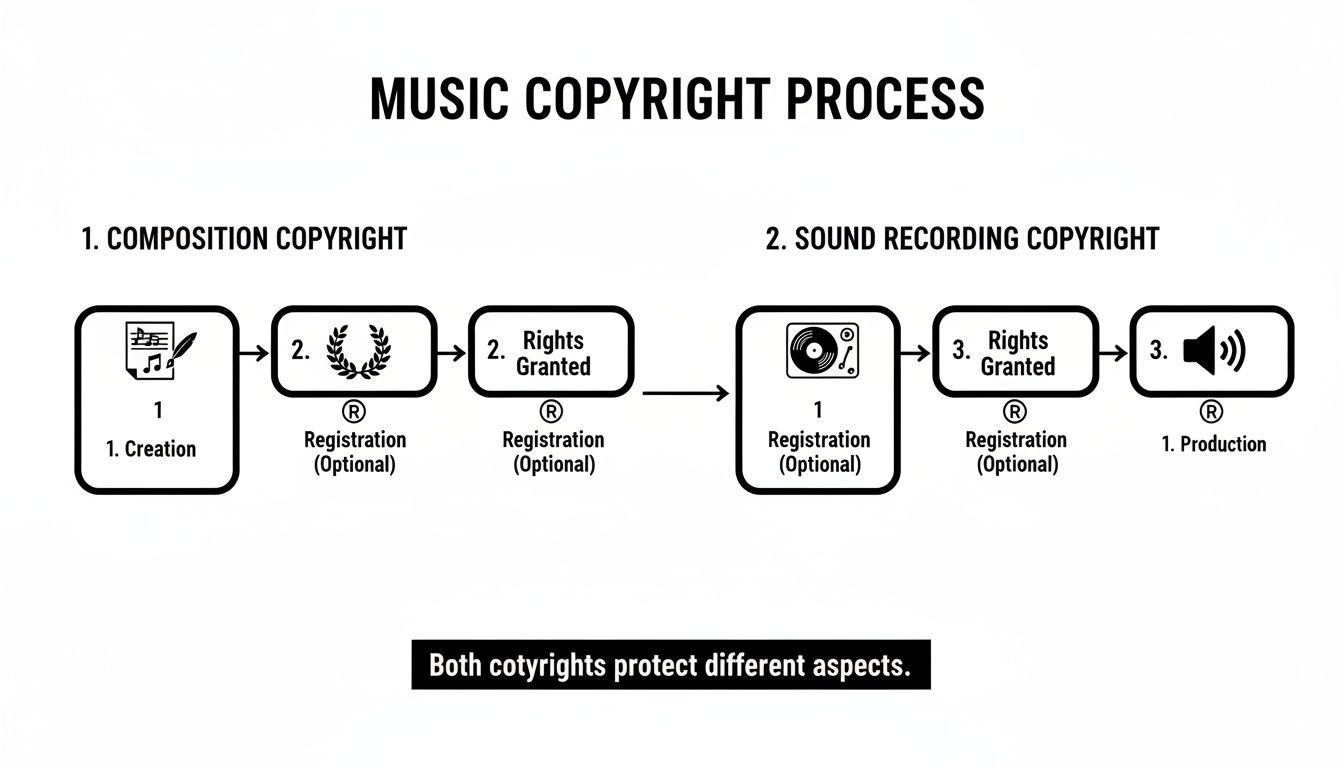
As you can see, the path for the composition (the sheet music icon) is separate from the sound recording (the vinyl record icon). This visual really drives home the point that they are two distinct assets, and you need to think about protecting both.
Once you’re logged in, you’re hit with your first big decision: which application do you choose?
My Two Cents: Don't get paralyzed by the options. The real key is knowing what you're registering before you start clicking around. Why? Because once you select a registration type and get going, you can't just hit the back button and switch. You’ll have to start all over again.
For most musicians, it boils down to these two options:
Standard Application: This is your workhorse. It’s for registering a single song, an album that’s already out, or a track with multiple co-writers. Pretty straightforward. Register a Group of Unpublished Works (GRUW): This is a budget-friendly trick of the trade. If you’ve got a batch of up to 10 unreleased songs, you can bundle them all together and register them for a single fee. It's an absolute game-changer for protecting a new EP or a folder of demos before they ever see the light of day.
Getting this right from the jump will save you a ton of time and aspirin down the road.
Before you even think about starting the application, do yourself a favor and get your info together. The system will time out on you, and frantically texting your co-writer for their legal name while the clock is ticking is a recipe for pure frustration.
Here’s a quick checklist of what to have on hand:
Full legal names and addresses for all the authors (that means every songwriter and composer). The title of your work (or all the titles if you’re using the GRUW option). The year of completion for the song. The date and nation of first publication (only if it’s already been released). The names of the copyright claimants (this is just the person or company who will own the copyright—probably you!).
Having this ready is like prepping your ingredients before you start cooking. It just makes the whole process feel less like a chore.
Once you've filled out all the forms, you'll need to pay the fee and upload your "deposit copy"—which is just the fancy government term for the actual file you're protecting. As of 2024, a basic registration will set you back about $45 to $65. That's a tiny price for ironclad legal protection that can last a lifetime.
For the deposit itself, you just upload the files directly through the portal:
For a Composition (Form PA): An upload of your sheet music or a lyric sheet as a PDF will do the trick. A simple lead sheet with chords and lyrics is usually plenty. For a Sound Recording (Form SR): Just upload a high-quality audio file, like an MP3 or WAV. For Both: You guessed it. You'll need to submit both the visual file for the composition and the audio file for the recording.
The opportunity for creators right now is massive. The music licensing market is projected to explode to over $16 billion by 2034, all thanks to the endless hunger for content from streaming services, ads, and more. This registration process is the one-time action that separates hobbyists from professionals ready to get paid and defend their art. Want to dive deeper? Check out the full research on the booming music licensing market.
After you’ve paid and uploaded your files, your part is done. Kick back and relax. Processing can take a few months, but here’s the crucial part: your copyright protection is effective from the date the office receives your complete application, not when they finally approve it.
So, the moment you hit that submit button, you can breathe easy. Your work is officially on the record.
So you’ve got that official certificate from the Copyright Office. It’s your golden ticket, the undeniable proof that you own your music. But let's get one thing straight: it's not an ATM card. That piece of paper won't magically start wiring royalty payments into your bank account.
To actually turn your creative work into cash, you need to plug it into the music industry's financial grid. This is where you activate your earnings by connecting with a web of organizations built to track your music, collect the money it generates, and send it your way.
First stop for any songwriter? A Performing Rights Organization (PRO). You’ve definitely heard of the big ones in the U.S.: ASCAP, BMI, SESAC, and the more exclusive GMR. Think of them as your personal music detectives, keeping tabs on every single time your song gets played in public.
And "public performance" is a much bigger category than you might think. It covers:
Radio Play: Every spin on AM/FM or satellite stations like SiriusXM. Television: When your song pops up in a TV show, a car commercial, or as a catchy theme song. Live Venues: Any time your song is performed live—by you or a cover band—in a bar, club, or stadium. Background Music: Even when it’s just the soundtrack at a restaurant, gym, or your local Target.
PROs collect license fees from all these places and then slice up the pie for the songwriters and publishers they represent. If you don't join a PRO, you're essentially walking away from money that is rightfully yours.
These days, the real action is happening online. With over 600 million paid streaming subscribers worldwide, digital royalties are the lifeblood for most artists. It’s a massive market, projected to blast past $3 billion by 2033. For you, this means getting your music registered in the right digital databases isn't just a smart move; it’s the only move.
This is where a couple of other crucial players enter the scene.
The Mechanical Licensing Collective (The MLC): Based in the U.S., The MLC is your go-to for collecting mechanical royalties from streaming services like Spotify and Apple Music. These royalties are generated every single time someone streams or digitally downloads your song. To get paid, you have to register your songs directly with them.
SoundExchange: This organization handles a completely different type of digital royalty. SoundExchange collects money from non-interactive services—think Pandora radio, cable TV music channels, and internet radio. They pay the owners of the sound recording (that's you, the artist, and your label, if you have one) and the featured performers on the track.
Pro Tip: Registering with The MLC and SoundExchange costs you exactly $0. It's free. Seriously. This is one of the simplest, highest-impact financial moves you can make as an artist. Don't put it off.
Okay, you've registered with all the right groups. The money should just start pouring in, right? Almost. There’s one last, critical piece of the puzzle: metadata. This is the digital DNA of your music files, the behind-the-scenes info that tells all these systems who created the song and, most importantly, who to pay.
Think of it like a shipping label. You can have the most valuable package in the world, but without the right address, it’s going nowhere. Your metadata is that address. Two codes are absolutely non-negotiable:
ISRC (International Standard Recording Code): This is a unique fingerprint for your sound recording—the master track. It tracks every stream and sale of that specific audio file across the globe. ISWC (International Standard Musical Work Code): This is the unique identifier for the underlying composition—the lyrics and melody. It tracks public performances and mechanicals owed to you, the songwriter.
When you're getting ready to release your music, you have to make sure these codes are embedded correctly. Most modern distributors handle this, but it's your job to double-check. For a deeper dive, check out our guide on the top music distribution tools for independent artists. Nail your metadata, and you'll ensure that every play, stream, and spin gets tracked and paid back to you.
So, you've done the paperwork. Your music is officially registered, timestamped, and ready to go. But what happens when you’re doomscrolling and stumble upon your carefully crafted beat being used as the background music for a cat meme compilation without your permission?
This is the moment your copyright registration goes from being a boring certificate to your best weapon. It's time to learn how to actively protect your creation.
Your go-to tool for this is the Digital Millennium Copyright Act (DMCA). Think of it as the bouncer for your music online. It’s the legal muscle you use to tell platforms like YouTube, SoundCloud, or any other website to take down content that’s ripping you off. It’s a direct, no-nonsense way to stop infringement cold.
Filing a DMCA takedown notice sounds like something only a lawyer could do, but it's usually just a straightforward online form on the platform's website. You'll need to prove you're the owner (that copyright registration number comes in handy here) and point them directly to the offending content. Once you do, the platform is legally required to pull it down.
Let's be real: you don't have time to manually hunt down every single unauthorized use of your music across the internet. That would be a soul-crushing, full-time job. Thankfully, we have robots for that. This is where Content ID systems become your new best friend.
Big players like YouTube and Facebook use incredibly sophisticated "digital fingerprinting" technology. When you sign up with a distributor, you can usually opt into these systems. Here's the magic behind it:
Your Music Gets Fingerprinted: The system analyzes your track and creates a unique digital ID for it. The Platform Scans Everything: It constantly sifts through all the videos people upload, looking for a match to its database of fingerprinted tunes. It Finds a Match: When the system finds a video using your music, it automatically triggers a policy that you've pre-selected.
From there, you call the shots. You can choose to monetize their video (basically, run ads on it and collect the cash), simply track its performance stats, or block it entirely. This is how you can flip a potential theft into an unexpected revenue stream.
Think of Content ID as your tireless digital bounty hunter, scouring the internet 24/7 to find and claim royalties on your behalf. It’s one of the most effective ways to manage your music rights at scale.
Here's one of the coolest parts about getting your music copyrighted in the U.S.: its power doesn't stop at the border. Thanks to international agreements like the Berne Convention, your registration is recognized and enforceable in over 180 countries.
That means if someone in Tokyo uses your song in an ad or a DJ in Berlin uploads your track to their channel, your rights are still solid. This global protection is exactly what allows your PRO to collect royalties for you from a radio station in Paris or a TV show in Sydney. Suddenly, your music isn't just a local project; it's a global asset.
A simple takedown notice is often all it takes. But what about a bigger company or an infringer who just won't quit? That’s when you need to escalate.
The next step is usually a cease and desist letter. This is a much more formal demand, typically sent by a lawyer, that puts the infringer on notice: stop using my work immediately, or I'll see you in court.
Often, the scary-looking legal letterhead is enough to get the job done. But if they call your bluff, you might have to consider a lawsuit. Legal battles can be a long, expensive grind, so it's a decision that shouldn't be taken lightly. Even the biggest names in the business get tangled in these fights, as we've seen in cases like Kanye West's dispute with EMI over music rights.
Before you go down that road, always talk to a music attorney. They can help you understand your real-world options and what it might actually cost to fight for your rights.

Alright, let's talk about the elephant in the room. You’re using awesome new tools to make music, maybe even platforms like SendFame, and wondering where that leaves you legally. It's a new frontier, but the core rules are actually pretty old-school.
The U.S. Copyright Office has drawn a firm line in the sand: copyright only protects works with a human author. If you let an AI run wild and it spits out a complete song with zero input from you, that track is in the public domain. Tough luck.
But let's be real, that's not how artists actually work with these tools.
When you're making music with an AI assistant, you're the producer, the conductor, the one calling the shots. That's the part the Copyright Office cares about. Your creative decisions are what make the final work yours to protect.
Think about what you bring to the table:
The Big Idea: You’re the one typing in the prompts, setting the vibe, choosing the genre, and defining the mood. That's pure creative direction. The Curation: AI might spit out ten different basslines, but you're the one with the ear to pick the one that slaps. That's an artistic choice. The Arrangement: You take the pieces—the melody here, the drum loop there—and you build a song. You decide where the verse goes, when the chorus hits, and how the bridge builds tension.
These aren't just technical steps; they're acts of human creativity. That’s your authorship, plain and simple.
The Copyright Office doesn't really care what paintbrush you used; they care about the painting you created. Your job is to show them how your human touch shaped the final song.
When you go to register a track made with AI, you’ll need to be transparent about the process. Be prepared to explain how you were the creative force. Detail your selection of melodies, your arrangement of the song structure, and your mixing decisions.
This shows you weren't just a bystander—you were the author. If you want to dive deeper into the creative process, check out our guide on how to make AI-generated music that’s truly your own.
Alright, still got a few "what ifs" bouncing around in your head? Good. The music business is absolutely crawling with myths and bad "I heard from a guy" advice that can get you into serious trouble. Let's bust a few of the biggest ones right now so you can sidestep the drama.
Think of this as your rapid-fire myth-busting session.
Oh, this old chestnut. You’ve definitely heard it: "Just burn your song to a CD, mail it to yourself, and never open the envelope!" The idea is that the postmark proves when you created it. It's probably the most persistent—and most useless—piece of folklore in the entire industry.
Let's be brutally honest here: the "poor man's copyright" is legally worthless. In a U.S. court of law, it means absolutely nothing. It won't help you sue for infringement, and it won't stand up as evidence. The only way to get the real, actionable legal power you need is by registering your work with the U.S. Copyright Office.
There are no clever workarounds for this. Official registration is the only way to get the legal teeth required to defend your music and, more importantly, to sue for statutory damages and attorney's fees. Don't waste the postage.
This one trips up a lot of new artists, but the answer is a hard no. Copyright law protects your original expression—the finished work—not the individual building blocks or the ideas behind it.
You simply can’t lock down these elements on their own:
Song Titles: They’re considered too short and generic. Imagine if someone could copyright "I Love You." Chord Progressions: Think of common progressions like a I-V-vi-IV as the alphabet of music. They're fundamental tools available to everyone. A Vibe or Style: You can't copyright the "sound" of Motown or the "feel" of a trap beat.
Your copyright covers the unique way you weave melody, harmony, rhythm, and lyrics together into a specific, tangible piece of art. It’s the final recipe, not the raw ingredients.
This is another dangerous myth—the idea that there's some magical "fair use" time limit, like you can safely lift three seconds of a track without permission. That's completely, 100% false.
Using any part of someone else's sound recording without clearing it is copyright infringement. Period. It doesn't matter if it's a one-second drum break or a ten-second vocal hook. If you didn't create it, you need permission. This means getting two separate licenses: one for the master recording (usually from the record label) and another for the underlying composition (from the music publisher). Skip this, and you're opening yourself up to a world of legal pain.
Ready to skip the legal minefield of sampling and create something that’s all yours? With SendFame, you can generate original, royalty-free music and even slick music videos in a matter of seconds. Create something entirely new and sidestep the headaches. Try the AI Music Generator today
Create Epic

SendFame

Create Epic with SendFame!
Questions: info@sendfame.com