How to AI Generate Music Video Masterpieces
ai generate music video
Welcome offer — 56% OFF


A practical guide on how to write a music video treatment that gets noticed. Learn to craft compelling concepts and sell your vision with real-world examples.
So, you’ve got a killer idea for a music video. Awesome. But how do you get it out of your head and into the hands of the artist, the label, and the crew without it sounding like a rambling mess? You need a music video treatment.
This isn’t just some stuffy document; it’s your blueprint and your sales pitch all rolled into one. It’s the tool that gets everyone nodding in agreement before a single frame is shot.
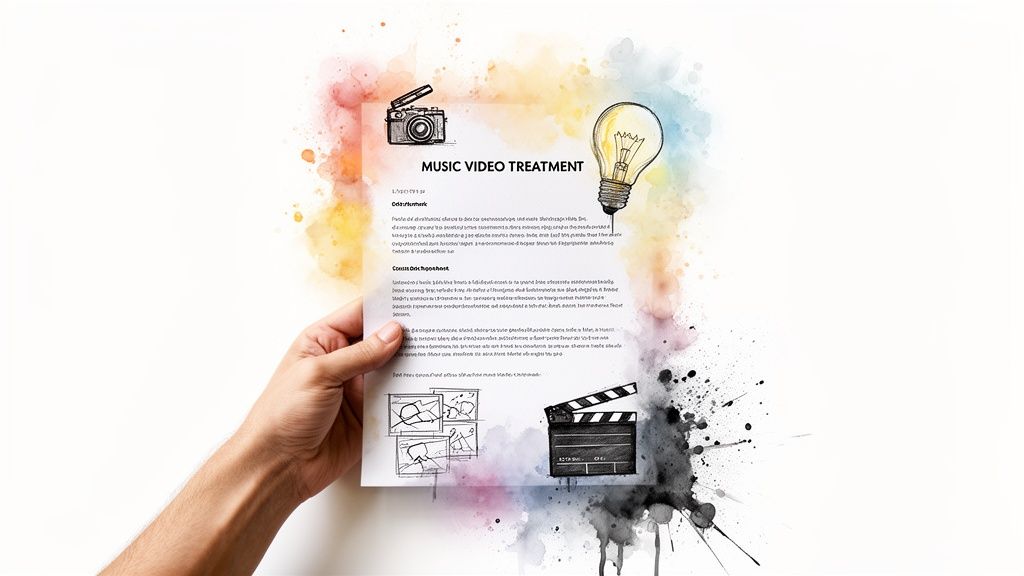
Before we get into the nitty-gritty of how to write one, let's be crystal clear on what it is. A music video treatment is the soul of your project. It's the document that takes a fleeting idea and turns it into a tangible, exciting, and doable plan.
Think of it as your ultimate communication tool. It sells your vision to the money people, gives your creative team a clear roadmap, and gets the artist hyped. Without a solid treatment, you're basically just winging it, and nobody has the time or budget for that.
A killer treatment does more than just sound cool—it's your secret weapon for preventing chaos. I once got pulled onto a shoot where the "concept" was just a vibe the artist and director discussed over coffee. Predictably, when we showed up on set, everyone had a wildly different idea of what that "vibe" meant.
The result? Hours of expensive arguments, a frantic scramble for new props, and a final video that felt like three different ideas mashed together. A proper treatment would have saved the entire day. It forces you to nail down the specifics and turn abstract feelings into a concrete plan.
A music video treatment isn’t just about getting a 'yes.' It’s about creating a shared language for the whole team. It’s what separates a passion project from a professional production.
This single document is what bridges the gap between that first spark of an idea and the complex machine of a full-blown production. It's where you prove your concept is not only brilliant but actually achievable. While the treatment covers the big picture, it also sets the stage for more detailed planning. To see how that vision breaks down into a shot-by-shot guide, check out our post on how to write a music video script.
To make it even clearer, here’s a quick breakdown of what every solid treatment needs.
Think of these components as the essential ingredients. Miss one, and the whole thing might fall flat.
| Component | Purpose | Key Information to Include |
|---|---|---|
| Logline & Concept | To hook the reader in one sentence and then expand on the big idea. | A catchy one-liner, a brief summary of the video's core concept, and why it fits the song. |
| Artist & Song Info | To provide immediate context. | Artist name, song title, album/EP, and links to the track. |
| Synopsis/Narrative | To tell the story of the video from start to finish. | A paragraph or two detailing the beginning, middle, and end. Who are the characters? What happens? |
| Visual Approach | To define the look and feel. | Mood boards, color palettes, camera style (e.g., handheld, cinematic), lighting, and overall aesthetic. |
| Locations & Wardrobe | To paint a picture of the setting and characters. | Descriptions of key locations, styling concepts for the artist and any other talent. |
| Director's Note | To add a personal touch and show your passion. | A brief, personal statement about why you connect with the song and your vision for the project. |
Putting these pieces together shows you’ve thought through every angle.
In an industry where first impressions mean everything, a vague or sloppy treatment is a one-way ticket to getting your email deleted. A sharp, well-written treatment screams professionalism and shows you can be trusted to execute a high-level creative vision.
And let's be real, the stakes are massive. The global film and music market is on track to hit USD 578.67 billion by 2030, all driven by an insatiable demand for top-tier visual content. A polished, persuasive treatment is your key to getting a piece of that pie. It’s your proof that you can deliver a video that’s worth the investment. You can dig into more stats about this growing market on Research and Markets.
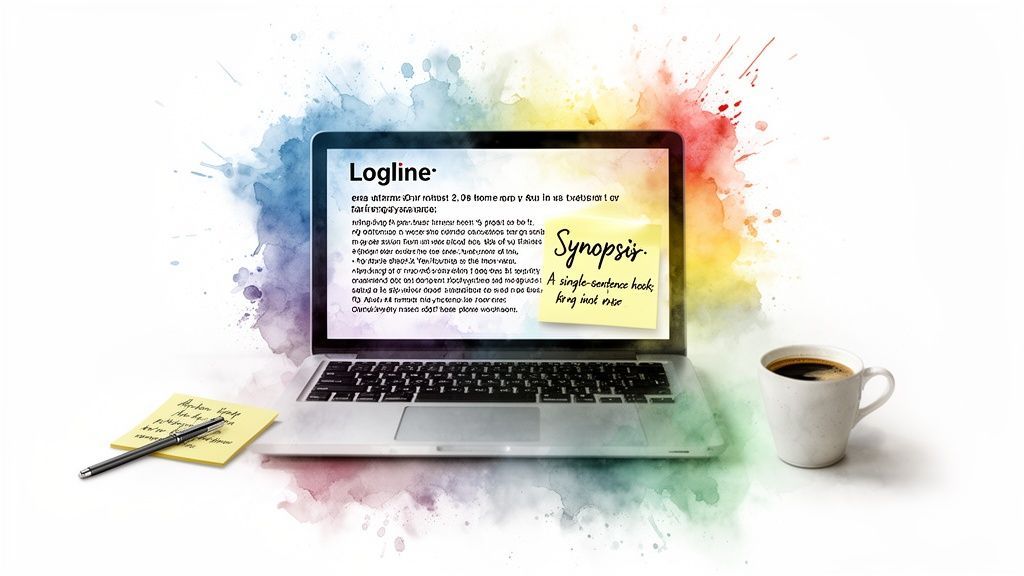
Alright, this is where you make your first impression, and you only get one shot. Your logline and synopsis are the first things anyone sees, so they need to land like a punch. Ditch the flowery, vague language. This is your moment to boil down your entire vision into a few sentences that are impossible to ignore.
Think of your logline as the ultimate elevator pitch—one killer sentence that hooks them instantly. It's the headline for your entire idea. The synopsis comes right after, expanding on that hook with a short, punchy narrative that makes the reader feel the video’s story before a single frame is shot.
A truly great logline doesn't just describe; it evokes. It should be so vivid that the reader can already see the video playing in their head. It's the difference between "a performance video in a warehouse" and "Trapped in a decaying industrial cathedral, a lone artist battles their inner demons as the walls close in, transforming rage into a blistering performance."
See the difference? One is a location, the other is a story.
If you're stuck, try this simple but powerful formula:
Who: The artist or main character. What: The core action or conflict. Where: The setting or world you're building. Why: The emotional stakes.
You don't need all four every time, but they're a great starting point for creating a mini-story that makes someone lean in and say, "Tell me more."
Let's break it down with an example for an indie-pop song about breaking free from a boring small town.
Before: "A video about a girl leaving her hometown." (Yawn.) After: "A disillusioned dreamer escapes her suffocating, pastel-perfect town by building a ramshackle rocket, launching herself into a starlit unknown on the song's final, explosive beat."
The "after" version gives us a character we can root for, a wild visual hook (the rocket!), a clear setting, and a sense of triumphant escape. It’s a whole vibe in one sentence.
Once the logline has them hooked, the synopsis reels them in. This isn't a boring, scene-by-scene list. It's the narrative summary of your video's beginning, middle, and end, written like a gripping short story. Your job is to guide the reader on the emotional and visual journey.
Get descriptive. Use sensory language. Is the video drenched in moody neon, or is it stark and sun-bleached? What's the emotional arc? You want them to feel the video's pulse just from reading your words.
A strong synopsis doesn’t just list what happens; it explains why it matters. It connects every visual beat back to the song's lyrics and themes, proving your concept is intentional and powerful.
For our rocket-girl, the synopsis might describe the quiet desperation of her town with its cookie-cutter houses, the manic, joyful energy of her building the rocket from scrap, and that final, breathtaking shot of her soaring above it all. Every part of the story should feel perfectly synced with the song's energy.
Look, a killer concept isn't just about making cool art—it's about creating a powerful marketing tool. The music industry is a serious business. With global music copyright revenues hitting a record $47.2 billion and climbing, a music video's ability to grab attention is directly tied to a song's success.
Your treatment is the blueprint for that success. The data on global music revenue growth tells the story: attention is currency.
This is why your logline and synopsis are so damn important when you write a music video treatment. They’re your first and best chance to prove you have an idea that isn't just creative, but commercially smart. You’re selling a vision that will help a song slice through the noise and connect with an audience.
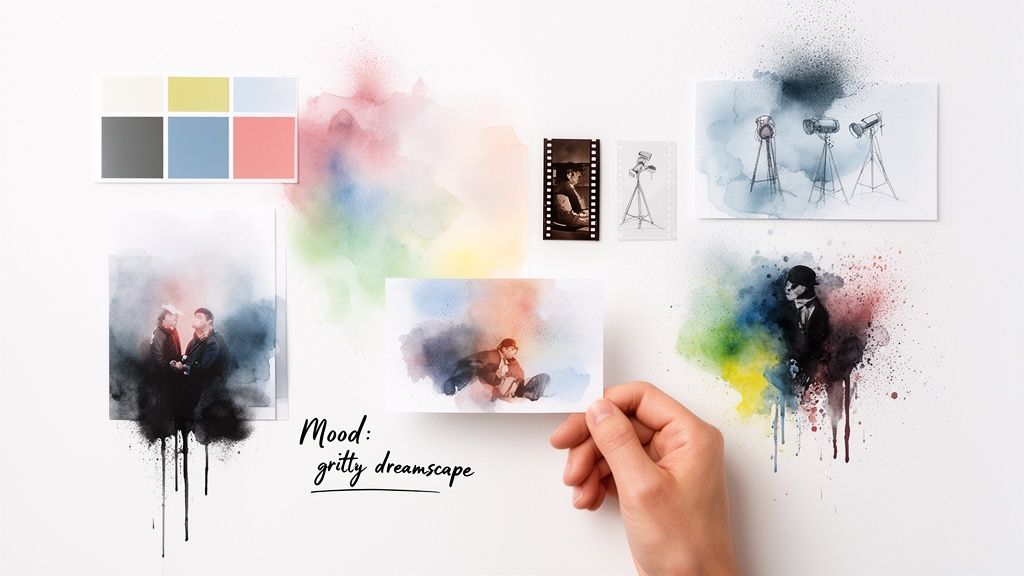
Alright, you've hooked them with a killer logline and your synopsis is solid gold. Now for the real magic trick: making everyone else see the movie that’s already playing in your head. This is where you put down the writer's hat and pick up the painter's brush, using words to create a world so vivid they’ll feel like they can step right into it.
Forget about creating a dense, technical shot list with lens sizes and camera models for now. That comes much later. Your mission here is to bottle the vibe, mood, and aesthetic of the entire project. You're setting the artistic North Star that will guide every single decision, from the color of the artist’s jacket to the way the camera glides through a room.
Before you type a single word, stop and ask yourself: what does this video feel like? Is it a hazy, sun-drenched memory? A sharp, neon-soaked nightmare? Your language needs to mirror that feeling. Don’t just state facts; you’ve got to evoke emotion.
Let’s say we’re brainstorming a concept for a melancholic ballad.
What a rookie would write: "We will use slow-motion shots and a blue color palette." (Yawn.) What you should write: "The cinematography will feel like a waking dream. We’ll use graceful, floating slow-motion to stretch out these moments of heartbreak, letting the artist drift through a world washed in deep, melancholic blues and cold, sterile whites. The camera will be a quiet observer, keeping its distance to amplify that crushing sense of isolation."
See the difference? The second one gives your team so much more to chew on. The DP gets the emotional goal, the colorist sees the palette, and the artist understands the mood they need to bring to set. You’re not just listing techniques; you’re explaining the why behind them.
The most powerful visual descriptions connect every technical choice back to the story's emotional core. Your camera style, color grade, and lighting aren't just for looks—they're characters in your narrative.
Lean on powerful adjectives and tangible comparisons. Is the camera movement frantic and handheld like a found-footage horror flick, or is it smooth and perfectly symmetrical like a Wes Anderson film? Give your reader a clear, immediate reference point.
A mood board is your visual anchor. It's a collage of images, color swatches, textures, and film stills that instantly telegraphs the tone you’re after. It's probably the single most important visual in your treatment because it completely bypasses the analytical part of the brain and hits the reader right in the gut.
Your mood board needs to feel curated and intentional, not like you just dumped your Pinterest feed onto a page. It should tell its own little story.
A solid mood board section should have these three things:
A Curated Image Grid: This is the main event. Pull together 8-10 high-impact images that nail your vision. These can be film stills, photography, paintings, or even just textures. Color Palette: Pull 4-5 key colors directly from your reference images. This proves you’ve considered the specific color story and gives a huge head start to the production designer and wardrobe stylist. Keyword Callouts: Slap a few descriptive words on there that crystallize the aesthetic. Think terms like "Vintage Americana," "Gritty Cyberpunk," "Surreal Dreamscape," or "Minimalist Brutalism."
Modern tools have made this part of the job incredibly fast. You don’t have to spend hours doom-scrolling for the perfect image anymore. For anyone looking to seriously speed things up, there are guides on how to create AI images from text that can spit out dozens of unique reference images in minutes. It lets you build a hyper-specific mood board that perfectly matches that weird, brilliant vision in your head.
Lighting is everything. It sculpts the mood, tells the audience where to look, and can make a shoestring-budget location look like a million bucks. Describe it with the same punchy, evocative language you use for everything else.
For a high-energy pop track: "The lighting will be electric and dynamic, with sharp, colorful spotlights slicing through hazy darkness. We'll play with lens flares and strobing effects that pulse right along with the beat, creating a non-stop party atmosphere." For an intimate acoustic song: "We'll lean on soft, natural light pouring through a window, catching dust motes hanging in the air. The whole feeling is warm, organic, and deeply personal, with gentle shadows that create a real sense of intimacy and vulnerability."
Finally, give them a hint about the editing. The pace of your cuts is the heartbeat of the video. Is it a rapid-fire montage with jump cuts that match a frantic drum solo? Or is it built from long, meditative takes that let the viewer just sink into the scene? Mentioning this shows you’re thinking about the project’s rhythm from start to finish, proving that every piece of the puzzle is working together to serve the song. That’s how you write a music video treatment that feels complete and undeniable.
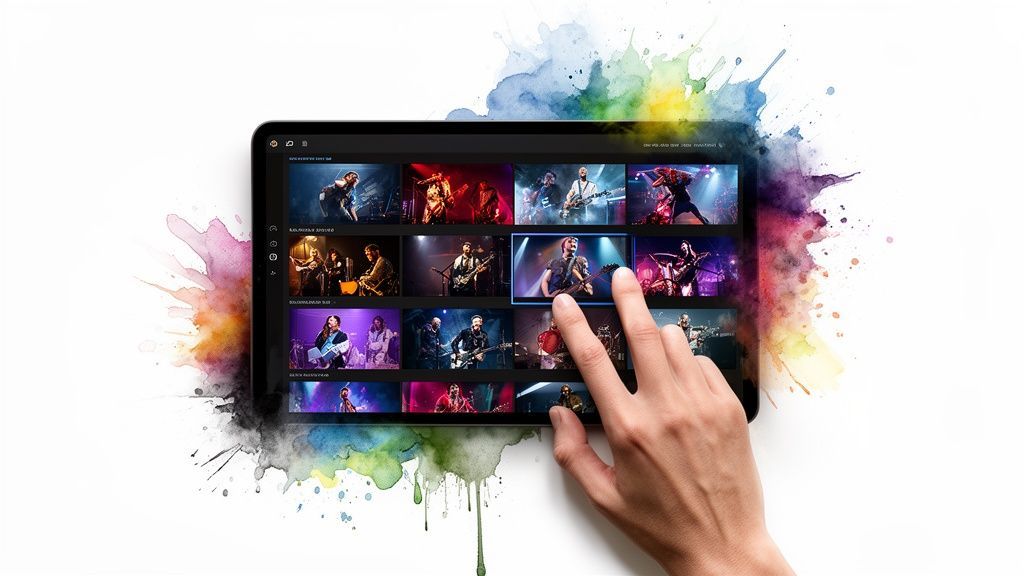
Alright, let's talk about the tool that’s completely changing the creative game. AI isn't some scary robot coming for your director’s chair. Think of it more like a tireless, insanely fast creative partner that’s here to amplify your vision.
Honestly, it's the ultimate weapon against that dreaded blank page.
Imagine being stuck on a visual concept. Instead of losing hours scrolling through film stills for inspiration, you can use AI to conjure up dozens of unique mood board images in minutes. This isn't about replacing your ideas—it's about multiplying them.
The first few hours of writing a treatment are often the hardest. You’re trying to wrestle a concrete story out of the abstract vibes of a song, and it can feel like pulling teeth. This is where AI can be an incredible sounding board, letting you rapidly explore different narrative paths without losing momentum.
Here’s how you can put it to work right away:
Lyric Analysis: Dump the lyrics into a model and ask for thematic interpretations, symbolic imagery, or even potential character archetypes you might have missed. Scene Generation: Give it a simple prompt like, "Draft three different scene ideas for a chorus about feeling triumphant," and you'll get instant, detailed starting points to build on. Logline Crafting: Instead of agonizing over the perfect hook, ask an AI to spit out ten different loglines for your core concept. Then, you can mix and match the strongest parts.
This whole process turns hours of lonely head-scratching into a dynamic, back-and-forth brainstorming session. If you want to dive deeper into which platforms work best, check out some of the best AI writing tools currently available.
This is where AI truly shines for directors and visual artists. A killer treatment is packed with compelling images, and you no longer need to be a Photoshop wizard to create them. With just a few lines of text, you can generate stunning, hyper-specific concept art.
Think of it like this: AI visuals are the ultimate show-and-tell. Instead of just describing a "futuristic, rain-slicked city at midnight," you can actually drop a breathtaking image of it right into your PDF. It makes your vision instantly real.
Platforms like SendFame are pushing this even further, helping creators turn static ideas into actual motion. Our AI music video generator, for instance, can help you mock up short pre-visualization clips or animated storyboards. Imagine embedding a 15-second animated clip of your key scene into your digital treatment. That's a pitch no one forgets.
And this isn't just some gimmick; it's rapidly becoming a core part of the industry. The AI video generator market is on track to explode from $534.4 million to over $2.5 billion by 2032. With nearly 57% of online ads already featuring AI-generated content, this is the new standard. It levels the playing field, making high-production-value pitches accessible to everyone, not just those with big budgets.
Ready to give it a shot? Here’s a quick and dirty workflow for creating some killer concept art for your next treatment.
Start with a Detailed Prompt: Don’t be vague. "A cool shot of a singer" gets you nothing. Be specific: "Concept art for a music video, a female pop star with neon pink hair stands on a skyscraper rooftop at dusk, cinematic lighting, dramatic clouds, style of a Blade Runner movie poster, photorealistic." Generate and Refine: Use an AI image tool to kick out a few versions. Don't love the first one? Tweak the prompt. Change "dusk" to "golden hour" or add "wide-angle shot" and see what happens. Curate Your Mood Board: Generate a handful of images that nail different elements—one for the location, one for the artist's wardrobe, and one that captures the overall color palette. Integrate into Your Treatment: Drag and drop these custom-made images right into your document.
This simple process elevates your treatment from a boring text document into a rich, visual pitch deck. It proves you have a clear, compelling vision and makes it way easier to get that enthusiastic "hell yes" from the artist and their team.
Alright, you’ve wrestled with your muse and emerged victorious with a killer concept. You've poured your creative soul onto the page. But here’s a hard truth: a brilliant idea trapped in a sloppy, confusing document is going nowhere fast.
Now comes the final showdown—getting the green light. This is where your presentation skills become just as vital as your creative vision. Your job is to make it ridiculously easy for a busy artist, manager, or label exec to say "yes." Think of your treatment as the slick packaging for your big idea; it needs to look as good as the concept inside.
First things first: keep it clean. Your treatment absolutely must be a PDF. Never, ever send a Word doc or a link to a Google Doc. A PDF is the industry standard for a reason—it locks in your formatting and looks professional on any device, every single time.
Pick a clean, readable font like Helvetica or Arial and keep it between 10-12 points. And please, embrace white space. It’s your best friend. It gives the reader’s eyes a break and makes the whole document feel less like homework and more like an exciting proposal.
Here are a few golden rules to live by:
Brand Yourself: Slap your name or logo, the artist's name, and the song title in the header or footer of every page. It’s a small detail that screams professionalism. Guide Their Eyes: Use clear headings and subheadings to carve up the text. Bold your key phrases or killer concepts to draw the reader's eye exactly where you want it to go. Weave in Your Visuals: Don't just attach your mood board as a separate file—that’s just giving them extra work to do. Embed your images right into the document, placing them next to the text they illustrate. You're telling a visual story, so make it a seamless one.
The perfect treatment length is a delicate balancing act. You're aiming for the 2-5 page sweet spot. Anything shorter feels half-baked, but anything longer and you risk their attention wandering off. Respect their time. Be concise, be powerful.
Remember, every single element on the page needs to earn its spot. If it doesn't add clarity or build excitement, cut it without mercy.
With your polished PDF ready to fly, it's time to write the email that carries it. This email is your digital handshake, your first impression. Make it count. Your subject line needs to be sharp and professional, not something that looks like it’s selling discount electronics.
Subject Line: Music Video Treatment: [Artist Name] - "[Song Title]"
Keep your email almost comically brief. Seriously. Nobody has time to read an essay. The entire goal is to introduce yourself, state your purpose, and get them to click on that beautiful PDF.
Here’s a simple structure that just plain works:
The Hook: Open with a single sentence that proves you get the music. "The raw energy of '[Song Title]' is incredible—I immediately saw this world come to life." The Logline: Drop your amazing one-sentence logline right into the email. Give them a taste of the magic before they even open the attachment. The Ask: State your purpose clearly. "I've attached the full treatment breaking down the concept, visuals, and tone. I’m really excited for you to check it out when you have a moment." The Sign-off: End it professionally with your name and a link to your reel or portfolio.
And whatever you do, avoid sending a generic mass email. Tailor each pitch. A little personalization shows you care and makes all the difference.
You hit send. Now what? The waiting game is pure agony, but your follow-up strategy has to be cool, calm, and collected. Give them at least a full week before you even think about following up.
When you do, keep it even shorter than the first email. A simple, polite bump on the original thread is all you need. "Just wanted to bring this back to the top of your inbox. Eager to hear your thoughts when you have a free moment."
If the answer is a "no" or they come back with notes, handle it with grace. Thank them for their time and feedback, genuinely. The music industry is a surprisingly small town, and the reputation you build for being professional—even in rejection—will pay off down the line. Honing this entire process is a crucial step in learning how to make music videos that actually get made.
Alright, so you’ve got the core components down. But let's be real—the moment you sit down to actually write, a bunch of nagging questions always pop up. It's the same for everyone. Let's get these sorted out now so you can stop second-guessing and pitch your idea with confidence.
Think of this as the stuff they don’t always teach you in film school—the practical, real-world advice that separates the pros from the people who just talk about making videos.
The million-dollar question! Honestly, the sweet spot is 2 to 5 pages. It's just enough real estate to sell your vision without making a busy label exec’s eyes glaze over.
Think of it like a movie trailer. Your job is to show them the best parts and leave them desperate to see more. A single page feels flimsy, like you didn't really think it through. But push past five pages, and you've written a novel they simply don't have time to read.
Your goal is to be comprehensive but concise. A killer mood board can say more than three paragraphs of descriptive text. When in doubt, cut it down. Less is almost always more.
And always, always remember your audience. The artist's manager wants the big idea, the vibe, the hook—and they want it fast. Your Director of Photography? They might actually appreciate a few more technical details. Tailor it, but keep the overall package lean and mean.
Easy one: absolutely not. Keep that number on a separate document.
The treatment is your sacred creative space. Its only job is to get everyone to fall head-over-heels in love with your idea. The second you slap a price tag on it, the conversation shifts from "Whoa, this is incredible!" to "Hmm, can we afford this?" It just kills the magic.
Here’s the workflow:
First, blow them away with an amazing treatment and get the creative sign-off. Then, you follow up with a detailed, line-by-line budget.
This doesn’t mean you should dream up a fantasy concept you can't afford. You have to write to the budget. Don’t pitch a Michael Bay blockbuster if you know they’ve got the cash for a one-day shoot in a warehouse. Just don't put the number in the creative document itself.
Beyond a sloppy layout, a few classic blunders will get your treatment tossed in the trash faster than you can say "action." Steer clear of these at all costs.
Being Vague: This is the #1 treatment killer. Words like "a cool, edgy video" or "a cinematic performance" are totally meaningless. What does "edgy" look like? Is it a gritty, handheld camera style? A stark black-and-white color grade? Get specific. Being Too Wordy: You're not writing a screenplay. Let your reference images do the heavy lifting. Use punchy, evocative language to set the scene, and then get out of the way. If a picture is worth a thousand words, a great mood board is worth five pages. Using Too Much Jargon: Nobody is impressed by your film-school vocabulary. The artist, their manager, and the label exec need to connect with the feeling of the video. They can’t do that if they need to Google what a "dolly zoom" is. Save the technical talk for your crew.
Nope. Not if you want it to be your treatment.
Look, AI is an incredible tool for smashing writer's block. It can spit out a dozen loglines, generate stunning concept art, and brainstorm scenes you'd never think of. It's a fantastic creative partner.
But it's a co-pilot, not the autopilot. Let it generate ideas, then you, the director, step in to curate, refine, and inject your unique voice. The magic happens when your human creativity directs the machine's power, not the other way around.
Ready to turn your vision into a killer pitch without all the creative friction? With SendFame, you can generate stunning visuals, draft concepts, and even create entire AI-powered video clips to embed in your treatment. Stop staring at a blank page and start building your next masterpiece. Start creating on SendFame today.
Create Epic

SendFame

Create Epic with SendFame!
Questions: info@sendfame.com