The 12 Best AI Video Generators of 2026: From Memes to Masterpieces

best ai video generators
Welcome offer — 56% OFF


Learn how to write a music video script with our guide. Get actionable tips on concept, formatting, and collaboration to create compelling visuals.
Let's be honest. The difference between a music video that gets millions of views and one that gets… well, crickets, isn't always the song. It's the story. And that story starts long before a camera ever rolls. It starts with a script.
Ever tried to build a house without a blueprint? That's what shooting a music video without a script is like. You might get a few cool shots, but you'll end up with a confusing, expensive mess. Winging it sounds romantic and spontaneous, but in reality, it's a fast track to a production nightmare.
A solid script is your single most important weapon. It's the professional foundation that takes those awesome ideas swirling in your head and puts them onto a page where your whole team can see, understand, and execute them perfectly.
Think of your script as the command center for the entire project. It’s the one document that gets everyone—from the director to the editor—on the same page, speaking the same visual language. Without it, you're just gambling that your director is a mind reader. (Spoiler: they're not).
So, what does a script really do for you?
Forces Creative Decisions: It makes you lock in your concept, narrative, and key visual moments before you're on set with the clock ticking and money burning. Gets Everyone Aligned: Your director, cinematographer, and production designer are all working from the same playbook. No more confusion, just a cohesive vision. Keeps Your Budget in Check: When you plan every scene, you know exactly what you need. Locations, props, crew—it all gets calculated, preventing those nasty, expensive "surprises." Makes Production a Breeze: A good script is the first step to a detailed shot list, which guides the shoot and makes the final edit so much smoother.
This isn't just good advice; it's essential in today's market. The global music video production scene was valued at a whopping USD 5.2 billion in 2023 and is on track to nearly double by 2032. With platforms like YouTube Shorts rocketing past 50 billion daily views, you're competing in a crowded space. A professional plan is no longer optional.
A script isn't a cage for your creativity—it's the launchpad. It lets you solve problems with a pen instead of your wallet, which is the most valuable lesson you can learn about how to make music videos that look amazing on any budget.
At the end of the day, writing a script is about giving your music the visual counterpart it deserves. It’s how you ensure your video is a deliberate piece of art, not just a collection of cool-looking accidents.
Before we dive into the nitty-gritty of how to write one, let's get a quick overview of the essential parts.
A professional script has a few core components that make it universally understood by any film crew. Here's a quick breakdown of what they are and why they matter.
| Element | Purpose | Why It's Critical |
|---|---|---|
| Scene Heading | Sets the location (INT./EXT.) and time of day (DAY/NIGHT). | Immediately tells the crew where they need to be and what kind of lighting is required. |
| Action Lines | Describe the visual action and what the characters/artist are doing. | Paints a clear picture of the scene for the director, DP, and art department. |
| Lyrics/Dialogue | Includes the song lyrics timed to the action. | Syncs the visual story directly to the music, ensuring perfect timing in the edit. |
| Transitions | Instructions on how to move from one scene to the next (e.g., CUT TO:, FADE OUT). | Guides the editor and helps establish the video's pacing and style from the start. |
Getting these basics right will instantly make your script look professional and, more importantly, make your vision crystal clear to everyone on your team.
Before you even think about writing a script, you need a concept. A real, honest-to-god idea. This is the soul of your music video—the central theme that’s going to dictate every single shot, location, and performance. Without a strong core concept, you're basically just pointing a camera at someone playing a song, and nobody has time for that.
The best concepts don't just mirror the lyrics; they crank up the song's emotional volume. So, your first job is to live with the track. Put it on repeat. What colors pop into your head? What feelings bubble up when the chorus hits? Is the bridge a quiet, reflective moment or an all-out explosion of energy? You have to become a detective of your own music.
A brainstorming session shouldn't be a total free-for-all. It's easy to get lost in a sea of cool-but-unrelated ideas. Instead, let's give it some structure. Most killer music videos fall into one (or a mix) of these three lanes.
Narrative Videos: These tell a straight-up story. They have characters, a plot, a beginning, middle, and end. Think of it like a mini-movie set to your song, like Taylor Swift's "All Too Well" short film. This is a fantastic route for songs with strong storytelling lyrics because it forges a cinematic bond with the viewer. Performance Videos: Here, the artist is the main event. It's all about the energy, the charisma, the look. The goal is to capture the raw power of the performance. Think of Dua Lipa's "Don't Start Now," where the choreography and killer sets turn a simple performance into a visual feast. Abstract/Conceptual Videos: These are the weird ones, and I mean that in the best way. They use symbolism, surreal visuals, and artistic vibes to create a mood. There’s no linear story. Many of Billie Eilish's videos are perfect examples—they create an unsettling, unforgettable atmosphere that’s a perfect match for her music.
If you’re leaning towards a narrative, it’s worth digging into the principles of cinematic storytelling. Understanding this will help you think like a filmmaker and turn your lyrical ideas into visual scenes that actually hit people in the feels.
So, which path is right for you? Honestly, it comes down to a mix of your song's personality, your artistic brand, and—let's be real—your budget. A sprawling narrative epic sounds amazing, but it’s a non-starter if you’ve only got $500 and a weekend to shoot.
The best concept is the one you can actually pull off. A simple, beautifully shot performance video will always beat an ambitious narrative that looks cheap and unfinished.
To narrow it down, ask yourself a few honest questions:
What's the #1 emotion of this song? Is it joy? Heartbreak? Defiance? Your concept has to serve that feeling above all else. What’s one killer image you want people to remember? Sometimes, a single, powerful visual can be the anchor for the entire video. Does the song tell a story or create a vibe? This is the quickest way to decide between a narrative and a more performance-focused or abstract idea.
Once you have a general direction, it's time for a "brain dump." Open a blank document and just let it all out. Write down every single idea, no matter how wild. Locations, characters, color palettes, specific visual moments that pop into your head during the guitar solo—get it all down. Don't filter yourself. This is about creating raw material.
From that chaos, a concrete idea will start to emerge. For example, maybe you notice you keep writing down images of water and reflections. Boom. That could become a central theme for a song about self-reflection. That's the seed of your concept.
And hey, we're living in the future. Modern tools can help you see these ideas before you commit. If you're new to this, learning how to create AI-generated videos can be an incredible way to prototype visual styles without spending a dime. It lets you test-drive your concepts, making this whole process way more dynamic. Your concept is your road map—let it lead you somewhere amazing.
Alright, you've got your big, brilliant idea. Fantastic. But a concept is just a ghost until you give it a body. Now we get to the really fun part: the alchemy of turning sound into sight.
This is where you stop dreaming and start building. We're talking about mapping every single lyric, every drum hit, every soaring synth line to a specific visual moment on screen. It’s less about writing a traditional script and more about choreographing a dance between the audio and the visuals.
This detailed breakdown is the secret ingredient that makes a video feel intentional and gripping, not just a random collection of cool-looking shots. You're building a visual rhythm that either echoes or plays against the music, keeping your audience hooked from the first note to the final fade-out.
Think of your song as a timeline. Your job now is to fill in that timeline with visual events.
Seriously, print out your lyrics or pull them up in a doc. The easiest way to start is with a simple two-column table. On the left, drop in the timestamp and the corresponding lyric. On the right, describe what we’re seeing.
But don't just think about the plot. You need to start thinking like a director and an editor right now. For each line, ask yourself:
What's the camera doing? Is it a slow, creeping push-in on the artist's face? A frantic, handheld shot running through a forest? A dramatic crash zoom on the chorus? What's the action? What is the artist, or any character, physically doing? Are they slumping in a chair, kicking over a trash can, staring into the middle distance? Be specific. How's the light? Does the scene suddenly plunge into darkness? Does a lens flare hit right on the snare drum? What's the cut feel like? Are we looking at a lightning-fast montage of 10 different shots, or is this one long, luxurious, unbroken take?
This might feel a little tedious at first, but trust me, making these creative calls now saves you from a world of expensive indecision and arguments on set.
This whole creative flow is about breaking down a big idea into small, manageable, and shootable pieces.
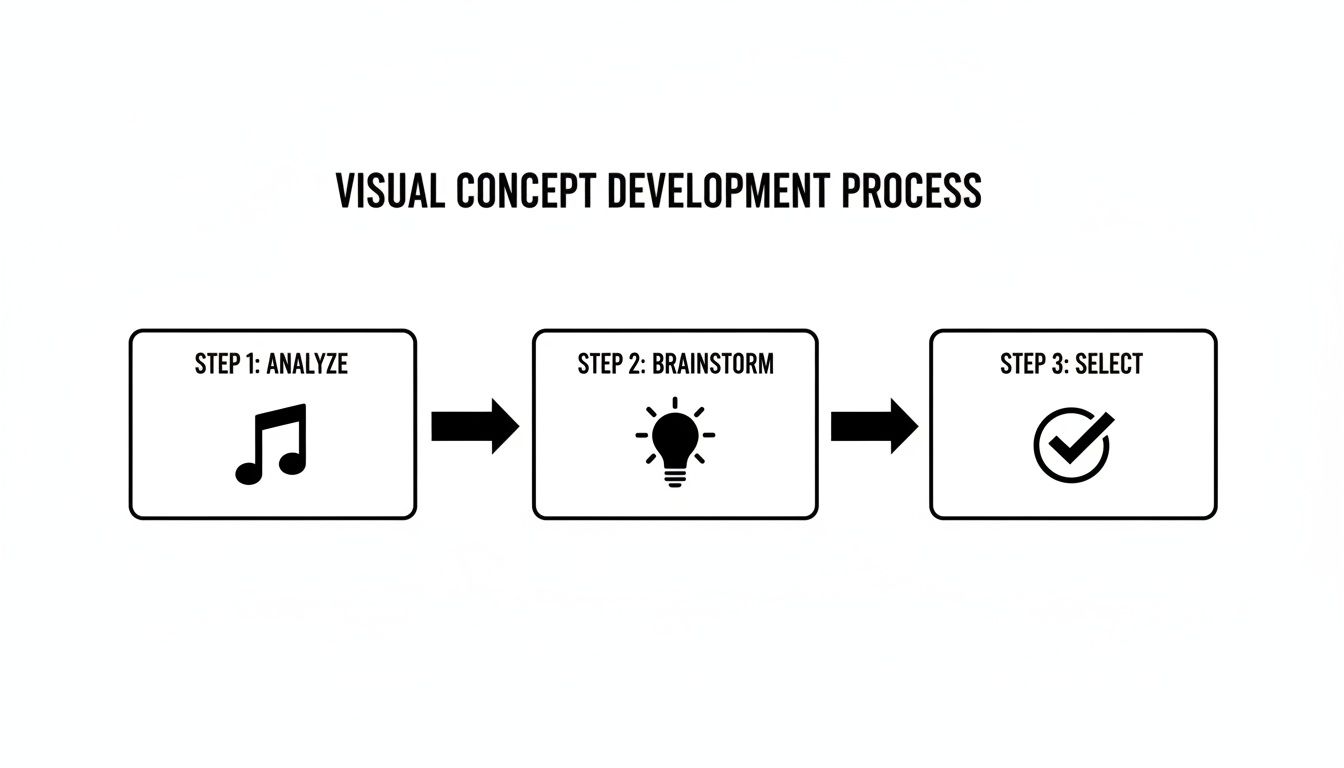
It’s that simple: Analyze the song, brainstorm the visuals, and then select the strongest moments to build your script.
Let's make this real. Imagine your song has this opening verse:
(0:15) "The city lights are ghosts tonight..."(0:20) "...flickering on the rain-slicked glass."
Okay, how do we show that? The obvious first thought might be:
Version 1 (The Obvious Take):
(0:15) Visual: WIDE SHOT of a city at night. (0:20) Visual: CLOSE-UP of rain on a window.
It works. It's fine. But it’s not great. It’s literal. Let's add some flavor, some mood.
Version 2 (The Detailed Breakdown):
(0:15) Visual: SLOW-MOVING DRONE SHOT gliding over a deserted city street. The streetlights are soft, out of focus, creating a dreamy, ghostly bokeh effect. (0:20) Visual: RACK FOCUS from the blurry lights outside to a single raindrop tracing a path down a windowpane. We catch the artist's distorted reflection in the glass for just a second.
See the difference? The second version doesn't just illustrate the lyrics; it amplifies the feeling behind them. It tells a mini-story. This is the kind of detail that gets a director and cinematographer excited, giving them a clear vision to execute and build upon.
If you’re still getting the hang of crafting lines that paint a picture, our guide on how to write song lyrics for beginners offers some great tips for writing evocative phrases that practically beg to be filmed.
Pro-Tip: Don’t just sync to the lyrics. Listen for the music! That killer guitar riff, the moment the bass drops, a sudden cymbal crash—these are golden opportunities for a hard cut, a camera shake, or a dramatic lighting change.
Putting in this front-end work can feel like a chore, but it's what separates the pros from the amateurs. It’s a tough world out there; in the screenwriting sphere, only about 39.67% of Writers Guild members even earned money from their craft in 2023. While music videos operate a bit differently, the core principle is the same: meticulous planning and professionalism get you noticed. Good prep makes your project look legit and guarantees a much smoother ride during production.
When you map everything out, you create a blueprint that your entire team can follow. The director, the DP, the editor—everyone knows exactly what's supposed to be happening at the 2:03 mark. And when your whole team is in sync, that's when you capture lightning in a bottle.
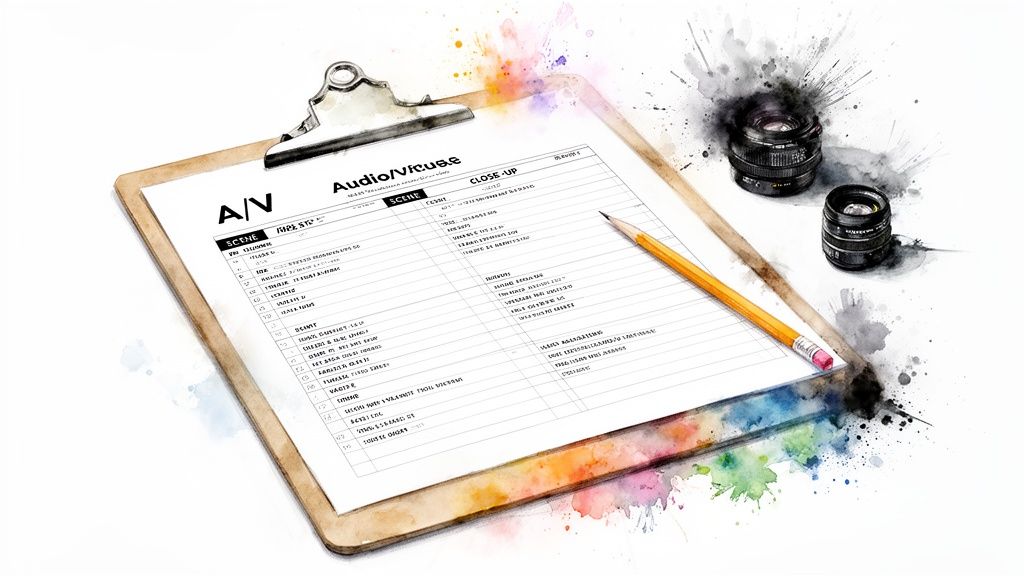
This isn’t just about looking official. A proper script is your secret weapon for clarity. It ensures that the video in your director's head is the exact same one that's been living in yours. No confusion, no weird interpretations.
For music videos, the industry standard is the Audio/Visual (AV) script, sometimes called a two-column script. It’s your new best friend.
First things first, forget everything you know about traditional movie screenplays. Music videos are a totally different beast. They aren't driven by dialogue; they're driven by the beat. The AV format is brilliantly simple and built for exactly that.
Picture a page split right down the middle:
Left Column (AUDIO): This is for everything we hear. You’ll put the song's timestamp here, the specific lyric being sung, and any other important sound cues. Think "heavy synth drops" or "sound of a breaking plate." Right Column (VISUAL): This is for everything we see. This is where you describe the action, the camera work, the setting, the vibe. It’s where you bring the visual story to life.
This side-by-side layout is the whole point. It lets your crew instantly connect a specific sound with a specific visual. It's the ultimate sync-up tool.
The visual column is where your inner filmmaker gets to play. The trick is to be vivid but also ridiculously clear. You need to speak the language of the camera.
Here are the key ingredients for a perfect visual description:
Scene Heading: Every time you change locations, you need a new scene heading. Just write it in all caps, like INT. DUSTY GARAGE - NIGHT or EXT. ROOFTOP - SUNSET. This one little line tells the crew where they need to be and what kind of lighting to bring. Shot Size: Are we close or far away? This detail totally changes the feeling of a shot. A WIDE SHOT (WS) can show off a massive landscape or make your artist look tiny and alone. A CLOSE-UP (CU) on their face, however, pulls the viewer right into their emotions. Camera Angle & Movement: Tell us what the camera is doing. Is it looking up from the ground (LOW ANGLE) to make someone look like a hero? Is it smoothly gliding alongside the action in a TRACKING SHOT? Be specific!
Mastering a few basic camera terms elevates your writing from "we see the singer" to "A LOW ANGLE CLOSE-UP on the singer's face, rain dripping from her hair." See the difference? The second one is an instruction. It’s an entire mood.
One of the best perks of a clean script is how easily it becomes a shot list. Think of the shot list as the holy bible for your director and cinematographer on shoot day. It’s a detailed checklist of every single camera setup you need to get.
You’ve already done the hard part. Each visual description in your script becomes its own item on the shot list. This forces you to get practical and ensures you don't forget that one crucial shot you’ve been dreaming about.
This level of planning isn’t just nice to have; it's essential. Making a video is a wild dance of creative ideas and technical needs. Scripts today have to account for visual effects, editing notes, and precise audio cues. With teams collaborating from all over, you need a rock-solid plan. In fact, understanding how audiences watch is key, which is why professionals always explore more about video engagement data to inform their timing.
The shot list is what keeps the chaos organized. It lets the crew film all the similar shots at once to save a ton of time. For example, you can capture all the close-ups in the garage in one go, even if they show up at different points in the final video. That's how you run a smooth shoot and stay on budget.
Your script is the blueprint, but the shot list is the step-by-step construction guide. You need both to build something incredible.
Okay, so you've poured your heart and soul into crafting a killer script. That's a huge win, but it’s really just the beginning. The real magic kicks in when you start turning those words on a page into a living, breathing project. And today, that means getting smart with your tools and your teamwork.
Gone are the days of endless email chains, confusing feedback, and lost files. Modern tech can transform your script from a static document into a dynamic, collaborative playground. Think of your script as the blueprint and technology as the power tools—the stuff that helps you build something amazing.
One of the toughest parts of this whole process is getting the visuals in your head onto the page and then into your team's heads. You can write "a surreal, dream-like sequence of the artist floating through a galaxy of neon flowers," but what does that actually look like? Everyone's interpretation will be a little different.
This is where AI tools completely change the game.
Platforms like SendFame can take your text prompts and spin them into visual concepts, storyboards, or even short video clips in a matter of seconds. It's like having a creative co-pilot.
Brainstorm at Lightning Speed: Just feed your lyrics or a scene description into an AI and watch the visual ideas roll in. It’s like having an art director on call 24/7, ready to riff with you. Test-Drive Your Concepts: Not sure about the vibe for the chorus? No problem. Generate three different visual styles—maybe one is dark and moody, another is vibrant and pop-art, and a third has a grainy, vintage film look. See which one just feels right. Show, Don't Just Tell: Instead of trying to describe that wild idea to your director, you can just show them an AI-generated image or clip that perfectly captures the mood.
This screenshot from SendFame's homepage gives you a glimpse of how simple text prompts can blossom into stunning visuals.
This visual-first approach cuts through the noise and gets everyone on the same creative page from day one. That alone can save you countless hours of back-and-forth later.
By using AI to prototype, you're not replacing your creativity; you're amplifying it. You’re solving visual problems in minutes that used to take days of mood boarding and guesswork.
The power to generate assets this quickly is a massive leg up, especially for independent artists. If you want to explore this further, our guide to the best AI music video generator tools is a great place to find the right platform for your ideas.
Once the script is drafted, it's time for feedback. The goal here is to make this process as painless as possible. A script isn't a fragile masterpiece you need to defend at all costs; it's a living document that gets stronger with input from your director, cinematographer, and other key players.
The secret to great collaboration is having a single source of truth. Seriously, forget about emailing Word docs back and forth and creating a file-naming nightmare like "Final_Script_v4_REVISED_real_final.docx." Just don't. Use cloud-based tools where everyone is looking at the exact same thing.
Here's how to keep the feedback loop smooth:
Live in the Cloud: Use something like Google Docs or a dedicated screenwriting app that allows real-time comments and edits. Everyone always has the latest version, period.Be Specific with Your "Asks": When you send your script out for notes, tell people what you need. Are you looking for big-picture story feedback? Or are you drilling down into camera angles and shot specifics?Do a Table Read (Virtually): Get your key team members—especially the director—on a video call and walk through the script scene by scene. It's the perfect time for questions, brainstorming, and gut checks.Check Your Ego: The director's job is to challenge your ideas and make them better. Be open to their suggestions. Sometimes the best thing for the video is cutting a shot you absolutely love.
At the end of the day, your script is the hub for all pre-production activity. When you pair a solid script with smart AI tools for visualization and streamlined platforms for collaboration, you create a workflow that’s efficient, creative, and totally in sync. It’s the best way to make sure the incredible vision you worked so hard to put on paper is the one that actually ends up on screen.
Alright, so you've got the vision bubbling in your head, but a few nagging questions keep popping up and killing the vibe. It happens to everyone. Let's clear the air and tackle some of the most common hurdles you'll face when scripting your first (or next) music video.
If you've ever dabbled in screenwriting, you've probably heard the old "one page equals one minute" rule. For music videos? Chuck that rule right out the window. It’s completely useless here. A script for a killer three-minute track could easily balloon to 10 or even 15 pages.
So, what gives? It all comes down to density. Music videos are a different beast entirely—they're often a relentless barrage of quick cuts, visual punchlines, and hyper-detailed action sequences. Your script's mission is to capture every single one of those fleeting moments.
Don't get hung up on page count. The real goal is crystal-clear communication. Your script needs to be long enough to leave zero room for interpretation on set. If a shot is going in the final cut, it needs to be on the page.
Think about it: a video with 100 hyper-kinetic shots is naturally going to have a much thicker script than one built around a few long, sweeping takes. Be thorough. Every camera pan, every subtle smirk, every shift in lighting deserves its own line.
These three documents are the holy trinity of pre-production, but they each have a very different job. Mixing them up is a classic rookie move, so let's break it down.
Imagine it like a funnel, guiding your massive idea into a perfectly executed plan.
The Treatment: This is your big-picture pitch. It’s a 1-to-3-page prose document that sells the soul of your video—the core concept, the vibe, the story. It’s all about the why and the what. The Script: This is the technical blueprint we’ve been building. It’s your two-column AV script that syncs every visual cue directly to the lyrics and timestamps. This is the how and the when. The Storyboard: This is where the script gets a face. It's a sequence of drawings or images (sometimes AI-generated!) that shows exactly how each shot will be framed. This is the ultimate visual guide for your Director of Photography.
They all flow into one another. The Treatment gets everyone excited, the Script lays out the battle plan, and the Storyboard shows what victory looks like.
Yes! And honestly, you have to. A solid script is your single most powerful weapon when you’re running on passion and pizza money. When you can't throw cash at problems, you have to outsmart them with killer planning. That’s what a script is for.
A great script forces you to turn your limitations into your greatest strengths. Instead of dreaming up a scene with a helicopter chase you can't afford, you can architect a concept that’s emotionally devastating but logistically a cakewalk.
Find one incredible location you can get for free and build your whole story there. Write a narrative that hinges on a raw, captivating performance instead of pricey special effects. Plan every single shot so you don't waste a second of your crew's time (who are probably your friends working for free).
Your script is how you maximize every single thing you have. You solve all the tough problems on paper first, so you’re not burning daylight—or favors—trying to brainstorm a Plan B on set.
AI has stormed onto the scene and become an unbelievable creative sidekick for this process. No, it won't write an emotionally resonant masterpiece for you from scratch, but it can supercharge your workflow and help you smash through creative blocks.
Tools like SendFame are an absolute game-changer for visualization. Instead of just writing "a surreal, dream-like shot of the singer floating through a cosmic cloud," you can use AI to generate that exact image or even a short video clip. Instantly.
This helps you clarify your own vision and communicate it to your director or cinematographer with perfect accuracy. It's the ultimate rapid-prototyping machine, letting you test-drive your wildest ideas before committing a single dollar or minute of production time.
Ready to stop dreaming and start making? With a little help from AI, you can bring your script's most ambitious ideas to life in seconds. Let SendFame be your creative co-pilot, helping you generate stunning visuals, storyboard scenes, and prototype your music video with just a few clicks. Check out how easy it is to get started and turn your vision into reality.
Create Epic

SendFame

Create Epic with SendFame!
Questions: info@sendfame.com