The Top 12 Celebrity Voice Generator Free Tools for 2026

celebrity voice generator free
Welcome offer — 56% OFF


Learn how to write a rap song with this guide. We cover finding beats, writing lyrics, mastering your flow, and crafting an unforgettable hook.
Let's get one thing straight: writing a great rap song isn't some mystical art form reserved for a chosen few. It's a craft. And like any craft, it breaks down into a handful of core skills you can absolutely learn. Nail these four, and you’ll have a repeatable process for taking any idea from a random thought in your head to a finished track.
So, you’re ready to write a rap song. Good. You’re stepping into a culture that has dominated the globe for decades. Hip-hop is the language of now, powering everything from street anthems to viral TikTok clips. The cool part? The fundamentals of what makes a song stick are the same, whether you're trying to be the next Kendrick or just want to make something your friends will love.
This isn't going to be some vague, "feel the music" guide. We're getting practical. This is your playbook for building a song from the ground up, so you can stop staring at a blank page and actually start creating.
Before we get into the fun stuff, let's break down the raw materials you'll be working with. Every killer rap song you've ever heard is built from these same four pillars. Getting a handle on what they do is the first real step to making them work for you.
Here's a quick look at the essential components you'll need to master when writing your rap song.
| Component | What It Is | Why It Matters |
|---|---|---|
| The Beat | The instrumental track. It’s your song's entire mood and rhythmic backbone. | It's the canvas. A fire beat can inspire your entire song, while the wrong one can kill a great idea before it starts. |
| The Structure | How you arrange the parts of your song (intro, verse, hook, bridge, etc.). | It takes the listener on a journey. A good structure keeps people engaged and makes your track feel complete, not just like a long, rambling freestyle. |
| The Lyrics | Your words, plain and simple. This is your storytelling, your punchlines, your rhymes. | This is the heart of your message. It's what connects with people on an emotional and intellectual level. |
| The Flow | Your vocal delivery. It’s the rhythm and cadence you use to ride the beat. | This is your signature. Your flow is just as important as what you say; it’s how you say it that makes it memorable. |
Think of these as your ingredients. Once you understand them, you can start mixing them up to create your own unique flavor.
At its core, songwriting is just a series of choices. You choose a beat that sets a mood, a structure that tells a story, and lyrics that deliver an idea. The 'magic' everyone talks about? That's what happens when all those choices click together perfectly to create a single, powerful feeling.
While hip-hop’s roots go back to the ‘70s, the modern song formula really took shape in the ‘90s and is still changing. But one thing has stayed remarkably consistent: the 16-bar verse. It's the bedrock of modern rap, found in an estimated 80% of top-charting tracks since 2010.
With hip-hop now claiming a massive 26% of music listeners worldwide, learning these fundamentals isn't just an artistic exercise—it's your ticket to connecting with a seriously huge audience. You can dive deeper into rap's dominant trends on Accio.com if you want to geek out on the data.
Every great rap song kicks off with one thing: the beat. It's the sonic world your lyrics will live in, the vibe that fuels your flow, and the first thing that grabs a listener by the ears. Finding the right instrumental isn't just a box to check; it’s the most critical creative decision you’ll make.
Think of it this way: the beat is the movie scene, and your lyrics are the dialogue. A dark, moody beat with a deep 808 rumble is going to inspire a completely different story than a bright, soulful track with a crisp piano loop. Before you even think about writing a line, you need to find the sound that matches the feeling you're trying to nail down.
So, where do you find these magical instrumentals? You’re in luck. The internet is basically an all-you-can-eat buffet of beats—you just have to know where to pull up a chair.
YouTube "Type Beats": This is your ground zero. Search for something like a "J. Cole type beat" or "Travis Scott type beat" to find instrumentals that mimic the style of artists you look up to. It’s an incredible way to find a vibe and just start practicing your writing.Beat Marketplaces: Sites like BeatStars and Airbit are where the pros play. Producers upload high-quality beats you can lease or buy exclusively. When you’re ready to actually release your music, this is the route you’ll want to take.SoundCloud: This place is a goldmine for undiscovered producers and wild, experimental sounds. If you want something truly unique that no one else has touched, you've got to be willing to dig through SoundCloud.
When you’re listening, pay attention to more than just the melody. Does the drum pattern make your head nod instinctively? Is there enough space in the instrumental for your vocals to really breathe and cut through? A great beat doesn't just sound good; it practically begs you to rap on it. If you get really ambitious, you could even learn how to produce your own rap beats and have total creative freedom.
This flowchart pretty much nails the first few steps: finding your sound, then using it to build the song’s framework.
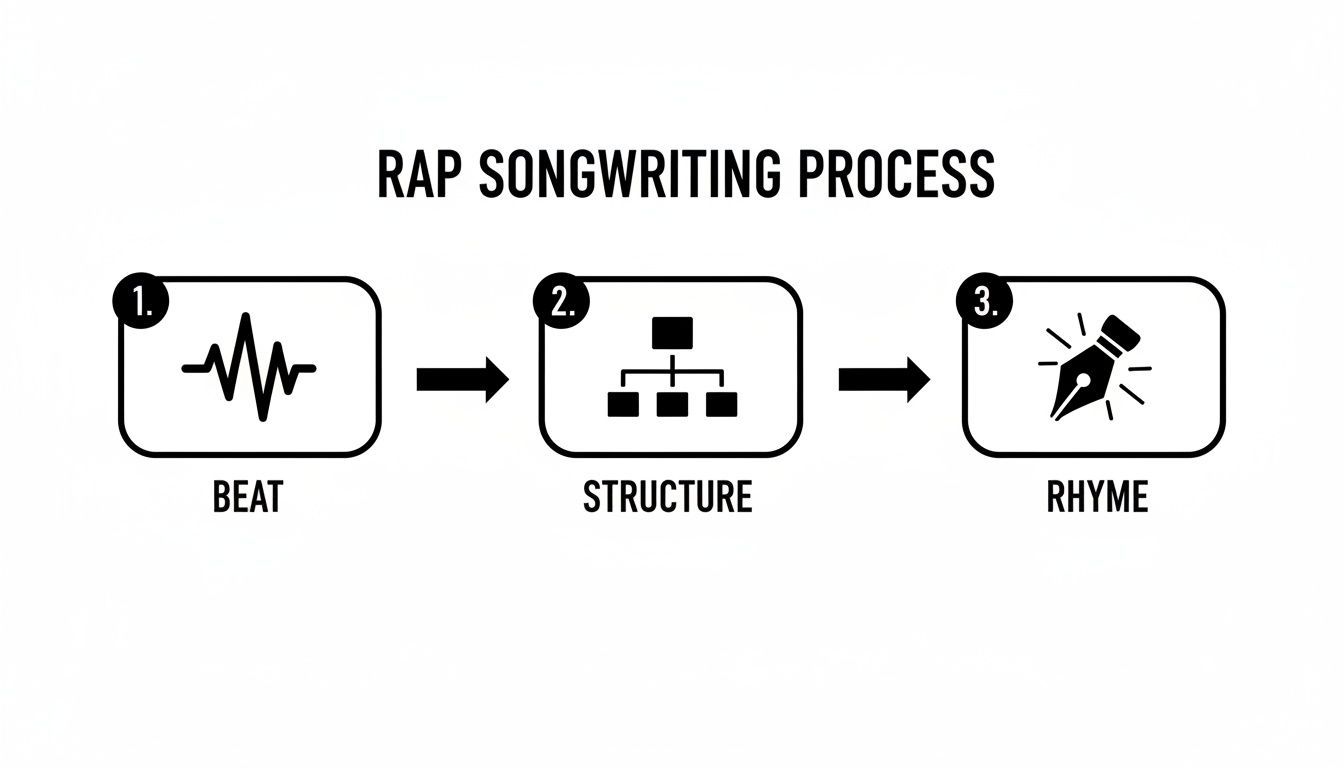
It’s a simple flow: the beat gives you the structure, and the structure organizes your rhymes. Get this right, and you're already halfway to a track that hits hard.
Once you’ve landed on a beat that speaks to you, it’s time to give your song a skeleton. A random collection of dope lines isn’t a song; it's a freestyle. A real song has structure—a deliberate map that guides the listener on a journey from the first bar to the last.
Your song's structure is its roadmap. It builds anticipation, delivers the payoff with a killer hook, and creates moments for the listener to breathe, making sure they stay hooked and never get lost.
While there are no unbreakable rules in art, most successful rap songs follow a proven formula. Getting these building blocks down is key to writing a track that feels polished and complete.
The Classic Rap Song Structure
| Section | Typical Length | What It Does |
|---|---|---|
| Intro | 4-8 bars | Sets the mood and grabs attention right from the jump. |
| Verse | 16 bars | This is your storytelling canvas. You develop ideas, paint pictures, and flex your lyrical muscles here. |
| Hook/Chorus | 8 bars | The main event. It’s the catchy, repeatable part that sticks in everyone’s head and sums up the song’s core idea. |
| Bridge | 4-8 bars | An optional section that switches things up, often with a different melody or rhythm, right before the final hook. |
| Outro | 4-8 bars | Wraps it all up. This could be you repeating a key phrase or just letting the beat ride out into the sunset. |
Listen to the instrumental you picked. Most producers build these sections right into the beat, with clear transitions that signal where a verse should end and a hook should begin. Try to map it out first—something like, Intro -> Verse 1 -> Hook -> Verse 2 -> Hook -> Bridge -> Hook -> Outro. Having this blueprint keeps you on track when you dive into the real fun: filling it all in with bars.
Alright, so you've got a beat that makes your head nod. That’s the pulse, the lifeblood of the track. But the lyrics? That’s the soul. This is where you turn a cool sound into an unforgettable story. It's your shot to paint a picture so vivid your listeners can close their eyes and see it.
Your words are your weapon. They're how you connect, how you share your unique angle on the world, and how you leave your mark. So let's get past just finding words that rhyme and really dig into the craft of writing lyrics with genuine impact.
Before you even think about penning a single bar, ask yourself one crucial question: What’s the point? Every great song is built around a central theme or a core idea. Maybe it’s a story from your block, a strong opinion you need to get off your chest, or a raw feeling like ambition or heartbreak.
Having that clear message is your creative North Star. It’ll guide your word choices, your metaphors, and your punchlines, making sure every line is pulling in the same direction to tell one cohesive, powerful story.
Try this quick exercise to get the juices flowing:
Grab an emotion: Pick one. Confidence, frustration, nostalgia—anything. Jot down three images: What three specific things make you feel that way? For "nostalgia," it might be an old pair of Jordans, a specific street corner, or the intro to a 90s cartoon. Mash 'em into a sentence: "Lacing up those old Jordans on that rainy street corner takes me right back."
Boom. Just like that, you've got a tangible, emotional core to build your song around. This little trick turns vague feelings into concrete ideas you can actually write about.
The best rap lyrics aren’t just clever; they’re honest. Authenticity connects with listeners on a level that the most complex rhyme scheme ever could. Write what you know and feel, and the impact will follow.
And for those days when the well feels dry, figuring out how to overcome writer's block can give you the tools to break through and keep the words flowing.
Look, basic A-B-A-B rhymes (cat/hat, run/sun) are fine when you're starting out. But to really sound like a pro, you’ve got to add some layers. This is how you separate yourself from the amateurs—by making your lyrics sound as musical as the beat they're riding.
Here are a few rhyme types that will instantly make your bars sound more dynamic:
Internal Rhymes: This is about dropping rhymes inside the lines, not just at the end. For example, "I make a play today on this stage, my words turn the page." It creates this slick, rhythmic bounce that just sounds professional. Multisyllabic Rhymes: Instead of rhyming one syllable, you rhyme multiple. Think of rhyming "lyrical miracle" with "spiritual individual." It’s a signature move of legends like Eminem and MF DOOM, and it shows you have serious command of the language. Assonance (Vowel Rhymes): This is a serious secret weapon. It’s about repeating the same vowel sound in nearby words, like the "o" sound in "Go slow over the road." You'll find this technique in an estimated 75% of modern hits, including all over Kendrick Lamar's 'HUMBLE.'
Rap is a global force, with 26% of listeners worldwide tuning in, but it absolutely dominates in major markets like the US and UK. With indie artists snagging a massive 43% market share, it's crystal clear that sharp songwriting is what makes you stand out. And get this: studies show that 55% of pros freestyle up to 70% of their initial lyrics, polishing them later. Improvisation is key.
Wordplay is what makes a line jump out of the speakers and get stuck in someone's head. It's that "ooooh!" moment, the punchline that makes you rewind the track just to catch it again. It's the art of being clever without trying too hard.
Here are a few literary devices to start playing with in your writing:
| Device | What It Is | A Quick Example |
|---|---|---|
| Simile | A comparison using "like" or "as." | "My flow is like water, it runs through the cracks." |
| Metaphor | Saying something is something else. | "The city is a jungle, and I’m a lion on the hunt." |
| Punchline | A clever, witty line with a twist. | "They're sleeping on me, guess they need a Tempur-Pedic." |
Don't feel like you need to cram every single bar with a complex metaphor. The real magic is in the balance. Sometimes, a simple, direct line hits harder than the wittiest punchline.
If you want to go even deeper, you can check out our detailed guide on how to write rap lyrics for more advanced techniques. The goal is to create those little moments of surprise and delight for your listener, making your story resonate with both style and substance.

Alright, you’ve picked a beat that gets your head nodding and you've got some lyrics cooking. Now we get to the fun part—the stuff that separates a bedroom demo from a certified banger. It’s time to find your flow and craft a hook that people can't forget.
Think of it this way: your lyrics are what you’re saying, but your flow is how you’re saying it. It's your signature rhythm, your personal pocket, the unique cadence that makes your voice its own instrument. A fire beat deserves way more than just reading words over it.
Your flow is how you dance on the beat. It’s your swagger, your energy, your personality baked right into the rhythm of your words. The greats don’t just rap on the beat; they play with it. Sometimes they’ll ride the snare perfectly, sometimes they’ll lag just behind it to create a laid-back vibe, and other times they'll rush ahead to build hype.
This is where you stop being a writer and start being a performer. Don't just sit there and read your lines. Get up. Feel the groove.
To start, just listen to the kick and snare—those are your anchors. Try rapping one line over and over, just focusing on making a specific word land hard on every snare hit. Once you feel locked in, you can start experimenting.
Here are a few exercises to get you going:
Play with Speed: Rap a verse at a snail's pace, then try to double the speed. This is a fantastic way to tighten your breath control and master your pacing. Shift the Emphasis: Take the same two bars and rap them three times. Each time, put a heavy emphasis on a different word. Hear how that changes the entire meaning and feel? Listen to the Masters: Put on some Kendrick Lamar, Missy Elliott, or J. Cole. Don't just listen, analyze. How do they use pauses? When do they speed up? Notice how their voice alone creates excitement.
A rapper’s flow is their personal brand. It’s the invisible thread that connects your lyrics to the beat, turning simple words into a performance. Master your flow, and you’ll sound like yourself—and no one else.
Now for the main event: the hook. The hook (or chorus) is the magnetic center of your song. It’s the part that gets stuck in people’s heads, the part they sing in the shower, the part that becomes an Instagram caption. A weak hook will sink your track, no matter how good the verses are.
A killer hook needs to be simple, memorable, and boil down the entire vibe of your song into a few powerful bars. This isn't the place for your most complicated metaphors or tongue-twisting rhymes. It's about a feeling, a melody, and a message that hits instantly.
The Three Ingredients of a Knockout Hook
| Ingredient | Why It's Crucial | The Pro Move |
|---|---|---|
| Simplicity | Easy-to-remember lines are what get stuck in a listener's head. Don't overthink it. | Sum up your song's entire message in one or two punchy lines. That's your hook. |
| Melody | A strong vocal melody is often more catchy than the words themselves. It’s what makes people hum along. | Before you even write the words, try humming different melodies over the beat. Find the tune first. |
| Repetition | Hearing a key phrase or melody again and again is what drills it into the listener's brain. | Don't be shy about repeating the most powerful line two or even four times. Make it stick! |
Think of your hook as home base. Your verses can go on adventures, tell stories, and flex your lyrical muscles, but they should always lead back to the core idea of your hook. And if you're looking to make your rhymes feel even smoother, you can always dig deeper into how to make words rhyme more effectively, which is a huge part of crafting a hook that just flows.
Feeling stuck? This is a perfect time to use an AI tool as a creative sparring partner. Jump into SendFame's lyric generator and give it a prompt like, “Write a catchy, 4-line hook about feeling unstoppable on a summer night.” You don’t have to use what it gives you, but it might just spit out a word or a phrase that sparks the perfect idea. It's a great way to smash through writer's block and find that unforgettable hook your track is missing.
Alright, you’ve put in the work. The beat is hitting right, the structure is tight, and the lyrics are telling your story. But a song that only exists on paper is like a script that never gets filmed. It's time to get this thing out of your notebook and into some headphones.
This is the final leg of the race. We're turning those written words into a real, polished track and then figuring out how to get it in front of the right people. Let's break down the essentials of getting your song recorded and then dive into building an actual audience.
Look, you don't need a million-dollar studio to get a clean, powerful vocal. Not anymore. With just a few key pieces of gear and the right approach, your home setup can crank out professional-sounding results. The real goal here is to capture your performance with as much clarity as possible, which will make the mixing process a million times easier later on.
The absolute heart of your home studio is the microphone. To snag your vocals with quality and clarity without emptying your wallet, check out some of the great budget USB microphones on the market. These are pretty much plug-and-play, perfect for artists who want to focus on the music, not on becoming audio engineers overnight.
Got your mic? Here are a few dead-simple tips for a clean recording:
Find Your Spot: Record in a room with soft surfaces. There's a reason closets stuffed with clothes are a legendary recording hack—they soak up sound reflections and kill that nasty echo. Steer clear of empty rooms with bare walls and hard floors. Mic Placement is Everything: Set up the mic about 6-8 inches from your mouth and just a little off to the side. This simple trick helps you dodge those harsh "plosives"—the bursts of air from "p" and "b" sounds that can totally wreck a take. Always Do Multiple Takes: Seriously, don't chase that one single "perfect" take. It's a waste of time. Run through the entire song three or four times. Later, you can listen back and "comp" the vocals, grabbing the best line from take one, the dopest bar from take three, and stitching them together into one flawless performance.
Great writing is rewriting, and great recording is re-recording. The best artists are absolutely relentless when it comes to editing their own work. Don't ever be afraid to scrap a verse, rewrite a hook, or do twenty more takes until it feels undeniably right.
With your song recorded, it’s time to switch hats. You’re not just an artist anymore; you're the CEO of your own music career. And the good news? The independent music scene is absolutely booming right now.
It’s a bit of a numbers game, but the odds are way more in your favor than you might think. A huge stat for any songwriter to know is that 43% of the global music market is now indie artists. To get noticed, you have to be smart. For example, data shows tracks that drop specific stats in their lyrics get 30% more traction. And that 8-bar intro verse? 80% of top rap songs use that structure to build tension.
This isn't about luck; it's about making smart, targeted moves with your music.
You don't need a record label's permission to start building a fanbase. In fact, proving you can build an audience on your own is one of the most powerful things you can show an A&R scout. Your journey as a public artist starts the second you decide it does.
Here’s a simple game plan to hit the ground running:
Claim Your Digital Real Estate: Go grab your artist name on all the key platforms—TikTok, Instagram, X, YouTube. Keep your branding consistent with the same profile picture and a clear, punchy bio everywhere. Create Content Around the Song: Don't just drop the track and pray for the best. Film yourself writing it. Give people a behind-the-scenes peek at your recording setup. Tease your best punchline with a simple text-on-screen video. Make people care about the song before it even drops. Find Your People: Connect with other aspiring rappers, producers, and fans in your lane. Leave thoughtful comments on their posts, join conversations, and build real relationships. This is about building a community, not just blasting your own links.
This whole process is a marathon, not a sprint. Consistency is everything. If you're looking for an even deeper dive into getting your sound out there, we put together a full playbook on how to promote your music independently. Your journey from learning how to write a rap song to seeing real people connect with your music starts right now.
Alright, so you're in the thick of it, trying to piece together your first (or next) masterpiece. It’s totally normal to hit a wall or have a nagging question that won't go away. Let's get into some of the most common things that trip up new rappers.
No fluff, just real talk. Think of me as your producer in the booth, here to help you get unstuck.
This is always the first question, and thankfully, the answer isn't some big mystery. You want to aim for the sweet spot: somewhere between 2 minutes 30 seconds and 4 minutes.
Why that range? Simple. It's long enough to build a vibe, drop a couple of killer verses, and hammer home a memorable hook. But it’s also short enough to keep someone’s attention on TikTok or get a nod from a playlist curator. It's the perfect length for radio, streaming, and our goldfish-like attention spans.
A classic, battle-tested structure usually looks something like this:
Intro: 4-8 bars (just enough to set the mood) Verse 1: 16 bars Hook: 8 bars Verse 2: 16 bars Hook: 8 bars Outro: 4-8 bars (fade out or end with a bang)
Sticking to a blueprint like this helps your track feel polished and complete, not like a freestyle that just kind of... trails off.
Writer's block is a lie. It's just fear of writing something that isn't amazing right away. Newsflash: everyone has a story. You just have to stop waiting for some epic, life-changing event to write about and start looking at what’s right in front of you.
Your life doesn't have to be a movie to be interesting. The best songs come from the little things—the daily grind, the small wins, that one annoying thing your friend does. Your point of view is what makes it fire.
Feeling totally blank? Let's kickstart that engine. Try one of these:
Describe your messy bedroom like it's a crime scene. What do the details say about you? Think about the last thing that made you laugh so hard you couldn't breathe. Rap about that. Invent a character—maybe the guy who works the late shift at the corner store or an astronaut bored in space—and tell the story of their worst day ever.
The point isn't to write a Grammy-winner on the first go. It's about getting the words moving. Once you start playing around, you’ll be surprised by what bigger ideas start to bubble up.
Here’s a secret: You don't "find" your style. You build it, piece by piece, over time. It’s a Frankenstein's monster of your influences, the natural rhythm of your voice, your personality, and a ton of practice. Don't sweat it if you sound like your favorite rapper at first. We all start by copying.
It's like learning to play guitar. First, you learn "Smoke on the Water." You copy the riff exactly. But after a while, you start adding your own little bends and flourishes, and suddenly, you're not just playing a song—you're playing music.
Want a game plan? Here you go:
Listen to Everything. Don't just stick to your Spotify algorithm. Dig into 90s boom-bap, UK drill, the weird stuff from the Soundcloud era. Absorb the crazy rhyme schemes of MF DOOM and the melodic autotune of Post Malone. The more you hear, the bigger your toolkit becomes. Experiment Like a Mad Scientist. Grab beats you'd never normally touch. Try rapping super fast and choppy, then slow it down to a lazy, conversational flow. The only way to find what works is to try a bunch of stuff that doesn't. Record. Every. Single. Thing. Your phone's voice memo app is your best friend. Record yourself freestyling in the car, mumbling hook ideas, everything. Listening back is the fastest way to hear what sounds genuinely like you versus what sounds like a bad impression.
Your unique voice is hiding at the intersection of what you love to listen to and what feels good coming out of your mouth. Trust the process.
Hitting a wall with a rhyme or need a fresh idea for that hook? The SendFame AI Music Generator can be a game-changer. It’s the perfect co-pilot for brainstorming new lines and smashing through creative blocks, helping you cook up original bars that still sound 100% you. See how it can speed up your workflow at https://sendfame.com.
Create Epic

SendFame

Create Epic with SendFame!
Questions: info@sendfame.com