10 Best Marketing Job Boards for 2026

best marketing job boards
Welcome offer — 56% OFF



Prompt marketplace guide for 2026: learn how to buy, sell, and price AI prompts, plus trust, SEO, and growth tactics that work on platforms like SendFame.
You've probably got one of two tabs open right now. In one, you're tweaking a prompt that finally gives you the exact output you want. In the other, you're wondering whether that prompt should stay in your notes, get shared with clients, or be turned into something people can buy.
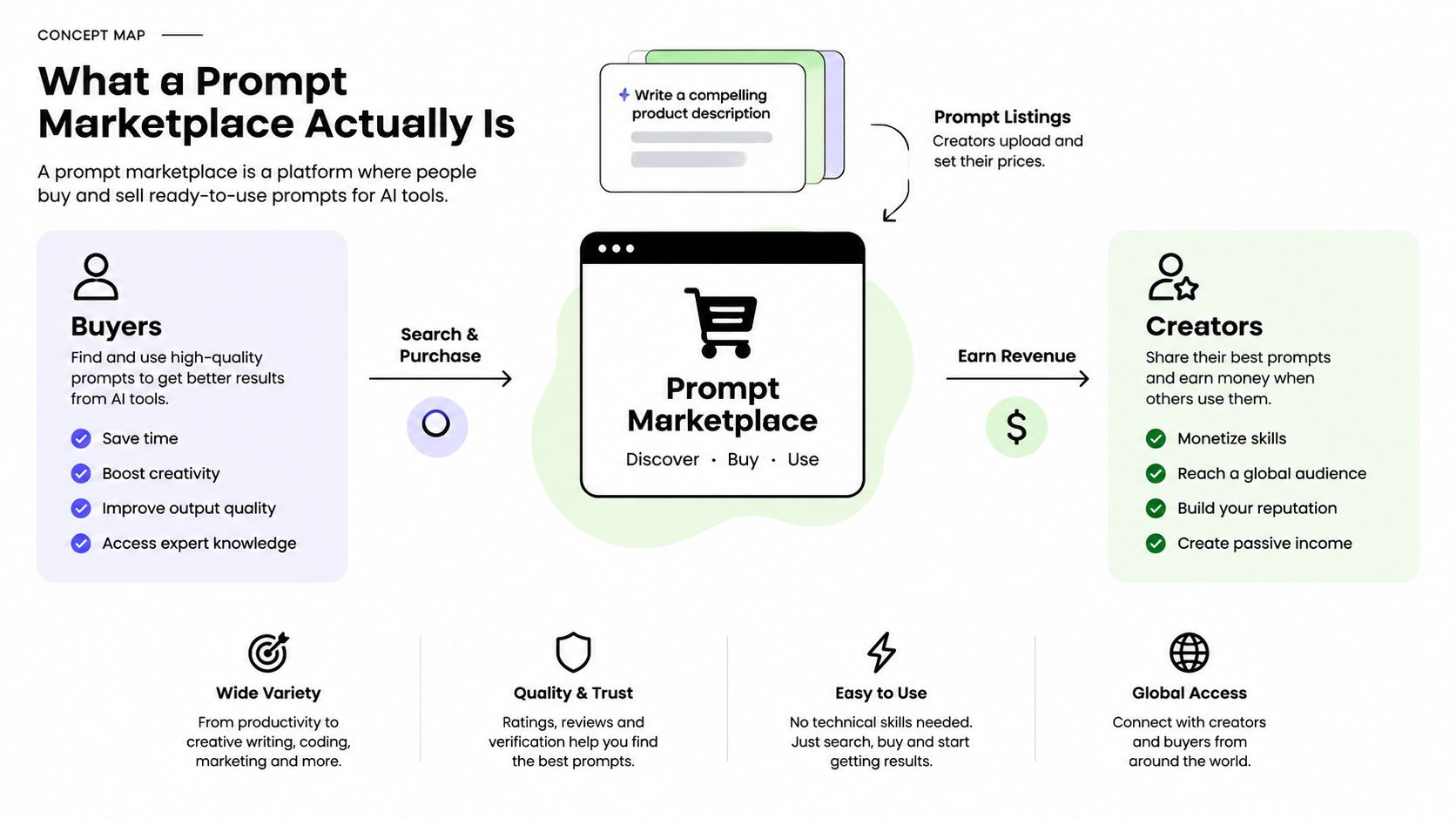
That's the core starting point for a prompt marketplace. It isn't just a folder of clever strings. It's a place where reusable prompts, prompt chains, and workflow packs get listed, discovered, licensed, and exchanged so other people can run the same process without rebuilding it from scratch. The market itself is no longer tiny. Grand View Research puts the global artificial intelligence prompt marketplace market at USD 1,406.0 million in 2024, with a projection to reach USD 10,992.4 million by 2033 at a 25.9% CAGR from 2025 to 2033 (Grand View Research).
That growth matters because it explains what sells now. Buyers don't want a cute line of text they can already draft themselves. They want a repeatable way to get a model to behave, produce, and format output the way a real job requires. That's why the strongest marketplaces are moving from text libraries toward workflow-product platforms, where the purchase provides a repeatable process, not just a string.
If you want the surrounding media context to make sense, the definition of AI-generated content helps frame where prompts sit in the stack, especially once outputs start crossing into images, text, and video. A useful primer is this overview of AI-generated content.
What a Prompt Marketplace Actually Is The three layers that matter What gets soldBusiness Models and Pricing Structures Four lanes creators actually chooseBuyer and Seller Workflows Side by Side What the buyer is really doing What the seller has to do before launchHow PromptHero Can HelpReal Use Cases Across Content, Marketing, and Music Content creation that ends in assets, not drafts Marketing that turns briefs into launch kits Music workflows that benefit from iterationTrust, Legal, and Ethical Considerations Read the license like a buyer, not a fan Where remix culture gets messyGrowth Tactics Through Community and Multi-Modal Tools Community turns listings into lineages Multi-modal tools widen the surface area Three plays you can run this weekSEO, Launch Checklist, and What to Do Next Launch with a page people can scan A simple 14-day promotion arc
A creator can spend an evening refining a 600-word prompt that produces studio-quality product photos and still not know where it belongs. Notes app? Gumroad? A Discord? The answer depends on whether the prompt is just a personal shortcut or a reusable asset with enough structure for other people to run it successfully.
A real prompt marketplace usually has three layers. The first is the listing surface, where people browse a catalog, filter by tags, preview examples, and decide whether the output looks trustworthy. The second is the transaction layer, where pricing, access, licenses, subscriptions, or revenue shares get handled. The third is the workflow layer, where the prompt can be remixed, versioned, or attached to multi-step output generation.
That third layer is where the category has changed. TechCrunch described prompt marketplaces in 2023 as e-commerce portals where users could buy, sell, or give away prompts for AI systems, and noted how fast the field expanded from a single major player to a dozen or more marketplaces found through a simple search (TechCrunch). The important part isn't the count. It's the speed at which a new supply chain formed around prompt creation, curation, and reuse.
What changes hands is broader than raw prompt text. Sellers package:
Prompt templates, usually with example inputs and expected outputs. Prompt chains, where one step feeds the next. Model presets, tuned for a specific generator or style. Bundled outputs, such as thumbnail concepts, caption sets, or image directions that make the prompt easier to evaluate.
Practical rule: If the buyer has to guess how to use it, the listing is too thin. If the buyer can run it and get a usable first result, you've built something closer to a product.
That's the right mental model for the rest of the topic. A prompt marketplace is less like a library shelf and more like a workflow shop. You're either buying a shortcut that saves setup time, or selling a process other people can repeat without your help.
A prompt marketplace is a pricing decision before it is a catalog decision. The model you choose shapes the kind of buyer you attract, how much support the listing will demand, and whether the offer behaves like a product or a one-time file. A prompt that fits a solo creator may fall apart as a subscription if the buyer expects fresh updates. A niche workflow can justify a license when it solves a narrow business job well enough to be reused.
One-off purchase is still the cleanest fit for a single prompt or a compact stack. It works best when the buyer wants to test the workflow without committing to an ongoing relationship. Public marketplace listings often sit in the $1.99 to $9.99 range for mainstream prompts, with premium or bundled systems reaching $20 to $100+ when commercial licensing or multi-step workflows are included (LaPrompt). That pricing makes sense because the buyer is paying for saved iteration, not for word count.
Subscriptions make more sense when the seller has depth, not just one strong prompt. Agencies, power users, and recurring teams usually want libraries, prompt credits, or fresh bundles. The upside is steadier revenue. The trade-off is churn pressure, because the catalog has to keep moving or the value feels stale.
Free with tips, or freemium, suits community-driven hubs. It lowers friction, builds trust, and leaves room to earn through donations, upgrades, or platform fees later. The catch is simple, free listings often pull in casual users unless the workflow is clearly better than what they can improvise on their own.
Licensing and enterprise agreements fit buyers who care about commercial rights, team use, resale limits, or API access. These deals usually take longer to close, but they can support higher-value contracts when the prompt package solves a specific business task and reduces support load.
A practical reference point is SendFame, where community and remix behavior turn prompts into compounding assets instead of static downloads. That is the direction stronger marketplaces are heading. The listing is only the first sale. The value comes from reuse, versioning, and the way a good workflow keeps getting adopted in slightly different forms.
| Prompt Marketplace Business Models Compared | Typical Price | Best For | Trade-Off |
|---|---|---|---|
| One-off purchase | Low to moderate | Solo buyers, first-time tests, compact prompts | Harder to build recurring revenue |
| Subscription bundle | Moderate monthly access | Agencies, heavy users, teams | Requires constant catalog upkeep |
| Free with tips | Free | Community hubs, audience building | Weak revenue unless the audience is already warm |
| Licensing and enterprise | Higher, contract-based | Commercial teams, resale-sensitive use cases | Slower sales cycle, more legal overhead |
Choose the model that matches the buyer's buying pattern, not the revenue story you wish the listing told. High volume favors one-off or subscription. Deep niche value favors licensing. Community depth can support freemium, but only if people remix the prompt and come back to it.
The buyer and the seller usually enter the marketplace with opposite frustrations. Buyers want proof that the prompt works in their model, for their task, under their license. Sellers want discoverability, low support load, and a path to repeated sales instead of one-time curiosity clicks.
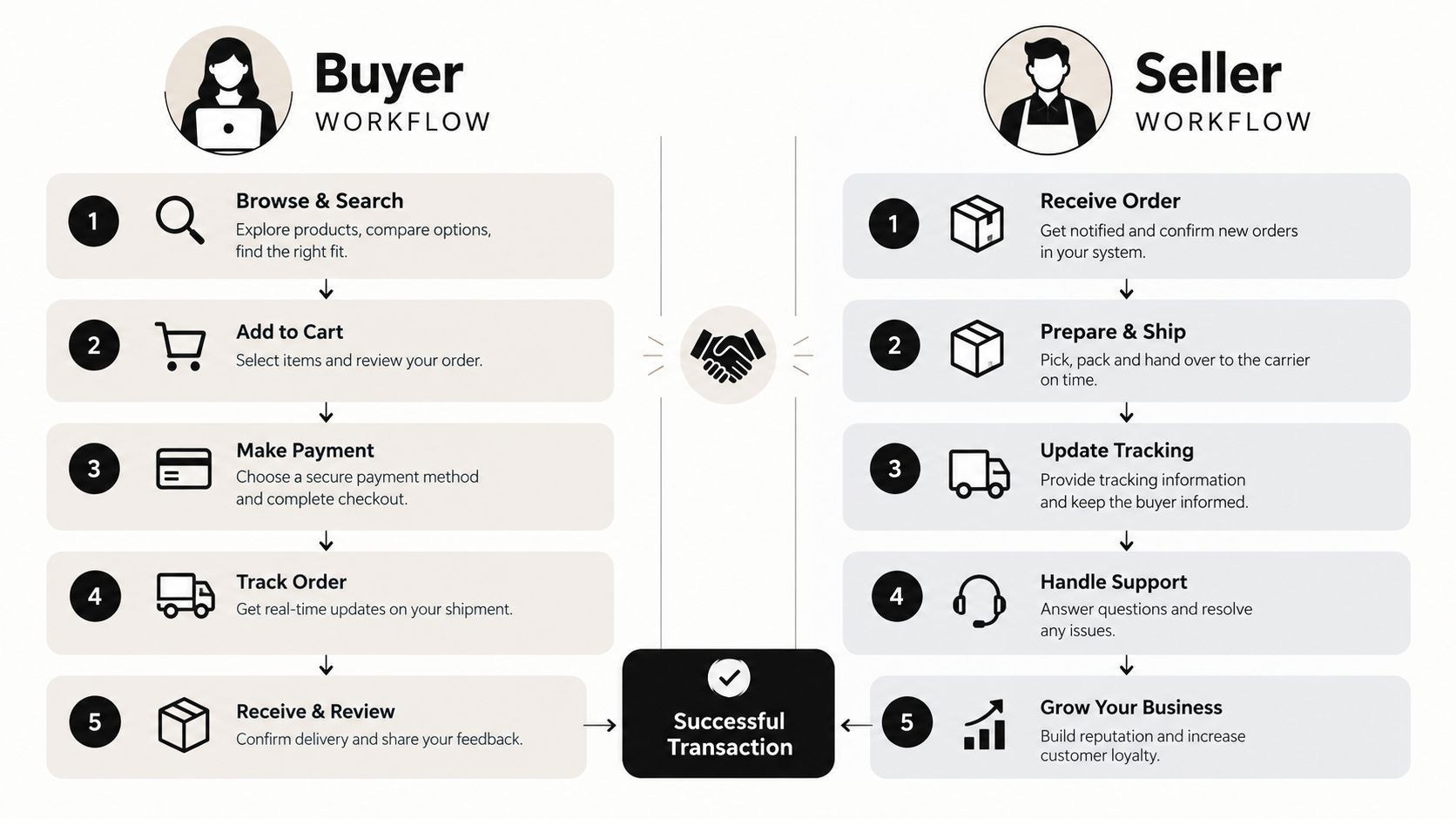
A buyer usually runs a five-step sequence. First, they search and filter by model, niche, or output style. Then they inspect the preview gallery or test render. Next, they check ratings, license terms, and refund rules. After that, they purchase or subscribe. Finally, they copy, import, or run the prompt directly in the connected tool or starter file.
The friction points show up fast. Preview accuracy matters because a polished mockup can hide a weak prompt. License clarity matters because buyers don't want to discover later that “commercial use” wasn't as broad as they assumed. Refund policy matters because prompt quality is hard to judge before use.
The seller workflow is more demanding than it looks. The sequence is research, draft, pressure-test, package, price, publish, then iterate. Research means looking for a niche gap in search results and competitor listings. Drafting means testing the prompt across at least three models so you're not overfitting to one output engine. Packaging means adding a preview image, instructions, and a license that matches the buyer's intended use.
Practical rule: A listing that doesn't show how to run the prompt is not a finished product. It's a draft with a checkout button.
The operational habits that separate a one-off sale from repeat revenue are simple but essential. Buyers need repeatable evaluation. Sellers need clear documentation, quick iteration, and enough feedback loops to improve the listing after launch. If either side treats the transaction as the end of the process, the marketplace becomes noisy fast.
If you use AI to draft or package assets around the prompt itself, the mechanics are similar to other content workflows. This guide on using AI for content creation is a useful companion because the same workflow discipline applies once prompts become part of a larger production system.
PromptHero is useful when you need a large, searchable prompt catalog rather than a narrow one-purpose store. It indexes and organizes prompts across image and video models, and it gives you a way to see how prompts are structured with parameters, examples, and community ranking signals. That matters when you're trying to reverse-engineer what a good listing should look like, or when you're testing whether your own prompt is specific enough to stand beside community examples.
The practical value is in the discovery layer. A seller can study how prompts are categorized across styles like photography, anime, fashion, or architecture, while a buyer can browse by model and compare prompt patterns without jumping between tools. If you're evaluating where a prompt marketplace should put emphasis, a PromptHero prompt marketplace search experience is a solid reference point because it combines catalog depth with visible metadata and community curation.
For a content creator, that means faster inspiration when a thumbnail prompt stalls. For a marketer, it means seeing how structured prompts turn into reusable outputs instead of one-off experiments. For anyone working across image and video generation, it's also a reminder that the marketplace value isn't just the prompt text, it's the surrounding context that makes reuse easier.
PromptHero is especially useful when you want structured prompt examples, model-specific collections, and a centralized place to compare results. It's less about hype and more about reducing search friction when you're deciding what to build, what to buy, or how to package a prompt so other people can use it.
A prompt marketplace works best when buyers see a workflow they can reuse, not just a block of text. The prompt is the starting point. What sells is the chain of outputs it produces, and the way a seller packages that chain into something another operator can run again.
A solo YouTuber usually does not need a clever prompt. They need a shot-list prompt that produces B-roll direction, caption ideas, and a thumbnail concept in one pass. The useful listing looks like a workflow stack, where one instruction shapes the outline, another narrows the visual angle, and a third turns the output into upload-ready pieces.
That is the product. The creator gets a content package, not a paragraph. In a marketplace built this way, the prompt becomes a reusable production template, which is what makes it worth buying again.
A B2B marketer can use a sequenced prompt stack to turn a rough brief into a LinkedIn carousel, an email sequence, and ad variants without leaving the interface. The buyer is not paying for copywriting help. They are buying a repeatable method for pulling several assets from one source brief.
Strong listings make the intermediate steps visible. They show how the input becomes a carousel outline, then an email draft, then ad angles. That gives another marketer enough context to trust the workflow and enough structure to remix it into a bundle later.
See more examples in this overview of generative AI use cases.
An independent musician can use lyric and mood prompts inside SendFame's music tools to move from idea to demo in an afternoon, then remix the winning prompt for a second track. That matters because it shows how modern prompt platforms turn prompts into compounding assets through community use and remixing. The prompt is part of an output loop, and the next version builds on what worked instead of starting over.
SendFame's community-plus-remix model makes that pattern easy to see. A prompt that earns traction can keep producing value as other creators adapt it for new tracks, new moods, or new formats. That is closer to a workflow product business than a text library.
The broader lesson is simple. When prompts help produce finished assets, the marketplace value comes from repeatability, not cleverness. The strongest listings show the path from input to artifact to the next use case. If that chain is hidden, buyers usually pass.
A prompt marketplace only works if buyers trust that the thing they bought can be used the way they expected. That trust lives in the license text, the moderation policy, and the platform's handling of disputes. It also lives in the seller's judgment, because remix culture makes authorship feel fuzzy even when the transaction was clear.
Standard prompt licenses can be narrower than buyers assume. Some allow personal use only. Some allow commercial use but block resale. Some let you remix the prompt but not redistribute the file itself. Others reserve platform rights that matter once a prompt gets folded into a client workflow.
The practical problem is simple. If the license language is vague, buyers will overread it, then blame the seller when a client asks questions later. Creators should also watch payout terms, dispute handling, moderation history, and whether the platform offers any indemnity for downstream misuse. Those are the details that determine whether a marketplace is a channel or a liability.
The same issue shows up in broader synthetic media workflows, where disclosure and authorship become more sensitive as outputs travel through multiple hands. This synthetic media overview is relevant because prompt reuse and generated output often meet the same trust problem from different directions.
A prompt can be remixed, refined, and re-posted so many times that attribution becomes hard to trace. That doesn't erase the original author, but it does make provenance harder to communicate. Watermarking helps in some marketplaces. Clear version history helps more.
The ethical edge cases deserve real caution. Prompts that imitate named artists, outputs that lean on scraped copyrighted corpora, and content shipped without disclosure all create different risks. Some platforms handle this with moderation. Others push the burden onto the creator. That choice should influence where you list.
| Prompt License Types Compared | Permitted Uses | Restrictions | Typical Price Range |
|---|---|---|---|
| Personal use | Private experiments, internal learning | No client work, no resale | Lower tier |
| Commercial use | Client work, marketing, published assets | May still block redistribution | Mid tier |
| Resale or redistribution rights | Repackaging and resale under defined terms | Often stricter attribution or platform rules | Higher tier |
| Enterprise license | Team deployment, broader rights, custom terms | Contract-specific limitations | Custom pricing |
If the platform can't explain those tiers in plain language, treat that as a warning sign. A good marketplace helps buyers understand what they can do next. A careless one just sells confusion at checkout.
A prompt marketplace grows faster when it behaves like a community product instead of a static listing board. Buyers become contributors when they can remix, publish variations, and get credit for better outputs. Sellers benefit because every strong remix can act as distribution for the original idea.
Public creator profiles, remix lineage, featured spotlights, and challenge prompts all help turn a single listing into a compounding asset. The buyer who remixes a prompt into a better version isn't just a customer. They're a signal that the original workflow had enough utility to fork. That signal can drive more clicks than a polished product page alone.
Marketplace design matters. If users can see who created the prompt, how it changed, and what outputs it produced, they're less likely to treat it like disposable text. The prompt gets context, and context increases perceived value.
A prompt's reach grows when it can move across image, video, voice, or music outputs. One workflow can spawn thumbnails, ad creatives, short-form clips, narration, or demo tracks. That's valuable because each output type gives the prompt another place to be discovered.
SendFame is a concrete example of that kind of workflow thinking. Its browser-based tools turn prompts into videos, images, and music, and its community gallery supports sharing and one-click remixing. That doesn't make it a pure prompt marketplace, but it does show how a platform can turn prompt-driven creation into a compounding loop.
Enter one challenge: Use a public prompt challenge to test whether your workflow can survive outside your own head. Remix one top listing: Study the structure, then adapt the mechanics to your niche instead of copying the surface language. Publish one before-and-after demo: Show the raw input, the prompt structure, and the final output so buyers can see the jump in quality.
The fastest-growing listings usually do one thing well. They show a visible path from first prompt to remixable output. That's the difference between a marketplace item and a creator asset.
The fastest way to waste a good prompt is to publish it with a vague title and no context. Buyers search by use case, role, and outcome. If the page doesn't speak that language, it won't show up where the intent is strongest.
Use a title formula that combines use case + role + outcome. Put the first 120 characters of the description to work as a hook, not a summary dump. Add five long-tail tags that reflect the actual task, not just the model name. Include one screenshot of the output, a demo video link, and a pinned changelog line so returning users can see what changed.
Preview assets need care too. Alt text helps accessibility and gives search engines more context. Where your platform supports it, schema markup and internal links from related blog posts make the listing easier to discover. That matters because prompt buyers usually arrive with a task in mind, not a brand search.
Start with a launch post in a community where your niche already talks shop. Then give the listing a paid boost to creators with clear purchase intent. After that, test a public price drop or bundle to see whether volume or ticket size responds better.
Here's a launch-day checklist that keeps the work tight:
Title and hook: Write for the task, not the tech. Assets: Add a clean screenshot, a short demo, and a visible output example. Metadata: Fill tags, license language, and changelog notes before publishing. Feedback loop: Ask the first buyers what they had to edit and what they reused. Review cycle: Set a quarterly prune date for weak prompts and double down on the ones that get remixed.
The next move is simple. Pick one niche, ship three prompts that solve adjacent jobs, and collect feedback before you add more. If remix traction is strong and buyers start reusing the output in multiple formats, you've found something worth expanding. Build around that signal, not around your favorite draft.
Create Epic

SendFame

Create Epic with SendFame!
Questions: info@sendfame.com