Best Screenshot App: 10 Tools Compared in 2026

best screenshot app
Welcome offer — 56% OFF



Compare the best marketing job boards for in-house, agency, freelance, and remote roles, with pricing, pros, cons, and application tactics.
More listings don't automatically mean better marketing opportunities. A product marketer, agency strategist, marketing operations specialist, content creator, and startup generalist each need a different search lane, because the same board can over-index on sales-adjacent roles, vague titles, or stale postings. That's especially true in a market where broad “marketing” searches can mix in commercial roles that aren't really marketing, and where specialty filters matter more than raw volume. A recent company-career-page crawl found 6,084 open positions labeled broadly as marketing across 458 companies, but 63% of those postings were sales or adjacent roles, not true marketing work, which is exactly why the best marketing job boards reward specificity over size (marketing hiring analysis).
The smartest approach is to use a small mix of boards, not blast the same application everywhere. One board should give you broad marketing relevance, one should match your function, and one should match the employer type you want, whether that's a startup, agency, SaaS company, or professional association. When the role calls for creative communication, your portfolio should do more than sit in a PDF, it should show the work in a clean image set, a short video, or an audio-backed example when that format strengthens the story.
1. GrowthRoles Why it works for practical searches2. American Marketing Association Job Board Where it fits best3. MarketingJobs.com Breadth is useful, but it can get noisy4. MarketingHire Best for roles where scope matters5. Adweek Jobs Use it when industry context matters6. Mediabistro Job Board A strong fit for visible creative work7. Exit Five B2B Marketing Jobs Best for B2B and SaaS searches8. Product Marketing Alliance Jobs Narrow focus, high relevance9. MarketingOps.com Jobs Specialist language cuts the noise10. Built In Best for tech-minded marketers11. Wellfound Startup fit, compensation clarityTop 11 Marketing Job Boards ComparisonBuild a Board Mix That Matches Your Search
GrowthRoles is the strongest first stop if you want a marketing-only search without sorting through unrelated commercial roles. It pulls live postings from many companies, shows function, level, location, and pay where available, and sends you to the employer's site to apply. That direct-apply setup keeps you closer to the company's own process instead of burying you in a generic intermediary funnel.
The platform is built around marketing-specific taxonomy, so you can browse categories such as general marketing, product marketing, growth, brand, SEO, social, content, graphic design, community, events, and email. It also gives you filters for seniority, remote-only roles, and country-specific indexes, which makes it easier to compare a junior role in one market against a senior role in another without cleaning the results by hand. That solves a real board problem, because a generic “marketing” keyword often pulls in account executive, customer success, and go-to-market openings that do not fit the role you are targeting. The broader point is the same one raised in the marketing role mix analysis, broad labels can hide a lot of non-marketing work.
Practical rule: use GrowthRoles when relevance matters more than raw volume.
The board also gives you useful compensation signals. Where employers publish pay, you can see it. Where they do not, the site shows estimated ranges based on comparable roles. It surfaces live market signals like requested skills and refreshed opening counts too, which helps you tune your CV to current hiring patterns instead of old advice.
GrowthRoles works best when you are searching across specialties, building a shortlist quickly, or comparing level and pay in one place. It is less useful if you want a community-heavy board with lots of editorial content, or if you prefer employer-brand storytelling over structured filtering. For serious marketing applicants, though, it is one of the best marketing job boards to open first because it strips out noise before you spend time on deeper research.
The American Marketing Association job board makes sense when credibility matters as much as reach. It's a strong fit for corporate marketing, agency, and higher-education roles where the hiring team values professional association affiliation and a more career-marketer audience. That usually means fewer throwaway applicants and more people who already understand marketing discipline, even if the volume isn't as large as on a giant generalist board.

AMA's posting model includes 30-day listings, optional distribution across the Marketing Career Network, employer profile branding, local chapter amplification, and Job Flash email promotion. That structure is useful if you want your role seen by marketers who already follow a professional association rather than by a broad crowd skimming for any remote job. For employers, the brand context can carry real weight, especially when the role needs judgment, stakeholder management, or a more formal career track.
A good AMA listing usually spells out the function, seniority, location or work arrangement, and the business outcome the hire is expected to support. That makes the post more credible and easier to self-qualify against. Candidates should do the same in reverse, by tailoring a CV toward the specific discipline, whether that's brand, communications, events, or demand generation, instead of sending a generic “marketing” resume.
The trade-off is straightforward. Pricing isn't fully standardized online, and the candidate pool can be smaller than on huge generalist platforms. That's not a flaw if you're hiring for fit over flood. It's a real advantage if the role needs a polished, profession-minded audience and you're willing to trade raw scale for better alignment.
MarketingJobs.com is the broad specialist board in this roundup, which makes it a good middle ground when you want a marketing-only environment without narrowing too early. It covers brand, digital, content, and analytics roles, so it works well for employers hiring across several functions and candidates who want breadth without leaving the marketing category. If you're unsure whether your next move is content, demand gen, or brand, this board gives you enough room to compare.
The platform offers 30-day postings, bundle options, Job Flash email distribution, featured employer branding, and resume database access. That mix is handy for employers trying to keep a role visible to a marketing-specific audience while also getting some extra distribution. For candidates, the biggest benefit is that you're searching inside a specialist environment, not filtering marketing out of a generalist board full of irrelevant listings.
That said, breadth cuts both ways. A wider marketing mix can make searches noisier, so keyword discipline matters. Search for function, seniority, channels, and tools, not just title fragments. A listing that says it owns email, paid social, and attribution is much more useful than one that says “digital marketing ninja,” because it tells you what the day-to-day work looks like.
If you're using AI to accelerate your application process, keep the output grounded in the role. A concise workflow and a role-specific CV version usually outperform a polished but generic application. For a practical process lens on that, this guide on how to use AI for marketing is a useful companion read.
The board's downside is mostly operational. Pricing can be higher than some community options, and the interface feels more legacy than modern. Even so, it's still a sensible specialist board when you want a marketing-first audience and enough breadth to compare several functions in one pass.
MarketingHire is a good pick when the search is clearly mid-career or senior, and the employer wants people who can make decisions instead of just execute tasks. The board leans into branding, resume search, and distribution tools, which makes it more useful for experienced marketers than for early-career applicants looking for volume. It's the sort of place you use when the role needs judgment, not just activity.

MarketingHire supports Job Flash email amplification, resume database access, branded employer profiles, and 30-day posts with visibility upgrades. That makes it practical for employers who need a bit more than a simple listing and for candidates who want to gauge whether the job is backed by a real hiring effort. The audience is narrower than on a general board, but that's often the point.
The strongest listings here usually clarify scope, decision-making authority, team context, and the evidence candidates should submit. If a role says it owns lifecycle strategy, channel performance, and cross-functional reporting, the applicant should respond with work samples that show exactly those capabilities. A vague portfolio won't help much if the employer is screening for ownership, not polish.
A useful outreach move after applying is to reference one business challenge from the posting, connect it to a relevant result or sample, and ask whether the search is still active. That's direct, respectful, and far more credible than a recycled networking note. It also signals that you read the role carefully, which matters on a board built for experienced marketers.
MarketingHire's biggest limitation is scale. It won't match the sheer reach of a mass-market board, and some pricing details may require login or contact. Still, if you're targeting experienced marketing talent or looking for a role that expects immediate contribution, it's a smart place to be.
Adweek Jobs is strongest when the role sits at the intersection of marketing, media, creative strategy, and agency work. If the job requires industry fluency, campaign understanding, and comfort with fast-moving client environments, Adweek's audience can be a serious advantage. It's less useful for generic in-house marketing searches, but that's exactly why it works for agency-heavy hiring.
The board offers Featured Company options, branded employer profiles, partner network distribution, and site-module placement. Those visibility tools matter because the audience is already primed to care about media, campaigns, and brand work. Employers trying to recruit against agency competition can benefit from that contextual recognition, especially when they need candidates who understand deliverables and stakeholder pressure.
The best Adweek listings tend to be specific about specialty, deliverables, collaboration, and portfolio expectations. A campaign strategy role should name the channels and work products it owns. A brand role should show whether it needs conceptual thinking, production oversight, or both. If the role is production-heavy, candidates should know that upfront, because a creative strategist and a studio coordinator are not the same hire.
Don't apply to an agency-style listing as if it were a broad marketing role. Read the work model first, then match your portfolio opening to strategy, creative judgment, or media results.
A practical caution helps here. Some posts sound marketing-led but are really agency production roles with limited strategic scope. That's not a problem if you want that kind of work, but it is a problem if you expected ownership over positioning or campaign direction. Tailor the application to the actual mandate, not the brand name on the job board.
Mediabistro is a strong crossover board for content marketing, social media, copywriting, communications, editorial, and creative marketing work. It's especially good when your value shows up in the work itself, not just in channel metrics. If you write campaigns, shape brand voice, or build content systems, the board's audience is usually a better fit than a pure performance platform.
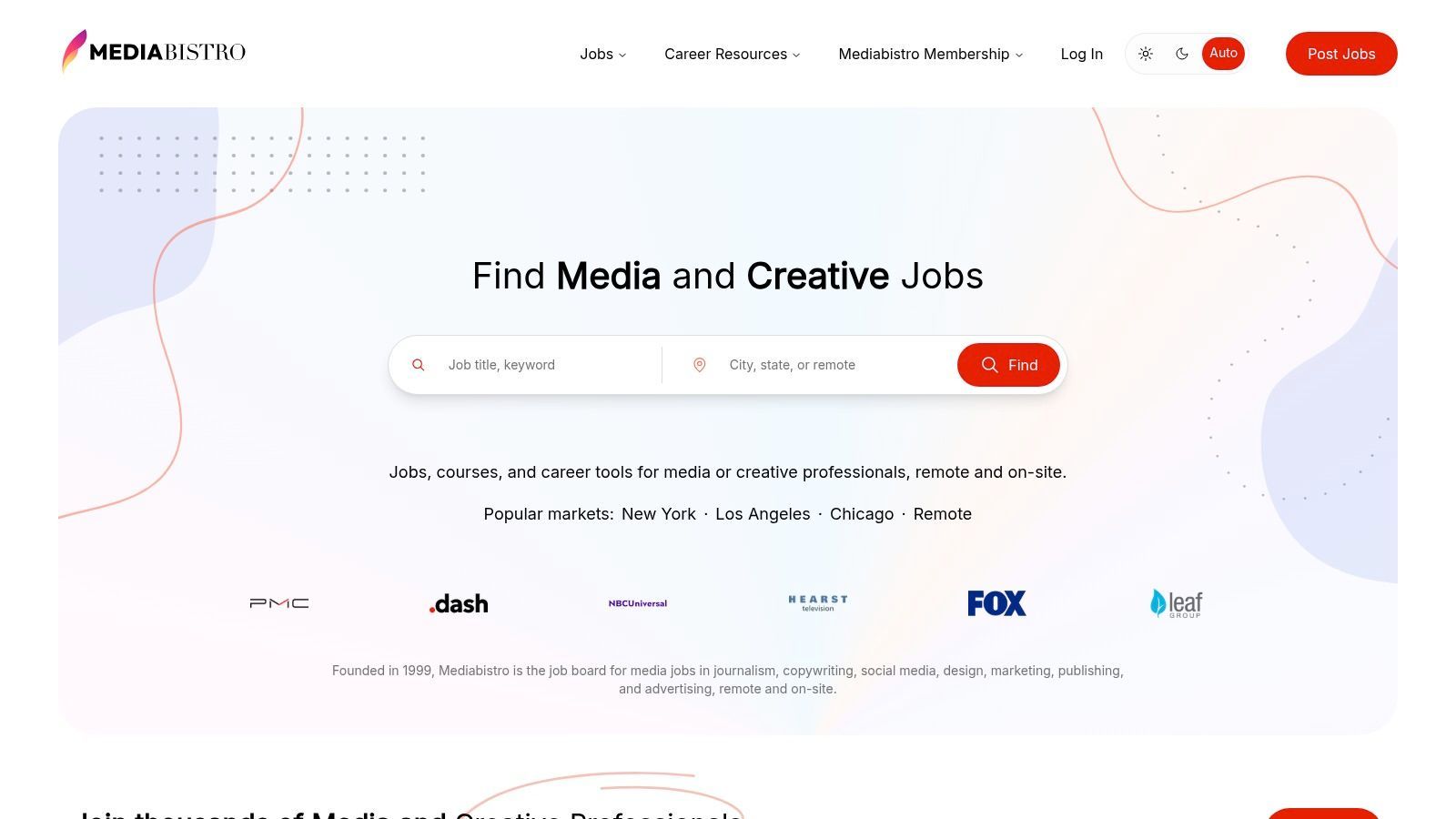
The board includes searchable editorial and creative categories, newsletter distribution to 70,000+ subscribers, and flexible employer posting options. Those features make sense for roles where the audience expects a more media-aware talent pool. It's a particularly sensible choice for hiring managers who want candidates with a portfolio, writing samples, or clear proof of taste.
For applicants, the key is to separate editorial responsibilities from marketing goals. A content role might involve SEO support, campaign copy, or editorial calendar ownership. A social role might need platform fluency, format testing, and a strong sense of brand voice. If you can show the work clearly, the board gives you a decent shot at standing out.
A short case-study summary works well here, especially if you add a few selected images or campaign artifacts. A brief promo video or music-backed showreel can help too, but only when it adds clarity rather than distraction. If the role is copy-heavy, a reel should support the writing, not replace it.
The limitation is simple. Not every listing is strictly marketing, because there's real media and creative crossover on the platform. Pricing and product details also tend to sit closer to a sales flow than a self-serve checkout. Even so, for content-led marketers, it's one of the more relevant boards to keep in rotation.
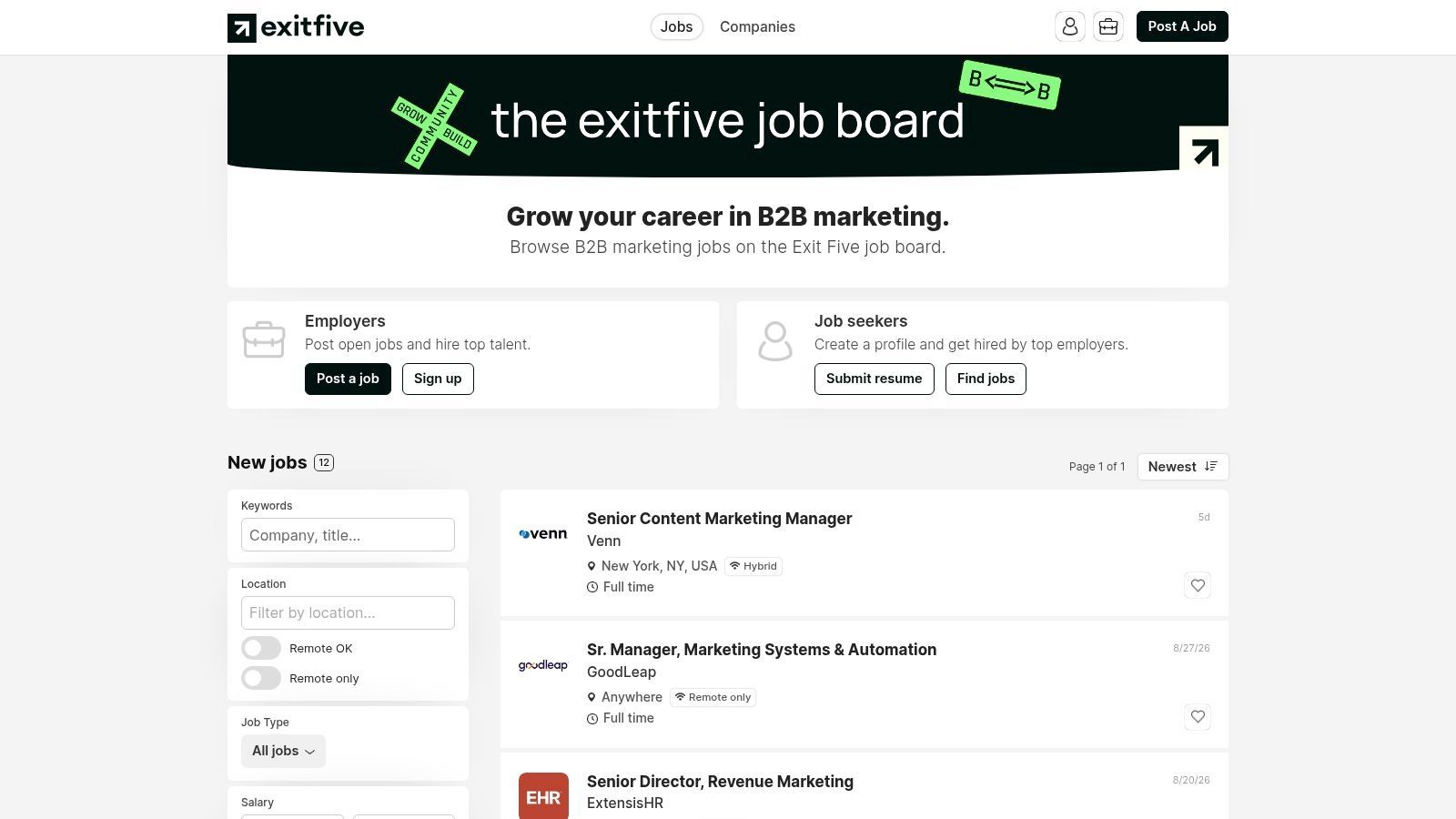
Exit Five is the board to watch if your search is squarely in B2B, SaaS, demand generation, lifecycle, product marketing, or marketing leadership. The value isn't just the board itself, it's the community layer around it. That community context tends to improve signal quality because the audience already speaks the language of funnels, buyers, and revenue influence.
Jobs are posted to a B2B-only audience and community discussion channels, with member pricing and posting options that can include free tiers depending on membership. That mix helps keep the audience focused, which is exactly what you want if you're hiring or applying for a role where broad consumer marketing experience won't be enough. The signal-to-noise ratio is usually better than on mixed-purpose boards.
The best listings here are specific about the buyer, funnel stage, ownership boundaries, and cross-functional partners. “Drive growth” is too vague. “Own inbound lifecycle for mid-market buyers, partner with sales ops, and report on pipeline contribution” is useful. Candidates should mirror that language in their CV and outreach so the role reads as a fit, not a guess.
Practical rule: if the job post doesn't explain what part of the funnel you own, the listing is incomplete.
Exit Five is less compelling for consumer brand roles or generalist searches outside the B2B world. It's also a place where community participation can matter, so you'll usually get more traction if you join relevant discussions, set alerts, and send a concise note that shows you understand the company's market. Don't pretend you know their private performance data. Just show you understand the problem they're hiring for.
Product Marketing Alliance Jobs is the specialist lane for product marketing managers, PMM leads, and go-to-market roles. If the work revolves around launches, positioning, messaging, enablement, or internal alignment, this is a much better fit than a broad marketing board. Narrow focus is a strength here because it surfaces the exact type of applicant the employer wants.
The board supports dedicated postings, employer packages, community channels, Slack amplification, bundles, and upgrades for PMM roles. That setup is useful for employers hiring for launch ownership or senior product marketing scope, because the audience already expects to see positioning work, release coordination, and messaging judgment. It's not a substitute for a broad growth board, but it doesn't need to be.
For candidates, this board rewards specificity. Lead with positioning work. Show the thinking behind a launch asset. If a visual or video walkthrough helps explain a complex product story, include it. If not, keep the portfolio lean and strategic. PMM reviewers usually care more about reasoning and narrative control than flashy production.
A role like this benefits from a CV that uses precise product language, not generic marketing phrasing. Mention the audience, the problem, the launch motion, and how success was measured. If the job is asking for cross-functional enablement, show how you partnered with product, sales, or customer success.
For people who want to sharpen AI-assisted workflow thinking around product and launch marketing, the article on best AI tools for marketing is a useful adjacent reference. It's not a substitute for PMM judgment, but it can help with ideation, drafting, and workflow speed.
The board's limitation is its strength. It's narrow, and it's not built for generalist, performance, or brand searches. If product marketing is your lane, though, that focus saves time and improves fit.
MarketingOps.com Jobs is the tightest fit here for marketing operations, MarTech, attribution, automation, and RevOps-adjacent work. It serves people who manage systems and workflows, not just campaigns. If the role lives in HubSpot, Marketo, Salesforce, reporting, or lifecycle infrastructure, this is the board to check first.
The board routes 30-day job postings to the site and a hiring Slack channel, and it includes free posting options for employers. Agency and community partner options also allow unlimited listings. For niche teams, that matters because it puts the role in front of candidates who already speak the language, instead of a broad audience that may miss the operational scope.
Strong listings here name the systems, workflows, ownership model, and operational problem. “Marketing technology” is too loose. “Own lead routing in HubSpot and Salesforce, maintain attribution hygiene, and document lifecycle workflows” gives candidates something real to assess. If you apply, mirror that wording in your CV and be ready to show process documentation or dashboard examples without exposing confidential data.
Portfolio choices should be practical. Screenshots can help, but strip out private fields and customer data. A clean before-and-after explanation of an automation workflow often does more than a crowded dashboard image. If the role requires cross-functional alignment, point to documentation that shows how you worked with product, sales, or customer success, and include a reference to internal communications best practices if your work depended on tighter handoffs.
The board's limitation is also its filter. It is too narrow for generalist marketing hires, and its reach is smaller than mass-market options. For specialized talent, that trade-off is useful.
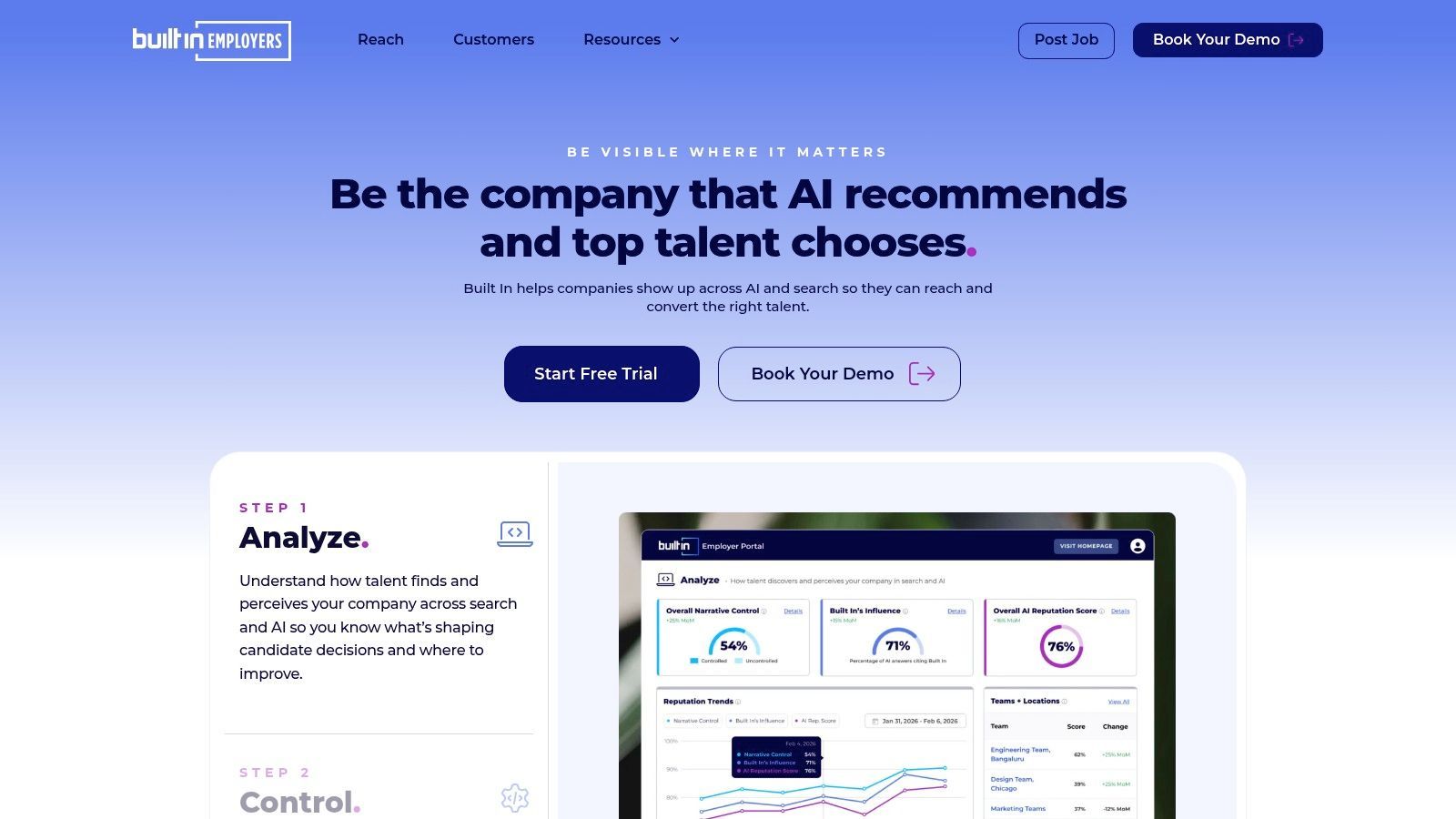
Built In is the employer-branding-led option for marketers who want to work at tech companies, startups, and scale-stage organizations. It fits growth, lifecycle, product marketing, brand, and communications roles, especially where company story and product narrative influence candidate interest. If the employer wants to look like a serious tech brand, Built In is a natural place to show up.
The platform offers employer branding content, Best Places to Work programs, AI-supported recruitment, job distribution, and custom employer packages. That means its value often goes beyond a single post. For employers hiring multiple roles, or for those trying to strengthen brand perception alongside recruiting, the platform can be more effective than a one-off listing.
The best postings are explicit about the marketing mandate, product stage, work arrangement, and decision rights. A candidate should be able to tell whether they're joining a scrappy team, a scaled function, or a company rebuilding its brand. That context matters because a startup-style role and a scale-stage role can look similar at first glance but feel very different after day one.
For applicants, the move is to research the employer narrative before you apply. Then build a portfolio that combines strategic thinking with polished media assets when those assets help. A short campaign reel or image gallery can work well here if the job is brand- or content-facing. If the role is more analytical, the portfolio should lean on outcomes, structure, and clarity instead of production value.
The trade-off is pricing and format. Costs are quote-based, so it's not ideal if you just want a single low-friction post. It's stronger as part of a broader employer-branding effort or a multi-role hiring plan.
Wellfound fits marketers who want startup scope, fast decisions, and some early-stage ambiguity. It works well for growth, content, social, lifecycle, community, and product marketing roles at startups and growth-stage companies. If you want a role where the boundaries stay flexible and the team expects quick adaptation, this board belongs on your shortlist.
For employers, the platform offers free basic posting, paid sourcing, AI-agent features, ATS or ATS sync, and salary or equity fields on many listings. That mix matters because startup roles usually come with trade-offs in scope and compensation structure. Clear fields help candidates judge risk and upside faster, especially when they are comparing remote roles or distributed teams through a setup like the one discussed in SendFame.
Wellfound suits adaptable marketers more than enterprise specialists. It is not the strongest place for traditional brand searches where process, hierarchy, and established teams matter more than speed. If you are open to wearing multiple hats, it gives direct access to companies where that breadth is normal.
A strong listing here should spell out the reporting line, startup stage, compensation structure, and first priorities. If a role combines content, lifecycle, and community, say so plainly. If the company expects the first hire to build the function, make that clear too.
For applicants, the search workflow should stay tight. Filter for startup stage, compensation transparency, and scope that matches your strengths, then review the employer narrative before you apply. Use a portfolio that shows outcomes, not just polish, and add multimedia only when it helps the story. A short campaign reel, image set, or product demo can work if the role touches brand or content. If the work is more analytical, lead with structure and results instead of production value.
| Platform | Core features | Target audience (👥) | Quality & Reach (★) | Price / Value (💰) | Standout USP (✨🏆) |
|---|---|---|---|---|---|
| growthroles | Marketing-only listings, pay visibility, nightly refresh, AI shortlists | 👥 Marketing job seekers & recruiters | ★★★★☆ | 💰Free search / employer pricing varies | ✨Salary transparency, nightly market data, AI shortlisting 🏆 |
| American Marketing Association (AMA) Job Board | 30‑day posts, Career Network distribution, employer profiles, Job Flash | 👥 Career marketers & association-minded hires | ★★★★☆ | 💰Varies by chapter (💰Varies) | ✨Local chapter amplification & association credibility 🏆 |
| MarketingJobs.com | 30‑day postings, bundles, Job Flash, resume DB, featured branding | 👥 Broad marketing professionals (all functions) | ★★★★ | 💰$ (listed pricing higher than community boards) | ✨Marketing‑only scale with email distribution & resume access |
| MarketingHire | Mid‑to‑senior focused, resume search, branded profiles, visibility upgrades | 👥 Experienced marketers & advertising professionals | ★★★★ | 💰Member/non‑member pricing (contact) | ✨Niche senior audience + strong employer branding |
| Adweek Jobs | Featured companies, branded profiles, partner distribution, site placements | 👥 Agency, media, creative strategy marketers | ★★★★ | 💰Quote / package based | ✨Adweek audience & media/agency focus for portfolio roles 🏆 |
| Mediabistro Job Board | Editorial & content marketing categories, newsletter distribution | 👥 Content, editorial, social & copy professionals | ★★★★ | 💰Flexible (contact/sales) | ✨Strong reach for content-driven portfolios & editorial hires |
| Exit Five (B2B Marketing) Jobs | B2B job distribution, community channels, member pricing/free tiers | 👥 B2B/SaaS marketers (demand gen, product marketing) | ★★★★ | 💰Member tiers / some free options | ✨Community signal‑to‑noise for B2B hiring |
| Product Marketing Alliance (PMA) Jobs | PMM‑focused posts, Slack/community amplification, bundles | 👥 Product marketers & PMM leaders | ★★★★★ | 💰Packages on request | ✨Laser focus on PMM roles; high relevance for launches & GTM 🏆 |
| MarketingOps.com Jobs (MO Pros) | 30‑day posts, #hiring Slack routing, free posting options, agency partner lanes | 👥 Marketing ops, RevOps, MarTech specialists | ★★★★ | 💰Free & paid options (good value) | ✨Highly targeted MarTech/ops audience; low irrelevant apps |
| Built In (Tech Companies) | Employer branding, Best Places programs, AI recruitment, custom packages | 👥 Marketers for tech startups & scaleups | ★★★★ | 💰Quote / best for multi-role branding investments | ✨Employer storytelling + tech candidate audience 🏆 |
| Wellfound (formerly AngelList) | Free basic posts, paid sourcing/AI agents, ATS sync, salary/equity fields | 👥 Startup‑stage marketers comfortable with multi-role scope | ★★★★☆ | 💰Free basic / paid sourcing tools | ✨Startup audience + transparent comp/equity; good for multi-discipline roles |
The best job search strategy is a blend, not a pile of tabs. Pick one broad specialist board for coverage, one function-specific or community board for relevance, and one employer-type board that matches the world you want to join. That might mean GrowthRoles plus PMA plus Built In for a product marketing search, or GrowthRoles plus Exit Five plus Wellfound for a B2B startup search.
Each board earns its place differently. Broad specialist boards give you reach and better filtering. Community boards give you signal and better language fit. Employer-type boards give you context, branding, and a more precise view of the team you'd join. The trade-off is always the same: reach versus relevance, price transparency versus premium distribution, and speed versus fit. If you understand those trade-offs, you stop treating every board like it should do the same job.
A simple workflow keeps the search manageable. Save alerts for the exact titles you want. Rewrite your CV headline so it matches the role family, not just “marketing.” Keep two portfolio versions, one broad and one built for the specialty. Use a short outreach template that names the problem you solve and the work sample that proves it. Review listing freshness once a week so you don't waste time on stale posts.
Use a short promo video, image gallery, or music-backed showreel only when it demonstrates a relevant marketing skill. For a content or brand role, that might mean voice, pacing, or campaign storytelling. For a PMM or ops role, it might mean clarity, structure, or system thinking. The explanation of the work still matters more than the production effect.
The best marketing job boards are the ones aligned with the role's specialization, employer context, seniority, and the evidence you can show. Pick the boards that match your target, then apply like someone who understands the work, not just the title.
Create Epic

SendFame

Create Epic with SendFame!
Questions: info@sendfame.com