Top 10 Unforgettable Birthday Video Message Ideas for 2026

birthday video message ideas
Welcome offer — 56% OFF


Discover how can i write a good song with practical tips on lyrics, melody, and structure that captivate listeners.
So, you want to write a great song. It all boils down to two things: finding a killer idea that means something to you, and then giving it a solid structure.
It's about taking those everyday moments—the good, the bad, the weird—and turning them into something that hooks a listener. Think of it like this: the idea is the soul of the song, and the structure is the skeleton that holds it all together.
Every amazing song you've ever loved started as a tiny spark. It wasn't some grand, earth-shattering moment of divine inspiration. It was just an idea—a raw, honest thought that felt like it needed to be said.
The real trick isn't waiting around for lightning to strike. It's learning to see the magic hiding in your own life. All the best songs do this; they take a super specific, personal detail and make it feel universal.
Your best material is probably right under your nose. It’s that weird line you overheard at the grocery store, the specific way the light hit the dashboard on a long drive, or that nagging feeling of "what if?" that keeps you up at night. Your job is to become an emotional detective.
Staring at a blank page is the fastest way to get nowhere. Instead, you need to be an active participant and dig for the good stuff.
Here are a couple of tried-and-true methods to get you started:
Sensory Writing: Pick a memory that still hits you hard. Close your eyes and put yourself back there. What did you see? What did you smell? What sounds were in the background? Write it all down, even the tiny details. This is what makes a song feel like a movie in the listener's head. Emotional Journaling: Grab a notebook and just dump whatever you're feeling onto the page. Are you frustrated? Ecstatic? Nostalgic? Don't just name the feeling—ask yourself why. The answer to that "why" is almost always the heart of a song.
This isn't just about writing; it's about being honest with yourself. Songwriter Jason Isbell talks about how the rules for writing a good song are often the same rules for living a better life, because it forces you to process what you’re really feeling. It helps to actively foster creativity so your observational muscle stays strong.
The best songwriting ideas live in the uncomfortable places. Don’t shy away from the feelings that make you squirm. That vulnerability is where you'll find the stories that everyone can connect with.
Of course, some days the well just feels completely dry. It happens to everyone. That's not a sign you're out of ideas forever; it's just a hurdle. For those moments, you need a game plan. Our guide on how to overcome creative block is packed with practical ways to get the faucet running again.
Think of your song idea as the soul. It's the raw, brilliant spark. But without a skeleton, it’s just a ghost. That’s what structure is—the framework that gives your song shape, moves it forward, and takes the listener on a ride they won't forget.
A great song structure is like an invisible tour guide. It creates anticipation and delivers a satisfying payoff, making listeners feel like they're in good hands. This isn't about memorizing rigid rules; it’s about understanding human psychology. The most common structures are popular for a reason—they just work. They tap into the way we naturally process stories and emotions.
So, what are the actual building blocks? Let's treat them like different rooms in the house you're building for your song.
Verse: This is your storytelling space. The verses are where you paint the picture, set the scene, and move the plot along. Each verse should reveal something new. Chorus: Welcome to the heart of the song. The chorus is your big, central message—the emotional thesis statement. It’s what everyone will be singing in the shower, so it has to be memorable and hit hard. Bridge: The bridge is the scenic overlook. It’s a deliberate detour from the main path of your song, offering a fresh perspective, a sudden twist, or an emotional shift before you bring it all home with that final chorus.
Getting a handle on these elements is way easier when you have a basic grasp of musical fundamentals. If you're shaky on the basics, diving into how to learn music theory effectively will give you a massive leg up in making intentional, powerful choices.
This diagram shows how different creative sparks—a memory, a feeling, a conversation—can become the raw material you'll organize within your song's structure.
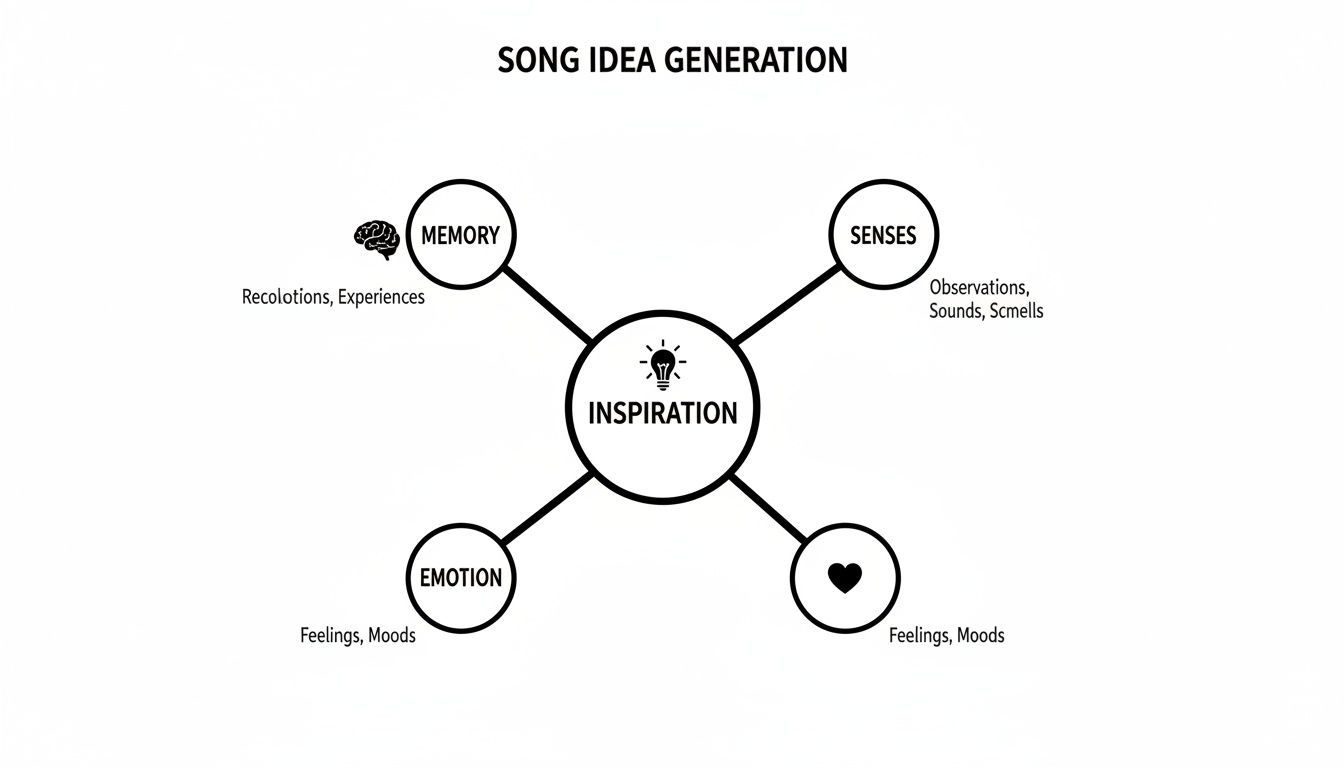
It doesn't matter where the idea comes from. A solid structure is what transforms that fleeting thought into a complete and compelling song.
Choosing a structure isn't just a technical decision; it's an emotional one. Different arrangements create different feelings. Here’s a quick guide to some of the most popular blueprints and when to use them.
| Structure | What It Is | Best For |
|---|---|---|
| Verse-Chorus-Verse-Chorus | The workhorse of pop music. Alternates storytelling (Verse) with a big, repeatable hook (Chorus). | Creating catchy, radio-friendly hits where the main idea needs to stick. Perfect for pop, rock, and country. |
| Verse-Chorus-Verse-Chorus-Bridge-Chorus | The classic journey. Adds a Bridge for a new perspective or emotional shift before the final payoff. | Building emotional depth and telling a more complete story. This is the go-to for powerful ballads and anthems. |
| AABA (Verse-Verse-Bridge-Verse) | A classic, often found in jazz, theater, and older pop. The "B" section (Bridge) provides contrast. | Simple, direct storytelling. Great for singer-songwriter tracks and ballads where lyrics are the main focus. |
| Through-Composed | No repeating sections. The music continuously evolves from beginning to end, like a story. | Epic, narrative-driven songs that don't need a central hook. Think cinematic pieces or folk epics like "Bohemian Rhapsody." |
This table is just a starting point. The real magic happens when you find the structure that serves your story best.
Let's get real: we're writing for the streaming era, where attention is everything. With global recorded music revenues hitting $29.6 billion and streaming making up a whopping 69% of that, you can't afford to make people wait.
The data is clear: songs that hit the chorus within the first 30 seconds see 20-30% higher completion rates. For anyone wondering "how can I write a good song," the takeaway is simple. The classic verse-chorus-verse-chorus-bridge-chorus format is still king, especially if you can keep the whole thing under three minutes.
A good song structure doesn't just organize your ideas; it manipulates time. It makes three minutes feel like a complete journey, with a clear beginning, a compelling middle, and a satisfying end.
Don't be afraid to break the mold once you know the rules. A simple AABA structure can be devastatingly effective for a raw, heartfelt ballad. And sometimes, a story is so linear it needs a through-composed structure with no chorus at all.
If you’re feeling stuck, AI tools can be a fantastic co-pilot. Something like SendFame’s AI Music Generator can spit out a professionally structured instrumental track, giving you a solid foundation to build your lyrics and melodies on without getting bogged down.
Let's be real. Powerful lyrics are what separate a decent song from a song that someone tattoos on their arm. They're what make a listener slam on the brakes, crank up the volume, and feel like you’ve been reading their diary. This isn't about flexing your vocabulary; it's about finding the perfect words to build a world so real your listener can walk right in and look around.
The secret sauce? Ditch the generic, high-level emotions. Instead of just saying you’re sad, describe it. Talk about the hollow feeling in your stomach, the way rain on the windowpane sounds like mocking laughter, or how your favorite song now feels like a personal attack. That's where the magic is.
If you remember one thing from this guide, make it this. "Telling" your audience you were heartbroken is easy, but it keeps them on the outside looking in. "Showing" them pulls them right into the experience with you.
Let’s break it down:
Telling: "The party was loud and I felt alone." (Okay, we get it.) Showing: "The bass is rattling my teeth, but all I can see is the empty space you left on the couch."
Huge difference, right? The second one uses sensory details—the vibrating floor, the visual of an empty space—to put the listener right in that room. They don’t just hear about the loneliness; they feel it in their bones.
Think of your lyrics as a movie script, not a meeting memo. Fill them with sights, sounds, smells, and textures. Let the listener piece together the emotion on their own.
This is non-negotiable if you want to write a song that sticks with people long after the music stops.
Sometimes, plain language just won't cut it. Metaphors and similes are your secret weapons for describing those messy, complicated feelings that are almost impossible to nail down. They work by creating punchy, memorable images and drawing unexpected lines between two different things.
Here’s a quick refresher:
A simile is a comparison using "like" or "as." A classic example: "Your memory fades like a photograph left in the sun." A metaphor is a direct comparison, saying one thing is another. For example: "Her laugh was a lighthouse in the storm."
These aren't just fancy literary devices; they're tools for injecting personality and depth into your words. If you want to go deeper down this rabbit hole, our full guide on how to write song lyrics for beginners has a ton more techniques.
Ever have a word stuck on the tip of your tongue? You know the feeling you want to convey, but you’re just cycling through the same tired rhymes and clichés. This is the perfect time to bring in an AI lyric assistant.
But hold on—this isn't about letting a robot write your song for you. Not at all. Think of it as a creative sparring partner. A tool like SendFame's lyric generator can act as a springboard when you're feeling stuck.
It can help you:
Escape Rhyme Jail: Get suggestions that break you out of those predictable AABB patterns. Find a New Angle: See your core theme from a completely different perspective. Spark Metaphors: Generate unique comparisons that can unlock a whole new verse.
The goal isn't to copy and paste. It's to use the AI's suggestions to jolt your own brain into action, helping you see possibilities you might have otherwise missed.
Your lyrics might tell the story, but the melody? That's what grabs people by the heart and makes them feel it. A great song is really a conversation between words and music, and it’s in that back-and-forth that a good idea becomes truly unforgettable.
The good news is you don't need a degree in music theory to write a killer melody. You just need to listen closely to the story you're already telling.
Believe it or not, the melody is probably already hiding inside your lyrics. Try reading them out loud. Can you feel the natural rhythm? The cadence of the phrases? Notice where the emotional weight falls. That’s your melodic roadmap. A line that builds in intensity just wants to climb higher in pitch, while a moment of quiet reflection will probably feel more at home on a lower, softer note.
Let's kill a myth right now: melody isn't some separate, complicated task you bolt on at the end. It's an extension of the lyric. Your words already have a musical pulse, and your job is simply to find it and turn up the volume.
Follow the Rhythm: Start by just humming as you read your lyrics. Don't try to force a tune. Let the natural swing of the words suggest a rhythmic pattern. You'll find that the most powerful melodies often mimic the way we actually speak. Lean on Key Words: In every line, there are a few words that carry all the emotional punch. Circle them. These are your money words, and they're perfect candidates for higher notes, longer holds, or a little rhythmic flair. Just Let It Rip: Grab your phone, hit record, and sing your lyrics freestyle over a single, simple chord—or even no chords at all. Don't judge it, don't edit, just let your voice wander. The goal here is to capture raw ideas. You’d be amazed at the melodic gold you can find when you stop overthinking.
This whole approach keeps your melody grounded in the song's core emotion, making sure your music and lyrics are pulling in the same direction.
Think of chords as emotional shorthand. Even if you only know a few, you have a powerful toolkit for setting the mood. There’s a reason simple, common chord progressions are so popular—they instantly create a feeling that listeners recognize.
Take the famous I-V-vi-IV progression (think G-D-Em-C in the key of G). It’s been used in a gazillion hits because it just feels hopeful, familiar, and deeply satisfying. Strumming those four chords can immediately give your song a solid foundation to build on.
A melody’s contour—its shape, its ups and downs—should mirror the emotional rollercoaster of your lyrics. When your character is on top of the world, let the melody soar. When they're down in the dumps, let it fall.
This connection between harmony and melody is everything. Sure, you can pair a sad lyric with an upbeat, major-key progression for a bit of intentional irony, but most of the time, you want them to be on the same team.
This is where technology can be an incredible creative partner, especially if you're not a guitar wizard or a piano virtuoso. Find yourself wondering, how can I write a good song without a deep knowledge of theory? Modern tools are here to bridge that exact gap.
AI music generators, for example, can take your raw lyrics and instantly cook up a full instrumental track around them. This isn't about replacing you; it's about giving you a finished musical canvas to react to. Hearing your words performed over a professionally arranged track can spark countless melodic ideas you might never have stumbled upon otherwise. For a deeper dive into this, check out how you can create AI music and see how it can seriously jumpstart your writing process.
Ultimately, the best melodies feel inevitable. They sound like they couldn't have possibly been any other way, perfectly serving the words and cranking the story's emotional dial all the way up.
So you’ve got a first draft. It’s a beautiful, chaotic mess, isn't it? It’s got the spark, the raw emotion, but let's be honest—it’s probably a little rough around the edges. Now comes the real magic. This is the part where we take that messy demo and turn it into something that feels truly finished.
Here's the most powerful revision tool I know, and it costs absolutely nothing: time. Seriously. Put the song away for a day or two. Go live your life. When you come back to it, you'll have fresh ears. You'll instantly hear that one clunky lyric or awkward melodic jump you were completely deaf to before. This isn't procrastination; it's a non-negotiable part of the creative process.
Okay, you've taken a break. Now it's time to be ruthless. Your mission, should you choose to accept it, is to make sure every single word, note, and chord is pulling its weight. If a line doesn’t serve the story or amplify the core emotion, it’s got to go. This isn't about butchering your creation; it's about making what's left behind hit that much harder.
Here's a quick hit-list to run through:
The Lyric Test: Read your lyrics out loud, like you're performing a monologue. No music. Do you trip over any phrases? Does it sound like something an actual human being would say? If it feels awkward to speak, it'll feel awkward to sing. The Melody Test: Hum the melody on its own, no words allowed. Is it catchy? Does it stick in your head? More importantly, does the emotional arc of the melody match the feeling of the lyrics? A sad lyric with a peppy, upbeat melody can work, but it has to be intentional. The Structure Test: How's the energy flow? Does the song build and release tension in a way that keeps you hooked? A great bridge should feel like a mini-vacation, giving you a new perspective before dropping you back into that final, explosive chorus.
This is also where a little production polish can take your song from "hey, that's a neat idea" to "wow, I need this on my playlist." Even basic recording and mixing skills can make a world of difference. If you're new to the production side of things, checking out some of the best music production programs for beginners will give you the tools you need to make your track gleam.
Sharing your unfinished art feels a bit like standing in front of a crowd in your underwear. It’s terrifying, but it’s a necessary evil. The trick is to pick your crowd carefully. Find one or two trusted friends—the kind who know how to be honest without being brutal.
Here's a pro tip: Never ask, "Do you like it?" That's a dead-end question. Instead, ask something specific like, "How does this song make you feel?" or "Which line sticks with you the most after it's over?" Their answers will be pure gold.
At the end of the day, remember that feedback is just data. You are the artist. You don't have to take every single suggestion. Your job is to listen, absorb, and then decide what truly serves your original vision for the song. This final polish is what separates a good idea from a great song, ensuring every last element works together to land that emotional punch.
Alright, let's get into the nitty-gritty. You've got the basics down, but now you're hitting those inevitable roadblocks and second-guessing every move. It happens to everyone.
Think of this as your friendly songwriting FAQ. These are the same questions that pop up whether you're just starting out or have a dozen albums under your belt.
This is a big one, especially now. Back in the day, you could get away with a seven-minute rock opera, but in the streaming era, attention is gold. The sweet spot for most pop, rock, and hip-hop tracks is somewhere between 2 minutes 30 seconds and 3 minutes 30 seconds.
Your main goal is to hook the listener and not let go. That means getting to your chorus or main idea pretty quickly—ideally within the first 30 to 45 seconds. Every single section needs to earn its keep. If a verse feels like it's just treading water, it probably is. Cut the fat and keep the story moving.
Let’s bust this myth right now: you absolutely do not need to be a guitar god or a piano virtuoso to write a killer song. Seriously. Some of the most iconic songwriters were lyricists and melody writers first, humming their ideas into whatever recording device they had handy.
Your voice is an instrument. Your phone’s voice recorder is your best friend. Use it to capture melodic fragments and lyrical sparks the second they hit you.
And today, technology has completely leveled the playing field. Tools like AI music generators can take your raw lyrics and spin them into a fully-realized instrumental track. This lets you play to your strengths—your storytelling, your unique melodic sense—without getting bogged down in technical skills you haven't mastered yet.
Your most powerful songwriting tool isn't an instrument; it's your perspective. Don't ever let a lack of formal training stop you from sharing it with the world.
Focus on what you're genuinely good at, whether that's a clever turn of phrase or an unforgettable hook.
First off, writer's block doesn't mean you're out of ideas. It's just your brain's way of telling you it's bored with your current routine. It’s a signal to mix things up, not to give up.
Instead of banging your head against the wall, try taking a creative detour.
Here are a few tricks I’ve used to break through:
The 10-Minute Freewrite: Grab a notebook (or a blank doc) and just write. Don't stop, don't edit, don't even think. It doesn't have to be lyrics—it can be a grocery list, a rant, whatever. The point is to get the creative gears turning again. Flip Your Process: Always start with a chord progression? Try writing a melody acapella first. Always begin with a title? Start with a drum beat instead. Reversing your workflow forces your brain out of its rut. Bring Someone Else In: Collaboration is the ultimate cheat code for writer's block. A fresh set of ears and a different perspective can instantly shine a light on a path you couldn't see on your own.
Ah, the million-dollar question. While "good" is totally subjective, a truly effective song usually does two things: it makes someone feel something, and it has at least one part that gets stuck in their head.
The only way to know for sure is to get it in front of people. But don't just ask them, "Do you like it?" That's a useless question that invites polite, unhelpful answers.
Instead, get specific. Ask things like:
"If you had to hum one part back to me, what would it be?" "What kind of scene or movie would you imagine this song playing in?" "Was there any line or moment that felt a bit clunky or pulled you out of the vibe?"
Their gut reactions—what they remember, how they feel—are way more valuable than a simple "Yeah, it's nice." That’s the feedback that tells you if your message is truly landing.
Ready to stop wondering and start creating? The SendFameAI Music Generator can instantly turn your lyrics into a fully produced song, helping you find melodies and break through creative blocks in seconds. Explore the possibilities and bring your ideas to life.
Create Epic

SendFame

Create Epic with SendFame!
Questions: info@sendfame.com