Free Producer Tag Maker: Top Tools for Your Sounds (free producer tag maker)
free producer tag maker
Welcome offer — 56% OFF


Learn how to make a diss track that gets noticed. This guide covers writing fiery lyrics, finding the right beat, and promoting your track to go viral.
Ever wondered how a personal grudge can explode into a viral sensation that tops the charts? Welcome to the high-stakes, high-reward world of the diss track. This isn't just about throwing insults over a beat; it's a calculated game of chess where lyrics are your pieces, and the internet is your board.
In the old days, you'd need a big-name producer and a record label to even get in the game. Forget that. Now, with AI music tools, anyone with a grievance and a little creativity can cook up a professional-sounding track right from their bedroom.
This guide is your all-access pass. We're going to walk through the entire process, from finding the perfect chinks in your opponent's armor to launching a release strategy that makes sure your track not only lands its punches but goes viral.
Making a diss track is a strategic art form. It's about turning a personal rivalry into a piece of content so sharp, so clever, and so catchy that the whole world has to pay attention. You’ll need to pick a target, craft lyrics that cut deep with a hook that sticks, and find a beat that brings the fire. After that, it’s all about a killer recording, a clean mix, and a marketing blitz to own the conversation.
The journey from a heated argument to a viral hit really boils down to three stages: the rivalry, the creation, and the release. This simple framework is the secret sauce behind every legendary diss track, from underground SoundCloud spats to global chart-toppers.
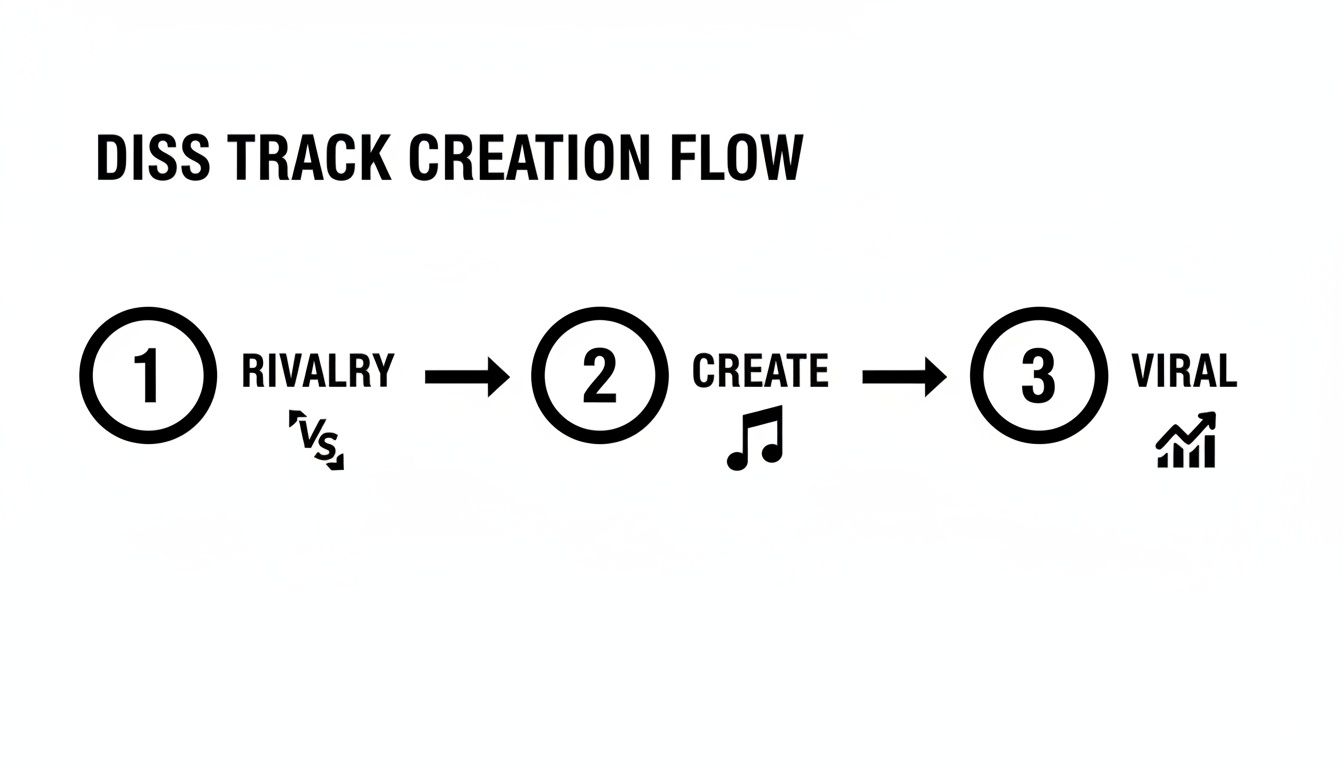
This is the path you'll follow, turning that initial conflict into a full-blown viral moment. Seeing it laid out like this makes it clear: a diss track isn't just a song. It's an entire campaign.
And when you get it right, the payoff can be massive—both culturally and financially. Just look at the recent Drake vs. Kendrick Lamar showdown. Kendrick’s “Not Like Us” became a global anthem, racking up over 308 million streams and rocketing to #1 on the Billboard Hot 100. It completely overshadowed Drake’s “Family Matters,” which pulled in a respectable but much smaller 66 million streams. That's the power of a perfectly executed diss track.
So, what separates a weak jab from a knockout punch? Let's break down the essential ingredients that turn a good diss track into a legendary one.
| Component | Description | Pro Tip |
|---|---|---|
| Authentic Beef | The conflict has to feel real. Listeners can smell a fake rivalry from a mile away. | Ground your disses in real events or known facts. The more truth, the harder it hits. |
| Clever Wordplay | This is where you shine. Use metaphors, punchlines, and double entendres to showcase your skill. | Don't just insult them—outsmart them. A witty line is more memorable than a simple curse. |
| Catchy Hook | The hook is the Trojan horse. It gets stuck in people's heads and makes them sing along to your insults. | Keep it simple, repetitive, and chantable. This is what will get shared on TikTok and Instagram. |
| Hard-Hitting Beat | The beat sets the mood. It should be aggressive and energetic, matching the tone of your lyrics. | Choose a beat that leaves plenty of room for your vocals to cut through. The focus is on your words. |
| Shock Value | A great diss track reveals something new or unexpected. It’s the "Oh damn!" moment that gets everyone talking. | Unearth some little-known facts or spin a popular narrative in a completely new way. |
A viral diss track is a perfect storm of all these elements, creating a piece of content that's as entertaining as it is vicious.
It's simple: we're wired for drama. Diss tracks feed our natural curiosity about conflict, competition, and masterful storytelling. They give us a raw, unfiltered peek behind the curtain, making us feel like we’re in on the secret.
A truly great diss track isn't just an attack; it's a performance. It blends the razor-sharp precision of battle rap with the compelling story arc of a great film, creating something absolutely magnetic.
That’s why these tracks get shared so obsessively. People don't just listen; they analyze every line, pick sides, and argue about it online. The song stops being just music and transforms into a cultural event. And remember, once you've created your masterpiece, you need to protect it. Check out our guide on how to copyright your music to make sure your work stays yours.
Look, anyone can string together a bunch of insults. A legendary diss track? That's a different beast entirely. It’s a story. It’s a full-on psychological operation. Before you even think about writing a bar, you need to answer two huge questions: who are you going after, and—more importantly—why?
This is the chess game before the first punch is thrown. Get this part right, and you've basically already won.
Think of it like casting a movie villain. A weak opponent makes for a boring film. You can't just pick a random person; that feels desperate and confusing. Aiming too low just makes you look like a bully. You need a target that matters.
This isn't just my opinion—it's baked into hip-hop history. The most explosive beefs always involve major players. A fascinating graph study analyzing the network of historic diss tracks showed why guys like 2Pac were so lethal. They were central figures in the scene, so when they threw a punch, the whole world felt the shockwave.
When you target someone with a big audience, their fans automatically become your audience. It’s instant exposure.
Okay, you’ve got your target. Now it’s time to do some digging. A truly vicious diss track isn't built on lies; it’s built on hard, undeniable truths. Your mission is to become a private eye and dig up all the receipts. The evidence has to be so solid that your claims are undeniable.
Here’s where you should focus your recon:
Public Contradictions: Have they flip-flopped? Preached one thing while doing the exact opposite? Hypocrisy is pure gold because everyone understands it, and nobody respects it. Artistic Flaws: Is their flow always the same? Do they rely on ghostwriters? Questioning their actual skill is a classic move that cuts right to their core as an artist. Character Weaknesses: Are they notoriously arrogant? Deeply insecure? Transparently fake? Weave your story around these traits to paint a picture the public will instantly recognize and believe. Past Fails: Get on Google. Dig into their history. Embarrassing interviews, failed business ventures, public gaffes—these are the ingredients for killer punchlines.
The point isn't to be random and cruel. It's to be surgical. Every single line should be a scalpel, backed by something real. That’s what separates a playground insult from a career-ending body blow.
A diss track without a story is just angry noise. The narrative is the glue that holds all your attacks together and, crucially, gets the audience on your side. You need to position yourself as the protagonist in this drama. Are you the underdog finally fighting back? Or the hero exposing a fraud?
For instance, if your opponent is a bigger artist who took a shot at you, your story is David vs. Goliath. You're punching up. People are hardwired to root for the underdog, so frame the track as a necessary response to their out-of-control ego.
Or maybe you're calling out a peer for being phony. In that case, your narrative is about protecting the culture. You become the gatekeeper of what’s real, and they're the impostor you’re kicking out. This angle makes you look like an authority figure, not just another rapper with a grudge.
A great narrative makes the audience feel like they're picking a side in a battle of ideals, not just watching a petty squabble. It turns personal drama into something that feels important.
To make this work, you need a crystal-clear angle. Don't just throw every piece of dirt you have at the wall. Pick the most powerful theme—their hypocrisy, their fakeness, their jealousy—and build the entire song around it. That focus makes your message razor-sharp and unforgettable. A story with a clear beginning (why the beef started), a middle (your relentless attacks), and an end (your final, triumphant statement) is how you win in the court of public opinion.
Alright, this is where the real fun begins—turning your ideas into weapons. You’ve got your target locked and loaded, and you know the story you want to tell. Now, it's time to forge the words that will actually do the damage. We're not just rhyming here; we're crafting lyrical missiles.
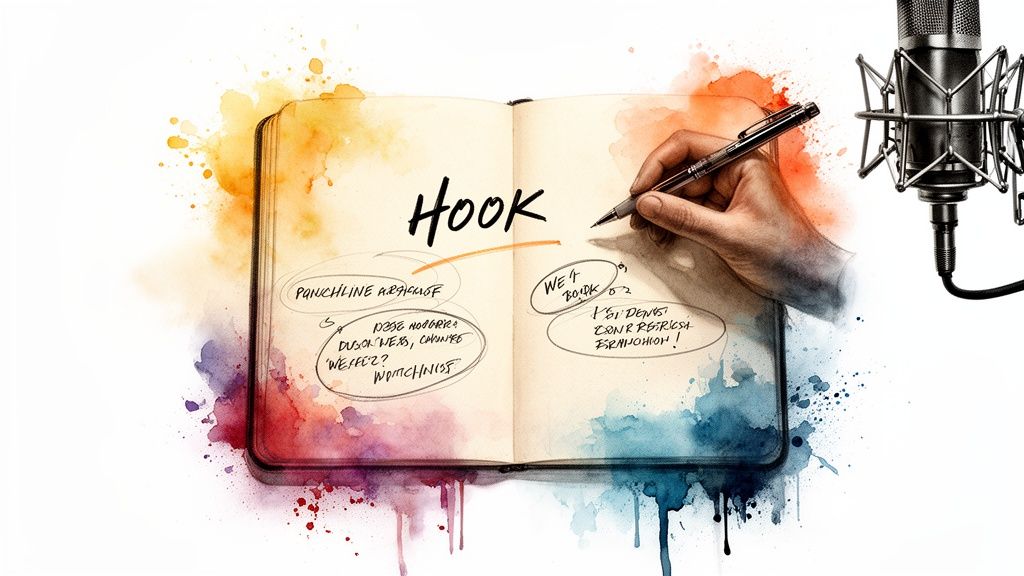
Think of your track's structure as your plan of attack. A classic, battle-tested layout is a couple of verses loaded with your best shots, all tied together by a hook that's impossible to forget. The verses are for laying out the evidence, piece by damning piece. The hook? That’s the war cry everyone will be screaming.
Don't just spray insults randomly and hope something sticks. Every verse needs a mission. Your first verse can kick the door down, laying out the main reason this whole thing is happening. Use the second to get surgical, exposing those specific weak points you found earlier. The third verse is for the finisher—the final haymaker that sums up why you’ve already won.
To make your lines sting, you need to get clever with wordplay. Go beyond basic A-B-A-B rhymes and load up your lyrical arsenal:
Metaphors and Similes: This is your bread and butter. Calling your target "a ghostwriter's puppet" hits way harder than just saying, "You don't write your own stuff." Get creative. Double Entendres: This is next-level stuff. A line that means two things at once—one on the surface, one that's a deep cut—shows you’re smarter and makes people hit rewind. Punchlines: These are the knockout blows that end up in memes. A killer punchline often comes out of nowhere, twisting a familiar phrase into something absolutely brutal.
When you're really in the zone, the ideas can start flowing faster than your fingers can keep up. To avoid losing a brilliant line, it helps to learn how to write faster without typing faster by using your voice. It keeps you locked into the creative moment, focused purely on the lyrical takedown.
The most devastating punchlines are always rooted in some kind of truth. An insult that everyone knows is based on reality will land a thousand times harder than something you just made up.
Let's be real: the hook is probably the most important part of your diss track. It’s the soundbite that’s going to get clipped for TikTok, chanted by your fans, and burrow itself into your opponent's brain for weeks.
A killer hook is simple, ridiculously catchy, and viciously on-point. It should boil down your entire argument into one infectious line. Think about Kendrick Lamar’s "They not like us"—it's short, easy to shout, and perfectly captures the theme of his entire track. Your hook is your propaganda slogan. Make it count.
If you want to get a better handle on song structure and lyricism, our guide on how to write a rap song is a great place to sharpen your fundamental skills.
How you say something is just as crucial as what you’re saying. Your delivery—your flow—sets the entire mood and can completely change how a line is received. Are you coming in hot with raw aggression, or are you coolly dissecting them with a condescending tone?
Think about what style fits your message:
The Aggressive Onslaught: A fast, high-energy flow that feels like a non-stop barrage. This is pure anger and dominance. The Calm & Condescending: A slower, almost conversational delivery. This makes you sound so confident and above it all that it’s almost more insulting than yelling. The Storyteller: A clear, methodical flow focused on laying out a narrative from A to Z. Perfect for exposing a long and sordid history.
The flow you choose needs to vibe with the beat and your overall story. Play around with different tones and cadences when you're practicing. See what makes your words hit with the most force. A diss track is a performance, after all, and your voice is the main event.
The beat is your battlefield. Before you spit a single word, the instrumental sets the stage, draws the battle lines, and lets everyone know what kind of fight this is about to be. Is it a dark, menacing ambush or a victory lap anthem? The choice is everything.
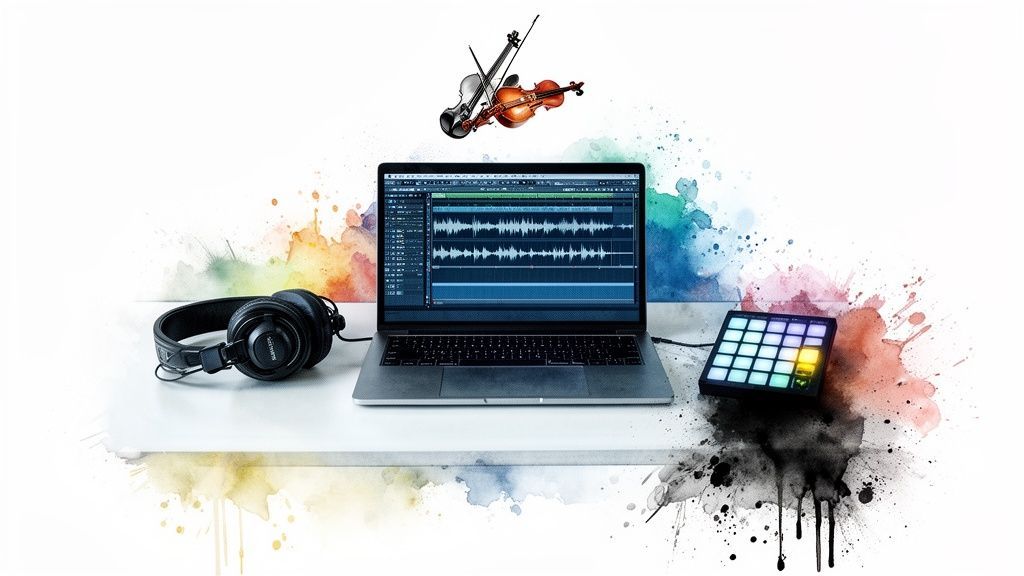
Just think about the difference between a sinister trap beat with those booming 808s and the upbeat, West Coast bounce of Kendrick Lamar’s "Not Like Us." The vibe is completely different. One feels like a threat whispered in a dark alley; the other is a full-blown public party celebrating your rival’s downfall.
Not too long ago, finding the right beat meant dropping serious cash on a producer or scrolling endlessly through YouTube for "type beats." Those are still valid moves, but the game has seriously changed.
Here’s your modern-day arsenal:
Leasing Beats Online: Marketplaces like BeatStars are packed with fire instrumentals from producers all over the world. You can find any style you can dream of, but just remember—someone else might be rapping on that same beat.Hiring a Producer: Got the budget? Collaborating with a producer is the ultimate move for a custom-tailored sound that fits your flow and message like a glove.Using AI Music Generators: This is the creator's new secret weapon. Seriously. Tools like SendFame let you cook up a totally unique, royalty-free beat from a simple text prompt.
Imagine typing "dark trap beat with ominous piano melody and hard 808s" and getting a custom-made instrumental dropped in your lap seconds later. That's the power you have now. It completely levels the playing field.
The beat's style dictates the entire mood of your track. To help you pick the right flavor of aggression, here's a quick rundown of some classic choices.
| Beat Style | Common Mood/Vibe | Best For... | Example Track |
|---|---|---|---|
| Trap/Drill | Dark, Menacing, Aggressive | Direct threats, gritty call-outs | Pusha T - "The Story of Adidon" |
| Boom Bap | Old School, Gritty, Lyrical | Showcasing complex wordplay | Nas - "Ether" |
| West Coast/G-Funk | Bouncy, Confident, Funky | Triumphant, celebratory disses | Kendrick Lamar - "Not Like Us" |
| Cinematic/Orchestral | Epic, Grandiose, Dramatic | Making a massive, high-stakes statement | Drake - "Duppy Freestyle" |
Ultimately, the best beat is the one that makes you feel something. It should make you want to grab the mic and go off. Don't overthink it; trust your gut.
Using an AI music generator gives you an insane advantage. You’re not just picking a beat from a catalog; you’re literally creating something from scratch that no one else has. This ensures your diss track is 100% yours, from the lyrics right down to the sonic DNA.
This approach also lets you experiment at lightning speed. Not feeling the trap vibe anymore? Cool. Generate an epic, cinematic beat with orchestral strings. In just a few minutes, you can test-drive a half-dozen instrumental ideas until you find the one that makes your disses hit ten times harder.
If you want to go deeper down this rabbit hole, check out our guide on how to produce rap beats with these new tools.
Alright, you’ve got the perfect beat. Now it’s time to step up to the mic.
You don't need a million-dollar studio to get a clean, punchy vocal. A decent USB microphone and a quiet room can get you 90% of the way there.
The gear isn't the most important part. The performance is. A diss track is pure emotion—raw anger, unshakeable confidence, dripping condescension. Your delivery has to sell that feeling. Don’t just read your lyrics; perform them. Get angry. Sneer. Let that energy bleed through the mic so the listener feels every single jab.
Follow these simple tips for a pro-level home recording:
Find a Quiet Space: Your closet is your best friend. No, really. All those clothes soak up sound reflections and give you a surprisingly clean vocal take. Mind Your Mic Distance: A good starting point is about 6-8 inches away. Too close and you’ll sound muddy and distorted. Too far, and you’ll sound thin and weak. Do Multiple Takes: Never settle for the first one. Record each section (verse, hook, etc.) at least three times. This gives you a ton of options to stitch together the perfect "comp" take later. Emote, Emote, Emote: This is everything. The sarcasm in your tone, the aggression in your breath, the sheer confidence in your voice—that's what makes the track believable and devastating. Act it out.
Your vocal performance is the final touch that turns a good diss track into an unforgettable one. It’s the human fire that makes the lyrics and the beat truly connect and land with maximum impact.
So, the track is done. The mix is fire, and the animosity is practically dripping from the speakers. But here's the cold, hard truth: a masterpiece of malice means nothing if it’s only heard by you and your cat.
Now comes the real battle: turning your audio assault into a full-blown cultural moment. This is your marketing playbook.
A killer diss track release isn't a single event. It's a calculated campaign built to completely own the conversation. Speed and momentum are your most powerful weapons here. Just look at how Kendrick Lamar blitzed Drake—he dropped haymaker after haymaker, never giving his opponent or the audience a moment to breathe. That's how you control the narrative and force everyone else to react to you.
Your mission is to be inescapable. Releasing your track and then disappearing is the ultimate rookie mistake. You’ve got to constantly stoke the flames, feeding the algorithms and fan gossip to build an unstoppable wave of hype.
In the visual-first Thunderdome of TikTok and YouTube, your diss track desperately needs a face. A static image with the audio playing over it? That's not gonna cut it. You need something that yanks people out of their mindless scrolling within the first three seconds and keeps them glued to the screen.
Here are your best bets for crafting visuals that slap:
Lyric Videos: A classic for a reason. They put your cleverest bars front and center, practically begging fans to dissect every single word. Keep the text bold, the animations punchy, and the background visuals relevant to the beef.AI-Generated Clips: This is where you can get wild without a film crew. Using a tool like SendFame, you can cook up stunning, surreal, or downright hilarious visuals from a simple text prompt. Imagine your rival's face melting into a clown, or your lyrics burning across a post-apocalyptic cityscape—the only limit is your imagination.Reaction Montages: Splice together clips of influencers, friends, or even your target reacting to your track. This adds a powerful layer of social proof and makes the whole thing feel like a massive public spectacle.
The visual is your hook. A powerful video can make someone who has no idea who you are stop, listen, and pick a side. For a deep dive into turning your clip into a phenomenon, check out how to boost a video on YouTube and go viral.
Let's be brutally honest for a second. Diss tracks aren't just about ego—they're proven revenue rockets. A well-played feud can do more for your streaming numbers than a whole year of regular releases. The data from the recent high-profile clashes is just undeniable.
Future & Metro Boomin's "Like That" sat at the Billboard Hot 100 No. 1 spot for two weeks, powered by a mind-blowing 115 million Spotify streams. Kendrick’s rapid-fire responses caused insane spikes across his entire catalog.
Even though his overall fan conversion was only 43.5%, it highlights just how crucial it is to keep the new audience a beef brings in. With U.S. listeners making up a massive 60-62% of diss track consumption, it’s obvious where you need to focus for maximum impact.
Your diss track is a product launch. Treat it with that same strategic intensity. A well-marketed beef can build a die-hard following and establish your brand as a force to be reckoned with.
Plan your social media blitz like a military operation. Tease lyrics, drop cryptic hints, and jump directly into the fan theories in your comments. Use hashtags related to the beef to keep the conversation centralized. The goal is to transform your audience from passive listeners into active participants in the drama. Make them feel like they have a stake in who wins.
Ready to make your content explode? We've got you covered in our guide on how to create viral content.
Alright, so your battle plan is locked in, the lyrics are sharp enough to cut glass, and the beat is practically screaming for blood. But before you slam that "upload" button and launch your nuke into the social media stratosphere, you've probably got a few last-minute questions buzzing around.
This is your final pre-flight check. Let's tackle some of the common hangups—the stuff that keeps creators tossing and turning at night—so you can step into the ring with total confidence. We'll cover everything from walking the legal tightrope to the mind games of a counter-attack.
This is the big one, isn't it? That line between a legendary takedown and a lawsuit can feel razor-thin. While diss tracks are a time-honored tradition in creative expression, there are absolutely some legal landmines you need to tiptoe around.
The big, scary legal word you need to know is defamation. It comes in two flavors:
Slander: Spoken lies that mess up someone's reputation. Libel: Written or published lies that do the same thing.
Since your diss track is a recorded, published piece of work, you're squarely in libel territory. For your target to actually win a libel case, they'd typically need to prove you made a false statement of fact (this part is crucial), published it, and that it caused them real harm, like a lost sponsorship deal.
Here's the kicker: truth is your ultimate shield. If you can prove what you’re saying is true, it’s not libel. This is why "receipts" are so damn powerful—they’re basically your legal armor. Opinions are also fair game. Saying "I think their music is hot garbage" is perfectly fine. Saying "They stole money from a charity" when they didn't? That's when you'll be hearing from their lawyer.
And a word of caution: don't even think about revealing private information or making direct threats. Doxing or inciting violence will get you into serious legal trouble that makes a civil suit look like a walk in the park. Stick to tearing down their art, their public persona, and their actions.
The comeback. The clapback. The counter-punch. If your opponent actually musters up the courage to fire back, the pressure to respond can feel enormous. But should you? This is pure strategy, and there's no easy answer.
Think about it like this: every response you make validates their track. It tells the world, "Yep, that one got to me." Sometimes, the most devastating move is strategic silence. Ignoring a weak diss makes it wither and die, while you look completely unbothered and above the drama.
But what if their track is actually good and it's catching fire online? Then you might have no choice but to re-enter the arena. A killer counter-track can completely rewrite the story and put you firmly back in control.
Before you jump back in the booth, ask yourself:
Did they actually land any solid punches? Be real with yourself. If they hit a nerve or exposed a genuine weakness, you have to address it. Can you honestly top their track? A half-baked response is way worse than no response. You have to come back harder, with sharper bars and better production. What's the public saying? Are people starting to side with them? If the court of public opinion is turning, a comeback is your chance to win them over again.
Ah, the manufactured beef. The pro wrestling of the music world. A perfectly staged conflict cooked up just for clicks and engagement. It’s tempting, I get it. All the viral upside of a feud with none of the real-world animosity sounds like a marketer's dream.
And look, sometimes it can work... for a minute. A fake beef can whip up a quick storm of drama and get both of your names trending. It’s a classic shock-and-awe play.
But you're walking on a tightrope over a giant canyon labeled "authenticity."
Listeners today are sharp. They have finely-tuned BS detectors and can sniff out a fake conflict from a mile away. If your "beef" feels scripted, forced, or like there's nothing real at stake, you'll just end up looking foolish and alienating the very audience you wanted to capture. The backlash from being seen as a phony can hurt your career way more than any diss track could.
The most iconic diss tracks in history are fueled by something real—actual anger, legitimate betrayal, genuine competition. That raw, unfiltered emotion is what makes listeners feel the story. It’s a fire you just can’t fake.
If you’re thinking about faking it, just know you’re playing with fire. It can easily come off as a cheap stunt and nuke your credibility. The most powerful diss tracks are born from real conflict, not a marketing meeting.
Ready to stop strategizing and start creating? SendFame gives you the power to generate a custom, hard-hitting beat for your diss track in seconds with AI. Don't just settle for a generic "type beat"—craft a unique sonic backdrop that makes your words hit even harder. Create your track today at SendFame.
Create Epic

SendFame

Create Epic with SendFame!
Questions: info@sendfame.com