The 12 Best AI Tools for Social Media to Explode Your Growth in 2026
ai tools for social media
Welcome offer — 56% OFF


Discover how an AI singing voice can transform your content. This guide covers how the tech works, creative uses, and how to make your own viral vocal tracks.
An AI singing voice is exactly what it sounds like: a voice generated by artificial intelligence that can sing. But don't picture a clunky robot croaking out a tune. We're talking about technology that can take text, a melody, or even an existing audio clip and spin it into a surprisingly human, realistic, and often beautiful singing performance. It gets the nuances—pitch, rhythm, vibrato, and even emotion—to create vocal tracks that can stand on their own.
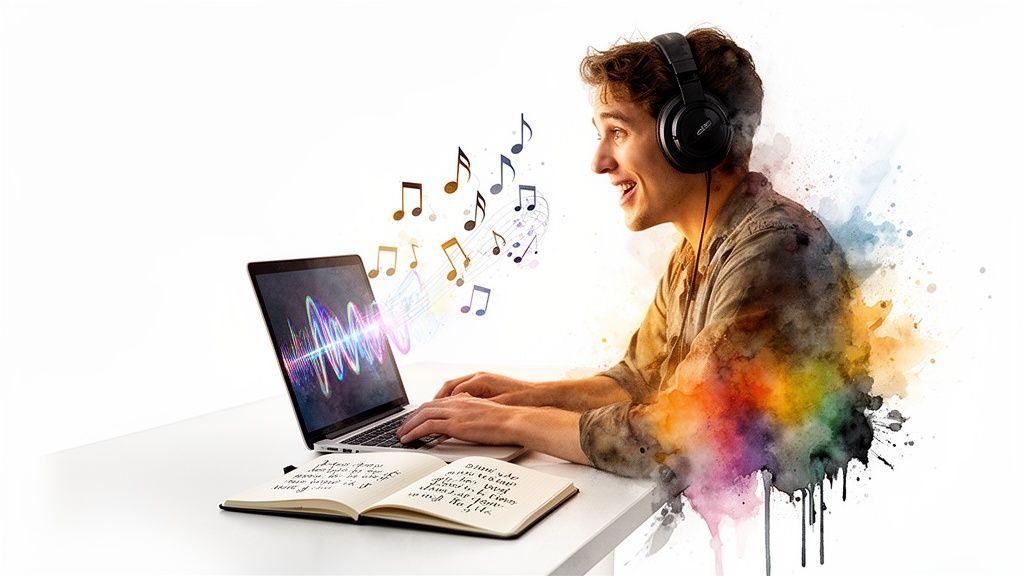
Ever had a killer song idea pop into your head but no way to record it? Or maybe you needed a catchy jingle for a project but didn't have the budget for a session singer? That’s where things are getting really interesting. The idea of producing a pro-level song without a fancy studio—or even a human vocalist—is no longer a sci-fi dream. It's happening right now.
This is a huge creative unlock for everyone from seasoned musicians to TikTok creators. Forget the monotone, robotic voices you might be thinking of. Today's AI is smart. It can craft melodies, layer harmonies, and inject a genuine sense of feeling into a track. Platforms like SendFame basically put a world-class singer on your laptop, ready to go whenever inspiration strikes.
This whole journey started way back in 1961. At Bell Labs, an IBM 7094 mainframe computer was programmed to sing "Daisy Bell," marking the very first time a computer sang a song. It was a quirky experiment, but it famously inspired the unforgettable scene where HAL 9000 sings the same tune in 2001: A Space Odyssey.
Talk about a glow-up. That one-off computer song planted the seed for what is now a massive industry. The AI music market is expected to rocket from $1.2 billion in 2023 to over $4 billion by 2030. A huge piece of that pie—around 35%—is driven by singing synthesis for content creation. You can take a deeper dive into the origins of synthesized singing to see just how far we've come.
So, why the sudden explosion? It’s all about breaking down old barriers.
No More Gatekeepers: You don't need formal music training or a pricey microphone to create amazing vocals anymore. Create at Lightning Speed: What used to take weeks of studio time—writing, recording, mixing—can now be done in minutes. Total Creative Control: Need a breathy pop vocal? A booming rock anthem? You can dial in the exact style, emotion, and tone to fit your vision.
Stick around, because this guide is going to pull back the curtain on the AI singing voice. We'll show you how to do everything from generating a hilarious birthday song in a celebrity's voice to producing a viral track for your next social media blitz.
Get ready. The only thing holding you back now is your own imagination.
So, how does a chunk of code go from silent bits and bytes to a digital diva hitting a high C? It's not magic, but it’s a lot like training a world-class athlete. An AI singing voice isn't born overnight; it’s meticulously coached, learning the art of performance by devouring massive amounts of data.
Think of it like this: a future Olympic swimmer spends thousands of hours in the pool, studying every stroke, kick, and breath until it becomes second nature. In the same way, an AI model is fed thousands of hours of vocal recordings. It analyzes everything—from the perfect pitch of a note to the subtle quiver in a singer's vibrato and the exact moment they take a breath.
This ocean of data is the AI's training ground. It learns to recognize the fundamental building blocks of a human voice, like phonemes (the distinct sounds we make), rhythm, and melody. By chewing on all this information, it starts to understand how these ingredients mix together to create a performance that actually moves you.
Here’s a crucial point: creating an AI singing voice is a whole different ballgame than the standard Text-to-Speech (TTS) tech you're used to. Your GPS and smart speaker use TTS to give you directions or tell you the weather. It gets the job done, but it’s not exactly going to bring the house down with a power ballad.
TTS is built for one thing: clear, understandable spoken language. It turns text into audible words, but usually with a pretty flat, almost monotonous delivery. An AI singing voice, on the other hand, is playing on a much more complex field. This specialized area is known as Singing Voice Synthesis (SVS).
SVS models have to think like a musician. They don't just "read" the lyrics; they have to interpret them within the entire musical context. This means wrestling with concepts like:
Pitch Control: Hitting specific musical notes, spot-on, across different octaves. Rhythmic Timing: Nailing the timing to stay perfectly in the pocket with the song's beat. Vocal Dynamics: Controlling the volume and intensity to convey emotion, from a delicate whisper to a full-throated belt. Expressive Nuances: Recreating all those human touches—like vibrato, slides between notes, and breath control—that make a voice feel alive.
That’s the real difference. TTS says the words, but an AI singing voice performs them. It’s the gap between a computer reading a Shakespearean monologue and a trained actor delivering it with raw passion on a stage.
Key Takeaway: While both use AI, Text-to-Speech (TTS) is all about turning text into clear, spoken words. Singing Voice Synthesis (SVS) is a much more sophisticated process that blends melody, rhythm, and raw emotion to create a genuine musical performance.
This table really helps hammer home the difference. You can quickly see why getting an AI to sing requires a completely different kind of brain than a typical voice assistant.
| Feature | Text-to-Speech (TTS) | AI Singing Voice (SVS) |
|---|---|---|
| Primary Goal | To speak text clearly and understandably. | To perform lyrics musically and emotionally. |
| Musical Input | Typically none; it only processes text. | Requires melody, rhythm, and lyrical information. |
| Pitch | Follows natural speech intonation (prosody). | Must follow a specific, often complex musical scale. |
| Rhythm | Follows the cadence of spoken language. | Must align precisely with a song's tempo and beat. |
| Emotional Range | Limited; often sounds neutral or robotic. | Can be trained to convey joy, sadness, or energy. |
| Common Use | Navigation apps, accessibility tools, assistants. | Music production, jingles, personalized songs. |
See? While they might seem similar on the surface, they are engineered for wildly different jobs. One is a public speaker, the other is a rockstar.
The models that make SVS possible are incredibly sophisticated. They often run on deep learning architectures, like neural networks, to process and generate sound. These systems essentially create a mathematical blueprint of a voice, which lets them either reconstruct it perfectly or generate entirely new vocal lines based on the patterns they’ve learned.
If you're curious about the nuts and bolts of how these systems "think," our introduction to machine learning for beginners is a great place to start.
This whole process allows the AI to do way more than just mimic. It can blend different styles, create unique vocal textures, and produce a performance that feels both authentic and fresh. Once you get a handle on the tech behind it, you start to see the incredible creative power you now have. It's not just a voice; it's a fully trainable, digital artist, ready to bring your next project to life.
Let's take a trip back in time. The story of the AI singing voice didn't just pop up overnight. It's a slow-burn saga that started decades ago with giant, room-sized machines trying their best to cough out a single, wobbly note. Long before you could create a viral hit in seconds, the pioneers of this tech were just happy to get a computer to make any sound that vaguely resembled a human.
Those early attempts? They were hilariously clumsy. Think less polished pop star, more Speak & Spell attempting to hold a tune at karaoke night. The sounds were metallic, choppy, and just plain robotic. But every single one of those warbles and beeps was a baby step forward, laying the foundation for the ridiculously powerful tools we have at our fingertips today.
The real game-changer was deep learning. This flavor of AI gave models the ability to listen—really listen—to the tiny, intricate details of a human voice. We're talking about the little gasp of air before a chorus, the subtle quiver of emotion in a ballad, or the crisp way a singer articulates a word. All at once, the goal shifted from just hitting the right notes to capturing the soul of the performance.
The evolution has been nothing short of wild. We've gone from 1939's clunky, mechanical Voder to today's neural networks, marking a mind-boggling 99% improvement in naturalness scores. Early systems, like the one that famously gave Stephen Hawking his voice, were incredible for their time, but today’s AI is playing a completely different sport.
For instance, tools like Microsoft's VALL-E can now convincingly clone a voice from just a 3-second audio snippet, locking onto the original speaker's emotional tone. This has catapulted quality from a Mean Opinion Score (MOS) of around 2.0 (think "obviously a robot") to a stunning 4.5 (think "wait, is that a real person?"). You can dive deeper into the full timeline and find out more about how AI voices were invented.
This flowchart breaks down how it all works now, turning raw vocal data into a polished AI song.
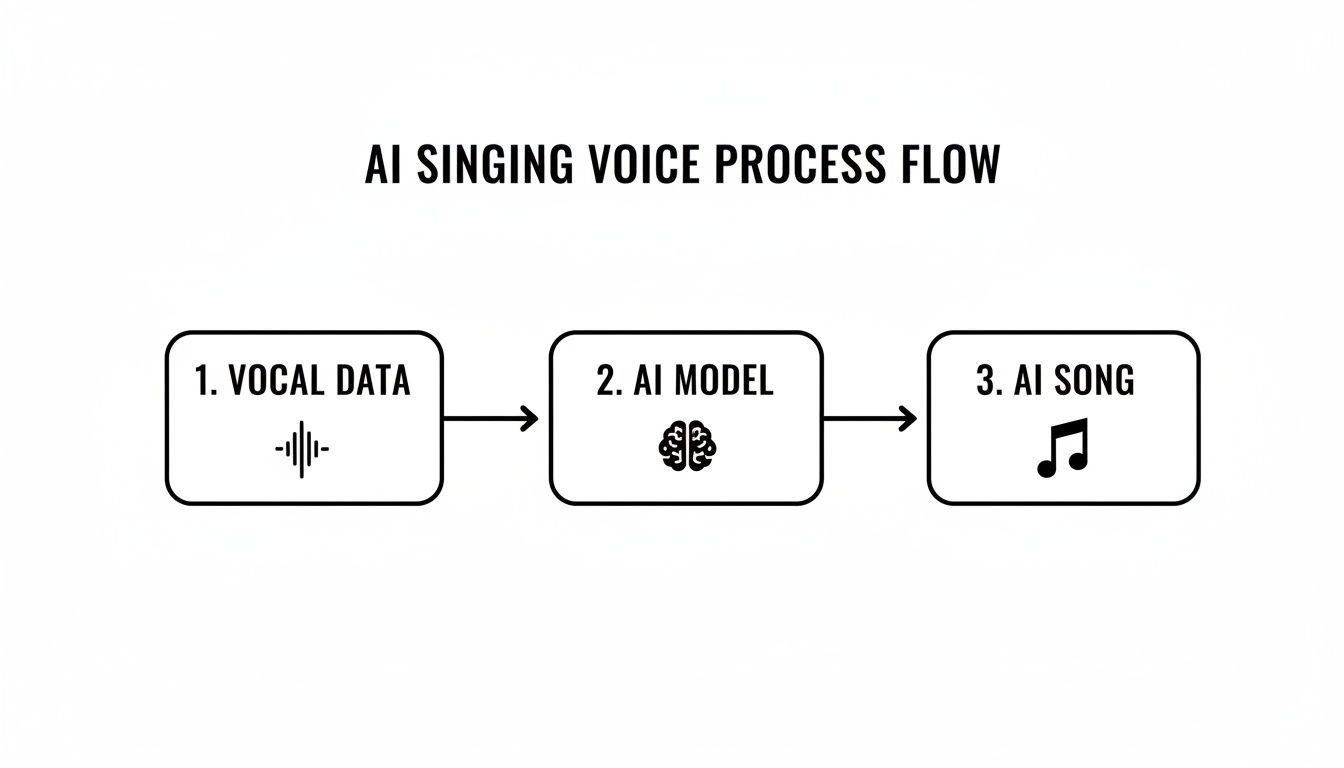
As you can see, the AI model is the "brain" of the operation. It's the interpreter that takes all the input data and generates a brand-new, unique vocal performance based on what it has learned.
This incredible leap in technology is what makes platforms like SendFame even possible. The tech has finally escaped the lab and landed directly in the hands of creators. What used to demand a team of engineers and a supercomputer can now be done with a few clicks on your laptop.
What we're witnessing is the democratization of professional vocal production. The technology has matured from a scientific curiosity into a practical, powerful tool for art, marketing, and personal expression.
Understanding this journey gives you context for the tools you're using. Every time you create a personalized celebrity message or a custom song, you're standing on the shoulders of giants and benefiting from decades of trial and error.
Those old robotic warbles paved the way for the hyper-realistic, emotionally rich AI singing voice of today. It's a wild ride that's given us an unprecedented level of creative freedom—and it’s a thrilling preview of what’s coming next.
Alright, let's get to the fun part. The theory is great, but what can you actually do with an AI singing voice? This is where the magic happens—where abstract tech becomes real, attention-grabbing content that you can share with the world.
Think of it as having a personal, on-demand vocalist ready for any wild idea you cook up. It’s a total game-changer, whether you’re a creator trying to go viral, a small business owner looking to make a splash, or just someone who wants to send a birthday message that nobody will ever forget.
In the chaotic, endless scroll of social media, unique audio is your secret weapon. An AI singing voice lets you create custom sounds that literally stop thumbs. Forget using the same tired, trending audio as everyone else. Now you can have a theme song for your channel or a slick little jingle for your next video series.
Here’s how creators are already using it:
Viral Sounds for TikTok and Reels: Cook up a short, catchy, and totally original song that speaks directly to your niche. Podcast Intros and Outros: Give your podcast that professional sheen with a sung intro that sets the tone and makes your show instantly recognizable. Custom YouTube Background Music: Why dig through royalty-free libraries when you can generate a vocal track that perfectly nails the mood of your video?
As you dive in, a solid guide to content creation with AI can give you some great strategies for making your projects truly pop.
For any business, a custom jingle isn't just a gimmick; it’s a branding superpower that can get stuck in a customer's head for days. That used to mean hiring singers, renting a studio, and dropping a small fortune. Now? You can create a professional-sounding jingle in the time it takes to drink your coffee.
Imagine a local coffee shop with its own groovy tune playing over its Instagram stories. Or an e-commerce brand with a sung call-to-action that makes people smile. This kind of audio branding was once reserved for the big dogs, but AI singing voices have opened the door for everyone.
The creative floodgates are wide open for musicians. An AI singing voice is like the ultimate collaborator—one that’s available 24/7 and never complains. It's a fantastic way to quickly lay down vocal ideas for a new song without having to book a session singer.
You can hear your lyrics performed in all sorts of vocal styles—from pop to soul to rock—and instantly find what fits your track. This isn't a new idea, either. It exploded back in 2004 with Yamaha's VOCALOID software, which gave birth to virtual superstars like Hatsune Miku. When a voice based on Japanese star Gackt was released, users cranked out nearly 200 songs in just three days. The appetite for this stuff is massive.
The Big Idea: An AI singing voice is more than a music tool; it's a communication tool. It allows you to add a layer of personality, emotion, and memorability to any message, whether it's for a global ad campaign or a private birthday greeting.
Honestly, some of the best uses are the simplest ones. With a tool like SendFame’s AI Music Generator, you can whip up personalized songs for any occasion imaginable.
Birthday Songs: Generate a birthday shout-out "sung" by a celebrity persona for a friend who'll get a huge kick out of it. Holiday Greetings: Create a custom carol for your family’s digital Christmas card that’s way better than a static photo. Inside Jokes: Turn that one hilarious phrase you share with your friends into a full-blown anthem.
Our simple, one-click process is built to make all of this dead simple, no matter your tech skills. It's a fun, surprisingly powerful way to connect with people. If this kind of tech fascinates you, you should also check out our guide on how AI voice actors are changing the game.
Alright, enough with the theory. Let's roll up our sleeves and actually make some magic. Creating a killer AI singing voice track isn’t about just pushing a button and hoping for the best. It’s a creative process, and your choices are what make the difference between a robotic demo and a studio-quality performance.
Think of yourself as a music producer in a recording session. The AI is your star vocalist, but it needs your direction to nail the take. The better your guidance, the more breathtaking the result. From the raw ingredients you feed it to the final polish, every single step counts.
This whole thing is a mix of artistic vision and a dash of technical know-how. Let's break down exactly how you can coach your AI to deliver a vocal that sounds polished, professional, and exactly like the one playing in your head.
Here’s the golden rule, and it never changes: garbage in, garbage out. The AI’s performance is only as good as the material you give it. Before you even think about hitting "generate," you need to set it up for success with clean, high-quality inputs.
The table below breaks down the different inputs you can use and what to expect from each. Getting this right is the first and most crucial step.
| Input Type | Description | Best For |
|---|---|---|
| Acapella | A clean, isolated vocal recording without any instruments. The higher the quality, the better the final output. | Creating a clone of a specific voice or converting an existing vocal performance to a different style. |
| MIDI | A digital file containing musical notes, pitch, and timing information, but no actual audio. | Providing a precise melody for the AI to follow, ensuring perfect pitch and rhythm. Great for complex melodies. |
| Lyrics | Simple text of the words you want the AI to sing. | The most straightforward input, perfect for generating a new song idea from scratch with a text-to-music model. |
| Audio File | A full song with instruments and vocals. The AI will try to isolate the vocal melody from the mix. | Quickly creating a cover or remix, but the quality can vary depending on how well the AI separates the vocals. |
At the end of the day, the cleaner and more direct your input, the more control you have over the final sound. A clear acapella or MIDI file will almost always give you a more predictable and polished result than a messy audio file.
Pro Tip: Keep your melodies simple and your lyrics crisp, especially when starting out. An AI can lock onto a well-defined tune much more accurately, which translates into a vocal performance that sounds natural and emotionally connected right from the jump.
Once you've got your foundation, it’s time to tell the AI how to perform. This is where you go beyond just notes and words and start shaping the entire vibe. Your instructions—or prompts—are your most powerful tool for dialing in the final sound.
To really get the hang of this, you’ll want to get familiar with prompt engineering. It's less of a science and more of an art form, all about crafting the right words to get the AI to do exactly what you want.
Nail the Genre: Are you going for a high-energy pop anthem, a soulful R&B ballad, or a gritty rock track? Tell the AI! Use descriptors like "upbeat pop," "somber acoustic," or "80s power ballad." Define the Vocal Style: Don't just say "sing." Ask for a "breathy, soft vocal performance" or a "powerful, belted chorus." The more specific you get, the closer the AI will get to the sound in your head. Set the Mood: Words like "happy," "melancholy," "energetic," or "dreamy" give the AI crucial emotional context that will absolutely influence the delivery. This is how you get a performance, not just a recitation.
Ever notice how a single vocal can sound a bit thin, but professional songs sound massive? The secret is layering. Most chart-topping hits use stacked vocals to create rich harmonies and a huge sense of scale. You can do the exact same thing with an AI singing voice.
Start by generating your main vocal melody. Once you're happy with it, create separate harmony tracks. Just tell the AI to sing a "high harmony" or a "low harmony" using the same lyrics. Pan these new layers a little to the left and right in your mix, and suddenly your track will sound wide and immersive. You can even add a few ad-libs or background oohs-and-aahs for extra texture. It’s a simple trick that takes your song from demo to done.
Let's see how this all comes together. With a tool like SendFame's AI Music Generator, the whole process is dead simple.
Choose Your Persona: First up, pick the kind of voice you're after. Male pop star? Female indie artist? Something else entirely? This choice sets the core character of your singer. Drop in Your Lyrics: Paste your lyrics into the editor. Make sure they’re clearly structured with verses, a chorus, and maybe a bridge. Describe Your Style: This is where you use that prompt engineering magic. In the prompt box, give it your creative direction. Something like: "An upbeat, happy pop song with a catchy chorus and a female vocal." Generate and Tweak: Hit generate! The AI will cook up a full song—vocals, instruments, the works. Give it a listen and, if it’s not quite right, just adjust your prompt and go again.
Following this simple workflow, you can go from an idea to a polished AI vocal track in just a few minutes. For a deeper dive, check out our full guide on how to make a song with AI.
With great power comes a whole new can of worms. As the AI singing voice gets so good it can trick even a seasoned producer's ear, we've found ourselves at a fascinating—and pretty complicated—crossroads. The tech is mind-blowing, but it also pries open a Pandora's box of ethical debates and legal gray areas.
This isn’t about scaring you off. It’s about being a smart, responsible creator. Getting a handle on the boundaries and the big conversations happening right now won’t just keep you out of trouble; it’ll help you use these tools in a way that’s both wildly creative and genuinely respectful. Let's dig into the big questions on everyone's mind.
At the core of the whole debate is a simple question with a ridiculously complex answer: who owns an AI-generated voice? If you spin up a vocal that sounds exactly like a famous artist, is it a clever homage or just straight-up theft? The law is still sprinting to catch up, but a few key ideas are starting to take shape.
You can't copyright a person's voice itself, but their vocal performance on a specific recording? Absolutely. The even bigger deal is the "right of publicity," which protects someone's name, image, and likeness from being used without their say-so. Using an AI to clone a celebrity’s voice for your track could land you in hot water over this.
The golden rule here is consent. Using a generic AI voice that a platform provides is usually fine for commercial projects. But cloning a specific, real person's voice without their explicit permission? That's when you start wandering into a legal minefield.
Thankfully, many platforms are building in ethical guardrails, making you prove you have the rights to a voice before you can clone it. This is a huge step in making sure the tech is used to create new art, not just exploit existing artists. For a deeper dive into the tangled web of using music in your content, our guide on Instagram and music copyright has some great insights.
Legal stuff aside, there's the bigger, more philosophical debate about what art even is. If a song is sung by an AI, does it lack that human "soul" that gives music its power? Some folks will tell you that real artistry only comes from lived experience, raw emotion, and all the beautiful little flaws in a human voice.
But then you have the other side of the coin. Plenty of creators see AI as just the next instrument in the studio. They’ll point out that synthesizers, drum machines, and Auto-Tune were all met with the same skepticism before becoming totally essential. The human element isn't gone; it's just changed its job description. The creativity is now in the prompts you craft, the melodies you compose, and the emotional direction you give the AI. It's a new kind of duet between human and machine.
The music industry isn't just sitting back and watching this unfold. Major labels and tech companies are scrambling to figure out how to make sure artists are credited and paid fairly when their data gets used.
Digital Watermarking: One of the slickest ideas is audio watermarking. This embeds an undetectable digital signature into AI-generated audio, making it easy to trace its origin. It’s a great way to fight misinformation and keep things transparent. Ethical AI Platforms: Good companies are writing clear terms of service that forbid nasty stuff like creating deepfake scams or unauthorized voice clones of your ex. Opt-In Models: The future is likely opt-in. Artists will be able to voluntarily license their voice for AI training, giving them total control and a cut of the profits. It's only fair.
The goal is to build a healthy ecosystem where an AI singing voice can be an incredible tool for creativity while still protecting the rights and soul of human artists. By staying in the loop and choosing platforms that actually care about ethics, you can be part of what makes the future of AI music exciting, not exploitative.
Still got a few things rattling around in your head? You're in good company. This whole AI singing voice thing is moving at light speed, and it's totally normal to have questions. Let's tackle some of the big ones we hear all the time.
You bet. The vast majority of modern platforms were built from the ground up for creators and businesses. A tool like SendFame, for instance, is perfect for whipping up a catchy jingle for your podcast, a killer soundtrack for a TikTok, or a unique tune for a promo video.
The real fork in the road is whether you’re using a pre-made AI voice or trying to clone a specific person. Sticking to the platform's library of original voices? You're almost always good to go for commercial use—just give their terms of service a quick scan. Trying to clone Drake's voice without permission? Yeah, that's where you wander into a legal minefield of publicity rights. Keep it original, and you'll be golden.
Honestly? It's mind-blowing. The best AI models out there today can spit out vocal tracks that are virtually identical to a human singer. We're talking the whole nine yards: subtle emotional inflections, natural breathing patterns, and even a little bit of vibrato.
The secret sauce is often what you feed it. Give the AI clean lyrics and a decent melody to work with, and you're setting it up for success. You might still catch a tiny digital hiccup here and there, but a touch of post-production magic can smooth those out, leaving you with a track that sounds polished and pro.
Don't be shocked when your friends start asking, "Who's the incredible new singer you hired?" The tech has gotten so good that the line between a human performance and an AI one is getting fuzzier every day.
Not even a little bit! And that's maybe the coolest part of this whole revolution. You don't need to know music theory, read a single note of sheet music, or have a clue what all the knobs do in a professional studio.
Tools like SendFame are designed to be dead simple. All you have to bring is the idea—the lyrics, the genre, the overall vibe you're going for. The AI then puts on the hats of composer, producer, and vocalist. It truly levels the playing field, giving anyone with a creative spark the power to produce a complete song, no musical background required.
Ready to cook up your own viral hit or a custom song in just a few clicks? Give SendFame’s AI Music Generator a spin and hear what all the fuss is about. Start creating for free today!
Create Epic

SendFame

Create Epic with SendFame!
Questions: info@sendfame.com